Understanding How an Amplifier Without 70V Output Drives Speakers With Transformers
Yes, can an amplifier without 70v output drivw speakers with transformers? The short answer is yes, but it requires an external step-up transformer to convert the low-impedance (4Ω or 8Ω) signal into a high-voltage (70V or 100V) signal. Alternatively, you can drive a very limited number of 70V speakers directly if the total impedance of the speaker transformers stays within the amplifier’s rated operating range.
In my years of designing commercial audio layouts for warehouses and retail spaces, I have often encountered situations where a client wanted to reuse a high-end consumer stereo amplifier for a distributed paging system. While not the “standard” way to do things, it is entirely possible with the right hardware and a solid understanding of Ohm’s Law.
Key Takeaways for Using Standard Amps with 70V Systems
- External Matching Required: A standard amp needs an autoformer or matching transformer at the output to reach 70V levels.
- Impedance is King: You must calculate the reflected impedance to ensure you don’t fry the amplifier’s output stage.
- Power Limitations: Your amplifier’s RMS wattage must exceed the total sum of the speaker “taps” by at least 20% to account for insertion loss.
- Safety First: Without a dedicated 70V amp, you lose built-in high-pass filters, which are critical to prevent transformer saturation.
The Technical Reality: Can an Amplifier Without 70V Output Drive Speakers with Transformers?
To understand if can an amplifier without 70v output drivw speakers with transformers, we have to look at how voltage and impedance interact. A standard home theater or professional power amp is designed to deliver high current into a low-resistance load (usually 4 to 8 ohms).
A 70V system, however, is a “constant voltage” system. It uses a transformer at the amplifier to step up the voltage and a transformer at every speaker to step it back down. This allows for long wire runs with minimal signal loss.
How to Bridge the Gap
If you have a standard amplifier, you have two primary methods to make this work:
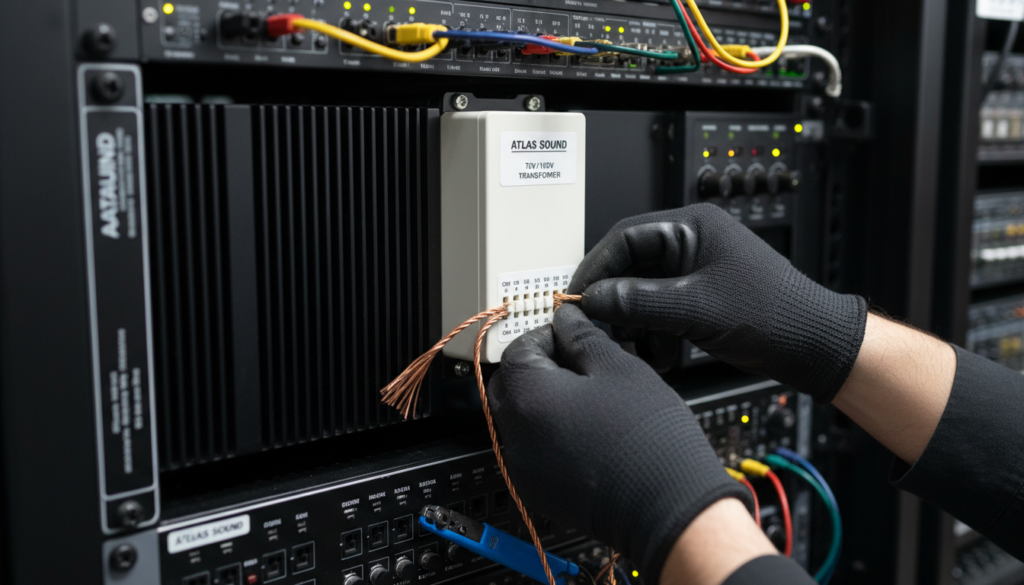
- The Step-Up Method: You buy a dedicated 70V matching transformer (like those from AtlasIED or Bogen). You connect the 8-ohm output of your amp to the 8-ohm input of the transformer. The output side of that transformer provides the 70V line for your speakers.
- The Direct Drive Method: You connect the 70V speakers (which have transformers) directly to the amp. This only works if you have very few speakers. For example, a 10-watt tap on a 70V speaker looks like roughly 490 ohms to the amplifier. If you connect ten of these, the amp sees 49 ohms, which is safe but very quiet.
Step-by-Step Guide to Connecting a Standard Amp to 70V Speakers
I have performed this “field hack” in several emergency repair scenarios. If you follow these steps, you can successfully manage how can an amplifier without 70v output drivw speakers with transformers.
Step 1: Calculate Total System Wattage
Look at the transformer taps on the back of your speakers. These usually offer settings like 5W, 10W, 15W, or 30W.
- Add up the wattage of every speaker on the line.
- Example: 10 speakers tapped at 5W each = 50 Watts total.
Step 2: Verify Amplifier Headroom
Your amplifier should have an RMS power rating higher than your total speaker wattage. I recommend the 80% Rule: Never load an amplifier beyond 80% of its rated capacity.
- If your speakers total 50W, use an amplifier capable of at least 65W to 75W RMS.
Step 3: Install an External Step-Up Transformer
Since your amp lacks a 70V tap, buy an external line matching transformer.
- Connect the speaker terminals of your amp to the Com and 8Ω terminals on the transformer primary side.
- Connect your long-run speaker wire to the Com and 70V terminals on the secondary side.
Step 4: Protect Against Saturation
Standard amplifiers output full-range audio, including deep bass. 70V transformers hate deep bass; it causes “saturation,” which leads to heat and distortion.
- If your amp has a Low-Cut or High-Pass Filter (HPF), turn it on.
- Set the filter to at least 80Hz or 100Hz.
Comparing Standard Amps vs. Dedicated 70V Amps
| Feature | Standard Amp (Direct/Step-up) | Dedicated 70V Amplifier |
|---|---|---|
| Wiring Complexity | High (Requires external matching) | Low (Direct to 70V terminals) |
| Distance Capability | Short (unless using step-up) | Excellent (up to 1,000+ feet) |
| Scalability | Limited by impedance calculations | Highly Scalable (just add taps) |
| Sound Quality | Better for music (lower THD) | Better for voice/paging |
| Safety Features | Usually lacks thermal protection for 70V | Built-in current limiting for 70V |
Why Impedance Matching Matters for 70V Transformers
When people ask can an amplifier without 70v output drivw speakers with transformers, they are often worried about blowing up their equipment. In my experience, the biggest risk is low impedance.
If you connect too many speakers with transformers to a standard amp without a step-up transformer, the reflected impedance might actually be too high, resulting in almost no sound. Conversely, if you bypass the transformers and wire the speakers in parallel, the impedance will drop too low (below 2 ohms), which will cause the amplifier to go into Protect Mode or overheat.
Pro Tip: Always use a Digital Multimeter or an Impedance Meter (like the GoldLine ZM1) to check the line before you hit the power switch.
Common Impedance Values for 70V Taps
- 5 Watts: ~980 Ohms
- 10 Watts: ~490 Ohms
- 15 Watts: ~325 Ohms
- 30 Watts: ~160 Ohms
Potential Risks and Expert Troubleshooting
Using hardware in ways it wasn’t originally intended requires extra vigilance. Here is what I’ve learned from “burning the midnight oil” on job sites.
Transformer Saturation
If the audio sounds “crunchy” or distorted at low volumes, your amplifier is likely sending too much low-frequency energy into the transformer. Transformers are essentially coils of wire; low frequencies make them act like a short circuit.
- The Fix: Use a crossover or EQ to roll off everything below 100Hz.
Insertion Loss
Every transformer in the chain absorbs a little bit of power, usually between 0.5dB and 2dB.
- The Fix: If the system isn’t loud enough, you cannot simply “turn it up” if the amp is already peaking. You must re-tap the speakers to a higher wattage or get a more powerful amplifier.
Voltage Spikes
Standard amps aren’t always designed to handle the back-EMF (Electromotive Force) that large transformers can kick back into the output stage when the signal stops abruptly.
- The Fix: Ensure your amplifier is a high-quality “Class AB” or “Class D” with robust protection circuitry. Cheap “no-name” amps will fail quickly in this configuration.
Frequently Asked Questions
Can I just remove the transformers from the speakers?
Yes. If you have a small number of speakers (2 to 4), you can bypass the internal 70V transformers and wire them directly to your standard amplifier in a series/parallel configuration to maintain an 8-ohm load.
What happens if I connect a 70V speaker to an 8-ohm amp without a transformer?
If you connect through the transformer, the volume will be extremely low. If you bypass the transformer, the speaker will work like a normal 8-ohm speaker, but you cannot run the wire over long distances without losing significant signal.
Will this setup damage my amplifier?
As long as the total impedance of the speaker line (with the step-up transformer) does not fall below the amplifier’s minimum rating (usually 4 ohms), your amplifier will be safe.
Can I use a car amplifier for 70V speakers?
Yes, using the step-up transformer method mentioned above. This is common in “mobile paging” setups for parades or food trucks where only 12V power is available.
Why is 70V better than 8-ohm for commercial use?
It allows you to run smaller gauge wire over much longer distances and makes it incredibly easy to adjust individual speaker volumes by simply changing the “tap” setting on each speaker.