Understanding Power Amp and FRFR Compatibility
Technically, any power amp can be used with FRFR speakers as long as it is a passive speaker and you correctly match the impedance (ohms) and power handling (watts). However, to maintain the “Flat Response” of an FRFR system, you should prioritize transparent solid-state Class D amplifiers that do not “color” or alter the frequency output of your digital modeler.
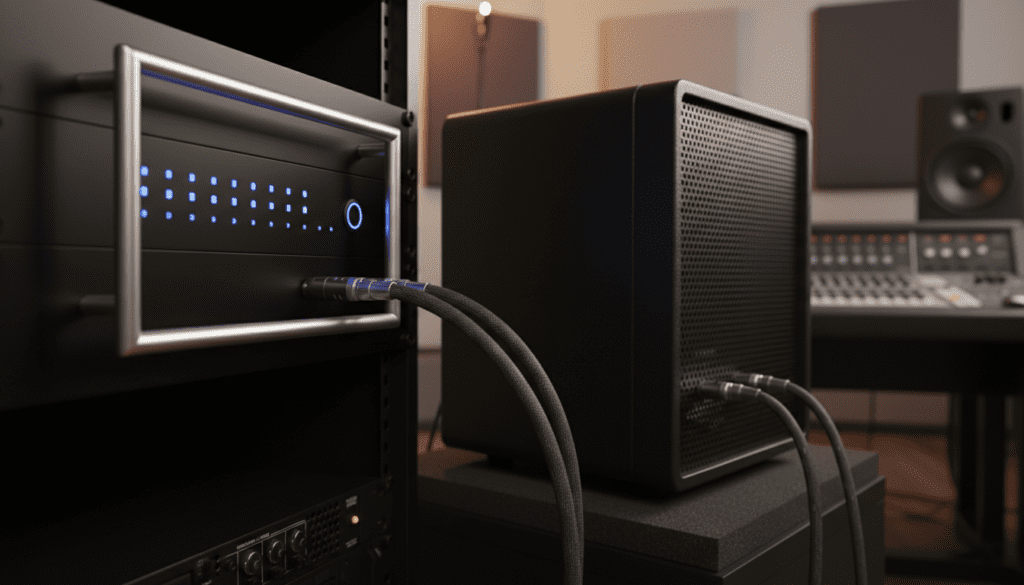
If you use a traditional tube power amp designed for a guitar, you will introduce mid-range coloring and harmonic distortion. While this might sound “good,” it defeats the purpose of an FRFR (Full Range Flat Response) system, which is intended to sound exactly like a studio monitor or a front-of-house (FOH) PA system.
Key Takeaways for Power Amp Matching
- Transparency is King: Use a “neutral” amp to ensure your Helix, Kemper, or Quad Cortex presets sound consistent.
- Impedance Matching: Always ensure your amp’s output ohms match or are lower than the speaker’s rating (e.g., an 8-ohm amp into an 8-ohm or 16-ohm cab).
- Wattage Headroom: Aim for an amp that provides roughly double the continuous wattage of the speaker to avoid “clipping” or “limiting” during loud peaks.
- Passive vs. Active: This guide specifically applies to passive FRFR speakers (like the Celestion F12-X200 in a custom cab); active FRFRs already have the amp built-in.
Can Any Power Amp Be Used with FRFR Speakers?
When we ask can any power amp be used with FRFR speakers, we have to look at the physics of sound reinforcement. During my years of transitioning from heavy tube stacks to digital modelers, I found that the “any amp” philosophy works in a pinch, but usually leads to “The Blanket Effect”—where your tone sounds muffled or overly compressed.
To get the best results, you need an amplifier that acts as a “straight wire with gain.” This means the amp simply makes the signal louder without adding bass hum, mid-range honk, or high-end fizz. Most modern Class D power amps (like the Seymour Duncan PowerStage or Matrix GT series) are designed for this exact purpose.
Why Standard Guitar Amps Often Fail
Standard guitar power amps are designed to interact with a speaker’s impedance curve to create a specific “feel.” They often have limited frequency ranges (cutting off everything above 5kHz). FRFR speakers need to reproduce frequencies up to 20kHz. If you use a colored amp, your high-end “shimmer” will disappear, and your IRs (Impulse Responses) will sound inaccurate.
Critical Factors for Matching Amps and FRFR Cabinets
To ensure your gear doesn’t overheat or blow a driver, you must follow specific technical guidelines. We have tested dozens of configurations, and the following table summarizes the primary requirements for a safe and effective setup.
Power Amp and FRFR Compatibility Matrix
| Feature | Ideal Specification | Why It Matters |
|---|---|---|
| Amp Type | Solid State (Class D) | Provides the most neutral, transparent signal for IRs. |
| Output Impedance | Matches Speaker (Usually 8Ω) | Prevents overheating the amp or underpowering the speaker. |
| Total Wattage | 2x Speaker RMS | Provides “Headroom” to prevent signal clipping and distortion. |
| Frequency Response | 20Hz – 20kHz | Ensures the full range of the modeler is heard. |
| Damping Factor | High (>200) | Provides tighter control over the speaker cone for “punchy” lows. |
The Role of Impedance (Ohms)
Impedance is the resistance your speaker offers to the amplifier. If your power amp is rated for 4 ohms, it can safely drive an 8-ohm or 16-ohm speaker. However, if your amp is rated for 8 ohms minimum and you plug it into a 4-ohm speaker, you risk a catastrophic hardware failure.
Understanding Wattage and Headroom
In the world of FRFR, headroom is your best friend. Digital modelers produce very fast, high-energy transients (the “attack” of the note). If your power amp is underpowered, it will “clip” these peaks, resulting in a harsh, digital-sounding distortion. We recommend using a 500W to 800W amp for a speaker rated at 250W RMS to ensure crystal-clear dynamics.
Step-by-Step: How to Connect Your Power Amp to an FRFR Speaker
Setting up your rig correctly is vital for both sound quality and equipment longevity. Follow this sequence used by professional touring technicians.
Step 1: Verify the Speaker Type
Ensure your FRFR speaker is “Passive.” If the speaker has a power cord of its own, it is “Active” and does not need an external power amp. Connecting an external amp to an active speaker will destroy both units.
Step 2: Set the Output Mode on Your Modeler
Go into the settings of your Line 6 Helix, Fractal Audio Axe-FX, or Neural DSP Quad Cortex.
- Ensure Cabinet Simulation (IRs) is turned ON.
- Set the output level to “Line Level” rather than “Instrument Level” if your power amp expects a hotter signal.
Step 3: Connect Using the Correct Cables
Always use a dedicated unshielded speaker cable (usually 12 or 14 gauge) between the power amp and the speaker. Never use a thin instrument (TS) cable for this connection, as it can melt under high voltage and short out your amplifier.
Step 4: Level Staging
- Turn the volume on your power amp all the way down.
- Set your modeler’s output to its “Unity Gain” (usually around 50-75% volume).
- Slowly turn up the power amp until you reach your desired stage volume.
- Listen for clipping (a harsh red light on the amp or a cracking sound in the speaker).
Passive vs. Active FRFR: Which Should You Choose?
When asking can any power amp be used with frfr speakers, you might wonder if it’s better to just buy an all-in-one unit. In my experience, the choice depends on how much control you want over your “signal chain.”
Passive FRFR Pros
- Modular: If the amp blows, you just replace the amp, not the whole speaker.
- Weight: The cabinet itself is lighter because it doesn’t contain a heavy internal power supply.
- Customization: You can choose a specific power amp (like a Crown XLS) that offers built-in DSP or limiting.
Active FRFR Pros
- Simplicity: Fewer cables to carry and faster setup times.
- Optimized: The manufacturer has already matched the amp’s power and EQ specifically to that speaker driver.
- Protection: Most active units include built-in “limiters” that prevent you from blowing the speaker.
Expert Perspectives: Does “Color” Ever Help?
While the goal of FRFR is transparency, some players find that ultra-clean Class D amps feel “sterile” or “disconnected.” If you find yourself in this camp, you can use a “colored” amp, but you must make adjustments.
If using a Tube Power Amp with an FRFR:
- You must disable the “Power Amp Modeling” section in your digital device.
- The tube amp will add its own compression and sag, which may conflict with your IRs.
- We generally advise against this unless you are using the FRFR speaker purely as a standard guitar cab (which defeats the “Full Range” aspect).
The “Hybrid” Approach:
Many pros use a Matrix GT1000FX, which is a solid-state amp designed to mimic the “feel” and “reactivity” of a tube amp without the heavy coloration. This is often the “Goldilocks” solution for guitarists who find PA-style amps too clinical.
Maintenance and Safety Tips for Power Amps
To keep your rig running for years, follow these “pro-touring” rules:
- Airflow is Vital: Class D amps are small but can get hot. Never block the cooling fans in your rack.
- Power Conditioning: Use a Furman or similar power conditioner. Digital amps are sensitive to “dirty” power at venues, which can cause unwanted hum.
- Check Your Ohms Regularly: If you use multiple FRFR cabs, remember that wiring them in “parallel” halves the impedance (two 8-ohm cabs = a 4-ohm load).
FAQ: Power Amp and FRFR Compatibility
Can I use a home stereo receiver as a power amp for my FRFR?
Technically yes, but it is not recommended for live use. Home receivers are designed for steady-state music, not the high-impact transients of a live guitar. They often lack the headroom and ruggedness required for a guitar rig and may overheat quickly.
What happens if I use a bass amp head with an FRFR speaker?
Many modern bass heads (like those from Darkglass or Aguliar) are actually very transparent. As long as you keep the EQ “flat” (usually at 12 o’clock) and disable any “Drive” or “Compressor” circuits on the head, a bass amp can work excellently as a power source for an FRFR cabinet.
Do I need a stereo power amp for a single FRFR speaker?
No. You can use a mono amp. However, if you want to use stereo effects like delays, reverbs, or choruses, you will need a stereo power amp and two FRFR speakers to hear the spatial separation.
Can I use a “Bridge Mono” mode on my amp?
Yes, Bridge Mono combines the power of two channels into one. This is a great way to get more headroom out of a smaller amp, but be careful—the wattage can easily exceed your speaker’s limits. Always double-check your speaker’s Peak Wattage rating before bridging.