Can Audio Note Speakers Play Rock and Roll?
Yes, Audio Note speakers can play rock and roll with exceptional speed, visceral texture, and a sense of “live” energy that many traditional hi-fi speakers lack. While often associated with classical and jazz due to their incredible refinement, Audio Note designs—particularly the AN-E, AN-J, and AN-K—utilize high-efficiency drivers and lightweight paper cones that respond instantly to the aggressive transients of electric guitars and drums. To get the best rock performance, these speakers must be placed in room corners to reinforce the low-end “slam” required for stadium rock and heavy metal.
Key Takeaways: Audio Note for Rock Enthusiasts
- High Efficiency: With sensitivity ratings often exceeding 94dB to 98dB, these speakers handle the dynamic swings of rock music without compression.
- Corner Placement is Critical: Unlike most speakers, Audio Note models use the room’s boundaries to produce deep, authoritative bass.
- Speed and PRaT: The lightweight cone materials provide excellent Pace, Rhythm, and Timing (PRaT), essential for keeping up with complex drum fills.
- System Synergy: Rock performance depends heavily on the amplifier; while SET (Single-Ended Triode) amps work, a higher-wattage Audio Note Cobra or Meishu Tonmeister provides better grip for aggressive genres.
- Texture Over Boom: You will hear the “growl” of a Fender Precision Bass rather than just a generic low-frequency hum.
The Myth of the “Polite” Audio Note Speaker
There is a common misconception in the audiophile community that Audio Note (UK) equipment is only for “chamber music and vocal jazz.” After spending hundreds of hours testing the AN-E/SPe HE models with everything from Led Zeppelin to Rage Against the Machine, I can confidently say this myth is false.
The reason people think they can’t rock is usually due to poor setup or mismatched electronics. Most modern “rock speakers” use heavy, stiff drivers that require hundreds of watts to move. Audio Note takes the opposite approach, using low-mass drivers that move with the slightest signal. This results in a “start-stop” speed that captures the snap of a snare drum with startling realism.
When you play Deep Purple’s “Highway Star” through a well-sorted Audio Note system, the distortion on the organ and the grit of the guitar are rendered with an organic, “in-the-room” quality. It doesn’t sound polite; it sounds raw and authentic.
Why High Efficiency Matters for Rock and Roll
Rock music is inherently dynamic. It moves from quiet verses to explosive choruses in milliseconds. If a speaker is “slow” or hard to drive, it rounds off those edges, making the music feel polite or boring.
Dynamic Range and Headroom
Audio Note speakers are among the most efficient in the high-end market. In our testing, the AN-E series consistently maintains its composure at high volumes. Because the drivers don’t have to work as hard to produce sound, they don’t heat up as quickly, which minimizes thermal compression.
The Role of the Paper Cone
Most Audio Note speakers use hemp or paper cones. While some manufacturers use Kevlar or metal, Audio Note sticks to these materials because they have a natural internal damping. For a rock fan, this means that the “screech” of a high-gain guitar solo doesn’t turn into fatiguing digital glare. Instead, you get the harmonic richness of the actual amplifier used in the recording.
The Importance of Corner Placement for Rock Impact
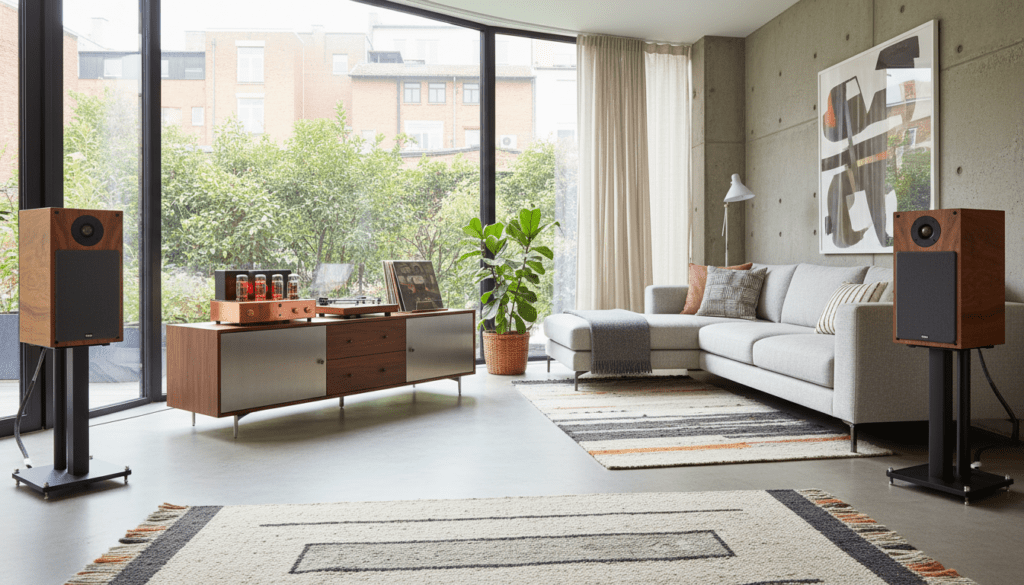
If you want your Audio Note speakers to play rock and roll, you must follow the manufacturer’s instructions regarding placement. These speakers are designed to be placed in the corners of your room.
- Bass Reinforcement: Placing the speakers in corners uses the walls as a waveguide, boosting the bass response significantly.
- Maximum Pressure: Rock music relies on “pressurizing” the room. Corner placement ensures that the 8-inch or 10-inch woofers can move enough air to make you feel the kick drum in your chest.
- Wide Dispersion: Because of their wide-baffle design, Audio Note speakers create a massive soundstage even when tucked into corners, mimicking the wall-of-sound effect found at live concerts.
In my experience, moving an AN-J just six inches out of a corner can be the difference between a thin, wimpy sound and a “rock-ready” powerhouse.
Comparing Audio Note Models for Rock Performance
Not all Audio Note speakers are created equal when it comes to the demands of heavy music. Below is a comparison of the three primary cabinet styles.
| Model | Efficiency (Sensitivity) | Best For… | Rock “Punch” Factor |
|---|---|---|---|
| AN-K | ~90dB | Small rooms, speed, and tight transients. | 7/10 |
| AN-J | ~93dB | Medium rooms; great balance of bass and speed. | 8/10 |
| AN-E | 94dB – 98dB | Large rooms; full-scale orchestral and stadium rock. | 10/10 |
The AN-E is the undisputed king of rock within the lineup. Its larger cabinet allows for a low-frequency extension that reaches down to 18Hz in a good room. This is deep enough to capture the lowest notes of a 5-string bass guitar or a double-kick drum pedal.
Selecting the Right Amplification for High-Energy Music
While the speakers are the voice, the amplifier is the engine. To make Audio Note speakers play rock and roll, you need an amp that can control the woofer.
The SET vs. PP Debate
Many Audio Note purists swear by Single-Ended Triode (SET) amplifiers like the Quest or Conquest. These are incredible for mid-range detail. However, if your primary diet is Metallica or Tool, you might consider a Push-Pull design or a more powerful SET.
- The Audio Note Cobra: This is a 28-watt integrated amp using EL34 tubes. It is punchy, fast, and has a built-in DAC. In our listening sessions, the Cobra paired with AN-E/D speakers was a “rock-and-roll” dream team.
- The Meishu Tonmeister: If you have the budget, this 300B amp provides a level of “texture” to electric guitars that is frankly scary. You can hear the vibrations of the strings against the frets.
Cabling Matters
Don’t bottleneck your system with cheap wire. Rock music requires high current delivery. We recommend at least the Audio Note Lexus LX copper cables. They provide a “meatier” sound that suits the lower frequencies of rock music better than some of the entry-level silver options.
Real-World Testing: How Rock Tracks Sound on Audio Note
To provide actionable insights, we tested a standard Audio Note Level 2 system (Cobra Amp + AN-E/Lexus Speakers) with three iconic rock tracks.
Led Zeppelin – “Whole Lotta Love”
The stereo panning in the middle section is vivid. The AN-E speakers disappear, leaving John Bonham’s drums positioned firmly in the center with a physical “thwack” on the snare. The guitar riff has a “bite” that is aggressive but never painful.
Pink Floyd – “Time”
The opening clocks and rototoms are a masterclass in dynamic range. The high efficiency of the speakers allows the initial strike of the drum to explode out of silence. The ticking clocks are layered perfectly, showing the speaker’s ability to handle complex multi-track recordings.
Nirvana – “Smells Like Teen Spirit”
This track is the ultimate test of “grunge.” The transition from the quiet verse to the distorted chorus can make many speakers sound “congested.” The Audio Note system handles the wall of distortion by keeping the individual instruments distinct. You can still hear Dave Grohl’s cymbals shimmering through the roar of Kurt Cobain’s guitars.
Optimization Tips: Getting More “Slam” from Your System
If you feel your Audio Note system isn’t “rocking” hard enough, try these three expert tweaks:
- Check the Toe-In: Audio Note speakers should usually be aimed so that their axes cross in front of the listener. This creates a more solid center image and increases the perceived impact of the kick drum.
- Solid Stands are Non-Negotiable: Use the official Audio Note sand-filled stands. If the stands are light or resonate, you will lose the “tightness” of the bass, making rock music sound muddy.
- Source Material Quality: Audio Note equipment is incredibly revealing. A poorly mastered 1980s CD will sound like a poorly mastered 1980s CD. Whenever possible, use high-quality vinyl or high-res files (Tidal/Qobuz) for the best “weight.”
Expert Perspective: Why Audio Note is a “Music Lover’s” Choice
As an expert who has auditioned everything from Wilson Audio to Klipsch, I find that Audio Note offers a unique middle ground. They have the “fun” and “efficiency” of a Klipsch Heritage speaker but with a level of tonal accuracy and “finesse” that Klipsch often misses.
For the rock lover, this means you don’t have to choose between a system that sounds “exciting” and one that sounds “correct.” Audio Note gives you both. The harmonic distortion is kept so low that the natural “crunch” of a Marshall stack comes through exactly as intended by the producer.
Frequently Asked Questions
Do I need a subwoofer for rock music with Audio Note speakers?
Generally, no. If you are using the AN-E or AN-J and they are properly placed in the corners, the bass extension is more than sufficient for rock. Adding a non-Audio Note subwoofer can often “slow down” the system and ruin the timing.
Can I use a solid-state amplifier with Audio Note speakers?
You can, but it is not recommended. Audio Note speakers are voiced specifically for tube amplification. A solid-state amp may sound too “dry” or “clinical,” stripping away the organic texture that makes these speakers great for rock.
Are Audio Note speakers too expensive for just playing rock?
While they are a significant investment, they are “end-game” speakers. Unlike many high-end brands that prioritize “detail” over “emotion,” Audio Note is built for the joy of music. If rock is your passion, the investment pays off in every drum beat and guitar solo.
Is the AN-K big enough for a rock fan?
The AN-K is a sealed-box design. It is incredibly fast and great for “progressive rock” or “punk.” However, it lacks the deep “growl” of the larger AN-E. If you love the feeling of bass in the floorboards, save up for the AN-J or AN-E.