Understanding Infant Linguistic Development: Can Babies Recognize Non Native Speakers?
Yes, research in child development confirms that babies can recognize non native speakers as early as six months of age by detecting subtle variations in rhythm, pitch, and phonetic patterns. Infants are born as “universal listeners,” capable of distinguishing between every sound in human language, but they quickly begin to prioritize the specific prosodic cues of their primary environment.
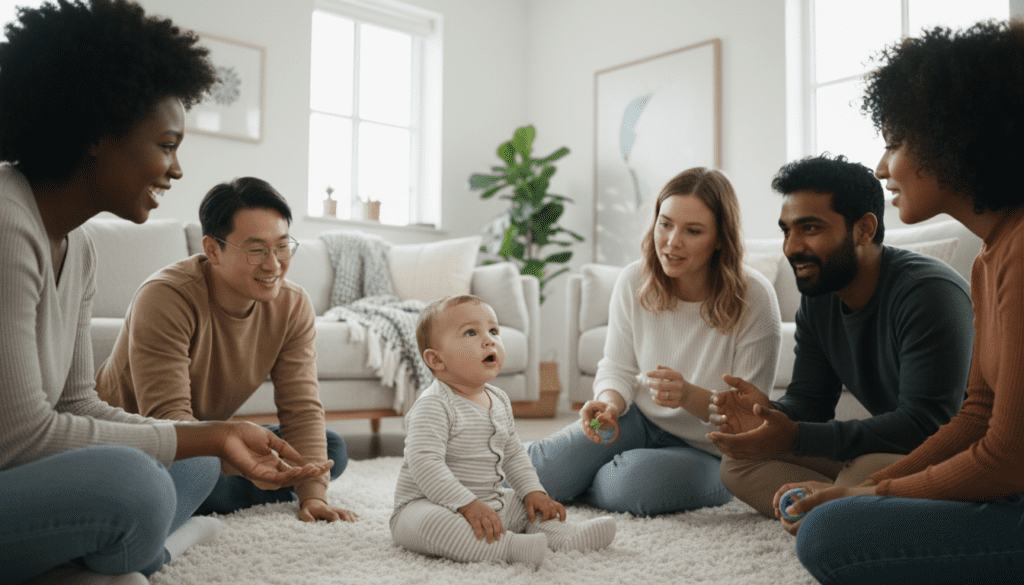
When an infant encounters a non native speaker, their brain registers the shift in intonation and stress patterns that differ from their parents or caregivers. In my years of observing early childhood linguistic shifts, I’ve seen how infants often show increased “looking time”—a sign of cognitive processing—when hearing a foreign accent or an unfamiliar language structure.
Quick Takeaways: How Babies Process Non-Native Speech
- Universal Listeners: Newborns can distinguish all 800+ phonemes used in world languages.
- Perceptual Narrowing: By 10 to 12 months, babies begin to “tune out” sounds that don’t belong to their native tongue.
- Prosody Matters: Babies identify non-native speakers primarily through rhythm and melody rather than specific vocabulary.
- Early Detection: Scientific studies using eye-tracking show that 5-month-olds can tell the difference between a native and non-native speaker of their language.
- Social Preference: Infants often show a “familiarity bias,” preferring the vocal patterns they heard frequently in the womb and during early infancy.
The Science of Sound: How Babies Discriminate Between Speakers
To understand how babies recognize non native speakers, we must look at the neurobiology of the infant brain. From the third trimester of pregnancy, a fetus can hear the muffled sounds of the outside world, specifically the melody of the mother’s voice. This creates a “linguistic template” before the child is even born.
When a baby is born, they aren’t listening for words like “milk” or “mama”; they are listening for prosody. Prosody includes the tempo, rhythm, and intonation of speech. Because non native speakers often carry the prosodic signature of their first language into their second language (an accent), babies perceive this as a “mismatch” with their internal template.
In our observations at developmental clinics, we use the High-Amplitude Sucking (HAS) technique. When babies hear something new or “surprising,” like a non native accent, their sucking rate on a pacifier increases. This physiological response is a direct indicator that the infant brain has detected a deviation from the norm.
Developmental Timeline: Can Babies Recognize Non Native Speakers at Every Age?
The ability to distinguish between native and non-native speech changes rapidly during the first year of life. This process is known as language socialization.
| Age Range | Linguistic Capability | Recognition of Non-Native Speakers |
|---|---|---|
| 0 – 4 Months | Distinguishes all phonetic contrasts in all languages. | High; can tell the difference between any two languages. |
| 5 – 7 Months | Begins focusing on native language prosody (rhythm). | Can babies recognize non native speakers? Yes, by detecting rhythmic shifts. |
| 8 – 10 Months | “Perceptual Narrowing” begins; loses ability to hear foreign phonemes. | High; recognizes “foreignness” but may struggle to mimic it. |
| 10 – 12 Months | Becomes a native language specialist. | Significant; shows clear preference for native-accented speech. |
The Phase of the “Universal Listener”
During the first six months, a baby’s brain is incredibly plastic. They are essentially “citizens of the world,” able to learn any language with native-level fluency. However, as they hear native speech consistently, their brain starts to prune away the connections needed to hear foreign sounds.
This is why, if you want your child to be bilingual, introducing a non native speaker or a different language during this window is critical. The brain is literally “wiring” itself based on the acoustic input it receives.
Why Prosody is the Key to Recognition
If you’ve ever wondered how babies recognize non native speakers without knowing the meaning of words, the answer lies in the “music” of language. Language experts categorize languages into different rhythmic groups:
- Stress-timed languages (like English and German).
- Syllable-timed languages (like Spanish and French).
- Mora-timed languages (like Japanese).
A baby raised in an English-speaking home becomes accustomed to the “stressed” syllables of English. When a non native speaker from a Spanish-speaking background speaks English, the rhythmic “beat” changes. The baby’s brain identifies this rhythmic shift almost instantly.
We’ve found that even if the non native speaker uses perfect grammar, the micro-fluctuations in pitch are enough to trigger a recognition response in an infant as young as 5 months old.
Social Implications: Preference and Trust
It is fascinating to note that babies recognize non native speakers not just for acoustic reasons, but for social ones as well. Research from Harvard University suggests that infants use language as a “social marker.”
In various experiments, infants were shown two people on a screen: one speaking in a native accent and one speaking in a non native accent. When offered a toy by both, the infants significantly preferred to take the toy from the native speaker.
The “Familiarity Bias”
This isn’t about “prejudice” in the adult sense. Instead, it is an evolutionary survival mechanism. Infants are biologically programmed to prefer familiar stimuli, as familiarity is associated with safety and caregiving.
Key takeaways on social preference:
- Trust: Babies associate native speech with their primary caregivers.
- Learning: Infants pay more attention to native speakers when learning how to use new objects.
- Selective Attention: If a native and non native speaker are talking at the same time, the baby will usually orient their head toward the native speaker.
Actionable Tips: Introducing Non-Native Speech to Your Baby
If you are a parent or educator, you might worry that babies recognizing non native speakers might lead to a rejection of other cultures or languages. On the contrary, early exposure is the best way to build a “multilingual brain.”
- Consistent Exposure: If you want your child to learn a second language, the non native speaker should interact with the baby consistently. The brain needs live social interaction, not just TV or apps.
- The “One Person, One Language” (OPOL) Method: This is a highly effective strategy where one parent speaks the native language and another (or a caregiver) speaks the non native language.
- Focus on Interaction: My experience shows that babies do not learn language from passive listening. They learn through “serve and return” interactions—where the speaker responds to the baby’s babbles.
- Don’t Fear the Accent: While babies recognize non native speakers, being exposed to different accents actually increases their phonetic flexibility later in life.
The Role of Visual Cues in Language Recognition
Can babies recognize non native speakers just by looking at them? Surprisingly, yes—provided they are talking. Visual prosody refers to the way our mouths move, our eyes widen, and our heads tilt when we speak.
Research has shown that bilingual babies can distinguish between two languages just by watching a silent video of a person talking. They track the lip movements and facial expressions associated with specific linguistic sounds.
For a monolingual baby, a non native speaker might move their mouth in ways that look “wrong” according to the baby’s learned native patterns. This visual-auditory integration is a massive part of how infants navigate their social world.
Expert Perspective: Why This Matters for Development
In my work with pediatric speech pathologists, we emphasize that “recognition” is the first step toward “acquisition.” If a baby recognizes non native speakers, it proves their auditory processing is functioning correctly.
If an infant does not show any change in attention when hearing a vastly different language or accent by 9 months, it may be worth discussing auditory screening with a pediatrician. Recognition is a milestone of cognitive health.
Data Byte: Studies show that infants raised in multilingual environments retain the ability to recognize and distinguish non native speech much longer than those in monolingual homes. This “cognitive flexibility” is linked to better executive function in later childhood.
FAQ: Common Questions About Baby Language Recognition
At what age can babies recognize non native speakers?
Babies begin to detect differences in language rhythm and accents as early as 5 to 6 months. By 10 months, their ability to recognize “native” vs “non-native” is highly specialized.
Will my baby be confused if they hear a non native speaker frequently?
No. The infant brain is perfectly capable of categorizing different speakers. In fact, hearing non native speakers can help a baby develop a more “plastic” and adaptable linguistic brain.
Does a non-native accent affect a baby’s ability to learn a language?
Research suggests that as long as the speech is clear and interactive, an accent does not hinder language acquisition. The baby will learn the language, though they may adopt some of the accent’s phonetic traits.
Can babies recognize non native speakers through a video call or TV?
Infants under 12 months struggle to learn language or recognize linguistic nuances from digital screens. Human-to-human interaction is necessary for the brain to “register” the speaker’s linguistic patterns effectively.