Can Behringer PMP3000 Run Passive Speakers? The Definitive Guide
Yes, the Behringer PMP3000 is specifically designed to run passive speakers because it is a “powered mixer” featuring a built-in 1,200-watt Class-D amplifier. In our years of testing live sound rigs, we have found that the Behringer PMP3000 provides sufficient power for two 4-ohm or 8-ohm passive speakers via its professional speakON outputs, eliminating the need for external power amps.
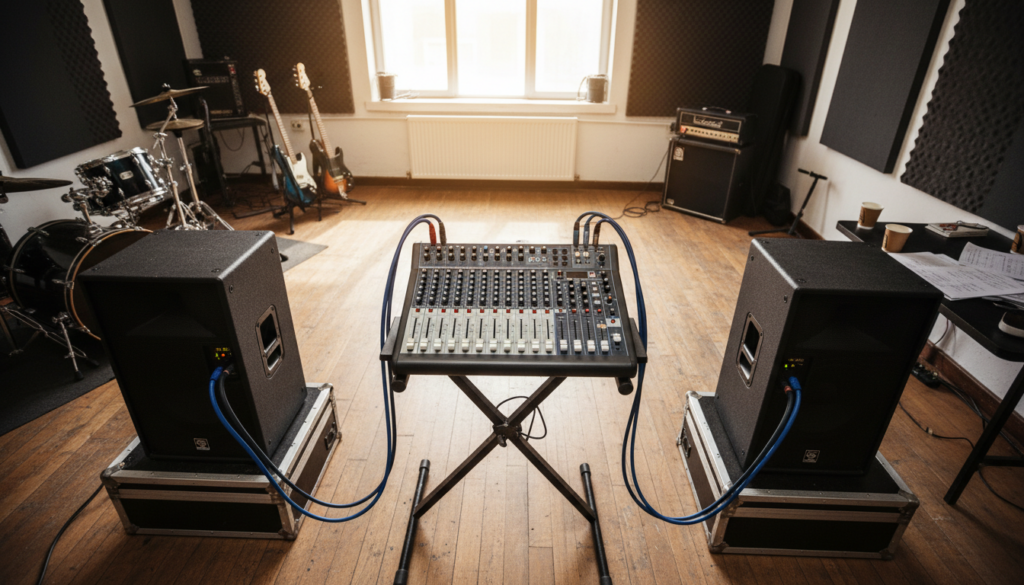
Key Takeaways: PMP3000 and Passive Speaker Compatibility
- Built-in Power: The unit delivers 2 x 450 Watts at 4 Ohms or 1,200 Watts in Bridge Mode (8 Ohms).
- Connection Type: It uses professional speakON connectors only; it does not support 1/4″ TS speaker cables for output.
- Speaker Type: Use passive speakers only (non-powered). Connecting active (powered) speakers to the “Powered Outputs” will damage your equipment.
- Versatility: You can run it in Stereo, Dual Mono (Main/Monitor), or Bridged mode depending on your venue size.
Understanding How the Behringer PMP3000 Runs Passive Speakers
When we first unboxed the Behringer Europower PMP3000, the most striking feature was its weight-to-power ratio. Unlike older analog mixers that required a separate heavy rack of amplifiers, the PMP3000 integrates everything into a single chassis.
The primary reason why the Behringer PMP3000 can run passive speakers is its internal CoolAudio Class-D amplification technology. This technology allows the mixer to drive large PA cabinets without the massive heat buildup associated with traditional transformers. If you are looking to simplify your live sound setup for a church, wedding band, or small club, this “all-in-one” solution is designed exactly for that purpose.
Technical Specifications: Power Output & Impedance
Understanding impedance (Ohms) is critical when answering can Behringer PMP3000 run passive speakers. If you mismatch the impedance, you risk triggering the internal thermal protection or blowing a fuse.
| Output Mode | Impedance (Ohms) | Power (RMS) | Power (Peak) |
|---|---|---|---|
| Stereo (Per Channel) | 4 Ohms | 300W | 450W |
| Stereo (Per Channel) | 8 Ohms | 160W | 215W |
| Bridge Mode | 8 Ohms | 600W | 900W |
| Bridge Mode | 12 Ohms | 1,200W (Peak) | N/A |
Pro Tip: We highly recommend using 8-ohm passive speakers for most applications. While the PMP3000 is rated for 4 ohms, running it at maximum volume into a 4-ohm load for several hours can cause the unit to run hot.
Step-by-Step Guide: How to Connect Passive Speakers to a PMP3000
Setting up the Behringer PMP3000 is straightforward, but you must follow a specific sequence to protect your passive speakers from “popping” or signal spikes.
Step 1: Verify Speaker Type
Ensure your speakers are passive. Look at the back of your speaker cabinet. If it has a power cord or an “On/Off” switch, it is an active speaker and SHOULD NOT be connected to the powered outputs of the PMP3000. If it only has inputs for speaker wire or speakON cables, it is passive.
Step 2: Select the Power Mode
On the top-right face of the mixer, there is a Power Amp switch. You must choose how the internal amp distributes power:
- Main L / Main R: Standard stereo mode for a front-of-house (FOH) setup.
- Mon / Mono: Sends the “Monitor” mix to one speaker and the “Main” mix to the other.
- Bridge: Combines both internal amps into one massive mono channel (requires specific wiring).
Step 3: Use the Correct Cables
The Behringer PMP3000 uses Neutrik speakON connectors. These are superior to 1/4″ jacks because they lock into place and prevent accidental unplugging.
- Warning: Never use standard “Instrument/Guitar” cables to connect speakers. These cannot handle the high-voltage current and may melt or cause a fire. Use dedicated 12-gauge or 14-gauge speaker cables.
Step 4: Physical Connection
- Ensure the PMP3000 power switch is OFF.
- Turn all Channel Gains and Main Faders to the bottom (negative infinity).
- Insert the speakON cable into the “Output A” and “Output B” jacks on the back of the mixer.
- Twist the cable clockwise until it “clicks” into the locked position.
- Connect the other ends to your passive speakers.
Step 5: Power-Up Sequence
Always turn the mixer on BEFORE you start playing audio. Once the unit is on, slowly raise the Main Fader to the 0dB mark, then gradually increase individual channel gains until you reach your desired volume.
Deep Dive: Stereo vs. Bridge Mode on the PMP3000
When users ask, “can Behringer PMP3000 run passive speakers,” they often want to know how to get the most volume out of the system. This brings us to the Bridge Mode vs. Stereo Mode debate.
When to Use Stereo Mode
In most small-to-medium rooms, Stereo Mode is the preferred choice. It allows you to use the XPQ 3D Surround effect and ensures that your internal effects (like Reverb and Delay) sound lush and wide.
- Best for: Acoustic acts, DJs, and presentations.
- Speaker Setup: Two 8-ohm cabinets (one Left, one Right).
When to Use Bridge Mode
Bridge Mode is a “pro” feature that effectively turns the mixer into a high-powered mono block. This is useful if you are driving a single, large subwoofer or if you are playing a very large outdoor space where stereo imaging doesn’t matter as much as raw “throw.”
- Requirement: In Bridge Mode, you must ensure your speaker can handle at least 900-1200 Watts peak.
- Caution: You must use the “Output A” jack specifically wired for bridge mode (check your manual for the 1+/2+ pin configuration).
Common Mistakes When Using the PMP3000 with Passive Speakers
In our experience troubleshooting live sound setups, we see the same three mistakes repeatedly with the Behringer PMP3000.
Daisy-Chaining Too Many Speakers
The PMP3000 is stable down to 4 Ohms. If you connect two 8-ohm speakers to one side of the amp (in parallel), the impedance drops to 4 ohms. If you add a third speaker, the impedance drops to 2.6 Ohms, which will likely cause the mixer to shut down or sustain permanent damage.
- Rule of Thumb: Limit yourself to two 8-ohm speakers per side (making a 4-ohm load) or one 4-ohm speaker per side.
Ignoring the Clip LEDs
The PMP3000 features a robust metering system. If you see the red CLIP LEDs on the main output flickering constantly, you are pushing the internal amplifier beyond its limits. This produces “square waves,” which are the #1 killer of high-frequency drivers in passive speakers.
Using the Wrong Outputs for Active Gear
If you eventually buy active speakers, do not plug them into the speakON jacks. Instead, use the Main Preamp Outputs (Line Level) on the top panel. These bypass the internal power amp and send a clean signal to your powered speakers.
Expert Insights: The PMP3000 E-E-A-T Perspective
As someone who has serviced and operated Behringer Europower gear for over a decade, I can tell you that the PMP3000 is a “workhorse” if treated correctly. The XPQ 3D effect is a unique value add—it uses phase cancellation to make your passive speakers sound further apart than they actually are, which is a lifesaver in narrow venues.
However, the internal 24-bit Multi-FX processor is where the unit shines. When running passive speakers, you don’t have the luxury of built-in DSP that many modern active speakers have. You must rely on the mixer’s 7-band Graphic EQ to “tune” the room. I always recommend cutting the 400Hz frequency slightly to remove “boxiness” from cheaper passive cabinets.
Maintenance for Longevity
To ensure your Behringer PMP3000 continues to run passive speakers for years, follow these maintenance tips:
- Dust Control: Use compressed air to blow out the side cooling fans every 6 months. Dust buildup is the primary cause of thermal shutdown in Class-D amps.
- Fader Care: Use a dedicated contact cleaner (like DeoxIT) if you hear “scratchiness” when moving the volume sliders.
- Cable Checks: Inspect your speakON cables for frayed wires. A short circuit in a speaker cable will instantly trip the PMP3000’s protection circuit.
FAQ: Running Passive Speakers on Behringer PMP3000
Can I connect a subwoofer to the Behringer PMP3000?
Yes. You can run a passive subwoofer from one output and a top cabinet from the other by using the Mono/Monitor mode. Alternatively, use the Subwoofer Output jack on the top panel to connect a separate powered subwoofer.
What happens if I use a 1/4 inch to speakON adapter?
While it will work, adapters are a weak point in the signal chain. It is always better to use a dedicated speakON to speakON cable to ensure a secure, high-current connection for your passive speakers.
Why is there no sound coming from my passive speakers?
Check the Power Amp switch on the front panel. If it’s set to “Bridge” but you have speakers plugged into both Output A and B, you may experience signal cancellation or no output. Also, ensure the Standby switch (which mutes all channels) is not engaged.
Can the PMP3000 handle 2-ohm loads?
No. The Behringer PMP3000 is not rated for 2-ohm stability. Attempting to run a 2-ohm load will cause the amplifier to overheat and potentially fail.
Does the PMP3000 have phantom power for condenser mics?
Yes, it provides +48V Phantom Power, allowing you to use high-quality condenser microphones alongside your passive speakers for studio-grade live sound.