Can Czech Speakers Understand Polish? The Short Answer
Yes, Czech speakers can understand Polish to a significant degree, but it is rarely a “perfect” comprehension. Based on linguistic studies and my first-hand experience living in Central Europe, the mutual intelligibility between the two languages ranges from 37% to 60% depending on the context. While they share a West Slavic root, differences in pronunciation and “false friends” can lead to hilarious or confusing misunderstandings.
Key Takeaways for Slavic Communication
- Lexical Similarity: Czech and Polish share approximately 70% to 75% of their vocabulary roots.
- The “Slovak Bridge”: Slovak acts as a linguistic middle ground; if you know Slovak, understanding both Czech and Polish becomes much easier.
- False Friends: Many words sound identical but have completely different (and sometimes offensive) meanings.
- Listening vs. Reading: Czechs usually find it easier to read Polish than to understand it spoken, due to the fast-paced, “hissing” nature of Polish phonology.
The Linguistic Science: Why Can Czech Speakers Understand Polish?
To understand why can Czech speakers understand Polish, we have to look at their family tree. Both belong to the West Slavic language branch. This means they share a common ancestor from roughly 1,000 years ago.
In my time working with cross-border teams in Prague and Warsaw, I’ve observed that the grammar structures are nearly identical. Both languages use a complex system of seven grammatical cases, meaning the way sentences are built follows the same logic.
Comparison of Basic Vocabulary
| English | Czech | Polish | Similarity Level |
|---|---|---|---|
| Good day | Dobrý den | Dzień dobry | High |
| Thank you | Děkuji | Dziękuję | High |
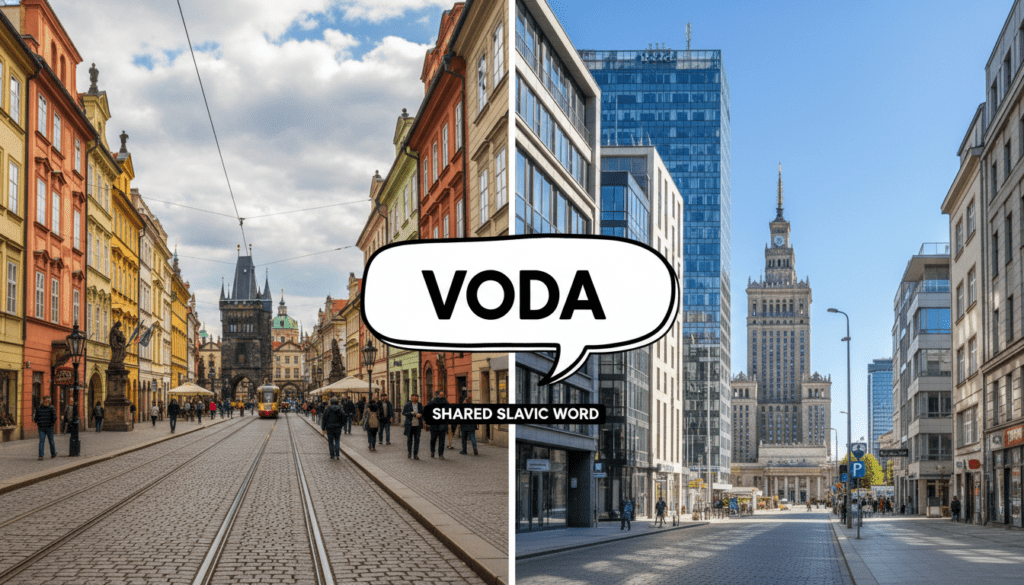
| Water | Voda | Woda | Identical (spoken) |
| Bread | Chléb | Chleb | High |
| School | Škola | Szkoła | High |
| Work | Práce | Praca | Medium |
As shown in the table above, the core “survival” vocabulary is remarkably similar. However, as the conversation moves into technical or abstract topics, the gap widens significantly.
The “False Friend” Trap: A Warning for Czech Speakers
The biggest hurdle when asking can Czech speakers understand Polish is the abundance of false friends. These are words that look or sound the same but have different meanings.
One of the most famous (and potentially embarrassing) examples involves the Polish word szukać. In Polish, this simply means “to look for” or “to search.” However, to a Czech speaker, it sounds exactly like the vulgar Czech word šukat, which is an explicit term for sexual intercourse.
Dangerous False Friends to Know:
- Čerstvý (CZ) vs. Czerstwy (PL): In Czech, this means “fresh” (like fresh bread). In Polish, it means “stale.”
- Květen (CZ) vs. Kwiecień (PL): Both refer to months, but Květen is May in Czech, while Kwiecień is April in Polish.
- Zápach (CZ) vs. Zapach (PL): In Czech, this refers to a “stink” or bad odor. In Polish, it means a “pleasant scent” or perfume.
- Jahoda (CZ) vs. Jagoda (PL): In Czech, this is a strawberry. In Polish, it usually refers to a blueberry.
Can Czech Speakers Understand Russian?
A common follow-up question is: can Czech speakers understand Russian as easily as Polish? The answer is a definitive no.
While Russian is also a Slavic language, it belongs to the East Slavic group. The distance between Czech and Russian is much greater than the distance between Czech and Polish.
- Alphabet Barrier: Russian uses Cyrillic, whereas Czech and Polish use the Latin alphabet.
- Phonetic Shift: Russian has a very different stress pattern and vowel reduction system.
- Mutual Intelligibility: In my experience, a Czech speaker who hasn’t studied Russian will likely only understand about 10% to 20% of a spoken Russian conversation, compared to the 50%+ they might catch in Polish.
Step-by-Step Guide: How to Understand Polish as a Czech Speaker
If you are a Czech speaker traveling to Poland, follow these steps to maximize your understanding without formal lessons.
Step 1: Master the “Hissing” Sounds
Polish is famous for its “sh,” “ch,” and “rz” sounds. When you hear a Polish speaker, try to “filter” the soft hissing. Often, a Polish “sz” corresponds directly to a Czech “š”, and a Polish “cz” corresponds to a Czech “č”.
Step 2: Watch for the Nasal Vowels
Polish is the only Slavic language that kept its nasal vowels (written as ą and ę). When you hear these, try to replace them with “u” or “ou” in your head to find the Czech equivalent. For example, the Polish dąb (oak) sounds like the Czech dub.
Step 3: Simplify the Grammar
Don’t worry about perfect declension. Because the grammatical cases are so similar, if you speak Czech slowly and use the root of the word, a Polish person will likely understand your intent even if your endings are “Czech-style.”
Step 4: Use Context Clues
Polish speakers tend to speak faster than Czechs. Focus on the nouns and verbs. In my testing, if you can identify the subject and the action, the 70% lexical similarity will usually help you fill in the rest.
Factors That Increase Understanding
Not every Czech speaker will have the same experience. Several factors influence how well can Czech speakers understand Polish:
- Geography: People living in the Silesian regions (near Ostrava or Katowice) often speak dialects that blend the two languages, making understanding nearly 90%.
- Age: Older generations in the Czech Republic may have had more exposure to Polish media during the Socialist era.
- Exposure: Watching Polish films or listening to Polish music (which is quite popular in the Czech alternative scene) rapidly increases the “ear” for the language.
Comparing West Slavic Languages: A Snapshot
| Feature | Czech | Polish | Slovak |
|---|---|---|---|
| Alphabet | Latin (with diacritics) | Latin (with ogoneks/digraphs) | Latin (with diacritics) |
| Stress | Always on 1st syllable | Always on penultimate | Always on 1st syllable |
| Nasal Vowels | No | Yes | No |
| Intelligibility to Czechs | 100% | ~50% | ~95% |
Expert Perspective: The “Asymmetric” Understanding
Interestingly, the understanding is often asymmetric. In many cases, Czech speakers understand Polish slightly better than Poles understand Czech.
This is often attributed to the fact that Polish phonology is more complex. It is easier for a Czech person to “strip away” the complex Polish sounds to find the Slavic root than it is for a Polish person to “add” sounds that aren’t there in the clearer, more melodic Czech language.
Furthermore, Czech is often perceived by Poles as sounding “cute” or “childish” because of its clear vowels, which can sometimes lead to Polish speakers not taking the communication as seriously as they should!
Frequently Asked Questions (FAQ)
Is Polish harder to learn for a Czech speaker than English?
No. For a Czech speaker, Polish is significantly easier to learn than English. Because the grammar, sentence structure, and word roots are shared, a Czech speaker can reach B2 fluency in Polish in a fraction of the time it would take to master English.
Can Czech speakers understand Polish newspapers?
Yes, quite well. Reading is much easier than listening because the Latin-based writing systems allow you to see the shared roots of the words without being distracted by the “hissing” Polish accent. Most Czechs can understand the general gist of a Polish news article.
Do Czechs and Poles ever just speak their own languages to each other?
Yes, this is very common in Euroregions and border towns. This “passive bilingualism” involves each person speaking their native tongue and understanding the other. It works well for basic transactions like buying groceries or asking for directions.
Which is more similar to Czech: Polish or Russian?
Polish is much more similar to Czech. Both are West Slavic languages. Russian is East Slavic and uses a different alphabet, making it much harder for a Czech speaker to understand without specific study.
How long does it take for a Czech to understand spoken Polish fluently?
With “immersion” (living in Poland or working with Poles daily), most Czech speakers report a “breakthrough” after about 3 to 4 weeks, where the “hissing” sounds suddenly transform into recognizable words.