Mastering the Logic: Why English Speakers Can Understand German Word Order
Yes, English speakers can understand German word order quite effectively because both languages share a common Germanic ancestor. While German is more rigid about verb placement (the famous V2 rule), the logic behind it is consistent and predictable. Once you grasp that the conjugated verb must almost always be the second element in a main clause, the rest of the sentence structure falls into place.
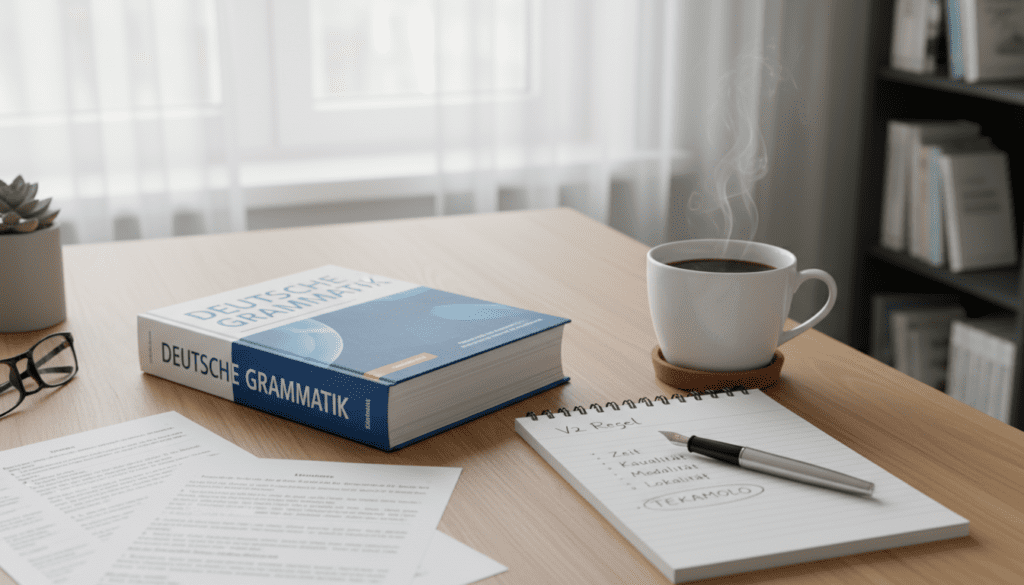
In my years of teaching German to native English speakers, I have found that the biggest hurdle isn’t the difficulty—it’s the “Yoda-like” feeling of shifting words. However, by using a few mental frameworks and visual markers, you can master these patterns in just a few weeks of practice.
TL;DR: Key Takeaways for Fast Learners
- The Golden Rule: The conjugated verb is always the second element in a standard statement.
- TEKAMOLO: Use this acronym (Temporal, Causal, Modal, Local) to order your descriptions.
- Flexibility: Because German has cases (Nominative, Accusative, etc.), you can move the object to the front for emphasis, as long as the verb stays in position two.
Can English Speakers Understand German Word Order Without Struggling?
To answer the question can english speakers understand german word order, we have to look at our shared linguistic history. English and German are both Germanic languages. Thousands of years ago, they functioned almost identically.
Over time, English became more “fixed” (Subject-Verb-Object), while German kept its inflectional system. I’ve observed that students who stop trying to translate word-for-word and start thinking in “blocks” progress the fastest.
If you can understand that “the second position” does not mean “the second word,” you have already won half the battle. For example, in the sentence “The tall man drinks coffee,” the phrase “The tall man” is one single element. Therefore, the verb “drinks” still sits in the second position.
The V2 Rule: The Backbone of German Sentences
The most critical concept to internalize is the Verb-Second (V2) Rule. In a standard German declarative sentence, the finite (conjugated) verb must occupy the second position.
Position One is a “Hot Seat”
While English almost always puts the Subject in the first position, German allows any element to sit there. If you want to emphasize when something happened, you put the time first.
- English: I go to the gym today. (Subject First)
- German (Option 1): Ich gehe heute ins Fitnessstudio. (Subject First)
- German (Option 2): Heute gehe ich ins Fitnessstudio. (Time First – Verb stays in position 2)
Comparison Table: English vs. German Word Order
| Feature | English Structure | German Structure | Example (English) | Example (German) |
|---|---|---|---|---|
| Standard Statement | Subject + Verb + Object | Subject + Verb + Object | I eat the apple. | Ich esse den Apfel. |
| Time Emphasis | Time + Subject + Verb | Time + Verb + Subject | Today I eat bread. | Heute esse ich Brot. |
| Questions | Auxiliary + Subject + Verb | Verb + Subject + Object | Do you eat bread? | Isst du Brot? |
| Subordinate Clause | Conj. + Subject + Verb + Obj. | Conj. + Subject + Obj. + Verb | …because I eat bread. | …weil ich Brot esse. |
Step-by-Step Guide: How to Build a German Sentence
Building a sentence in German is like playing with LEGO blocks. You have specific slots that need to be filled in a specific order.
Step 1: Identify Your Verb
Decide what the action is. Conjugate it to match your subject. This verb is your anchor. In a main clause, draw a mental line under the second slot—that is where this verb lives.
Step 2: Choose Your “Emphasis” Element
What is the most important part of your sentence?
- If it’s the person doing the action, put the Subject in Position 1.
- If it’s the time, put the Adverb of Time in Position 1.
Step 3: Apply the TEKAMOLO Rule
When you have multiple pieces of information (When? Why? How? Where?), use the TEKAMOLO order. I tell my students to treat this as a “law of nature” in German.
- TEmporal (When?) – heute, um 8 Uhr
- KAusal (Why?) – aus Liebe, wegen dem Wetter
- MOdal (How?) – schnell, mit dem Auto
- LOkal (Where?) – nach Berlin, im Hause
Example:
Ich fahre (Verb) + heute (TE) + mit dem Zug (MO) + nach Berlin* (LO).
Step 4: The “Verb Bracket” (Satzklammer)
If you use a modal verb (can, must, should) or a past tense (have/had), the second part of the verb goes to the very end. This creates a “bracket” that holds the rest of the information inside.
Ich muss heute meine Hausaufgaben machen.* (I must today my homework do.)
Subordinate Clauses: The Verb-End Trap
One of the main reasons people ask can english speakers understand german word order is the confusion caused by subordinate clauses. These are dependent phrases that start with conjunctions like weil (because), dass (that), obwohl (although), or wenn (if).
In these clauses, the conjugated verb is “kicked” to the very end of the sentence.
Why does this happen?
Linguists suggest that German historically preferred putting verbs at the end. While main clauses evolved to the V2 rule, subordinate clauses stayed “old-fashioned.”
Comparison:
- Main Clause: Ich bin müde. (I am tired.)
- Subordinate Clause: Ich trinke Kaffee, weil ich müde bin. (I drink coffee, because I tired am.)
The “Comma Rule”
In German, you must use a comma to separate a main clause from a subordinate clause. This comma acts as a signal that the word order is about to change.
Dealing with Separable Verbs: The “Prefix” Problem
German uses separable verbs (trennbare Verben), which act like a multi-part machine. A verb like anrufen (to call) splits apart in a main clause.
- The prefix (an) goes to the very end.
- The main part (rufen) stays in the second position.
Example:
Ich rufe meine Mutter an.* (I call my mother “on”.)
This is another reason why english speakers can understand german word order better if they view the sentence as a frame. You start the thought with the verb and “close” the thought with the prefix.
Real-World Practice: Making it Second Nature
When I lived in Hamburg, I noticed that even when I made mistakes with word order, Germans usually understood me. However, to sound authoritative and fluent, you must practice the “Inversion.”
The Inversion Drill
Whenever you start a sentence with anything other than the subject, the subject must move to the third position (immediately after the verb).
- Standard: Wir essen heute Pizza.
Pro Tip: Record yourself speaking. Start five sentences with a time expression (Yesterday, Tomorrow, At noon). Ensure your verb is always the second thing you say.
Common Pitfalls for English Speakers
Even advanced learners trip over these three common issues:
- The “Do” Support: In English, we say “I do not know.” In German, there is no “do.” You simply say “Ich weiß nicht” (I know not).
- Too Many Verbs: When using a modal verb, don’t forget to push the infinitive to the end. I’ve seen many students say “Ich kann schwimmen gut” instead of the correct “Ich kann gut schwimmen.“
- Adverb Placement: In English, we can say “I often go.” In German, the adverb “often” (oft) usually follows the verb: “Ich gehe oft.“
Why Understanding German Word Order is Actually an Advantage
Once you realize can english speakers understand german word order by looking at the rules as “slots,” you gain a creative freedom English doesn’t have. Because the Cases tell us who is doing what (Nominative vs. Accusative), we can move words around to change the “flavor” of the sentence without changing its basic meaning.
Den Hund (Object) beißt der Mann* (Subject).
This literally means “The man bites the dog,” but by putting “The dog” first, we emphasize that the dog* was the unfortunate victim of this strange event.
Frequently Asked Questions
Is German word order similar to English?
Yes and no. Simple Subject-Verb-Object sentences are identical. However, German is a V2 language, meaning the verb is always in the second position, whereas English is more flexible with adverbs but stricter with subject placement.
Why does the verb go to the end in German?
The verb moves to the end in subordinate clauses and when using infinitives or past participles. This is a remnant of older Germanic grammar and serves to “bracket” the information within the sentence.
What is the TEKAMOLO rule?
TEKAMOLO is a mnemonic for the order of adverbs in a German sentence: TEmporal (time), KAusal (reason), MOdal (manner), and LOkal (place). Following this order makes your German sound natural to native speakers.
How do you remember to put the verb second?
A great trick is to visualize the second position as a fixed anchor. No matter how many words you put in the first position (the “topic”), the verb must immediately follow it. Think of it as: [Topic] + [Verb] + [Everything Else].