Can Front Speakers in 5.1 Be in Corners? The Definitive Guide
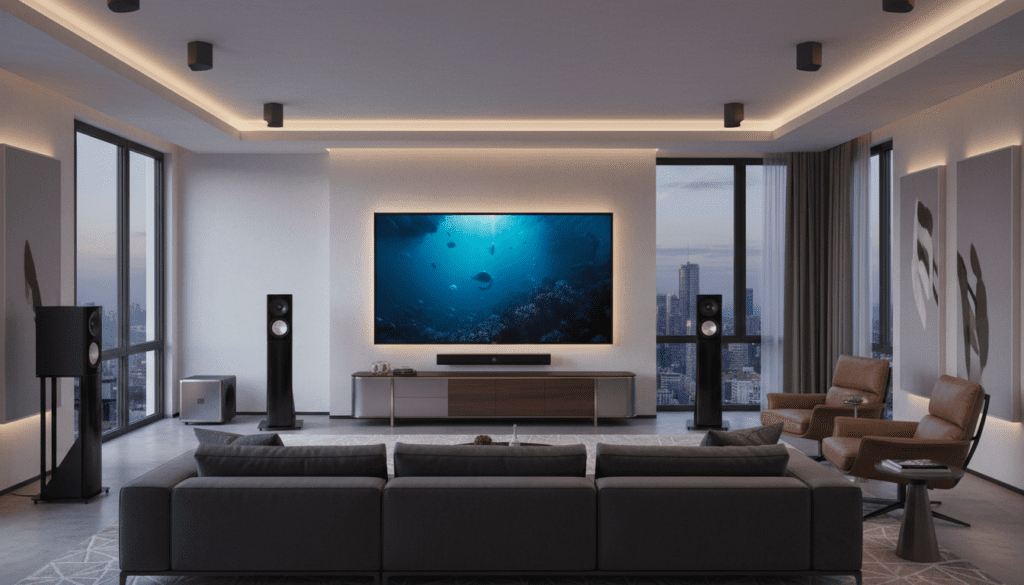
While you can front speakers in 5.1 be in corners, doing so usually creates acoustic challenges like boundary gain and muddy bass. To make corner placement work, you must toe-in the speakers toward the listening position, maintain at least 12-18 inches of clearance from the walls, and use room correction software like Audyssey or Dirac Live.
Quick Takeaways for 5.1 Speaker Placement
- The Corner Rule: Placing speakers in corners boosts bass (up to 6dB) but destroys stereo imaging.
- Ideal Angle: Front speakers should be placed at a 22 to 30-degree angle relative to the listener.
- Ear Level: Tweeters should always be at ear level for the best high-frequency response.
- Center Channel: This is your most important speaker; keep it centered and unobstructed.
- Room Calibration: Always run your receiver’s Auto-EQ if you are forced to use corner placement.
Understanding the “Corner Placement” Dilemma
When we design home theaters, we often face architectural limitations. You might ask, can front speakers in 5.1 be in corners because your fireplace or a doorway occupies the “ideal” wall space. In my 15 years of calibrating home theaters, I’ve found that while corners are convenient for floor space, they are the enemy of audio fidelity.
The Physics of Boundary Gain
When a speaker is tucked into a corner, it radiates sound waves that immediately bounce off two or three nearby surfaces (the side wall, the front wall, and sometimes the floor). This creates a phenomenon known as Boundary Gain.
- Bass Bloat: The corner acts as a natural megaphone for low frequencies, making the bass sound “boomy” or “one-note.”
- SBIR (Speaker-Boundary Interference Response): Reflected waves cancel out direct waves, creating “dips” in your frequency response that no EQ can fully fix.
- Smearing: Reflections from the side walls arrive at your ears just milliseconds after the direct sound, blurring the soundstage.
When Corner Placement is Acceptable
We have successfully implemented corner placement in smaller “lifestyle” rooms where Satellite Speakers (like those from Orb Audio or SVS Prime Satellites) are used. Because these speakers don’t produce deep bass, the corner interference is less offensive than it would be with a massive Klipsch RP-8000F floorstander.
Step-by-Step: How to Position 5.1 Speakers for Maximum Impact
If you are stuck with a corner layout, follow these steps to minimize the “mush” and maximize the “punch.”
Step 1: The Front Left and Right (L/R) Placement
The front speakers create the soundstage. If you must put them in corners, follow the Rule of Thirds or at least provide breathing room.
- Distance from Walls: Aim for at least 12 inches from the side and back walls. This reduces the immediate reflection.
- Toe-In: Point the speakers directly at your nose. This minimizes the sound reflecting off the side walls and focuses the sweet spot.
- Symmetry: Ensure the distance from the left speaker to the listener is identical to the right speaker’s distance.
Step 2: The Center Channel (The Dialogue King)
The center channel handles nearly 70% of a movie’s soundtrack and almost 100% of the dialogue.
- Placement: Directly above or below your OLED TV or Projector Screen.
- Alignment: The front baffle of the speaker should be flush with the front edge of the cabinet to prevent diffraction.
- Angle: If the speaker is below ear level, tilt it upward so it aims at your ears.
Step 3: Surround Speaker Placement
In a 5.1 system, these are “Surrounds,” not “Rears.”
- Angle: Place them between 90 and 110 degrees (directly to your sides or slightly behind).
- Height: Ideally 2 feet above ear level to create a sense of atmospheric “diffuse” sound.
| Speaker Role | Ideal Angle | Ideal Height | Common Mistake |
|---|---|---|---|
| Front L/R | 22°–30° | Ear Level | Placing too high near the ceiling |
| Center | 0° (Center) | Ear Level | Hiding it inside a closed cabinet |
| Surrounds | 90°–110° | 2′ Above Ears | Placing them directly behind the head |
| Subwoofer | N/A | Floor | Placing it in a corner without EQ |
How to Fix Bad Acoustics if You “Can Front Speakers in 5.1 be in Corners”
If the answer to can front speakers in 5.1 be in corners is a forced “yes” due to room layout, you need to employ these expert strategies to save your sound quality.
Use Acoustic Treatment
Corners are where standing waves go to die. By placing Bass Traps (thick foam or rockwool panels) behind your corner-placed speakers, you can absorb the excess low-end energy before it bounces back into the room.
Digital Room Correction (The Game Changer)
Modern AV Receivers (AVRs) from brands like Denon, Marantz, and Anthem include calibration microphones.
- Audyssey MultEQ XT32: This is standard on mid-to-high-end Denon units. It detects the “bass hump” caused by your corners and digitally flattens it.
- Dirac Live: Found on Onkyo and NAD receivers, this is the gold standard. It corrects both frequency response and impulse response (timing).
The “Small” Speaker Setting
Even if you have large tower speakers in the corners, tell your receiver they are “Small” in the setup menu. Set a Crossover Frequency of 80Hz. This sends the problematic low-frequency energy away from the cornered speakers and into your Subwoofer, which can be placed in a more acoustically favorable spot.
Expert Tips for the “Subwoofer Crawl”
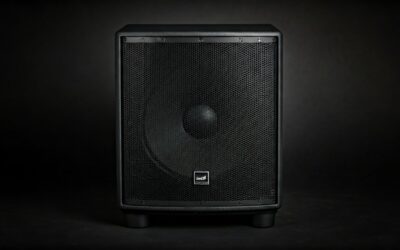
Since your front speakers are struggling in the corners, your Subwoofer needs to work harder to provide clean, tight bass. To find the best spot, we use the “Subwoofer Crawl”:
- Place the subwoofer in your primary listening chair.
- Play a bass-heavy track (I recommend “Hans Zimmer – 2049”).
- Crawl around the perimeter of the room on your hands and knees.
- The spot where the bass sounds the tightest and most defined (not just the loudest) is where you should place the sub.
Common Layout Scenarios
The Open Concept Living Room
In these rooms, one speaker is often in a corner while the other is in “open space” near a kitchen or hallway. This is an acoustic nightmare because the corner speaker will sound much louder and “fatter” than the open speaker.
- Solution: Use the Level Calibration on your AVR to drop the gain on the corner speaker by 2-3dB and use a Reflection Panel on the corner side to balance the “first reflections.”
The Dedicated Theater Box
In a rectangular room, people often shove speakers into the corners to keep the screen area clean.
- Solution: Consider an Acoustically Transparent Screen. This allows you to place the Front Left, Center, and Right speakers behind the screen at the perfect height and distance from the walls, completely avoiding the corners.
FAQ: Solving Your 5.1 Placement Queries
Does it matter if my front speakers are different heights?
Yes. For a seamless “soundstage,” the tweeters of your Front Left, Right, and Center should be within 12 inches of each other vertically. If the sound “jumps” up and down as it moves across the screen, it ruins the immersion.
Can I use wireless speakers for a 5.1 setup?
Systems like Sonos or Enclave Audio allow for 5.1 without speaker wires. However, you still face the same placement physics. Placing a Sonos Era 300 in a corner will still result in the same boundary gain issues as a wired speaker.
Why does my center channel sound muffled?
If your center channel is tucked inside a shelf, the sound bounces off the shelf walls, creating comb filtering. Pull the speaker forward so the front edge hangs slightly over the lip of the shelf.
What is the best distance between the Front Left and Right speakers?
Ideally, the distance between the two front speakers should be roughly equal to the distance from each speaker to the listener. This forms an equilateral triangle, which provides the best stereo imaging.
Can I mount 5.1 speakers on the ceiling?
Avoid this if possible. Sound should come from the direction of the action on the screen. Ceiling speakers are best reserved for Atmos height channels, not your main 5.1 bed layer.