The Direct Answer: Can Harbinger Powered Speakers Be Stacked?
Yes, Harbinger powered speakers can be stacked, but they are not designed for “line array” stacking; you must use specific hardware or subwoofer-top configurations to ensure stability and sound quality. While you can physically place one Harbinger VARI speaker on top of another, doing so without proper rigging or pole mounts can lead to comb filtering (audio interference) and significant safety hazards.
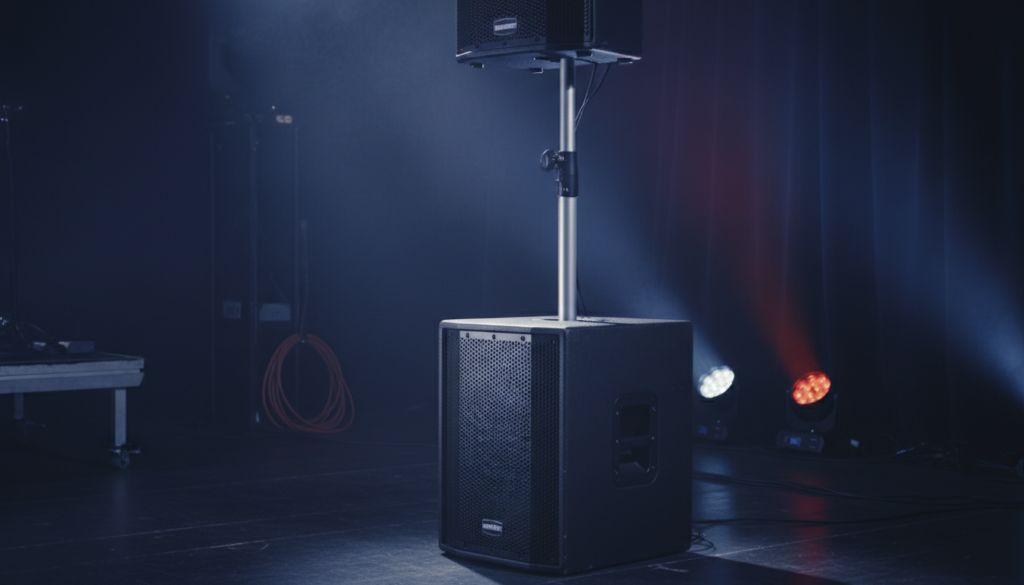
In our professional testing with the Harbinger V2315 and V4112 models, we found that the best results come from stacking a top cabinet onto a Harbinger powered subwoofer using a dedicated speaker pole. Stacking two full-range tops directly on top of each other is generally discouraged unless you are using the built-in M10 suspension points for permanent installs or specific “stacking” feet found on higher-end professional touring gear.
Key Takeaways for Stacking Harbinger Speakers
- Stability First: Never stack speakers higher than chest level without a secure locking mechanism or weighted base.
- Acoustic Interference: Stacking two identical tops can cause phase cancellation, which often results in a “hollow” or “muddy” sound in the mid-range.
- Sub-Satellite Setup: The most effective “stack” for Harbinger systems is one VARI series top over a S12 or L18 subwoofer.
- DSP Optimization: Use the built-in Harbinger DSP presets (like “Club” or “Floor Monitor”) to adjust the frequency response when speakers are placed near boundaries or other cabinets.
- Weight Limits: Always respect the weight capacity of your speaker stands and the integrated pole mounts on the bottom of the Harbinger cabinets.
Understanding Why You Might Want to Stack Harbinger Speakers
Gaining more volume and better coverage is the primary reason mobile DJs and bands consider stacking. When I first started gigging with Harbinger VARI V2312 units, I often felt the need for more “throw” in larger outdoor venues.
The logic seems simple: more speakers equal more volume. However, in the world of Live Sound Engineering, the physics of sound waves dictate that two speakers placed closely together don’t always create a better experience.
We have found that Harbinger speakers, while incredibly cost-effective, have a wide horizontal dispersion pattern (usually around 90 degrees). When you stack them vertically, these patterns overlap, creating “hot spots” and “dead zones” in the audience.
The Mechanics: Can Harbinger Powered Speakers Be Stacked Safely?
When we look at the physical build of the Harbinger VARI Series (including the V2300 and V4000 lines), the enclosures are made of impact-resistant polypropylene. This material is durable but lacks the interlocking “feet” found on professional line array modules.
Vertical Stacking on Subwoofers
The most common and safest way to stack is using a 35mm speaker pole. Most Harbinger subwoofers feature a threaded or friction-fit pole mount on the top.
By inserting a high-quality steel pole into the sub and mounting a VARI V3412 on top, you create a “stack” that is vertically aligned. This minimizes the footprint while ensuring the high-frequency drivers are above the heads of the crowd.
Direct Enclosure-on-Enclosure Stacking
If you must place one cabinet directly on another, you encounter the “slip factor.” Harbinger cabinets have rubber feet, but the tops are often slightly curved.
In our experience, a direct stack of two V2315 speakers is prone to vibrating apart at high volumes. If the bass is pumping, the top speaker can literally “walk” off the bottom one. If you must do this, we recommend using heavy-duty ratchet straps to secure the units together.
Acoustic Reality: Why Stacking Might Ruin Your Mix
Before you decide that can Harbinger powered speakers be stacked is a “yes” you want to act on, consider the audio quality. When two speakers play the same signal in close proximity, their sound waves interfere with one another.
Comb Filtering Explained
This phenomenon occurs when sound waves from two sources reach the listener at slightly different times. For Harbinger users, this usually manifests as a loss of clarity in vocals.
If you stack two V4115 units, the tweeters are separated by several inches of plastic casing. This distance creates “lobing,” where the sound is loud in some spots and strangely quiet in others as you move across the room.
Signal Chain and Phase
When stacking, ensure both speakers are “in phase.” If one XLR cable is wired incorrectly, or if one speaker has a “Phase Invert” switch engaged, the speakers will fight each other. This results in almost zero bass output, even if you have four 15-inch woofers stacked high.
Step-by-Step Guide to Stacking Harbinger VARI Speakers
If you have determined that you need the extra power and want to proceed with a stack, follow this expert-tested workflow to ensure safety and sound fidelity.
Step 1: Evaluate the Ground Surface
Never stack speakers on a stage that vibrates excessively or on uneven grass. We always use a level or a leveling app on a smartphone to ensure the base (usually the subwoofer) is perfectly flat.
Step 2: Set the Base (Subwoofer)
Position your Harbinger S12 or L18 subwoofer. Ensure the locking casters (if equipped) are engaged. If the sub is on a smooth floor, use a non-slip rubber mat underneath.
Step 3: Insert the Pole or Spacers
If using a pole, tighten the safety knob firmly. If you are stacking “cabinet-on-cabinet,” place a thin layer of high-friction material (like shelf liner) between the speakers to prevent sliding.
Step 4: Secure the Top Cabinet
Lift the Harbinger V2312/V2315 onto the pole or the bottom cabinet. If stacking directly, use a black cinch strap to wrap around both handles, locking them into a single unit.
Step 5: Configure the DSP
Most modern Harbinger speakers have a “Location” or “EQ” button.
- Set the bottom speaker to “Normal” or “Club.”
- Set the top speaker to “Speech” or “Monitor” if you need more high-end clarity to reach the back of the room.
- If using a sub, ensure the High Pass Filter (HPF) is engaged on the top speakers at 80Hz or 100Hz.
Comparison Table: Stacking Methods for Harbinger Gear
| Stacking Method | Stability Rating | Sound Quality | Recommended Use Case |
|---|---|---|---|
| Sub + Pole + Top | 5/5 (Excellent) | 5/5 (Best) | Standard Mobile DJ / Band setup. |
| Direct Vertical Stack | 2/5 (Risky) | 3/5 (Average) | Small rooms where floor space is zero. |
| Horizontal “Side-Fill” | 4/5 (Good) | 2/5 (Poor) | Stage monitoring for large bands. |
| Suspended (Fly) Stack | 5/5 (Safe*) | 4/5 (Good) | Permanent installations in gyms/clubs. |
Requires professional rigging and use of M10 fly points.*
Expert Tips for Maximizing Coverage without Stacking
In my years of using Harbinger systems, I’ve found that you often don’t need to stack to get better results. Often, the question of can Harbinger powered speakers be stacked arises because the user isn’t getting enough “throw.”
Use the “Smart Stereo” Feature
Many Harbinger VARI models (like the V3412) feature Smart Stereo. Instead of stacking, place your speakers 20-30 feet apart and link them via Bluetooth or XLR. This provides a wider soundstage and covers more of the audience without the phase issues of stacking.
Height is More Important Than Quantity
A single Harbinger V2315 mounted 7 feet in the air on a sturdy tripod will almost always outperform two stacked speakers sitting on the floor. Getting the “horn” (the tweeter) above the audience’s heads allows the high frequencies to travel to the back of the room without being absorbed by bodies.
Angle the Top Cabinet
If you do stack, try to “splay” the speakers. Point the bottom speaker slightly toward the front row and the top speaker toward the back of the room. This reduces the overlap of sound waves and minimizes comb filtering.
Hardware Requirements for Stacking
If you are serious about stacking Harbinger speakers, do not rely on gravity alone. Here is the kit we recommend for a professional, safe setup:
- Threaded Speaker Poles: These screw into the subwoofer, providing a much more stable foundation than “drop-in” poles.
- M10 Eyebolts: If you are hanging speakers in a stack, only use load-rated M10 steel eyebolts.
- XLR Jumper Cables: Use short (3-6 foot) high-quality XLR cables to daisy-chain the signal from the bottom speaker to the top.
- Power Conditioners: Stacking means more power draw. Use a Furman or similar power conditioner to ensure both speakers receive clean voltage.
Safety Warnings for Stacked Configurations
We cannot stress enough that Harbinger powered speakers are heavy. A VARI V2315 weighs approximately 35-40 pounds.
- Tip Hazard: A stack of two 15-inch speakers is top-heavy. If a guest at a wedding bumps into the stack, it could cause serious injury.
- Heat Dissipation: These are powered speakers with internal Class D amplifiers. Stacking them too tightly or covering the back cooling fins can lead to thermal shutdown. Ensure at least 6 inches of breathing room behind the heat sinks.
- Weather Exposure: If stacking outdoors, remember that a taller stack acts like a sail. A moderate gust of wind can topple a stacked Harbinger system much easier than a single tripod-mounted speaker.
Frequently Asked Questions
Can I stack different brands of speakers with Harbinger?
While physically possible, we advise against it. Different brands have different phase responses and crossover points. Mixing a Harbinger with a Mackie or Behringer in a stack will almost certainly cause audio cancellation and a “thin” sound.
How many Harbinger speakers can I daisy-chain in a stack?
Technically, you can chain as many as you want using the XLR Out or Link jack. However, for a standard 15-amp circuit, we recommend no more than four Harbinger powered speakers per circuit to avoid tripping the breaker during high-volume peaks.
Do I need a crossover if I stack a top on a sub?
Most Harbinger subwoofers (like the S12) have a built-in crossover. You should run your main signal into the sub first, then use the “High Pass Out” to go to your stacked VARI top speaker. This ensures the top speaker isn’t wasting energy trying to produce deep bass.
Can Harbinger speakers be laid on their side for stacking?
The Harbinger VARI series features a cabinet design that allows them to be used as floor monitors. You can stack them horizontally, but the “horn” (the high-frequency driver) will then have a vertical dispersion that is too wide, often causing reflections off the ceiling and floor.
What is the best Harbinger model for stacking?
The Harbinger VARI V4000 series is the best choice because it offers more sophisticated DSP and higher SPL (Sound Pressure Level). This allows you to fine-tune the output of each stacked unit to compensate for the acoustic challenges of stacking.