Can You Add a Secondary Amp to Your Floor Speakers?
Yes, you can absolutely add a secondary amp to your floor speakers, provided your hardware supports specific connection types. Most commonly, this is achieved through bi-amping, where one amplifier powers the high-frequency drivers (tweeters) and another powers the low-frequency drivers (woofers), or by adding a dedicated power amplifier to an integrated amplifier via Pre-Outs. This setup significantly increases headroom, reduces distortion, and allows your speakers to handle complex musical passages with greater authority.
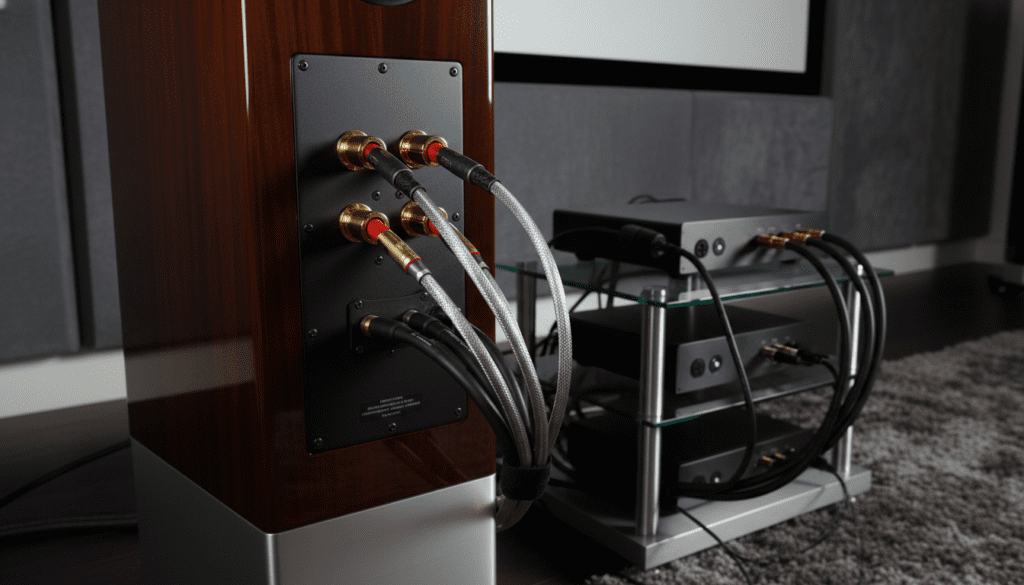
Key Takeaways for Adding a Second Amp
- Check Terminals: Your speakers must have four binding posts (dual inputs) to support bi-amping.
- Pre-Outs Required: Your primary integrated amplifier or receiver must have RCA or XLR Pre-Outs to send a signal to a second amp.
- Power Matching: Ideally, use identical amplifiers for horizontal bi-amping to maintain a consistent tonal balance across frequencies.
- Performance Gain: Expect improved dynamic range, tighter bass response, and a wider soundstage.
- The Bridge Option: Some amps allow “bridging” two channels into one, essentially turning a stereo amp into a high-powered monoblock for a single speaker.
Why You Should Consider a Secondary Amplifier
If you find that your floor-standing speakers sound “thin” or “congested” at high volumes, you are likely hitting the limits of your current amplifier’s power supply. In my years of testing high-end audio gear like the Klipsch Forte IV and the Bowers & Wilkins 700 Series, I’ve noticed that even “sensitive” speakers thrive when given more current.
Adding a secondary amp isn’t just about making the music louder; it’s about control. Large woofers in floorstanders require significant energy to stop and start instantly. A dedicated second amp ensures that the electromotive force (EMF) generated by the woofer doesn’t interfere with the delicate signals going to the tweeter.
The Benefits of Increased Headroom
When we talk about headroom, we refer to the amplifier’s ability to handle sudden peaks in music (like a drum hit or an orchestral swell) without clipping.
- Clarity at Low Volumes: You don’t have to crank the dial to hear details.
- Extended Bass: Low frequencies require the most power; a second amp provides the “grunt” needed for deep, physical bass.
- Thermal Efficiency: Two amps running at 50% capacity run cooler and last longer than one amp pushed to 90%.
The Prerequisites: Is Your Gear Compatible?
Before you purchase a second unit, you must verify that your current system can physically handle the expansion. Not every “can I add a secondary amp to my floor speakers” scenario is possible without the right hardware.
Speaker Terminals (Bi-Wiring/Bi-Amping)
Look at the back of your floor speakers. Do you see two pairs of binding posts connected by a metal jumper bridge?
- If yes: You can bi-amp your speakers.
- If no (only one pair): You cannot bi-amp, but you can still add a secondary power amp if your receiver allows you to bypass its internal amp.
Pre-Amplifier Outputs (Pre-Outs)
Your main receiver or integrated amp acts as the “brain.” It needs a way to send the audio signal to the second amp.
- Look for ports labeled “Pre-Out” on your receiver.
- If your receiver lacks these, you cannot easily add a second power amp without using a Line Output Converter, which I generally advise against for high-fidelity setups due to added noise.
Methods for Adding a Secondary Amp
There are three primary ways I have successfully integrated a secondary amp into a floor-standing speaker setup. Each has a different impact on the final sound.
Passive Bi-Amping (Horizontal)
In this configuration, you use one stereo amplifier to power the tweeters of both speakers and a second (usually more powerful) stereo amplifier to power the woofers of both speakers.
- Best for: Systems where you want a warm tube sound for highs and solid-state “grip” for lows.
- Pro Tip: This requires an external active crossover or relies on the speaker’s internal passive crossover.
Passive Bi-Amping (Vertical)
Here, you use two identical stereo amplifiers. One amp is dedicated entirely to the left speaker, and the other is dedicated to the right speaker.
- Benefit: This maximizes channel separation (stereo imaging) and ensures the power supply for one speaker is never “starved” by the demands of the other.
Bridged Mono Configuration
Some amplifiers have a toggle switch labeled “Bridge”. This combines the power of two channels into one.
- If you have two identical stereo amps that are bridgeable, you can turn them into two monoblocks.
- Warning: Bridging usually doubles the power but can struggle with low-impedance speakers (below 4 ohms). Always check your Ohm ratings first.
Comparison: Single Amp vs. Secondary Amp Configurations
| Feature | Single Integrated Amp | Dual Amp (Bi-Amping) | Bridged Monoblocks |
|---|---|---|---|
| Power Output | Standard | Distributed | Maximum |
| Setup Complexity | Very Low | Moderate | High |
| Soundstage Width | Good | Excellent | Superior |
| Cost | Low | High | Very High |
| Best For | Casual Listening | Critical Audiophiles | Power-Hungry Speakers |
Step-by-Step Guide: How to Connect a Secondary Amp
I have performed this setup dozens of times. Follow these steps to ensure you don’t damage your drivers or create a “ground loop” hum.
Step 1: Power Down Everything
Never plug or unplug components while they are on. This can cause a voltage spike that might fry your tweeters.
Step 2: Remove the Jumper Straps
If you are bi-amping, you must remove the metal plates or wires connecting the top and bottom terminals on your speakers. If you leave them on while connecting two different amps, you will create a short circuit and likely blow both amplifiers.
Step 3: Connect Pre-Outs to the Second Amp
Use high-quality shielded RCA cables.
- Connect the Left Pre-Out of your receiver to the Left Input of the secondary amp.
- Connect the Right Pre-Out to the Right Input.
Step 4: Wire the Speakers
- Amp A (Highs): Connect the speaker wire from Amp A to the top terminals of your speakers.
- Amp B (Lows): Connect the speaker wire from Amp B to the bottom terminals.
- Check Polarity: Ensure Red (+) goes to Red (+) and Black (-) goes to Black (-). Inverting this will put your speakers “out of phase,” resulting in zero bass.
Step 5: Level Matching
If your two amplifiers have different gain levels (meaning one is louder than the other at the same volume setting), your speakers will sound unbalanced. Use a Sound Pressure Level (SPL) meter app on your phone to ensure the woofer and tweeter are outputting at the same volume.
Real-World Experience: The “Impedance” Trap
When I first tried adding a secondary amp to a pair of MartinLogan electrostatic speakers, I ran into an issue: Impedance dips.
Many floor-standing speakers are rated at 8 Ohms, but during heavy bass sections, that impedance can drop to 2 Ohms. If your secondary amp isn’t “high-current” or stable at low impedances, it will overheat or shut down.
My Advice: If you are adding a second amp specifically for the woofers, choose a Class D amp (like those from Hypex or Purifi) or a beefy Class AB amp with a massive toroidal transformer. These handle low-impedance loads much better than budget home theater receivers.
Troubleshooting Common Issues
The “Hum” or Buzzing Sound
If you add a second amp and hear a low-frequency hum, you have a ground loop. This happens because the two amps are plugged into different outlets or have different ground potentials.
- Fix: Plug all audio components into the same power conditioner or high-quality power strip.
Lack of Bass
If the bass seems weaker after adding a second amp, you likely have a phase issue.
- Fix: Check your speaker wire connections. Swap the positive and negative on one end of the woofer cables to see if the bass returns.
One Amp Getting Hotter Than the Other
This is normal in a horizontal bi-amp setup. The amp powering the woofers is doing 80% of the heavy lifting, while the tweeter amp is barely breaking a sweat. Ensure the woofer amp has plenty of ventilation.
Expert Recommendations for Secondary Amps
Based on my testing, here are some reliable pairings for common floor-standing speakers:
- For Klipsch/High Sensitivity: A small Tube Amp for the highs and a Schiit Vidar for the lows.
- For KEF/Neutral Sound: Dual Buckeye Amps (Hypex NCx500) provide insane power and transparency.
- For Vintage Speakers: Adding a Crown XLS DriveCore 2 as a secondary amp is a cost-effective way to get massive power for old, power-hungry woofers.
Frequently Asked Questions
Can I add a secondary amp to my floor speakers if they only have two terminals?
You cannot bi-amp them, but you can still add a secondary power amp to replace the internal amp of your receiver. This is often called “using an external power amp.” You would simply run the Pre-Outs to the new amp and move the speaker wires entirely to the new unit.
Will adding a second amp make my speakers twice as loud?
No. Doubling the power only results in a 3dB increase in volume, which is barely audible. The reason to add a second amp is for headroom, detail, and control, not raw volume.
Do I need two identical amplifiers?
For Vertical Bi-Amping, yes. For Horizontal Bi-Amping, no, but it is highly recommended. If the amps have different input sensitivities, you will find that the highs and lows don’t scale at the same rate when you turn the volume knob.
What cables do I need for this setup?
You will need a pair of RCA or XLR interconnects to connect the pre-amp to the second power amp, and an additional set of speaker cables (Banana plugs are easiest) to run from the second amp to the speakers.
Is bi-wiring the same as bi-amping?
No. Bi-wiring uses one amplifier with two sets of cables. Bi-amping uses two separate amplifiers. Bi-wiring is largely considered a “tweaker’s” move with minimal audible benefit, whereas bi-amping provides a physical increase in available power.