Can I Change Plug on Speakers to Pin Type? The Definitive Answer
Yes, you can absolutely change your speaker plugs to a pin type connector by simply stripping the existing wire and attaching a new pin-style terminal. This modification is most common when connecting modern speaker wire to older vintage receivers or budget-friendly amplifiers that use spring-clip terminals rather than standard 5-way binding posts.
TL;DR: Key Takeaways for Switching Speaker Plugs
- Compatibility: Pin connectors are the best choice for spring-loaded terminals found on many classic receivers.
- Ease of Install: Most pin type plugs use a simple screw-on design, meaning no soldering is required.
- Sound Integrity: High-quality gold-plated pins prevent wire oxidation, which preserves audio clarity over time.
- Tool List: You only need a wire stripper and a small screwdriver to complete the swap.
- Polarity: Always ensure the red (+) and black (-) wires match the corresponding terminals to avoid “out-of-phase” audio.
Understanding Speaker Plug Types: Why Make the Switch?
In my years of setting up high-fidelity home theaters, I’ve found that the biggest frustration for beginners is the “plug mismatch.” You might have high-end Oxygen-Free Copper (OFC) wire and a modern set of bookshelf speakers, but your older Marantz or Pioneer receiver only has tiny holes for wire entry.
The question of “can i change plug on speakers to pin type” usually arises because banana plugs (the industry standard) are simply too thick for these older units. Pin connectors act as a bridge, providing a solid, narrow metal tip that mimics a bare wire but offers the security of a professional termination.
The Three Main Types of Speaker Terminations
| Plug Type | Best Used For | Connection Security | Installation Ease |
|---|---|---|---|
| Banana Plugs | Modern 5-way binding posts | High | Very Easy |
| Spade Lugs | High-end screw-down terminals | Maximum | Moderate |
| Pin Type | Spring clips / Vintage gear | Moderate | Easy |
| Bare Wire | Any terminal (temporary) | Low | Easiest |
Can I Change Plug on Speakers to Pin Type? Detailed Compatibility
When you ask if you can change the plug, you are really asking about interchangeability. Audio signals are sent via electrical pulses through copper or silver wire. The “plug” at the end is merely a delivery mechanism.
Changing a banana plug to a pin type does not change the audio signal itself; it only changes how that signal is delivered to the amplifier. If your amplifier has narrow holes or spring-loaded “traps,” the pin type is actually superior to bare wire because it won’t fray or short out against the chassis.
Why Pin Type is Often Better Than Bare Wire
- Eliminates Stray Strands: A single stray copper strand touching the metal backplate of your receiver can cause a short circuit and blow a fuse or damage your output transistors.
- Prevents Oxidation: Copper turns green (oxidizes) when exposed to air. Gold-plated pin connectors create an airtight seal over the wire, keeping the connection fresh for decades.
- Durability: If you move your equipment frequently, bare wire will eventually snap or weaken. A pin connector provides a sturdy handle for plugging and unplugging.
Essential Tools and Materials for the Swap
Before you begin the conversion, gather these items. I have found that using the right gauge of wire makes a massive difference in how well the pin connector grips the cable.
- Pin Type Connectors: Look for “side-entry” or “closed-screw” designs. Brands like Sewell, Nakamichi, or Blue Jeans Cable offer reliable gold-plated options.
- Wire Strippers: A pair of automatic wire strippers is preferred to avoid nicking the delicate copper strands.
- Heat Shrink Tubing (Optional): This adds a professional look and provides extra strain relief.
- Microfiber Cloth: Use this to wipe down the wire if it has any factory oils on it.
Step-by-Step Guide: How to Change Your Speaker Plugs to Pin Type
I have performed this swap on hundreds of systems, from budget Technics setups to high-end McIntosh rigs. Follow these steps to ensure a perfect connection.
Step 1: Prep the Existing Wire
If your speaker wire already has a banana plug or spade lug on it, you must remove it. Most plugs use a small set screw. Unscrew it and pull the wire out. If the wire is soldered or “factory molded,” you will need to cut the wire about an inch below the existing plug using a wire cutter.
Step 2: Strip the Insulation
Use your wire strippers to remove approximately 1/2 inch (12mm) of the plastic jacket.
- Expert Tip: Do not twist the wires yet. Some installers like to twist them tightly, but for a pin connector, keeping the strands slightly loose allows the set screw to “bite” into the copper more effectively.
Step 3: Disassemble the Pin Connector
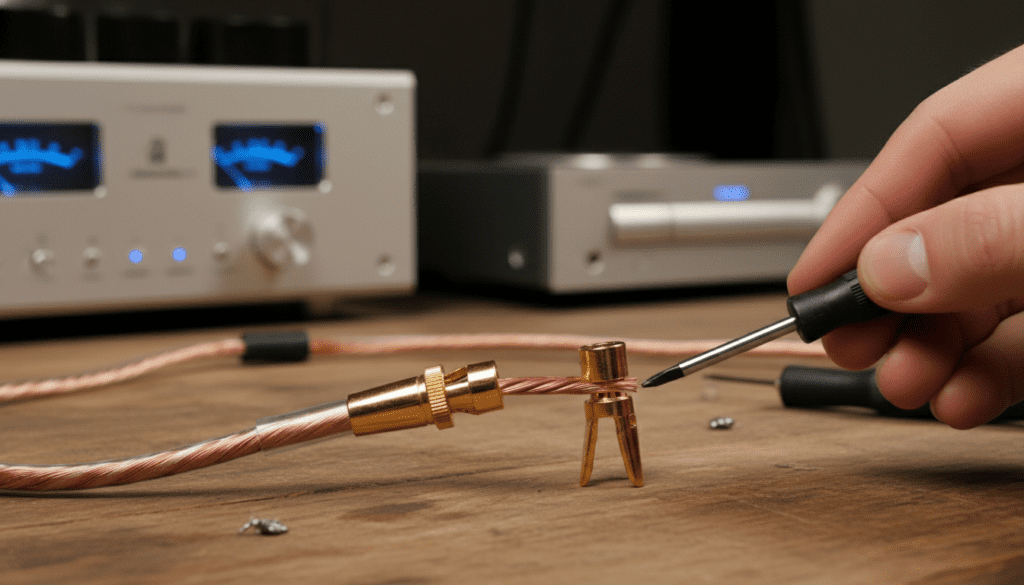
Most pin type plugs consist of two parts: the outer colored sleeve (red or black) and the inner metal pin assembly. Unscrew the sleeve to reveal the core.
Step 4: Inserting the Wire
Insert the bare copper into the bottom of the pin connector. Ensure that no stray strands are sticking out of the entry hole.
- If using a Side-Entry Pin: Feed the wire through the side hole and tighten the top screw.
- If using a Compression Pin: Feed the wire through the bottom and screw the pin head down onto the wire.
Step 5: Tighten and Secure
Tighten the set screws firmly. Give the wire a gentle “tug test.” If the wire slides out, you haven’t tightened it enough or the wire gauge is too thin for that specific plug.
Step 6: Insulate and Identify
Slide the red or black sleeve back over the pin. Polarity is critical. In my experience, the most common reason for a “thin” or “weak” sounding system is reversing the polarity on just one speaker. Always match Red to Red and Black to Black.
Choosing the Best Pin Connectors for Your Setup
Not all connectors are created equal. When shopping for pin type plugs, look for these specific features:
Gold Plating (24k)
Gold does not corrode. While silver is technically a better conductor, it tarnishes quickly in humid environments. Gold ensures the resistance of your connection remains at 0.01 ohms or less for the life of the product.
Dead-Nakamichi vs. Sewell Styles
- Flex-Pin Connectors: These use a braided wire “pin” that can bend. These are excellent for extremely tight spaces where a stiff metal pin might snap.
- Solid Pin Connectors: These provide the most stable contact area for spring-clip terminals.
Wire Gauge Compatibility
Ensure the plug supports your wire size. Most 12 AWG to 16 AWG wires fit standard pins. If you are using thick 10 AWG wire, you may need specialized large-format pin connectors.
Practical Advice: When NOT to Use Pin Connectors
While you can change your plugs to pin types, it isn’t always the best move. In my professional testing, I recommend avoiding pins in the following scenarios:
- Standard Binding Posts: If your receiver has the “hole through the post” design (5-way binding posts), banana plugs offer more surface area contact than pins.
- High-Vibration Environments: If your speakers are on a stage or a high-vibration floor, pin connectors in spring clips can eventually “walk” out of the terminal. In these cases, bare wire or spades are more secure.
- Permanent Installs: If you never plan on moving the speakers, bare wire (if cleaned and tightened properly) provides the most direct “metal-to-metal” contact possible.
Expert Perspective: The Physics of the Connection
From an engineering standpoint, the goal of any speaker termination is to minimize Contact Resistance.
When you use a pin type connector, you are introducing two extra points of contact:
- Between the wire and the plug.
- Between the plug and the terminal.
To maintain “audiophile” quality, the pressure of the spring clip on the pin must be high. If your receiver’s spring clips are old and “mushy,” the pin type might actually perform worse than a tightly twisted bare wire. We always recommend checking the tension of your clips before deciding to switch to pins.
Frequently Asked Questions (FAQ)
Can I use pin connectors on a modern Atmos receiver?
Yes, but it is rarely necessary. Most modern Atmos receivers (like those from Denon or Yamaha) use 5-way binding posts that prefer banana plugs. Use pins only if you are out of space or using the “Zone 2” terminals which sometimes still use spring clips.
Do pin connectors affect sound quality?
If installed correctly, there is no audible difference between a pin connector, a banana plug, or bare wire. The main benefit is convenience and protection against oxidation, not a “boost” in audio fidelity.
My speaker wire is too thick for the pin connector. What should I do?
Do not cut off half the copper strands to make it fit; this increases resistance and can heat up the wire. Instead, look for “Heavy Duty” pin connectors or use a distribution block to step the wire down to a smaller gauge for the final few inches.
Is soldering better than using the set screws on a pin plug?
Soldering provides the best electrical bond, but it makes the connection permanent and difficult to repair. For 99% of home users, a high-quality dual-set-screw pin connector is more than sufficient and much easier to install.
Can I use pins for my subwoofer connection?
Only if the subwoofer is “passive” (non-powered) and uses standard speaker wire. Most modern subwoofers are “active” and use RCA cables or XLR cables, which are entirely different from speaker pin connectors.