Can I Deactivate the Tweeter on My Car Speakers?
Yes, you can deactivate the tweeter on your car speakers by disconnecting the positive lead wire, removing the jumper from a crossover, or digitally muting the frequency channel through a Digital Signal Processor (DSP). If you are using coaxial speakers, you may need to physically clip the small wire leading to the center pole, while component speakers simply require disconnecting the wire at the external crossover box. This modification is common for car enthusiasts looking to reduce “harshness” or those moving to a dedicated active 3-way setup.
Key Takeaways: Quick Guide to Tweeter Deactivation
- Coaxial Speakers: Require physical clipping of the thin wires connecting the tweeter to the main terminal.
- Component Speakers: Easiest to deactivate by removing wires from the Crossover Out terminals.
- Digital Adjustment: Using an Equalizer (EQ) to drop frequencies above 5kHz can effectively “silence” a tweeter without physical modification.
- Impedance Risk: Deactivating a tweeter changes the impedance (Ohms) load on the crossover; always verify your amplifier can handle the change.
- Reversibility: Component speaker deactivation is 100% reversible, while coaxial modification is usually permanent.
Understanding Why You Might Deactivate a Tweeter
In my years of tuning high-end car audio systems, I’ve found that more speakers aren’t always better. Sometimes, a tweeter is simply too “bright” or “thin-sounding,” causing ear fatigue during long drives. You might want to deactivate a tweeter if you’ve recently installed A-pillar pods with higher-quality units and want to kill the factory dash tweeters.
Another common scenario involves Soundstage Alignment. If your door speakers are firing directly into your ankles, the high frequencies from the built-in tweeter might reflect off the floor mats, creating a muddy sound. By deactivating the inferior tweeter, you allow your Primary Sound Source to take over without phase interference.
Can I Deactivate the Tweeter on My Car Speakers? Exploring the Methods
When people ask, “can i deactivate the tweeter on my car speakers,” the answer depends entirely on the type of speaker architecture you have. Let’s break down the three primary methods we use in the shop.
The Component Speaker Method (Non-Invasive)
Component systems use a separate Crossover Network. This is a small plastic box that receives one input from the radio and splits it into two outputs: one for the woofer and one for the tweeter.
To deactivate the tweeter here, you simply unscrew the Tweeter (+) and Tweeter (-) wires from the crossover. I recommend wrapping the exposed wire ends in electrical tape or heat shrink to prevent a short circuit against the car’s metal frame.
The Coaxial Speaker Method (Permanent)
Coaxial speakers (all-in-one units) have the tweeter mounted on a post in the middle of the woofer. To deactivate these, you must locate the two tiny wires (usually copper or silver tinsel) that run from the main input terminals up the center pole to the tweeter.
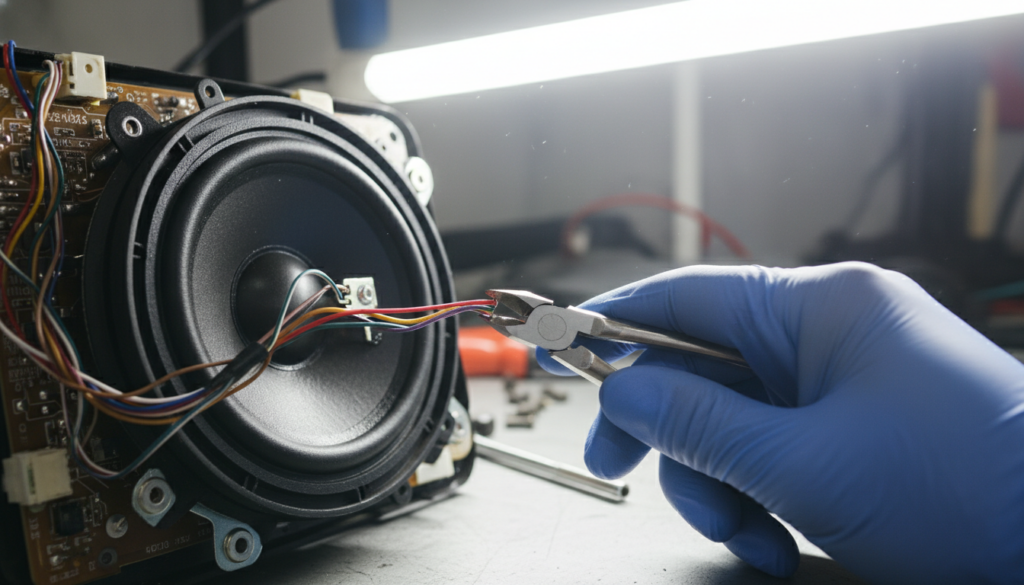
Using a pair of precision wire cutters, snip one of these leads. This breaks the electrical circuit. I’ve done this frequently on JBL and Rockford Fosgate coaxials when the customer wanted to use them as dedicated mid-bass drivers.
The DSP/Active Method (Professional)
If you are running an Active Setup where every speaker has its own amplifier channel, you don’t need to touch a single wire. You can simply go into your DSP software or high-end Head Unit (like a Pioneer NEX or Sony GS series) and mute the high-frequency output channel.
Comparing Deactivation Methods
| Method | Reversibility | Difficulty | Best For |
|---|---|---|---|
| Crossover Disconnect | High (100%) | Easy | Component Systems |
| Wire Clipping | Low (Permanent) | Moderate | Coaxial Speakers |
| DSP Muting | High (Instant) | Professional | Active/DSP Setups |
| In-Line Resistor | High | Hard | Reducing Volume (L-Pad) |
The Impact on Impedance and Amplifier Health
One thing we always caution DIYers about is System Impedance. Most car speakers are rated at 4 Ohms. A crossover is designed to maintain that load by balancing the resistance of the woofer and the tweeter together.
When you ask, “can i deactivate the tweeter on my car speakers,” you must realize that removing the tweeter might change the resistance the amplifier “sees.” In most passive systems, the woofer still carries the primary load, but in some rare Parallel Wiring configurations, removing the tweeter could increase the Ohms, causing the amplifier to produce less power.
From my experience, modern Class D Amplifiers are resilient, but always check your amp’s manual if you notice the unit getting excessively hot after the modification.
Step-by-Step: Deactivating a Coaxial Tweeter Safely
If you have decided that the “bright” sound of your 6x9s is too much, follow these steps to safely disable the integrated tweeter.
- Remove the Speaker: Unscrew the speaker from the door panel or rear deck.
- Identify the Tinsel Leads: Look at the back of the speaker. You will see the main terminals where the thick wires connect. Look closely for two much thinner wires that disappear into the center of the cone.
- The “Clip” Test: Use a multimeter to verify these leads are for the tweeter. They should show continuity to the tweeter diaphragm.
- Snip and Secure: Cut the wire in the middle. Do not pull on it, as you could tear the woofer cone.
- Insulation: Place a small dab of hot glue or silicone sealant on the cut ends to ensure they don’t vibrate or touch the woofer’s moving parts.
Alternatives to Deactivating: Reducing “Harsh” Highs
Before you permanently snip a wire, consider these “soft” alternatives. I often suggest these to clients who want a smoother sound without losing the high-end detail entirely.
Using an L-Pad or Resistor
Instead of deactivating, you can “dim” the tweeter. By adding a non-inductive resistor (usually 2 to 4 Ohms) in series with the tweeter wire, you can drop the output by 3dB to 6dB. This keeps the soundstage intact but removes the “piercing” quality.
The Foam Deflector Trick
In many Toyota and Subaru vehicles, the tweeters reflect off the windshield. Placing a small piece of open-cell acoustic foam over the tweeter grille can absorb the harshest frequencies (10kHz and above) while leaving the lower treble untouched.
Phase Reversal
Sometimes a tweeter sounds “bad” because it is Out of Phase with the woofer. Try swapping the positive and negative wires on just the tweeter. You might find that the “harshness” was actually destructive interference, and reversing the phase makes it sound significantly smoother.
Advanced Tuning: When Deactivation is Mandatory
In a 3-Way Active Front Stage (Tweeter, Midrange, Midbass), you often have overlapping drivers. If you’ve installed a new set of Silk Dome Tweeters in the sails, you must deactivate the factory tweeters.
Having two different tweeters playing the same frequencies creates Comb Filtering. This is a phenomenon where certain frequencies cancel each other out while others peak aggressively. If you want a “Zero-Click” professional sound, you cannot have two different sets of tweeters active in the same frequency range.
Common Tools Needed for the Job
If you’re ready to tackle this, ensure you have the following tools on your workbench:
- Wire Strippers/Crimpers: For component systems.
- Flush Cutters: Essential for the tiny wires on coaxial speakers.
- Multimeter: To check impedance before and after.
- Soldering Iron: If you plan on re-attaching wires later.
- Heat Shrink Tubing: To keep your connections professional and safe from moisture.
Expert Perspective: Why I Often Deactivate Rear Tweeters
When I’m building a system focused on SQ (Sound Quality), I almost always deactivate the tweeters in the rear doors. Why? Because high frequencies are highly directional.
If you have tweeters screaming from behind your head, it pulls the Stereo Image backward. By deactivating those rear tweeters and leaving only the rear woofers active, you get the “fill” and “warmth” of the bass without ruining the “stage” that should be right on your dashboard.
Frequently Asked Questions
Will deactivating my tweeter damage my car radio?
In 99% of cases, no. Most car radios are designed to handle a range of 2 to 8 Ohms. Removing a tweeter usually increases the resistance slightly or keeps it stable, which is safer for the radio than lowering the resistance.
Can I deactivate the tweeter using the ‘Treble’ setting on my phone?
While you can lower the volume of high frequencies using your phone’s EQ, it won’t “deactivate” the speaker. The tweeter will still move and produce sound; it will just be quieter. Physical deactivation is the only way to completely stop the driver.
What is the best way to hide the hole if I remove a component tweeter?
If you remove a tweeter from a door sail panel, I recommend using black acoustic cloth or a “blanking plate” 3D printed for your specific car model. Many enthusiasts also use the empty space to mount USB charging ports or Bass Knobs.
Can I deactivate the tweeter on my car speakers if they are factory-installed?
Yes, but factory systems often use inline capacitors hidden behind the tape in the wiring harness. You will need to locate the specific wire pair for the tweeter at the kick panel or behind the head unit to disconnect it without affecting the door woofer.