Can I Have a Sub and Two External Speakers in a Truck?
Yes, you can definitely have a sub and two external speakers in your truck by using a multi-channel amplifier or a dual-amplifier configuration. This setup typically involves a 3-channel or 4-channel amp to power your primary speakers and a dedicated line to drive the subwoofer for deep bass.
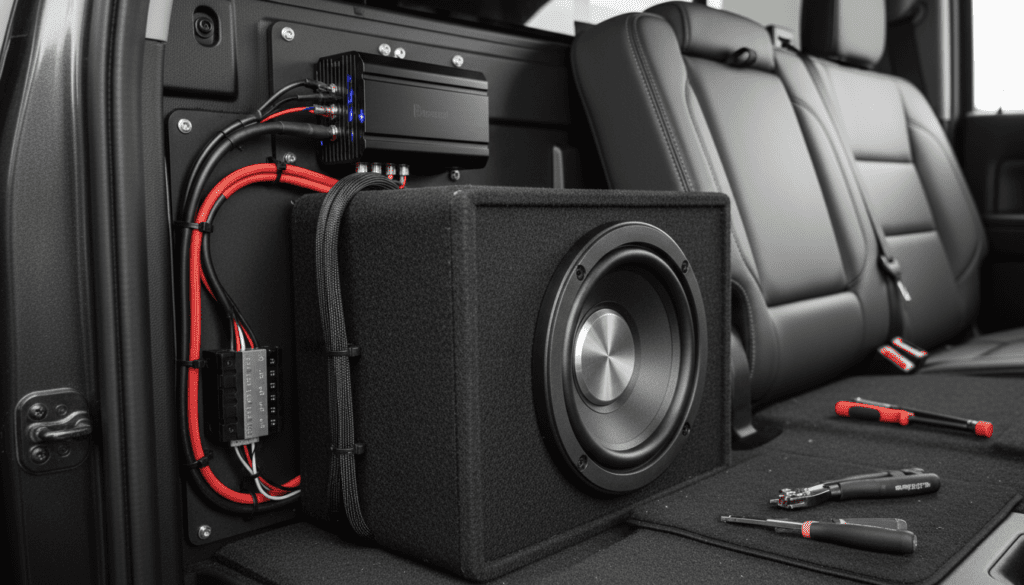
Installing a custom audio system in a truck requires balancing limited cabin space with high power demands. Whether you are looking to enhance your daily commute or want external-facing speakers for tailgating, the key lies in choosing the right wire gauge, amplifier class, and enclosure type. I have personally installed dozens of these systems in everything from Ford F-150s to Toyota Tacomas, and the transformation in sound stage and clarity is always worth the effort.
Key Takeaways for Truck Audio Setup
- Power is Priority: Use a multi-channel amplifier (4-channel or 5-channel) to minimize the footprint while powering both speakers and subs.
- Space Management: Opt for shallow-mount subwoofers if you are installing them behind or under the rear seats.
- Weatherproofing: If “external” means mounting speakers in the truck bed, ensure you use marine-grade components to prevent water damage.
- Wiring Matters: Always use Oxygen-Free Copper (OFC) wiring rather than Copper-Clad Aluminum (CCA) to ensure maximum current flow and prevent overheating.
The Fundamentals of a Truck Sub and Speaker Combo
When people ask, “can i have a sub and two extwrnal speakers truxk,” they are usually looking for a “2.1 system” (two full-range channels and one sub channel). In a truck, this is a highly efficient way to get loud, clear audio without draining your battery or taking up all your legroom.
Choosing Your Amplifier
The heart of your setup is the amplifier. You have three main paths:
- 3-Channel Amp: These are rare but perfect for this exact setup. They provide two channels for speakers and one high-power channel for a sub.
- 4-Channel Amp (Bridged): This is the most common method. You use channels 1 and 2 for your external speakers and bridge channels 3 and 4 to provide double the power to your subwoofer.
- 5-Channel Amp: This is my “pro-tip” choice. It gives you room to grow if you decide to add two more internal speakers later, while still providing a dedicated Class D sub channel.
Understanding “External” Speaker Needs
If your goal is to mount speakers in the truck bed or on a roll bar, you must prioritize durability. Standard car speakers use paper cones that will disintegrate if they get damp. I always recommend Kicker KB6 or JL Audio Marine pods for these “external” locations because they are UV-treated and water-resistant.
Step-By-Step Installation Guide
Setting up your truck audio system requires a methodical approach to prevent electrical shorts or “alternator whine” (that annoying buzzing sound that rises with engine RPM).
Step 1: Disconnect the Battery
Safety first. Before touching any wires, disconnect the negative terminal of your truck’s battery. This prevents blown fuses or damage to your truck’s sensitive ECU.
Step 2: Run the Power Wire
You need to run a heavy-gauge power wire (usually 4 AWG for most 500-800 watt systems) from the battery to the cabin.
- Look for an existing rubber grommet in the firewall.
- Never run wire through raw metal holes without a grommet, or the vibration will eventually cut the insulation and cause a fire.
- Install an in-line fuse within 12-18 inches of the battery terminal.
Step 3: Mount the Subwoofer and Speakers
In a truck, space is at a premium.
- Under-Seat Boxes: Great for Crew Cab trucks.
- Behind-the-Seat: Common for Single Cab trucks using thin-line subwoofers.
- External Mounts: If mounting in the bed, use self-tapping screws with silicone sealant to prevent rust where you’ve drilled into the truck body.
Step 4: Grounding the Amplifier
The ground is the most important part of the circuit. Find a solid metal bolt on the truck’s chassis. Scrape away any paint to ensure a metal-to-metal connection. A poor ground is the #1 cause of amplifier failure.
Step 5: Connecting Signal and Speakers
Run RCA cables from your head unit to the amp. If you are keeping the factory radio, you will need a Line Output Converter (LOC) to turn speaker wires into RCA signals. Connect your two external speakers to the front channels and your sub to the rear/sub channel.
| Component | Recommended Specification | Why It Matters |
|---|---|---|
| Power Wire | 4-Gauge OFC | Prevents voltage drops and heat. |
| Subwoofer | 10-inch Shallow Mount | Fits in tight truck cabins. |
| External Speakers | Marine-Grade Coaxial | Resists rain, mud, and sun. |
| Amplifier | Class D Multi-Channel | High efficiency, small size. |
| Fuse Rating | Match Amp’s total amperage | Protects your vehicle from fire. |
Optimizing for Information Gain: Expert Tuning Secrets
Once the hardware is in, the “magic” happens in the tuning. Most beginners skip this, resulting in muddy bass or blown tweeters.
Setting the Crossovers
Your external speakers shouldn’t try to play deep bass; that’s what the sub is for.
- Set the High Pass Filter (HPF) for your speakers to around 80Hz or 100Hz.
- Set the Low Pass Filter (LPF) for your subwoofer to 80Hz.
This creates a “handshake” between the components where each plays the frequencies it is best at.
Phase Alignment
In a truck’s small cabin, sound waves can sometimes cancel each other out. If your bass sounds “weak,” try flipping the phase switch (0° to 180°) on your amp. Sometimes, having the sub fire “out of phase” actually makes it sound louder at the driver’s seat because of how the waves bounce off the back wall.
Sound Deadening
Trucks are noisy. The “road roar” from large tires can drown out your music. I highly recommend applying a layer of Butyl-based sound deadener (like Dynamat or Noico) to the back wall and doors. In my experience, a $50 box of sound deadener makes a $200 subwoofer sound like a $500 one.
Common Challenges in Truck Audio
Installing a sub and two external speakers in a truck comes with specific hurdles you won’t find in a sedan or SUV.
The Alternator Load
Modern trucks have complex electrical systems. If your headlights flicker when the bass hits, your amp is pulling more current than the battery can provide.
- The Big 3 Upgrade: This involves upgrading the three main cables in your engine bay (Battery to Alternator, Battery to Chassis, Engine Block to Chassis). It is a game-changer for high-power audio.
Airflow and Cooling
Amps get hot. If you hide your amp under a seat or behind a panel, ensure there is at least an inch of “breathing room.” I once saw an amp melt a plastic trim piece because it was smothered by a floor mat. Use mounting feet to slightly elevate the amp for better convection cooling.
Frequently Asked Questions
Can I run a sub and speakers off my factory truck radio?
Yes, but you will need a Line Output Converter (LOC) or an amplifier with High-Level Inputs. This allows the amp to take the signal directly from the factory speaker wires.
What is the best sub size for a truck?
For most trucks, a 10-inch subwoofer is the “sweet spot.” It provides a balance of deep frequency response and a compact enclosure size. 12-inch subs often require more air volume than a truck cab can easily provide without sacrificing seats.
How do I protect my external bed speakers from theft?
Use security hex bolts and try to mount them in less conspicuous areas, such as under a tool box or inside the bed rails. Additionally, using quick-disconnect plugs allows you to remove the speakers and store them inside the cab when not in use.
Do I need a second battery for this setup?
Typically, no. For a standard setup with two speakers and one sub (under 1000 watts RMS), a healthy truck battery and alternator can handle the load. If you plan on listening to music for hours with the engine off, then a deep-cycle secondary battery is a wise investment.