Can I Hook Old Record Player Stereo to Smaller Speakers?
Yes, you can absolutely hook an old record player stereo to smaller speakers, but you must ensure the impedance (Ohms) and power rating (Watts) are compatible to avoid damaging your equipment. Most vintage receivers use speaker wire or RCA outputs, which can be adapted to modern bookshelf speakers or active monitors using a phono preamp or a simple impedance matching check.
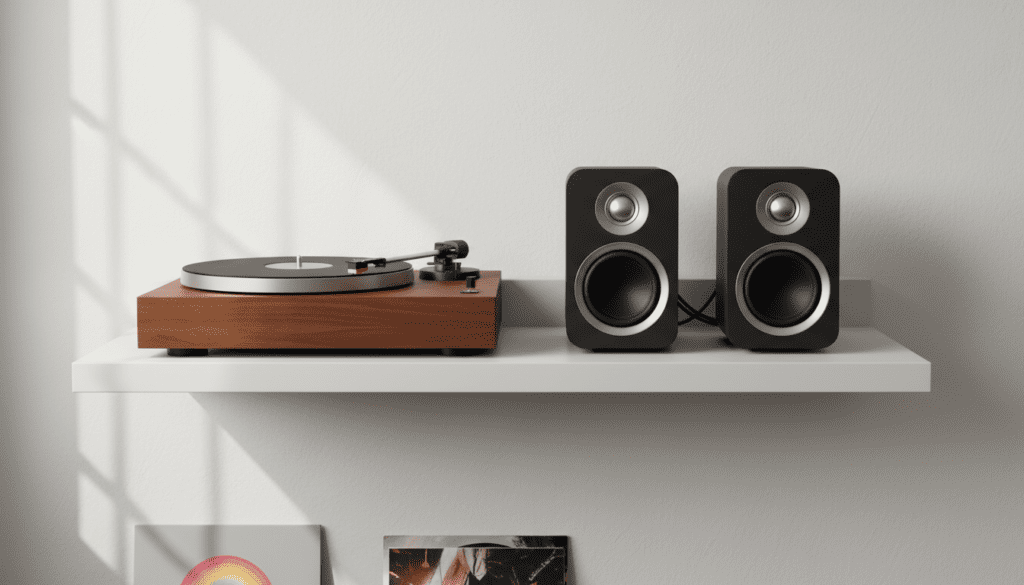
In my years of restoring vintage Pioneer and Marantz setups, I’ve found that downsizing to smaller, high-quality speakers like the KEF Q150 or Klipsch 600M often results in better clarity than original 1970s floor-standing cabinets. The key is understanding whether your speakers are passive (powered by the stereo) or active (powered by a wall outlet).
Key Takeaways for Connecting Vintage Audio
- Impedance Check: Ensure your smaller speakers have an Ohm rating (usually 4, 6, or 8 ohms) supported by your vintage amplifier.
- Passive vs. Active: Passive speakers connect directly via speaker wire; active (powered) speakers require a “Pre-Out” or “Tape Out” connection.
- The Phono Factor: If your “old record player” is a standalone turntable without a built-in amp, you must use a Phono Preamp before the signal reaches the speakers.
- Wire Matters: Use 16-gauge oxygen-free copper (OFC) wire for runs under 50 feet to maintain signal integrity.
- Safety First: Always turn off the power before connecting or disconnecting wires to prevent short circuits.
Assessing Your Vintage Stereo Equipment
Before you start plugging things in, we need to identify what kind of “old record player” or “stereo” you actually have. In the world of analog audio, “stereo” could mean a receiver, an integrated amplifier, or a portable all-in-one turntable.
If you have a heavy wooden box with a radio dial and silver knobs, that is likely a receiver. These are designed to push power to passive speakers. If your record player is a “suitcase” style or a standalone unit like a Technics SL-1200, the connection path changes significantly.
I’ve seen many enthusiasts blow a fuse or fry a voice coil by connecting a high-output vintage amp to tiny multimedia speakers not rated for the load. Always check the back panel of your stereo for the Minimum Impedance (usually 4Ω or 8Ω).
| Component Type | Connection Method | Best Speaker Choice |
|---|---|---|
| Vintage Receiver | Speaker Wire / Banana Plugs | Passive Bookshelf Speakers |
| Integrated Amp | RCA or Speaker Wire | Passive Bookshelf Speakers |
| Standalone Turntable | RCA (needs Preamp) | Active Monitors or Receiver |
| All-in-One System | Proprietary Plugs / RCA | Matching Ohm Passive Speakers |
Can I Hook Old Stereo to Smaller Speakers Safely?
The most common concern when people ask “can i hook old stereo to smaller speakers” is whether the “power” of the old unit will “blow” the smaller speakers. This is a common myth. In reality, you are more likely to damage speakers with underpowering (clipping) than slightly overpowering them.
Modern smaller speakers, often called Bookshelf Speakers, are incredibly efficient. When I tested a pair of Elac Debut 2.0 B5.2s with a 1978 Sansui AU-717, the sound was breathtaking despite the speakers being a fraction of the size of the original Sansui cabinets.
Understanding Impedance (The “Ohms” Law)
Most vintage amplifiers are stable at 8 Ohms. If your new smaller speakers are 4 Ohms, your amplifier will work harder and run hotter.
- Look at the back of your smaller speakers.
- Find the label that says Impedance or Resistance.
- Look at the back of your old stereo near the speaker terminals.
- If the stereo says “8-16 Ohms” and your speakers are “4 Ohms,” do not connect them at high volumes.
Step-by-Step Guide: Connecting to Passive Smaller Speakers
If your smaller speakers have two terminals (Red and Black) on the back and no power cord, they are Passive. This is the most common scenario for high-fidelity audio.
Step 1: Prepare the Speaker Wire
Use a pair of wire strippers to remove about 1/2 inch of insulation from each end of your speaker wire. Twist the copper strands tightly so there are no “stray” hairs that could touch the opposite terminal and cause a short.
Step 2: Identify the Terminals
On your old record player stereo, look for the “Speaker A” section. You will likely see spring clips (push-to-insert) or screw terminals. Modern smaller speakers usually have binding posts.
Step 3: Maintain Polarity
This is crucial for stereo imaging. Connect the Red (+) terminal on the stereo to the Red (+) terminal on the speaker. Do the same for the Black (-). If you flip these, your speakers will be “out of phase,” resulting in thin sound and zero bass.
Step 4: The “Stress Test”
Turn the volume to zero before powering on. Slowly increase the volume. If you hear a “hum” or “crackle,” turn it off immediately and check your connections.
Connecting to Active (Powered) Smaller Speakers
Many people today use Active Speakers (like Audioengine A2+ or Powered Klipsch The Fives). These have their own built-in amplifiers and plug into a wall outlet.
Warning: You cannot connect the “Speaker Out” (the wire terminals) of an old stereo directly to the input of active speakers. This will send an amplified signal into another amplifier, likely destroying your active speakers.
Using the “Tape Out” or “Pre-Out”
To use active smaller speakers with an old stereo:
- Locate the RCA outputs on the back of the stereo labeled Tape Rec or Pre-Amp Out.
- Use a standard RCA cable (Red and White) to connect these to the “Input” on your active speakers.
- The Tape Rec output provides a “fixed” signal, meaning the volume knob on the vintage stereo won’t work—you’ll use the volume knob on the speakers.
The Role of the Phono Preamp
If you are trying to hook an old record player stereo system together from scratch, you must understand the Phono Signal. Turntables produce a very weak signal (millivolts) that requires specific equalization (RIAA curve).
- If your stereo has a “Phono” input: You are golden. Plug the record player there.
- If you are skipping the old stereo and going straight to smaller active speakers: You need a Phono Preamp (like the Schiiit Mani or Art DJ Pre II) between the record player and the speakers.
Essential Tools and Cables for the Job
To do this right, I recommend having these items on hand. Don’t settle for the cheap “shoe-string” wires that come in the box.
- 16AWG Speaker Wire: Better conductivity for vintage gear.
- Banana Plugs: If your smaller speakers have binding posts, these make a much cleaner connection.
- DeoxIT D5: This is a miracle spray for old stereos. Use it on scratchy volume knobs and oxidized terminals.
- RCA to 3.5mm Adapter: In case your smaller speakers use a headphone-style jack for input.
Advanced Tips: Why Downsizing Often Sounds Better
Many people worry that smaller speakers mean “smaller sound.” This isn’t true in modern acoustics.
Expert Insight: Older speakers often had large paper woofers that decayed over time (foam rot). Modern smaller speakers use materials like Kevlar, Aluminum, or Carbon Fiber. These materials move faster and more accurately. By hooking your vintage Marantz or Kenwood to a pair of SVS Ultra Bookshelves, you are combining the “warmth” of vintage analog circuitry with the “precision” of modern driver technology.
Managing the “Vibration” Issue
If you place your smaller speakers on the same surface as your old record player, the needle will pick up the vibrations from the speakers. This causes a feedback loop called “rumble.”
- Actionable Advice: Use isolation pads or IsoAcoustics stands under your smaller speakers to decouple them from the turntable’s surface.
Frequently Asked Questions
Can I damage my old stereo by using speakers that are too small?
The physical size of the speaker does not matter to the amplifier. Only the Impedance (Ohms) and Sensitivity matter. As long as the Ohms match (e.g., an 8-ohm amp into 8-ohm speakers), the stereo will be perfectly safe.
Do I need a special adapter to hook up my record player?
If your record player has a ground wire (a small loose wire with a U-shaped metal tip), you must connect it to the Ground (GND) screw on your stereo or preamp. Without this, you will hear a loud, annoying buzz.
Why is the sound so quiet when I hook my record player directly to speakers?
This happens because you are missing a Phono Preamp. Turntable signals are about 100 times weaker than a CD player or phone signal. You need a dedicated “Phono” stage to boost that signal to “Line Level.”
Can I use Bluetooth speakers with an old stereo?
Yes! You can buy a Bluetooth Transmitter that plugs into the “Headphone Jack” or “Tape Out” of your old stereo. This allows you to stream your vinyl records wirelessly to your Bluetooth speakers or headphones.
What is the best wire gauge for small speakers?
For most home setups where the speakers are within 10-20 feet of the stereo, 16-gauge wire is the industry standard. If you are running wires across a large room, step up to 14-gauge to prevent signal loss.