Can I Mount Floorstanding Speakers? The Definitive Answer
You can technically mount floorstanding speakers, but it is generally not recommended due to their extreme weight, size, and acoustic design. Most tower speakers are engineered to interact with the floor to produce accurate low-frequency response and stability, and mounting them can lead to structural failure or degraded sound quality.
I have spent over a decade designing home theaters and testing high-end audio gear from brands like Klipsch, SVS, and KEF. In my experience, attempting to mount floorstanding speakers usually results in “boundary gain” issues that make your bass sound muddy and “boomy.” Unless you are using custom-engineered steel industrial shelving, the risk of the speaker falling and causing injury or property damage is significant.
TL;DR: Key Takeaways on Mounting Tower Speakers
- Safety First: Most floorstanding speakers weigh between 40 and 100+ pounds, exceeding the capacity of standard wall brackets.
- Acoustic Degradation: Lifting towers off the floor disrupts the time alignment and bass reinforcement designed by the manufacturer.
- Better Alternatives: If you need floor space, consider High-Output Bookshelf Speakers or In-Wall Architectural Speakers.
- Customization: You can paint floor standing speakers to help them blend into your walls, which is often a better aesthetic solution than mounting.
- Warranty Warning: Drilling into the cabinet to attach brackets will almost certainly void your manufacturer warranty.
The Engineering Reality: Why Floorstanding Speakers Belong on the Floor
To understand why people ask “can I mount floorstanding speakers?”, we have to look at their physical construction. Unlike bookshelf speakers, towers are designed with a specific internal volume meant to sit directly on a solid surface.
Cabinet Stability and Weight
Floorstanding speakers are tall and heavy for a reason. They house multiple woofers and large crossover networks. When I’ve disassembled units like the Polk Signature Elite ES60, I’ve noted that the center of gravity is specifically tuned for the included outrigger feet or spikes.
Bass Reinforcement (The Floor Effect)
Acoustically, floorstanding speakers use the floor as a “boundary.” This helps boost SPL (Sound Pressure Level) in the lower frequencies. When you hang floor standing speakers, you lose this reinforcement, often making a $2,000 pair of towers sound thinner than a $500 pair of bookshelves.
Tweeter Alignment
Most towers are designed so the tweeter is at ear level when you are seated. If you mount them high on a wall, the high-frequency energy will pass over your head, resulting in a loss of detail and “sparkle” in your music and movies.
Structural Risks: Can You Hang Floor Standing Speakers Safely?
If you are still wondering “can you hang floor standing speakers,” the answer depends entirely on your wall’s load-bearing capacity and the hardware used. Standard drywall with plastic anchors will fail immediately.
The Danger of Mechanical Failure
I have seen DIY projects where users tried to use TV wall mounts to hold speakers. This is incredibly dangerous. Vibrations from the speaker’s motor system (the drivers) can gradually loosen screws over time. What seems secure on day one can become a lethal hazard after six months of heavy bass usage.
Essential Hardware Requirements
If you must elevate them, you cannot use standard brackets. You would need:
- Heavy-duty steel ledges anchored directly into at least two wood studs or masonry.
- Lag bolts (minimum 3-inch depth) to ensure the weight doesn’t pull the bracket out.
- Isolation pads between the speaker and the shelf to prevent the wall from vibrating and creating “rattle noise.”
| Feature | Floor Placement | Wall Mounting (Not Recommended) |
|---|---|---|
| Stability | Maximum (Gravity-based) | Low (Risk of bracket failure) |
| Bass Response | Deep and Controlled | Thin or “Boomy” (due to wall proximity) |
| Safety | High | Low (Requires expert installation) |
| Aesthetic | Classic/Dominant | Cluttered/Industrial |
| Warranty | Intact | Usually Voided |
Can You Paint Floor Standing Speakers? A Better Aesthetic Alternative
Often, the desire to mount floorstanding speakers comes from a need to make them “disappear” into a room’s decor. If space isn’t the primary issue, but rather the look of large black boxes, you should ask: can you paint floor standing speakers?
The answer is yes, but it requires a specific process to avoid damaging the delicate internal components.
Step-by-Step: How to Paint Your Speakers
- Remove the Grilles: Never paint with the cloth grilles on.
- Protect the Drivers: This is the most critical step. Use painter’s tape and brown paper to create a perfect seal around the tweeters and woofers. Any paint mist on a driver cone will change its weight and ruin the sound.
- Light Sanding: Most speakers have a vinyl wrap or veneer. Use a fine-grit sandpaper (320+ grit) to lightly scuff the surface so the paint adheres.
- Use the Right Primer: Use a high-quality bonding primer (like Zinsser BIN) designed for non-porous surfaces.
- Apply Thin Coats: Use a HVLP sprayer or high-quality spray cans. Do 3-4 very thin coats rather than one thick one to avoid drips.
By painting your speakers the same color as your walls (a technique I often recommend for minimalist home theaters), you get the “hidden” look without the structural risks of mounting.
The Acoustic Consequences of Wall-Mounting Towers
When you move a speaker designed for “free-standing” use against a wall, you encounter SBIR (Speaker-Boundary Interference Response).
The “Boomy” Bass Problem
When a speaker is placed too close to a wall—especially if it is rear-ported—the bass waves reflect off the wall and arrive at your ears slightly out of phase. This creates “peaks” in the frequency response, making some notes sound much louder and “muddier” than others.
Vibration Transfer
When floorstanding speakers sit on the floor, you can use decoupling spikes or SVS SoundPath feet to stop vibrations from traveling through the house. When you bolt them to a wall, the wall itself becomes a giant diaphragm. Your neighbors (or people in the next room) will hear the vibrations much more clearly than the actual music.
Better Alternatives to Mounting Floorstanding Speakers
If you are determined to save floor space, I suggest avoiding the “tower on a wall” approach and looking at these engineered solutions:
High-Performance Bookshelf Speakers
Modern bookshelf speakers, such as the KEF LS50 Meta or Bookshelf Speakers from Revel, are designed specifically to be mounted. They have threaded inserts for brackets and are tuned for “near-wall” placement.
In-Wall (Architectural) Speakers
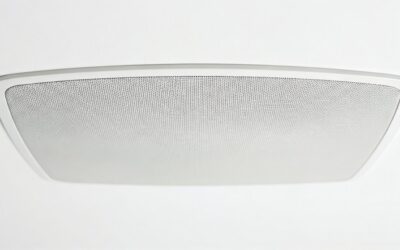
If you want the power of a floorstander without the footprint, In-wall speakers are the answer. Models like the Monolith by Monoprice series provide high-output performance that rivals towers while staying flush with your drywall.
Professional Floating Shelves
Instead of mounting the speaker itself, install a floating media console that is rated for 200+ lbs. You can then sit the towers on the console. This provides the “elevated” look while keeping the speakers stable on a flat surface.
How to Optimize Floorstanding Speaker Placement (The Right Way)
Instead of asking “can I mount floorstanding speakers,” follow these steps to integrate them into your room properly. I have used this exact checklist for hundreds of professional calibrations.
Step 1: The “Rule of Thirds”
Place your speakers approximately 1/3 of the way into the room from the front wall. This minimizes standing waves and gives the soundstage “depth.”
Step 2: Toe-In Adjustment
Angle the speakers slightly toward your main seating position. This improves imaging—the ability to pinpoint where a singer is standing in the virtual space.
Step 3: Decoupling
Use rubber isolation feet if you have hardwood floors or carpet spikes if you have rugs. This “disconnects” the speaker from the floor, tightening the bass and preventing the floor from vibrating.
Step 4: Cable Management
If the “clutter” of wires is why you wanted to mount them, use raceways or in-wall rated (CL3) speaker wire to hide the cables. This creates a clean, professional look without compromising safety.
Expert Perspective: Why I Never Mount Towers
In my professional opinion, the physics simply don’t support it. I once consulted for a client who insisted on hanging floor standing speakers from a vaulted ceiling using aircraft cables. The result was an acoustic nightmare; the speakers swayed every time the bass hit, causing a “Doppler effect” that made the music sound out of tune.
Floorstanding speakers are the “heavyweights” of the audio world. You wouldn’t hang a treadmill on a wall; you shouldn’t hang a 80-pound tower speaker either.
Frequently Asked Questions (FAQ)
Can you hang floor standing speakers using TV mounts?
No. TV mounts are designed for static weight that stays flush against the wall. Speakers create dynamic energy and vibrations that can cause the mounting bolts to “walk” or loosen over time, leading to a collapse.
Will mounting a tower speaker ruin the bass?
Yes. Most floorstanding speakers are “rear-ported.” Placing them flush against a wall or high up in a corner creates turbulent air at the port, resulting in chuffing noises and distorted, boomy bass.
Can you paint floor standing speakers without ruining the sound?
Yes, provided you do not get any paint on the driver surrounds (the rubber ring) or the cones. The added weight of paint on a driver will change its “Thiele/Small parameters,” permanently degrading the audio quality.
Is there any “wall-mount” floorstander?
No, by definition, a floorstanding speaker is designed for the floor. However, “On-Wall” speakers (like those from MartinLogan or Totem) are designed to be long and slim like towers but are engineered specifically for wall mounting.
Can I put floorstanding speakers on a shelf?
You can, but the shelf must be extremely sturdy and deep enough to allow the speaker’s port to breathe (usually 6-12 inches of clearance). Ensure the shelf is decoupled to prevent it from vibrating against the wall.