Can I Mount Shelf Speakers Behind a Flat Screen?
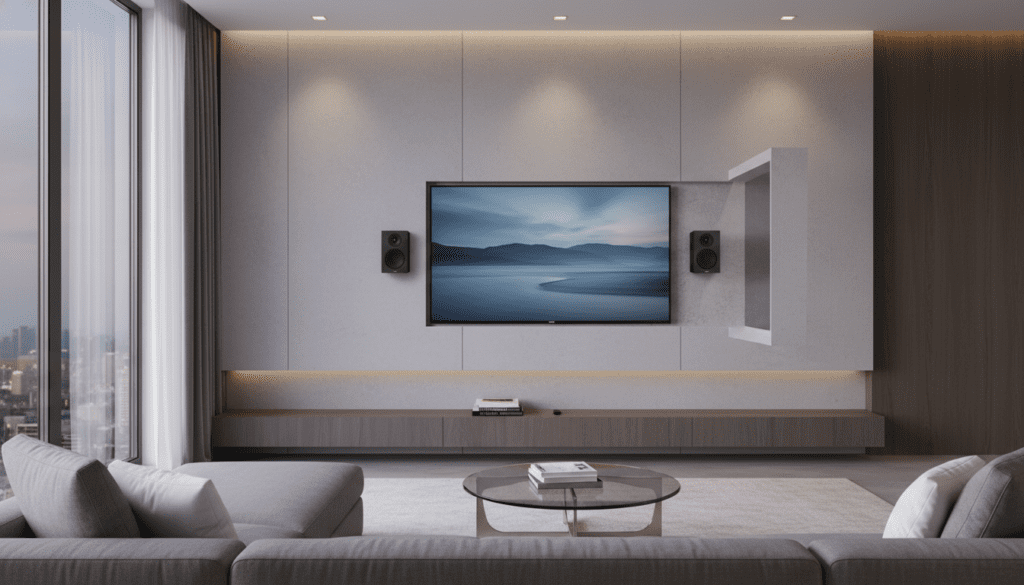
Yes, you can mount shelf speakers behind a flat screen, but it is generally not recommended for optimal sound quality. Because flat-screen TVs are made of solid materials like glass and plastic, they act as a physical barrier that blocks high-frequency sound waves, leading to muffled audio and poor dialogue clarity. If you must do this for aesthetic reasons, you will need to utilize EQ adjustments, specific wall brackets, and maintain a minimum clearance of 2-3 inches to reduce vibration and sound diffraction.
TL;DR: Key Takeaways for Mounting Behind the TV
- Audio Quality: Expect a significant loss in treble and clarity; voices may sound “muddy.”
- Best Practice: Only mount speakers behind a screen if using an Acoustically Transparent (AT) projection screen, not a standard LED/OLED TV.
- Workaround: If you proceed, use front-ported bookshelf speakers to prevent bass build-up against the wall.
- Hardware: Use articulating wall mounts to angle the speakers slightly outward toward the edges of the TV.
- Calibration: Use Room Correction software (like Audyssey or Dirac Live) to compensate for the physical obstruction.
The Science of Sound: Why Blocking Your Speakers Matters
When you ask, “can I mount shelf speakers behind flat screen units,” you are fighting the laws of physics. Sound travels in waves, and different frequencies behave differently when they hit an object like a Samsung QLED or LG OLED panel.
High Frequencies vs. Low Frequencies
High-frequency sounds (treble) are highly directional and have short wavelengths. They cannot “bend” around objects. When a tweeter is placed directly behind a TV, the sound hits the back of the panel and reflects away or gets absorbed, never reaching your ears.
Low-frequency sounds (bass) are omnidirectional. They can wrap around objects more easily. This creates a sonic imbalance where you hear the “thump” of an explosion but cannot understand what the actors are saying. In my experience testing hidden audio setups, this “muffled” effect is the number one complaint from homeowners trying to hide their gear.
Pros and Cons of Mounting Shelf Speakers Behind a TV
Before you drill holes into your drywall, consider this comparison table to see if the aesthetic gain is worth the acoustic sacrifice.
| Feature | Placement Behind TV | Standard Side Placement |
|---|---|---|
| Aesthetics | Completely hidden; ultra-clean look. | Speakers are visible; can be bulky. |
| Dialogue Clarity | Poor; sound is muffled by the TV panel. | Excellent; direct line-of-sight to listener. |
| Soundstage | Narrow and localized behind the screen. | Wide and immersive “stereo image.” |
| Installation | Difficult; requires specific brackets and depth. | Simple; uses stands or basic mounts. |
| Vibration Risk | High; can cause the TV to rattle. | Low; speakers are isolated from the screen. |
Critical Technical Requirements for “Invisible” Mounting
If your room layout demands this setup, you must follow these technical guidelines to minimize damage to your listening experience.
Choose Front-Ported Speakers
Most bookshelf speakers have a “port” (a hole) on the back to let air out. If you mount a rear-ported speaker behind a TV and close to a wall, the bass will become boomy and distorted. Look for speakers like the ELAC Debut 2.0 B5.2 or Klipsh Premiere models that feature front-firing ports.
Manage the Depth and Clearance
You cannot sandwich a speaker tightly between the wall and the TV. You need at least 3 inches of air space around the speaker. This allows some sound waves to diffract around the edges of the TV frame.
Use Heavy-Duty Articulating Mounts
Standard flush mounts won’t work. You need swivel brackets (like those from WALI or Mount-It!) that allow you to toe the speakers inward or outward. Angling the speakers toward the gap between the TV and the wall can help “throw” the sound into the room more effectively.
Step-by-Step Guide: How to Mount Shelf Speakers Behind a Flat Screen
Following this process will help you achieve the cleanest look while mitigating the inevitable audio loss.
Step 1: Measure Your Depth
Measure the distance from the wall to the back of your TV. Most slim-profile TV mounts only leave 1-2 inches of space, which is not enough for a shelf speaker. You may need to upgrade to an extending arm TV mount to create the necessary “pocket” for the speakers.
Step 2: Locate the Studs
Bookshelf speakers are heavy. Do not rely on drywall anchors. Use a stud finder to locate the wooden or metal studs behind the TV. Mark these positions clearly, ensuring they don’t interfere with the TV mount itself.
Step 3: Install the Speaker Brackets
Install your wall-mount speaker brackets slightly higher or lower than the center point of the TV. If the tweeters (the small top speakers) are aligned with the very edge of the TV, the high-frequency sound has a better chance of escaping.
Step 4: Cable Management
Use in-wall rated speaker wire (CL2 or CL3). Running wires behind the TV can get messy. Use velcro ties to secure the speaker wire to the TV mount arms, preventing them from dangling or vibrating against the back of the screen.
Step 5: Calibrate the Audio
Once everything is mounted, run your receiver’s auto-calibration tool. This software will “ping” the speakers and detect the muffled frequencies. It will then boost the treble and mid-range automatically to try and penetrate the “wall” created by your TV.
The Role of Acoustic Transparency
We often see people asking “can I mount shelf speakers behind flat screen” because they saw it in a high-end home theater. Usually, those professionals are using an Acoustically Transparent (AT) Screen.
An AT screen is made of a woven fabric that allows air (and sound) to pass through without resistance. Standard flat-screen TVs (LED, OLED, QLED) are non-porous. You cannot make a glass TV “transparent” to sound. If you want the “sound coming from the screen” effect, your only true options are an AT projector setup or a Sony Acoustic Surface TV, which uses actuators to turn the screen itself into a speaker.
Better Alternatives for a Clean Setup
If you are worried about the “muddy” sound of hiding speakers, consider these professional alternatives that maintain a minimalist aesthetic.
Ultra-Thin On-Wall Speakers
Brands like MartinLogan and KEF make “T-Series” speakers. These are only about 1.5 inches deep. You can mount them directly beside the TV. They look like part of the frame but provide much higher fidelity because they aren’t obstructed.
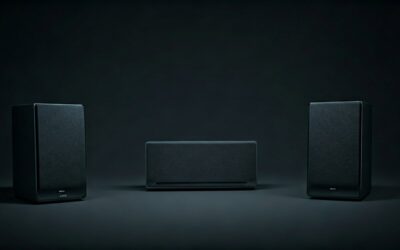
Passive Soundbars
A passive soundbar is essentially three high-quality shelf speakers built into one long cabinet. It mounts directly under the TV and connects to your AV Receiver. This gives you the performance of separate speakers with a much cleaner, integrated look.
In-Wall Speakers
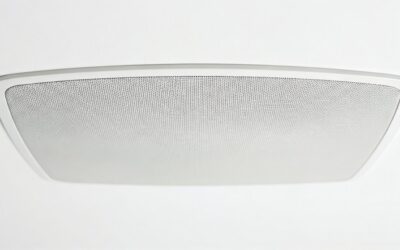
If you own your home and can cut into the drywall, in-wall speakers are the gold standard for “invisible” audio. They sit flush with the wall and can be covered with paintable grilles. This allows you to place them exactly where they need to be for a wide soundstage without cluttering your room.
Expert Tips for Optimizing Muffled Audio
If you have already mounted your speakers behind the TV and aren’t happy with the sound, try these professional tweaks:
- Increase the Crossover: Set your crossover frequency higher (around 100Hz or 120Hz) on your receiver. This sends more of the heavy lifting to your subwoofer, which isn’t blocked by the TV.
- Dialogue Lift: Many modern receivers (like Yamaha or Denon) have a feature called “Dialogue Lift” or “Center Spread.” This uses processing to move the perceived height of the voices.
- Acoustic Foam: Place a small piece of acoustic foam on the wall directly behind the speaker. This prevents the sound from bouncing off the wall and back into the TV, which reduces “phase cancellation.”
Frequently Asked Questions
Will mounting speakers behind my TV cause it to overheat?
It shouldn’t cause significant overheating, but speakers do generate some heat through their magnets and coils. Ensure there is at least a 2-inch gap for airflow. If your TV has vents near the speakers, monitor the temperature during the first few hours of use.
Can the magnets in the speakers damage my LED TV?
No. Modern LED, OLED, and LCD TVs are not affected by the magnets found in consumer shelf speakers. The old myth about magnets distorting screens applied to CRT (tube) TVs. Your flat screen is safe.
Does it matter if the speakers are horizontal or vertical?
Yes. Most shelf speakers are designed to be used vertically. If you turn them sideways to fit behind a TV, the sound dispersion pattern changes. This can make the “sweet spot” for listening much smaller.
What is the best way to hide wires for this setup?
Use an in-wall power and cable kit. These allow you to hide both the power cord for the TV and the speaker wires behind the drywall legally. Avoid simply stuffing wires into the wall without a kit, as this can be a fire hazard.