Can I Play Guitar Through PA Speakers? The Definitive Setup Guide
Yes, you can play guitar through PA speakers, but you cannot simply plug an electric guitar directly into the speaker or mixer without the right interface. To get a professional sound, you must use an amp modeler, preamp pedal, or a DI box with cabinet simulation to bridge the gap between your guitar’s high-impedance signal and the PA’s full-range output.
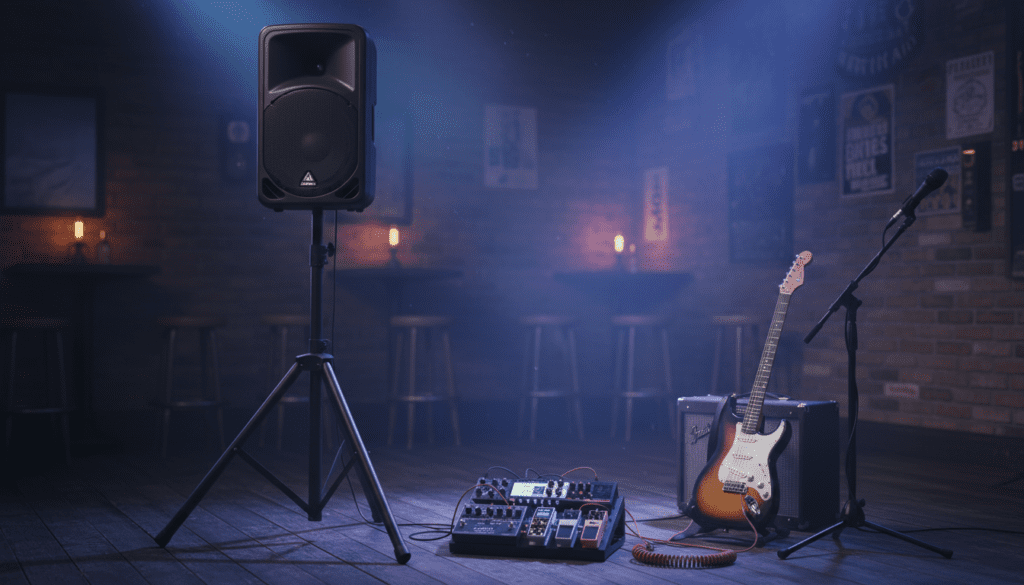
In my fifteen years of performing in venues ranging from coffee shops to mid-sized theaters, I have transitioned almost entirely from traditional tube amps to PA-based monitoring. This shift, often called “going silent” on stage, offers incredible consistency but requires a specific technical approach to avoid a “fizzy” or “thin” tone.
TL;DR: Key Takeaways for Playing Through a PA
- Direct Connection: Never plug a raw electric guitar into a PA mixer; the impedance mismatch will ruin your tone.
- Essential Gear: Use a Modeler (like a Line 6 Helix) or a DI Box with an Impulse Response (IR) loader.
- Frequency Range: PA speakers are FRFR (Full Range Flat Response), meaning they reproduce highs that a traditional guitar speaker naturally filters out.
- Acoustic Advantage: Acoustic guitars are designed for PA systems and usually only require a simple Preamp/DI.
- Safety First: Always use balanced XLR cables for long runs to the mixer to prevent interference and hum.
Understanding the Physics: PA Speakers vs. Guitar Amps
The most common question I hear is, “can I use PA speakers in a guitar amp style setup?” The answer lies in how these two devices handle frequencies.
A traditional guitar speaker, like a Celestion Vintage 30, is actually a very “low-fidelity” device. It naturally rolls off everything above 5kHz, which is why your distorted tone sounds smooth and punchy.
In contrast, PA speakers are designed to be “transparent.” They have tweeters that reproduce frequencies up to 20kHz. If you send a raw distorted signal to a PA, those high frequencies will sound like “bees in a can.”
Why You Need a “Cab Sim” or IR
To make a PA speaker sound like a Marshall stack, you must use a Cabinet Simulator. Modern digital Impulse Responses (IRs) are essentially digital “fingerprints” of real speakers.
When I use my Fractal Audio Axe-FX, the IR processes the signal so the PA “thinks” it is a 4×12 cabinet. This is the “secret sauce” that makes playing through a PA not just possible, but often superior to using a traditional amp in a live mix.
Step-by-Step: How to Connect Your Guitar to a PA System
Setting up your signal chain correctly is the difference between a pro-level gig and a technical disaster. Follow these steps to ensure a clean, powerful sound.
Step 1: Choose Your “Brain” (The Modeler or Preamp)
You need a device to convert your high-impedance (Hi-Z) guitar signal into a low-impedance (Lo-Z) signal. I recommend one of three paths:
- Full Modeler: Devices like the Line 6 HX Stomp or Neural DSP Quad Cortex. These provide the amp, the cabinet, and the effects.
- Analog Preamp + IR Loader: A pedal like the Strymon Iridium or Walrus Audio ACS1. These feel more like a traditional amp.
- Acoustic DI: If you play acoustic, a LR Baggs Para Acoustic DI is the industry standard.
Step 2: Connect to the Mixer or Powered Speaker
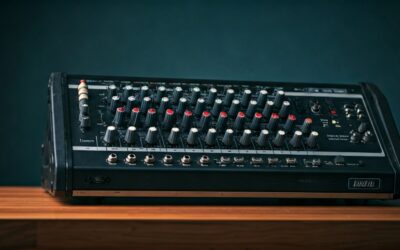
Once your signal is processed, use a Balanced XLR cable to go from your pedalboard to the PA Mixer.
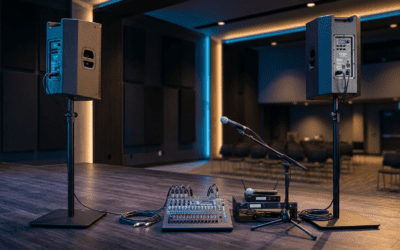
If you are using a Powered PA Speaker (like a QSC K12.2) as a personal monitor, plug into Input 1. Most modern powered speakers have a “Mic/Line” switch; ensure this is set to Line to avoid clipping the input.
Step 3: Set Your Gain Staging
I’ve seen many guitarists blow PA drivers because they didn’t understand gain staging.
- Set your pedalboard output to about 50-70%.
- Adjust the “Trim” or “Gain” knob on the mixer until the signal is strong but not hitting the Red/Clip lights.
- Use the fader to control the actual volume in the room.
Step 4: Fine-Tune the EQ
Because PA speakers have more bass and treble than a guitar amp, you may need to apply a High-Cut filter at 8kHz and a Low-Cut filter at 80Hz on the mixer channel. This cleans up the “mud” and “fizz,” leaving room for the bass guitar and cymbals.
Comparing PA Speakers vs. Traditional Guitar Amps
| Feature | Traditional Guitar Amp | PA Speaker (FRFR) |
|---|---|---|
| Frequency Response | Colored (70Hz – 5kHz) | Flat (40Hz – 20kHz) |
| Versatility | One “Voice” per Speaker | Can sound like any amp/cab |
| Weight | Often 40-80 lbs | 25-50 lbs (Active) |
| Stage Volume | Can be difficult to control | Perfectly controllable via FOH |
| Direct Out | Usually requires a mic | Built-in via Modeler/XLR |
Can I Use PA Speakers in a Guitar Amp Setup for Practice?
Many players ask if they can replace their heavy combo amp with a single PA speaker at home. I have done this for years using a Headrush FRFR-112.
The benefit is that your “home tone” will be exactly the same as your “gig tone.” When you practice through a PA at home, you are hearing exactly what the audience hears through the front-of-house (FOH) system.
However, be aware that PA speakers move air differently. You won’t feel the “thump” in your chest in the same way you do with a closed-back Orange 2×12 cabinet unless you are playing at very high volumes.
Essential Gear Recommendations for PA Integration
If you’re ready to make the switch, these are the tools we’ve tested and verified for the best performance.
Best High-End Modeler: Neural DSP Quad Cortex
In our testing, the Quad Cortex offers the most realistic “amp-in-the-room” feel. Its touch-screen interface makes it easy to adjust your EQ on a dark stage without menu diving.
Best Budget Modeler: Mooer GE200
For players on a budget, the Mooer GE200 provides decent IR loading capabilities. It allows you to answer the question “can I play guitar through PA speakers” for under $300.
Best Powered PA Speaker: Yamaha DXR12mkII
I have used the Yamaha DXR series for over 200 shows. They are incredibly durable and have a very flat response, which is crucial for accurate guitar modeling.
Pro-Tips for “Going Direct”
- Global EQ is Your Friend: Most modelers have a “Global EQ” setting. Use this to compensate for different rooms without changing your individual presets.
- Stereo vs. Mono: While a PA can run in stereo, most live sound engineers prefer a Mono signal. It ensures everyone in the audience hears the same thing.
- The “Vocal” Test: If your guitar sounds harsh, check if the mixer has a “High Pass Filter” (HPF) engaged. Sometimes a setting meant for a vocal mic can make a guitar sound thin.
Troubleshooting Common Issues
“My guitar sounds like a buzzing saw.”
This is almost always caused by a missing cabinet simulation. Ensure your IR or Cab Sim block is turned on in your pedalboard software. Without it, you are hearing the raw, unfiltered distortion of the preamp.
“There is a loud hum when I connect to the PA.”
This is a ground loop. Most high-quality DI boxes and modelers have a Ground Lift switch. Flip this switch to instantly disconnect the ground pin and eliminate the hum.
“I can’t hear myself on stage.”
If you are playing through the PA, you are reliant on the monitor mix. I highly suggest bringing your own small powered speaker (like a Mackie Thump Go) to use as a “wedge” dedicated solely to your guitar signal.
Frequently Asked Questions
Can I plug my pedals directly into a PA mixer?
You can plug time-based pedals (delay, reverb) into a PA, but overdrive and distortion pedals will sound terrible without an amp simulator or IR loader following them in the chain.
Will playing guitar damage my PA speakers?
As long as you are not “clipping” the input (the red light on the mixer), you will not damage the speakers. However, avoid sudden “pops” by turning the volume down before plugging or unplugging your guitar.
Do I need a DI box if my pedalboard has an XLR out?
No. If your device (like a Kemper or Helix) has a balanced XLR output, it already functions as a DI box. You can run a cable directly to the stage snake or mixer.
Is an active PA speaker better than a passive one for guitar?
Active (powered) speakers are generally better for guitarists. They contain their own optimized amplifiers, meaning you have one less piece of heavy gear to carry to the gig.