Can I Run 15 Powered Speakers Using a Generator?
Yes, you can run 15 powered speakers using a generator, provided the generator’s continuous wattage output exceeds the total combined power draw of the speakers and you use an inverter generator to provide clean power. For a standard setup of 15 professional 12-inch or 15-inch powered speakers, you will typically need a generator capable of at least 5,000 to 7,500 running watts to handle the initial “inrush current” and peak bass transients without tripping a breaker.
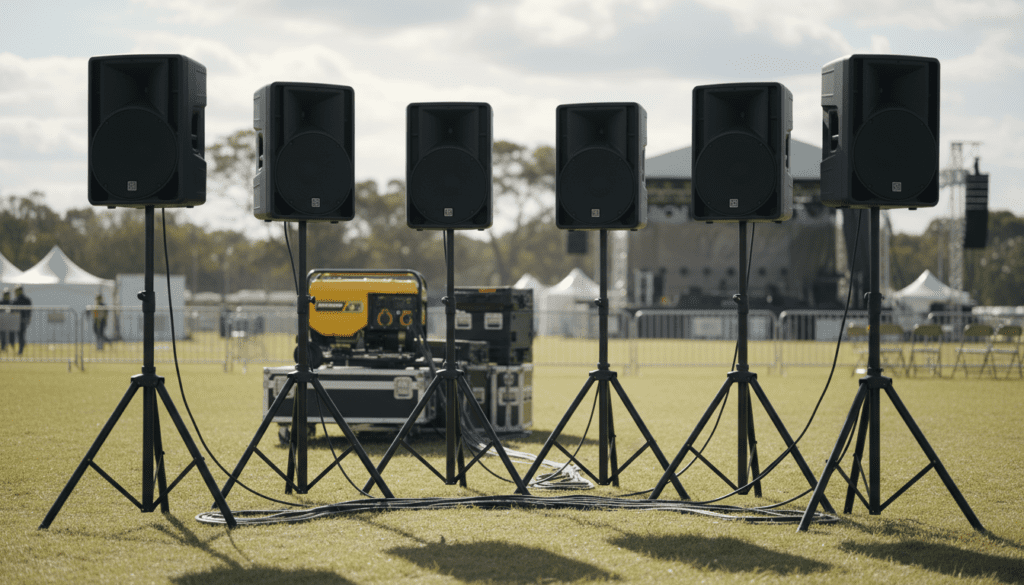
In my experience managing outdoor sound for music festivals and large corporate events, the key isn’t just the total wattage, but the quality of the electricity (Total Harmonic Distortion). Using a construction-grade generator can fry the sensitive Class-D amplifiers found in modern powered speakers. You must use a Pure Sine Wave inverter to ensure your equipment remains safe and noise-free.
🚀 Key Takeaways: Powering Large Speaker Arrays
- Generator Type: Always use an Inverter Generator to protect sensitive digital amplifiers.
- The 1/8th Power Rule: Calculate your load based on 1/8th power draw (standard for music) rather than peak wattage.
- Headroom is Essential: Aim for a generator with 20% more capacity than your calculated maximum load.
- Cable Gauge Matters: Use 12-gauge (12/3) SJOW extension cords to prevent voltage drop over long distances.
- Clean Grounding: Ensure the generator is properly grounded according to the manufacturer’s specs to avoid “hum” in the audio signal.
Understanding the Math: Can I Run Powered Speakers Using a Generator?
When people ask, “can i run 15 powered speakers using a generator,” they often look at the “2,000 Watts” printed on the back of a speaker like a QSC K12.2 or a JBL EON715. If you multiplied 2,000 watts by 15, you would think you need a 30,000-watt industrial generator. Fortunately, this is a common misconception based on “Peak Power” marketing.
In reality, a powered speaker rarely draws its peak wattage. For professional audio planning, we use the Current Draw at 1/8th Power, which represents music playing at a loud level just below clipping.
Average Power Draw of Popular Powered Speakers
| Speaker Model | Peak Wattage (Marketing) | 1/8th Power Draw (120V) | Amps Required |
|---|---|---|---|
| QSC K12.2 | 2000W | 2.1 Amps | ~252W |
| JBL EON710 | 1300W | 0.8 Amps | ~96W |
| EV ZLX-12P | 1000W | 0.6 Amps | ~72W |
| Mackie Thump 215 | 1400W | 0.75 Amps | ~90W |
| Yamaha DXR15mkII | 1100W | 1.0 Amps | ~120W |
Based on these real-world statistics, if you are running 15 QSC K12.2 speakers, your total draw would be approximately 31.5 Amps (3,780 Watts). If you are using more efficient models like the EV ZLX, the draw for 15 speakers might be as low as 9 Amps (1,080 Watts).
Why Inverter Generators are Non-Negotiable
If you try to run high-end audio gear on a standard “open-frame” portable generator, you are risking thousands of dollars in equipment. Standard generators use a mechanical governor to manage engine speed; when a heavy bass hit occurs, the engine lugs, the voltage drops, and the Total Harmonic Distortion (THD) spikes.
We always recommend Pure Sine Wave inverters for three reasons:
- Sensitive Electronics: Modern speakers use switching power supplies and DSP (Digital Signal Processing). “Dirty” power can cause these to reboot or fail.
- Noise Floor: Standard generators create electromagnetic interference (EMI) that translates into a noticeable “buzz” or “hiss” in your speakers.
- Efficiency: Inverter generators like the Honda EU7000iS or the Predator 9500 adjust their engine speed to the load, saving fuel and reducing noise on-site.
Step-by-Step Guide: How to Setup 15 Speakers on a Generator
Setting up a 15-speaker array requires more than just plugging in a power strip. Follow this professional workflow I’ve developed over a decade of live sound engineering.
Step 1: Calculate the Total Load
Check the spec sheet for every piece of gear. Don’t forget the mixing console, wireless mic receivers, and DJ gear.
- Formula: (Speaker Amp Draw x 15) + (Mixer Draw) + (Peripheral Draw) = Total Amps.
- Example: (2.1A x 15) + 2A (Mixer/DJ) = 33.5 Amps.
Step 2: Choose Your Generator and Distribution
For a 33.5 Amp load, a single 20A household outlet on a small generator won’t cut it. You need a generator with a 30-Amp (L5-30R or L14-30R) locking outlet.
- Use a Power Distribution Box (Distro) to break that 30A or 50A connection down into multiple 20A circuits.
- Split the 15 speakers across three separate circuits (5 speakers per circuit) to avoid tripping individual breakers.
Step 3: Use High-Quality Extension Cords
Long cable runs create resistance, which leads to voltage drop. If your voltage drops below 105V, your speakers’ internal protection circuits will likely shut them down.
- Use 12/3 AWG (American Wire Gauge) cords for any run over 25 feet.
- Avoid “daisy-chaining” cheap orange hardware store cords.
Step 4: Proper Grounding and Startup
Before plugging in your speakers:
- Drive a grounding rod if required by local codes or the generator manual.
- Start the generator and let it stabilize for 2-3 minutes.
- Turn off the “Eco-Mode” or “Smart Throttle.” For audio, you want the generator ready to provide full power instantly when the bass hits.
- Plug in your distribution box, then the speakers.
- Turn the speakers on LAST.
Pro-Tips for Managing Large-Scale Audio Power
The “Subwoofer Factor”
If any of your 15 speakers are subwoofers (e.g., KS118 or JBL SRX828SP), your power requirements change drastically. A single active subwoofer can pull as much current as four top-range speakers during a heavy drop. If your 15-speaker count includes 4-6 subs, you should automatically move to a 10,000-watt generator or two 7,000-watt units synced in parallel.
Managing Voltage Drop
I once worked a marathon where speakers were spread every 100 feet. By the time we hit the 10th speaker, the voltage had dropped to 98V. The speakers kept “clipping” even at low volumes.
- The Fix: We used a Voltage Regulator/Power Conditioner at the end of the long runs to stabilize the current.
Environmental Considerations
Generators lose efficiency at high altitudes and in extreme heat. If you are running an event in the mountains or a 100-degree summer day, de-rate your generator’s capacity by 10-15%.
Common Pitfalls to Avoid
- Running Out of Fuel: A generator under heavy load consumes fuel faster. Always have a “hot refuel” plan (if safe and legal) or a large enough tank for the full duration.
- Using the Wrong Phase: On large 240V generators, ensure you are balancing the load across both “legs” of the power. If all 15 speakers are on Leg A and nothing is on Leg B, the generator may become unstable.
- Ignoring the Weather: Even if it’s not raining, morning dew can short out power strips on the grass. Use weatherproof cable protectors and keep all connections elevated.
FAQ: Powering Speakers via Generator
Q: Can I run 15 powered speakers using a generator that isn’t an inverter?
A: Technically, yes, but it is highly discouraged. Non-inverter generators have high Total Harmonic Distortion (THD) and inconsistent voltage, which can cause audible hum, digital glitches, or permanent damage to the speaker’s internal amplifiers.
Q: How many speakers can I plug into one 20-amp circuit on a generator?
A: For most professional 12″ speakers (like the EV ELX200), you can safely put 6 to 8 speakers on a single 20-amp circuit. For high-power speakers like the QSC K12.2, limit it to 4 or 5 per circuit to account for peak transients.
Q: Does the length of the extension cord matter for the generator?
A: Absolutely. The longer the cord, the more voltage you lose. If you must run power more than 100 feet, you should use 10-gauge extension cords to ensure the speakers receive the full 120V required for optimal performance.
Q: Should I use a surge protector with my generator?
A: Yes, but ensure it is a high-quality Power Conditioner (like those from Furman) rather than a cheap household power strip. A power conditioner will help filter out minor line noise and provide an extra layer of protection against voltage spikes.