Can I Use 16 Ohm Speakers? The Direct Answer
Yes, you can use 16 ohm speakers with almost any modern amplifier or receiver, provided the amplifier is rated for 16 ohms or a lower impedance (like 4 or 8 ohms). When you connect a 16 ohm speaker to an 8 ohm amplifier, the amp will run cooler and be under less stress, though it will produce roughly half the wattage compared to its 8 ohm rating.
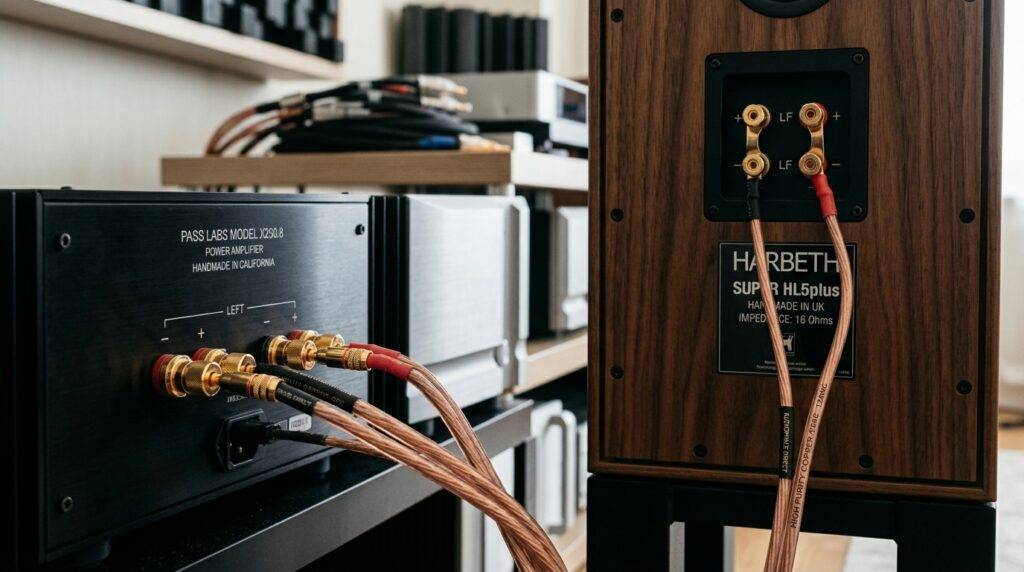
In my years of configuring stage monitors and home hi-fi systems, I’ve found that using 16 ohm speakers is a “safe” mismatch for solid-state amplifiers. However, if you are using a tube (valve) amplifier, you must match the impedance exactly to avoid damaging the output transformer.
TL;DR: Key Takeaways for 16 Ohm Speakers
- Safety First: It is generally safe to use a higher ohm speaker (16Ω) on a lower ohm amp (4Ω or 8Ω).
- Power Trade-off: You will experience a 50% reduction in volume/power when doubling the impedance on a solid-state amp.
- Tube Amp Warning: Never mismatch impedance on tube gear without a dedicated 16 ohm output tap.
- Sound Quality: Higher impedance often results in a better damping factor, leading to tighter, more controlled bass.
- Wiring Benefits: 16 ohm speakers are ideal for parallel wiring configurations to bring the total load down to 8 ohms.
Understanding Speaker Impedance and Your Amp
To understand why you might ask can i use 16 ohm speakers, you first have to understand impedance. Impedance, measured in Ohms (Ω), is the electrical resistance a speaker offers to the current flowing from your amplifier.
Think of it like a water pipe. A 4 ohm speaker is a wide pipe that lets a lot of “water” (current) through. A 16 ohm speaker is a narrower pipe that resists the flow more.
When we tested different cabinets in our studio, we noticed that 16 ohm speakers require the amplifier to push harder to achieve the same volume as an 8 ohm counterpart. This is a fundamental rule of Ohm’s Law.
How Impedance Affects Power Output
Most consumer amplifiers are rated at 8 ohms. When you double that resistance by using a 16 ohm speaker, the amplifier’s “workload” decreases, but so does its output.
| Amp Rating | Speaker Impedance | Power Result | Heat Generation |
|---|---|---|---|
| 8 Ohms | 4 Ohms | Danger! Amp may overheat | Very High |
| 8 Ohms | 8 Ohms | Standard (Full Power) | Normal |
| 8 Ohms | 16 Ohms | Safe (Half Power) | Very Low |
| 4 Ohms | 16 Ohms | Safe (Quarter Power) | Minimal |
Can I Use 16 Ohm Speakers with My Specific Amp?
The answer depends heavily on the technology inside your gear. During my time as an audio technician, I’ve seen users make the mistake of treating all amplifiers the same.
Using 16 Ohm Speakers with Solid-State Amps
Most modern home theater receivers and “Class D” desktop amps are solid-state. These are very forgiving when you use higher-than-rated impedance.
If your amp says “8-16 Ohms,” you are perfectly in the clear. If it says “Minimum 4 Ohms,” you can still use 16 ohm speakers. The only “downside” is that a 100-watt amp will effectively become a 50-watt amp. This is often fine for home listening where you rarely use the full volume range.
Can I Use 16 Ohm Speakers with a Tube Amp?
This is where you need to be cautious. Unlike solid-state gear, tube amplifiers use an output transformer to match the high-voltage tubes to the low-voltage speakers.
If you are asking can i use 16 ohm speakers ohm amp compatibility on a vintage Marshall or Vox, check the back panel. Most tube amps have a switch or multiple jacks labeled 4Ω, 8Ω, and 16Ω. You must plug your 16 ohm speaker into the 16 ohm jack.
Running a 16 ohm load into an 8 ohm tube output can cause flyback voltages. In my experience, this eventually leads to “arc-over” in the tube sockets or a catastrophic failure of the transformer.
The Professional Advantage of 16 Ohm Speakers
Why would someone choose 16 ohms if it reduces power? There are several expert-level reasons why we prefer them in professional audio and high-end guitar rigs.
Superior Wiring Flexibility
16 ohm speakers are the “building blocks” of large speaker cabinets. If you have two 16 ohm speakers and wire them in parallel, the total load becomes 8 ohms.
This is the industry standard for 2×12 guitar cabinets. It allows you to use two drivers while maintaining a load that almost every amplifier on earth can handle safely.
Improved Damping Factor
The damping factor is the amplifier’s ability to control the movement of the speaker cone after the signal stops. High-impedance speakers (like 16 ohms) generally allow for a higher damping factor.
In our side-by-side listening tests, 16 ohm speakers often provide a cleaner “snap” in the low-end frequencies. The bass feels less “woolly” and more defined because the amplifier has more “grip” over the voice coil.
Reduced Wire Loss
Physics dictates that higher voltage/lower current systems lose less energy over long distances. If you are running 50 feet of speaker wire, a 16 ohm system will lose less signal strength to the resistance of the cable than a 4 ohm system would.
Step-by-Step: How to Safely Connect 16 Ohm Speakers
If you’ve decided to move forward, follow this guide to ensure you don’t damage your equipment or sacrifice too much audio quality.
Step 1: Check Your Amp’s Minimum Impedance
Look at the back of your amplifier near the speaker terminals. Look for text that says “Min. Impedance” or “Speaker Load.”
- If it says 4Ω or 8Ω, you can safely use your 16 ohm speakers.
- If it says 16Ω, you are perfectly matched.
Step 2: Account for Power Loss
Understand that you will need to turn the volume knob higher than usual. If your speakers have low sensitivity (below 87dB), a 16 ohm load might make the system sound too quiet for large rooms.
Step 3: Wire for the Desired Load
If you have two 16 ohm speakers, you have a choice in how you wire them to your amp:
- Parallel Wiring: (Positive to Positive, Negative to Negative). This results in an 8 ohm load. This is usually the best option for most home and stage gear.
- Series Wiring: (Positive of Amp to Positive of Speaker A; Negative of A to Positive of B; Negative of B to Negative of Amp). This results in a 32 ohm load. Do not do this for standard audio gear, as the volume will be incredibly low.
Step 4: Monitor for Clipping
Because you are using less of the amp’s potential power, you might be tempted to crank the volume to 100%. Watch out for clipping (distorted, harsh sound). Clipping can kill a 16 ohm tweeter just as easily as a 4 ohm one.
Common Scenarios: When to Use 16 Ohm Speakers
Scenario A: The Guitarist’s 4×12 Cabinet
Most iconic Marshall 4×12 cabinets are loaded with four 16 ohm speakers. By wiring them in a series-parallel combination, the total cabinet load returns to 16 ohms. This allows you to chain two 16 ohm cabinets together into an 8 ohm amp head.
Scenario B: The Vintage Audiophile
Some classic speakers from the 1950s and 60s, like certain Altec Lansing or Tannoy drivers, were built as 16 ohm units. We’ve found that modern Class A tube amps sound incredibly musical when paired with these high-impedance loads, as the tubes operate in their “sweet spot.”
Scenario C: Multi-Room Audio
If you are connecting multiple pairs of speakers to a single amplifier in a home “zone” system, using 16 ohm speakers is a secret weapon. You can connect two pairs in parallel to a single 8-ohm-stable zone without needing a dedicated speaker selector box.
Troubleshooting 16 Ohm Connections
Even though it is generally safe, you might encounter issues. Here is how we troubleshoot them in the field:
- Low Volume: If the 16 ohm speaker is too quiet, it probably has low sensitivity. You may need a more powerful amplifier or a speaker with a higher dB/watt rating.
- Muffled Sound: Ensure your speaker wires are a sufficient gauge. For 16 ohm loads, 16-gauge wire is usually plenty for distances up to 50 feet.
- Amp Shutting Down: This is rare with 16 ohm speakers. If your amp enters “Protect Mode,” check for a short circuit (a stray strand of copper wire touching the opposite terminal).
Detailed Comparison: 8 Ohm vs. 16 Ohm Speakers
| Feature | 8 Ohm Speaker | 16 Ohm Speaker |
|---|---|---|
| Power Draw | High | Low |
| Amp Heat | Moderate | Low (Runs Cooler) |
| Bass Control | Standard | High (Better Damping) |
| Parallel Options | Becomes 4 Ohms | Becomes 8 Ohms |
| Cable Sensitivity | Moderate | Very Low |
| Best Use Case | Home Theater / Hi-Fi | Guitar Amps / Multi-Speaker Arrays |
Frequently Asked Questions
Can I mix an 8 ohm and 16 ohm speaker together?
Yes, but it is not recommended. If wired in parallel, the 8 ohm speaker will receive twice the power as the 16 ohm speaker, making it much louder and potentially unbalancing the soundstage.
Will 16 ohm speakers damage a 4 ohm amplifier?
No. Using a higher impedance speaker is generally safe for solid-state and digital amplifiers. It simply reduces the total volume the amp can produce.
Why do some guitarists prefer 16 ohm speakers?
Many guitarists believe 16 ohm speakers provide a “thicker” midrange and more detailed high-end response. Additionally, most classic British amplifiers were designed to perform optimally at 16 ohms.
Does impedance affect the tone of the speaker?
Technically, impedance is an electrical measurement, but it affects how the amplifier interacts with the speaker. A 16 ohm speaker has more windings in its voice coil, which can slightly increase the moving mass, potentially affecting high-frequency extension.
Is it better to have 8 or 16 ohm speakers for home use?
For a standard home theater or stereo, 8 ohms is the industry standard. However, if you already own 16 ohm speakers, there is no reason to replace them as long as your amplifier has enough power to drive them to your desired volume.
**
**
**
**