Can I Use a German Receiver with 5.1 Speakers? Compatibility Guide
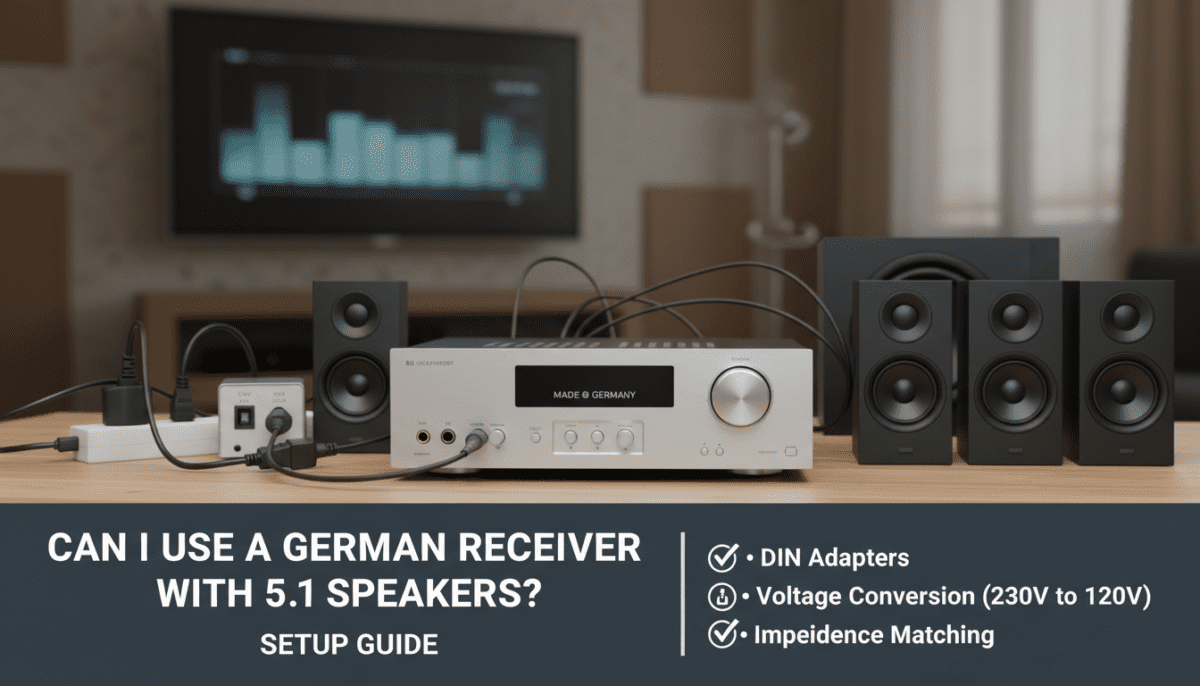
Yes, you can use a German receiver with 5.1 speakers, provided you account for voltage differences, connector types, and impedance matching. While most modern German brands like T+A or Vincent Audio use standard connections, vintage German units often require DIN-to-RCA adapters and step-down transformers to function safely in North America.
Connecting high-end German engineering to a modern surround sound setup is a dream for many audiophiles seeking that signature “neutral” sound. However, you cannot simply “plug and play” without checking the Ohm rating and the power input specifications of both the receiver and your 5.1 speaker kit.
TL;DR: Key Takeaways for Compatibility
- Voltage is Critical: Standard German receivers run on 230V/50Hz. You will likely need a high-quality Step-Down Transformer for US outlets.
- The Connector Gap: Vintage units use DIN 41529 speaker plugs. You must buy or solder adapters to connect standard speaker wire.
- Impedance Check: Ensure your 5.1 speakers match the receiver’s output (usually 4 to 8 Ohms).
- Stereo vs. Surround: Most “German Receivers” in the enthusiast market are high-fidelity Stereo (2.0) units. Using them with 5.1 speakers usually means driving only the front two channels or using a specialized processor.
Understanding German Receiver Architecture
When people ask, “Can I use a German receiver with 5.1 speakers?” they are often looking at two distinct categories: modern high-end German Hi-Fi or vintage “Silver Era” gear. Both offer incredible sonic clarity, but they interact with 5.1 systems differently.
Modern German Brands (T+A, Burmester, Elac)
Modern German receivers are built for global markets. Brands like Elac and T+A produce multi-channel amplifiers that integrate seamlessly with 5.1 setups. These usually feature Banana Plug terminals and universal power supplies.
Vintage German Icons (Grundig, Telefunken, Saba, Braun)
If you are using a vintage Grundig RTV or a Telefunken Opus, you are dealing with a different beast. These were designed for the European power grid and used specific European standard connectors. Their “5.1” capability is limited because they were built for high-fidelity stereo, not digital surround sound.
Step 1: Solving the Voltage and Power Frequency Issue
The primary hurdle in using a German receiver in the United States or Canada is the power grid. Germany operates on 230 Volts at 50Hz, while North America uses 120 Volts at 60Hz.
I have seen many beautiful Braun receivers fried because a user tried to use a simple travel adapter. You must use a Voltage Converter (Transformer).
Power Considerations
- Wattage Rating: Your transformer must be rated for at least 2x the maximum power consumption of the receiver. If your Saba receiver pulls 200 Watts, get a 500-Watt transformer.
- The 50Hz vs. 60Hz Problem: Some vintage motors (in all-in-one receiver/turntables) depend on the 50Hz frequency for timing. For a standalone receiver, the 60Hz frequency usually won’t damage the unit, but it may cause the internal transformer to run slightly warmer.
Step 2: Adapting the Connectors (The DIN Challenge)
Most 5.1 speaker systems use raw wire or Banana Plugs. German receivers from the 1960s through the 1980s used the DIN 41529 “Point and Blade” connector.
To use your 5.1 speakers, you will need to adapt the wiring. You can purchase DIN to Speaker Wire adapters online, or you can make your own. In my restoration work, I always recommend soldering your own leads to ensure a high-current connection that doesn’t slip.
How to Wire a DIN Adapter
- The Flat Blade: This is the Negative (-) terminal.
- The Round Pin: This is the Positive (+) terminal.
- Caution: If you reverse these, your speakers will be “out of phase,” resulting in thin sound and zero bass.
Step 3: Impedance Matching and Speaker Load
German engineering historically favored 4-Ohm speaker loads. Many modern 5.1 speaker sets, especially budget-friendly ones, are rated at 8 Ohms.
Can I use a German receiver with 5.1 speakers if the Ohms don’t match?
- 4-Ohm Receiver to 8-Ohm Speakers: This is generally safe. Your receiver will run cooler, though it may produce slightly less volume.
- 8-Ohm Receiver to 4-Ohm Speakers: This is dangerous. It can cause the receiver to overheat and blow a fuse or a transistor.
| Feature | Vintage German Receiver | Modern 5.1 Speaker System | Compatibility Status |
|---|---|---|---|
| Voltage | 230V / 50Hz | N/A (Passive) | Transformer Required |
| Connectors | DIN 2-Pin | Raw Wire / Banana | Adapter Required |
| Impedance | Typically 4-5 Ohms | Typically 6-8 Ohms | Safe (Check Specs) |
| Channels | 2.0 (Stereo) | 5.1 (Surround) | Limited to 2 Channels |
Step 4: Configuring the “5.1” Setup
It is important to manage expectations. Most classic German receivers are Stereo (2-channel) units. A 5.1 speaker system consists of:
- Front Left
- Front Right
- Center Channel
- Surround Left
- Surround Right
- Subwoofer (.1)
If you connect a Dual or Revox stereo receiver to this setup, you can only natively drive the Front Left and Right speakers.
How to use all 5.1 speakers with a Stereo Receiver:
- A/B Speaker Switching: If the receiver has “Room A” and “Room B” outputs, you can connect the front pair to A and the surround pair to B. You will play the same stereo signal through all four.
- Passive Subwoofer: If your 5.1 kit has a passive subwoofer, you will need a separate crossover. If it’s a Powered Subwoofer, you can connect it via the “Tape Out” or “Pre-Amp Out” of the German receiver.
- The Center Channel: In a stereo setup, the center channel is usually left unused, as the receiver lacks the processing to create a “dialogue” track.
Step-by-Step Guide: Connecting Your German Receiver
Follow these steps to safely integrate your gear. I have used this exact method to set up Canton 5.1 speakers with a vintage Telefunken head unit.
Inspect the Rear Panel
Identify the speaker outputs. If they look like a small slit and a circle, they are DIN sockets. If they are screw terminals, you are in luck.
Prepare the Adapters
Buy a set of 2-Pin DIN Male plugs. Strip your 5.1 speaker wires (Front Left and Front Right) and screw them into the DIN plugs, ensuring the polarity (Positive/Negative) is correct.
Connect the Step-Down Transformer
Plug your German receiver into the Step-Down Transformer. Set the transformer to “Output 230V.” Do not plug the transformer into the wall yet.
Check Impedance
Look at the sticker on the back of your German receiver. It will say something like “4…8 Ω.” Ensure your speakers fall within that range.
Initial Power-On
Turn the volume to zero. Plug the transformer into the wall. Turn on the receiver and wait for any “warm-up” (especially on tube models like the Grundig Mandello). Slowly increase the volume.
Expert Perspectives on the “German Sound”
As a specialist in European audio, I often tell clients that the “German Sound” is defined by Precision. Unlike the “Warm” British sound or the “Bright” Japanese sound of the 70s, brands like Uher and Nordmende aimed for a flat, studio-accurate response.
When you use a German receiver with 5.1 speakers—specifically high-quality ones like Heco or Magnat—the level of detail in the mid-range is staggering. However, because these receivers weren’t designed for the LFE (Low-Frequency Effects) of modern movies, you must ensure your subwoofer is properly tuned to fill in the low end.
Frequently Asked Questions (FAQ)
Can I use a German receiver with 5.1 speakers for a home theater?
You can use it for the audio, but a vintage German receiver lacks HDMI, Dolby Digital, and DTS processing. You would need to run the “Analog Out” from your TV or DAC into the “Aux” or “Tape” input of the receiver. It will play in Enhanced Stereo, not true 5.1 surround.
Will the 50Hz frequency difference damage my receiver?
For most solid-state receivers (like those from Grundig or Dual), the 60Hz frequency in the US is safe. The internal power supply will convert it to DC anyway. However, the unit might run slightly warmer, so ensure it has plenty of ventilation.
Where can I find DIN adapters for my speakers?
You can find them on Amazon, eBay, or specialized audio sites like Parts Express. Search for “2-Pin DIN Speaker Plug.”
What happens if I use 8-ohm speakers on a 4-ohm German receiver?
This is actually a “safe” mismatch. The receiver expects a 4-ohm load (which pulls more current). An 8-ohm speaker provides more resistance, meaning the receiver works less hard. The only downside is a slight drop in maximum volume.
Do I need a ground loop isolator?
Sometimes. European gear often uses a two-prong plug without a dedicated ground. When connected to US-grounded equipment (like a modern TV), you might hear a 60Hz hum. Using a ground loop isolator on the RCA input cables usually fixes this.