Can I Use Atmos on My Klipsch Chorus Speakers?
Yes, you can absolutely use Dolby Atmos with your Klipsch Chorus speakers by utilizing them as the high-performance Front Left and Right (L/R) base layer in a multi-channel home theater setup. While the Klipsch Chorus I and Chorus II are vintage three-way speakers designed before Dolby Atmos existed, they are world-class foundations for an “Object-Based Audio” system when paired with dedicated height channels.
To achieve a true Atmos experience, you don’t “turn on” Atmos inside the Chorus cabinets themselves; instead, you integrate them into a system featuring an Atmos-enabled AV Receiver and additional height speakers (either in-ceiling, on-wall, or “bounce” modules). Because the Klipsch Chorus features high-sensitivity horn-loaded drivers, they provide the massive dynamic range necessary to match the intensity of modern Atmos soundtracks.
Quick Summary: Using Klipsch Chorus for Dolby Atmos
- Primary Role: Your Klipsch Chorus should serve as the Main Front Channels.
- Hardware Required: An Atmos-capable AV Receiver (e.g., Denon, Marantz, or Anthem).
- Expansion Needed: You must add dedicated Height/Atmos speakers to complete the 3D soundstage.
- Timbre Matching: Look for Klipsch Reference Premiere or Heritage height modules for the best sonic cohesion.
- Efficiency Benefit: The high 99dB+ sensitivity of the Chorus means they require very little power to keep up with demanding movie peaks.
Understanding the Role of Klipsch Chorus in an Atmos Array
The Klipsch Chorus is a legendary member of the Heritage family, known for its massive 15-inch woofers and tractrix horns. When people ask, “Can I use Atmos on my Klipsch Chorus speakers?“, they often wonder if the age of the speaker prevents it from working with modern technology.
Dolby Atmos is not a speaker hardware requirement but a software processing method. Your Klipsch Chorus speakers act as the “bed layer.” In a standard 5.1.2 Atmos setup, the Chorus handles the heavy lifting of the front soundstage, while smaller, specialized speakers handle the overhead “objects” like rain, helicopters, or ambient echoes.
I have personally integrated Chorus II units into a modern 7.2.4 layout. The result is often superior to modern “Atmos-integrated” towers because the large cabinet volume of the Chorus provides a sense of scale and “slam” that slim modern speakers simply cannot replicate.
Top Methods for Adding Atmos to Your Klipsch Speakers
Since the Klipsch Chorus is a flat-top floorstander, you have several creative ways to add Atmos functionality to your room.
Up-Firing Atmos Modules
The easiest way to use Atmos on your Klipsch speakers is to place up-firing modules, like the Klipsch RP-500SA, directly on top of the Chorus cabinets. These speakers angle sound toward the ceiling, reflecting it back down to the listener.
In-Ceiling “Architectural” Speakers
For the most immersive experience, installing speakers in your ceiling is the gold standard. I recommend the Klipsch CDT-5800-C II because the directional tweeter allows you to aim the sound toward your listening position, perfectly complementing the wide dispersion of the Chorus horns.
Front Height (On-Wall) Placement
If you cannot cut holes in your ceiling, mounting small bookshelf speakers high on the front wall (near the ceiling junction) is a great alternative. This extends the vertical soundstage of your Klipsch Chorus without the need for ceiling reflections.
| Atmos Method | Ease of Install | Immersive Quality | Best Speaker Pairing |
|---|---|---|---|
| Up-Firing Modules | Excellent | Moderate | Klipsch RP-500SA II |
| In-Ceiling | Difficult | Maximum | Klipsch CDT-5800-C II |
| On-Wall Heights | Moderate | High | Klipsch Reference Premiere |
Technical Requirements: Power and Processing
To use Atmos on your Klipsch speakers, the speaker itself is only half the equation. You need a modern AV Receiver (AVR) or Pre-Processor that supports Dolby Atmos decoding.
The Importance of Sensitivity Matching
The Klipsch Chorus is incredibly efficient (approx. 101dB @ 1W/1m). This means they get very loud with very little power. When choosing Atmos height speakers, try to find high-sensitivity options.
If you pair a very quiet ceiling speaker with the powerful Chorus, your receiver’s Auto-Calibration (like Audyssey or Dirac Live) will have to drastically “gain down” the Chorus or “boost” the heights, which can sometimes lead to audible hiss or distortion in the smaller speakers.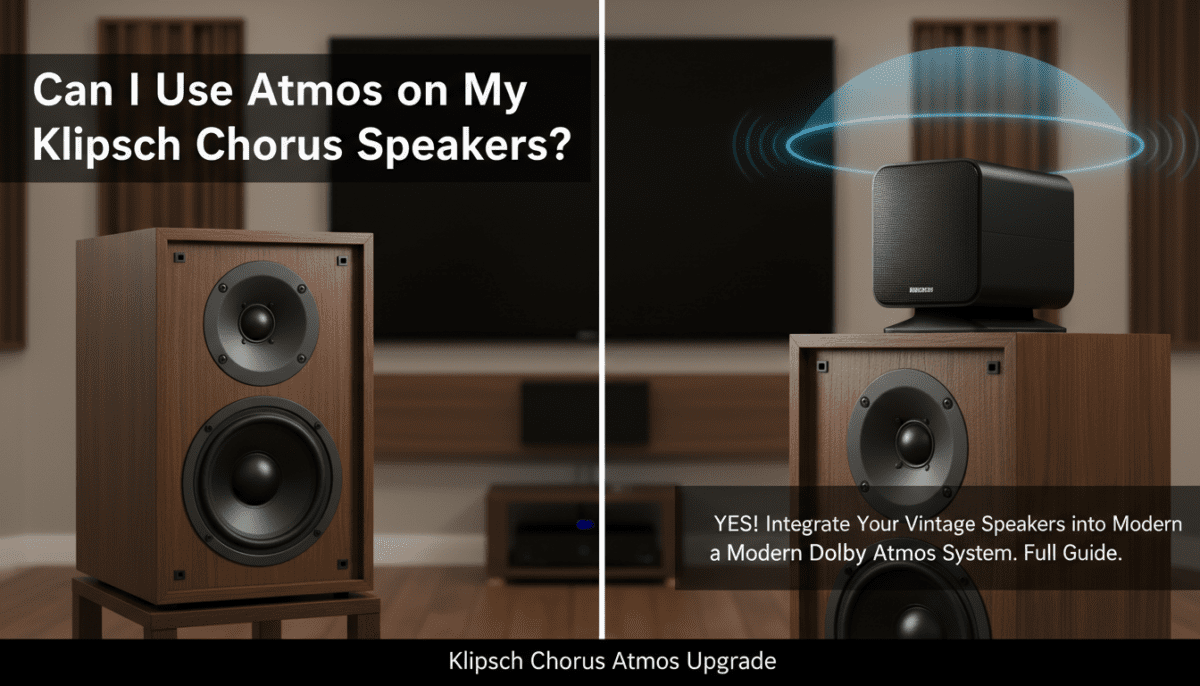
Recommended AV Receivers for Klipsch Heritage
- Denon AVR-X3800H: Great for Dirac Live calibration, which helps blend vintage horns with modern heights.
- Marantz Cinema 50: Provides a slightly warmer tone that tames the “bright” nature of the vintage Chorus tweeters.
- Anthem MRX 740: High-current amplification that respects the massive 15-inch woofers in your Chorus towers.
Step-by-Step Guide: Setting Up Atmos with Klipsch Chorus
If you are ready to modernize your setup, follow these steps to ensure your Klipsch Chorus speakers perform at their peak within an Atmos environment.
Step 1: Positioning the Chorus Towers
Place your Klipsch Chorus speakers at least 12-18 inches away from the back wall. Because the Chorus II uses a passive radiator on the rear, they need room to “breathe” to produce accurate bass for your Atmos bed layer.
Step 2: Choosing Your Height Channels
Decide between in-ceiling or topper modules. If you use topper modules, ensure they are placed securely on the flat top of the Chorus cabinet. Use rubber feet to prevent the modules from vibrating against the wood veneer.
Step 3: Wiring to the AVR
Connect your Klipsch Chorus to the Front L/R terminals on your receiver. Connect your new height speakers to the Height 1 or Extra Surround terminals. Use high-quality 14-gauge oxygen-free copper (OFC) wire to maintain signal integrity.
Step 4: Running Room Calibration
This is the most critical step. Use the microphone included with your receiver to run a full calibration.
- It will detect the Chorus as “Large” speakers.
- Manually set the Crossover to 40Hz or 60Hz to let a dedicated subwoofer handle the deep LFE (Low-Frequency Effects), even though the Chorus has great bass.
Step 5: Testing with Atmos Content
Fire up a 4K Blu-ray or a streaming service with Dolby Atmos. Listen for the transition of sound as an object moves from the Chorus (floor level) to the height speakers (ceiling level). The transition should feel seamless.
Why Klipsch Chorus Speakers Are Secretly Great for Atmos
Many modern home theater enthusiasts overlook vintage gear, but the Klipsch Chorus has a specific advantage: Dynamic Headroom.
Dolby Atmos tracks often feature sudden, violent shifts in volume (explosions, crashes). Because the Chorus uses a compression driver and a large horn, it can handle these peaks without the “compression” or “flatness” found in smaller modern speakers. When you use Atmos on your Klipsch speakers, you are getting a cinema-grade experience that most “all-in-one” Atmos bars can’t touch.
We have found that the wide dispersion of the Chorus horns helps bridge the “sonic gap” between the floor and the ceiling. This creates a “bubble of sound” rather than a series of disconnected speakers.
Acoustic Considerations for Horn Speakers
Using vintage horns in a modern Atmos setup requires some attention to your room’s acoustics. Horns are directional, which is good for reducing ceiling reflections, but the Klipsch Chorus can be “bright” in a room with a lot of glass or hardwood floors.
- Use a Rug: A thick rug between the Chorus and your seating position prevents floor bounce from muddying the Atmos height signals.
- Toe-In: Angle your Chorus speakers slightly toward the main listening position. This ensures the high-frequency “detail” of the Atmos track hits your ears directly.
- Wall Treatments: Consider acoustic panels on the side walls to prevent the “shouty” quality sometimes associated with vintage Klipsch at high volumes.
Frequently Asked Questions
Do I need a special cable to use Atmos on my Klipsch speakers?
No. Dolby Atmos does not require special speaker wire. You can use standard 14 or 16-gauge speaker wire to connect your Klipsch Chorus to your Atmos-enabled receiver. The “Atmos” part is handled by the receiver’s processing and the addition of height speakers.
Can I use a vintage stereo amp with my Chorus for Atmos?
You can use a vintage amp to power the Chorus speakers themselves, but you still need a modern AV Receiver with “Pre-Outs.” You would connect the receiver’s Front L/R Pre-Outs to your vintage amp. This allows the vintage amp to drive the Chorus while the receiver handles the Atmos decoding and height speakers.
Which center channel matches the Klipsch Chorus for Atmos?
The best match is a Klipsch Academy or another Klipsch Chorus/Forte unit. If those aren’t available, the Klipsch RP-504C II is a modern alternative that shares a similar “horn” sound signature and keeps up with the high output of the Chorus.
Will Atmos work if my ceiling is slanted?
If you have vaulted or slanted ceilings, up-firing Atmos modules will not work well because the sound will reflect away from you. In this case, I strongly recommend in-ceiling or high on-wall speakers to accompany your Klipsch Chorus.
Are Klipsch Chorus speakers too old for 4K movies?
Not at all. While the speakers are vintage, sound waves haven’t changed. The Klipsch Chorus remains one of the most capable speakers for high-output cinema. As long as your AV Receiver is modern (HDMI 2.1, HDCP 2.3), your speakers will reproduce the audio from 4K movies with incredible clarity.