Understanding the Signal Chain: Can I Use Just a Preamplifier With Passive Speakers?
No, you cannot connect a preamplifier directly to passive speakers and expect to hear sound. A preamplifier’s primary role is to switch between sources and provide enough voltage to drive a power amplifier, but it lacks the current and wattage necessary to move the physical drivers of a passive speaker. To complete the circuit, you must place a power amplifier between the preamplifier and your speakers.
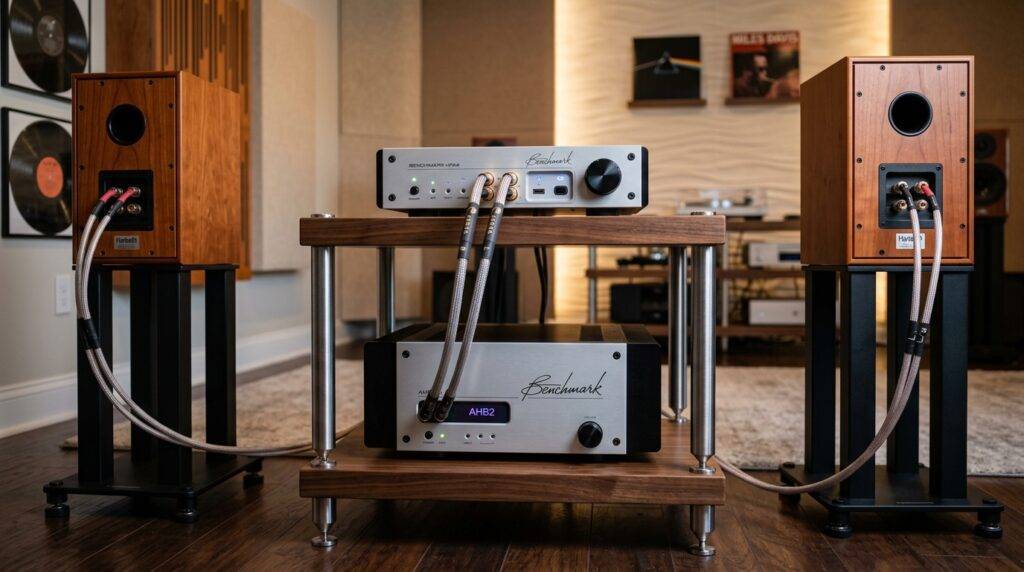
I have seen many beginners connect a high-end tube preamp directly to a pair of bookshelf speakers only to be met with total silence or a faint, distorted whisper. This happens because passive speakers require a high-level signal (measured in watts), while a preamplifier only outputs a low-level line signal (measured in volts). Without the “muscle” of a power amplifier, the signal simply doesn’t have the energy to create audible sound waves.
TL;DR: Quick Takeaways
- Direct Answer: No. You need a power amplifier or an integrated amplifier to drive passive speakers.
- The Signal Path: Source → Preamplifier → Power Amplifier → Passive Speakers.
- The Risk: Attempting to bridge this gap with custom cables usually results in impedance mismatches and potential hardware damage.
Why You Can’t Use Just a Preamplifier With Passive Speakers
To understand why this setup fails, we need to look at the physics of audio. In my years of testing Hi-Fi systems, the most common point of confusion is the difference between signal processing and signal amplification.
Line Level vs. Speaker Level
A preamplifier operates at Line Level. This is a low-voltage signal used to pass audio between components like CD players, DACs, and turntables. It is designed for fidelity and control, not for raw power.
Passive speakers require Speaker Level signals. These are high-voltage, high-current signals that can overcome the resistance (impedance) of the speaker’s voice coils. When you ask “can i use just a preamplifier with passive speakers,” you are essentially asking if a garden hose can power a hydroelectric dam. The pressure (voltage) is there, but the volume of flow (current) is missing.
The Role of Impedance
Most passive speakers have an impedance of 4, 6, or 8 ohms. Preamplifiers are designed to “see” a very high impedance (usually 10,000 ohms or more) at the next stage of the chain. If you connect a preamp to an 8-ohm speaker, the preamp tries to work much harder than it was designed to, which can lead to clipping, overheating, or blowing out the preamp’s output stage.
| Component | Signal Output Type | Purpose | Power Level |
|---|---|---|---|
| Preamplifier | Line Level (RCA/XLR) | Volume control, source switching | Very Low (milliwatts) |
| Power Amplifier | Speaker Level (Binding Posts) | Driving speaker cones | High (Watts) |
| Active Speaker | Internal Amplification | All-in-one solution | High (Internal) |
| Passive Speaker | N/A (Input only) | Converting electricity to sound | Requires External Power |
The Correct Way to Use a Preamplifier
If you have already purchased a preamplifier, don’t worry—you have the “brain” of a fantastic audio system. Now you just need to provide the “brawn.” Here is the professional step-by-step guide to integrating a preamp into your setup.
Step 1: Choose Your Power Stage
Since you cannot use just a preamplifier with passive speakers, you must choose between a Dedicated Power Amp or an Integrated Amplifier with a “Main In” bypass. In my experience, using separate components (a preamp and a power amp) provides better stereo imaging and lower noise floors compared to all-in-one units.
Step 2: Connect the Source to the Preamp
Connect your turntable (using a phono preamp if necessary), streamer, or PC to the inputs on the back of the preamplifier. Use high-quality shielded RCA cables to prevent electromagnetic interference (EMI).
Step 3: Connect Preamp to Power Amp
Use the “Pre-Out” jacks on the back of your preamplifier. Connect these to the “Input” jacks on your power amplifier.
- Pro Tip: If your gear supports XLR (Balanced) connections, use them. They offer superior noise rejection, especially over longer cable runs.
Step 4: Connect Power Amp to Passive Speakers
Use speaker wire (14-gauge or 12-gauge is standard) to connect the binding posts of the power amplifier to the terminals on your passive speakers. Ensure the polarity is correct: Red (+) to Red, and Black (-) to Black.
When “Just a Preamplifier” Actually Works
The only scenario where the answer to “can i use just a preamplifier with passive speakers” changes is if the speakers aren’t actually passive.
The Active Speaker Loophole
If you own Active Speakers (like the Audioengine A5+ or Yamaha HS8), they have a power amplifier built into the cabinet. In this case, you can and should use a preamplifier. The preamp acts as your master volume knob and input selector, sending a line-level signal to the speakers’ internal amps.
Preamp-Amps (Integrated Amps)
Many people confuse a Preamplifier with an Integrated Amplifier.
- If your device has speaker terminals (the plastic screw-down knobs) on the back, it is an Integrated Amplifier.
- If it only has RCA or XLR outputs, it is a dedicated Preamplifier.
Expert Insights: Maximizing Your Preamplifier’s Performance
When we set up high-end listening rooms, we focus on Gain Staging. This is the art of ensuring each component in your chain is operating at its “sweet spot” to minimize hiss and maximize dynamic range.
- Match the Sensitivity: Ensure your power amplifier’s input sensitivity matches the output voltage of your preamp. If the preamp is too “hot,” you’ll get distortion at low volumes.
- Short Signal Paths: Keep your RCA cables between the preamp and power amp as short as possible. I recommend 0.5m to 1.0m lengths to preserve signal integrity.
- Vibration Isolation: Preamplifiers—especially tube preamps—are sensitive to microphonics. Place your preamp on a solid, isolated shelf away from the vibrations of your speakers.
Common Misconceptions About Preamps and Speakers
“Can I use a headphone amp as a preamp for speakers?”
Technically, yes, many headphone amplifiers have a “Pre-Out” function. However, the same rule applies: you still need a power amp before the signal hits your passive speakers. You cannot plug speakers into a headphone jack and expect quality sound; the impedance mismatch is too severe.
“Does a preamp make passive speakers louder?”
A preamp doesn’t make the speakers louder; it provides a cleaner, more adjustable signal to the power amp, which then provides the volume. If your system sounds “thin,” a better preamplifier can improve the tonal balance, but the power amp determines the ultimate volume ceiling.
Summary of Audio Components
To avoid the mistake of trying to use just a preamplifier with passive speakers, refer to this checklist of what each component does:
- Preamplifier: The “Control Center.” Manages volume and inputs.
- Power Amplifier: The “Workhorse.” Converts line-level signals into high-current power.
- Integrated Amplifier: The “Hybrid.” Combines a preamp and power amp in one box.
- Passive Speaker: The “Output.” Requires an external power source to move the cones.
- Active Speaker: The “Independent.” Contains its own power amp; works directly with a preamp.
Frequently Asked Questions (FAQ)
What happens if I connect a preamp directly to a passive speaker?
Usually, nothing happens. You might hear a very faint, distorted version of the music if you turn the volume to maximum, but you risk damaging the output transistors of your preamplifier because it isn’t designed to drive such a low-impedance load.
Can I use a phono preamp as a regular preamp?
A phono preamp is specialized. It applies RIAA equalization and massive gain specifically for the tiny signal of a turntable needle. While it technically outputs a line-level signal, it lacks volume control and input switching, making it a poor substitute for a dedicated system preamplifier.
Do I need a preamp if my power amp has a volume knob?
Some power amplifiers have input gain controls (attenuators). If you only have one source (like a DAC with its own volume control), you could technically skip the preamp. This is known as a “Passive Preamp” or a “Direct-to-Amp” setup, which many audiophiles prefer for its transparency.
Why would someone want a separate preamp and power amp?
Separates allow for better heat management, dedicated power supplies for each stage, and the ability to upgrade one part of your system without replacing the whole thing. It is the gold standard for audiophile-grade sound reproduction.
How do I know if my speakers are passive or active?
Check the back of the speaker. If it has a power cord that plugs into a wall outlet, it is active. If it only has red and black wire terminals and no power plug, it is passive.