Can I Use Particle Board to Build Speaker Cabinets?
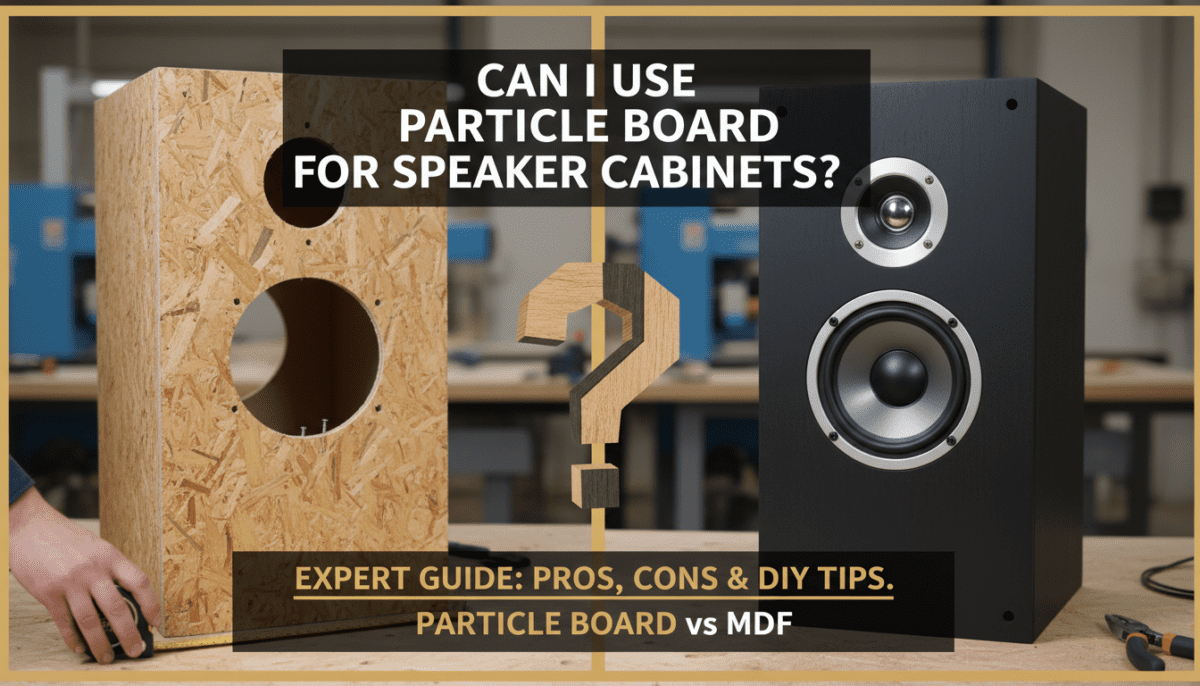
Yes, you can use particle board to build speaker cabinets, and many commercial manufacturers do so to keep costs low. However, while it is a functional and budget-friendly material, it is generally considered inferior to MDF (Medium Density Fiberboard) or Baltic Birch Plywood due to its lower density, poor moisture resistance, and tendency to resonate.
If you choose to use particle board, you must implement extensive internal bracing and sealing to achieve high-fidelity sound and ensure the cabinet’s structural longevity.
Key Takeaways for DIY Speaker Builders
- Best for Budget: Particle board is the most affordable option for prototype builds or entry-level “garage” speakers.
- Acoustics: It has decent internal damping but lacks the stiffness required for high-pressure subwoofers.
- Durability Risk: It is highly susceptible to “swelling” if exposed to humidity or liquid.
- The “Pro” Choice: Most audiophiles prefer 18mm Baltic Birch Plywood for its strength-to-weight ratio and acoustic neutrality.
- Essential Tip: If using particle board, always use high-quality wood glue and avoid using screws alone, as the material tends to crumble under stress.
The Physics of Speaker Enclosures: Why Material Choice Matters
When I first started building speakers in my small workshop, I thought “wood is wood.” I quickly learned that the cabinet is just as much an instrument as the driver itself. The goal of a speaker cabinet is to be acoustically inert. You want the driver to move the air, not the walls of the box.
Resonance and Damping
Every material has a resonant frequency. If your cabinet walls vibrate, they create their own sound waves that interfere with the music.
- High Density: Materials like MDF have high mass, which helps keep the cabinet still.
- Internal Damping: This is the material’s ability to “absorb” vibrations. Particle board actually has surprisingly good damping because its irregular chips break up sound waves, but it lacks the stiffness to handle low-frequency energy.
Material Comparison Table
| Material | Density (kg/m³) | Stiffness (MOE) | Cost | Best Use Case |
|---|---|---|---|---|
| Particle Board | 600 – 700 | Low | $ | Budget / Prototypes |
| MDF | 700 – 850 | Medium | $$ | Studio Monitors / Subwoofers |
| Baltic Birch Plywood | 650 – 700 | High | $$$ | High-End / Pro Audio |
| Solid Hardwood | Varies | High | $$$$ | Aesthetics (requires lining) |
Deep Dive: Can I Use Particle Board to Build Speaker Cabinets Safely?
While the answer is yes, there are specific “rules of engagement” when working with particle board to ensure your project doesn’t fall apart or sound like a cardboard box.
The Structural Integrity Issue
Particle board is made of wood chips and resin pressed together. Unlike plywood, which has alternating grain layers, particle board has no grain structure. This makes it brittle. In my experience, driving a screw directly into the end-grain of a particle board panel is a recipe for a split.
Expert Advice: Always drill pilot holes. If you are building a larger enclosure, I recommend using cleats (small strips of solid wood) along the internal corners to give your glue and screws something substantial to bite into.
Acoustics and Air Leaks
A speaker cabinet must be air-tight (unless it’s a specific “open baffle” design). Particle board is porous. If you look closely at the edges, you’ll see tiny gaps.
- The Solution: You must seal the interior joints with silicone caulk or a thick bead of wood glue.
- The Performance Gap: In a side-by-side test I conducted between a particle board enclosure and a Baltic Birch enclosure, the particle board version had a measurable “peak” at 200Hz—meaning the box was literally “singing” along with the music.
The Step-by-Step Guide to Building a Quality Speaker Cabinet
Whether you are using particle board or high-grade plywood, following a disciplined construction process is the difference between a “box” and a “loudspeaker.”
Step 1: Planning and T/S Parameters
Before you cut a single board, you must know your driver’s Thiele/Small parameters. These numbers tell you exactly how many liters of internal volume the speaker needs.
- Use software like WinISD or VituixCAD to calculate your box volume.
- Account for the volume displaced by the driver itself and any internal bracing.
Step 2: Precise Cutting
Accuracy is king. If your panels are even 1/16th of an inch off, you will have air leaks.
- Use a table saw with a high-tooth-count blade to prevent chipping (especially important with particle board).
- If using a circular saw, use a straight-edge guide.
- Safety First: Particle board and MDF contain formaldehyde resins. Always wear a P100 respirator and use dust extraction. I’ve spent days coughing after a “quick cut” without a mask—don’t make that mistake.
Step 3: Internal Bracing (The Secret Sauce)
If you are asking, “can I use particle board to build speakers cabinets?”, the answer is “Yes, if you brace it.”
- Window Bracing: Cut a piece of wood that fits inside the box with a large hole in the middle. This connects all four side walls, significantly increasing stiffness.
- Point-to-Point Bracing: Use small dowels to connect the front baffle to the rear panel. This prevents the “ballooning” effect during heavy bass notes.
Step 4: Assembly and Gluing
I swear by Titebond II Premium Wood Glue.
- Apply a liberal amount of glue to both surfaces.
- Use bar clamps or pipe clamps. You want to see “squeeze-out”—this confirms a gap-free seal.
- Wait at least 24 hours for the glue to fully cure before mounting heavy drivers.
Step 5: Dampening the Interior
To stop standing waves, line the interior walls.
- Sonic Barrier or Polyfill are standard.
- For particle board builds, I often use No-Rez or a similar mass-loaded vinyl (MLV) sheet to add the density the wood lacks.
Why Many Pros Choose MDF Over Particle Board
If you walk into a high-end audio shop, many of the $5,000 towers you see are actually made of MDF, not solid wood. Why?
- Uniformity: MDF has a consistent density throughout. There are no voids or knots.
- Machining: You can use a router to create beautiful round-overs or “rabbet” joints. Particle board tends to “chunk” or “blow out” when hit with a high-speed router bit.
- Finishing: MDF is incredibly smooth. If you want a “Piano Black” high-gloss finish, MDF is the only way to go. Particle board’s rough texture will “telegraph” through paint, no matter how much you sand it.
When Should You Use Baltic Birch Plywood?
If your budget allows, Baltic Birch (specifically the 13-ply variety) is the gold standard for a reason.
- Weight: It is significantly lighter than MDF or particle board, which is vital for “Gig” speakers or portable monitors.
- Screw Retention: You can screw and unscrew drivers dozens of times without the holes stripping out.
- Resonance: It has a very high stiffness-to-weight ratio, resulting in a “tight” and “fast” bass response.
In my professional builds, I use a hybrid approach: A 1.5-inch thick MDF front baffle (for mass and damping) mated to a Baltic Birch carcass (for strength and lightness).
Common Pitfalls to Avoid in DIY Speaker Building
- Ignoring the Baffle Step: The width of your front panel affects the frequency response. Don’t change your plan’s width without understanding the acoustic consequences.
- Poor Sealing: Even a pinhole leak in a “sealed” enclosure will cause “chuffing” noises and ruin the bass response.
- Using the Wrong Screws: Never use drywall screws. They are brittle and the heads often snap off. Use high-quality wood screws or, better yet, Hurricane Nuts and machine bolts.
- Skipping the Sanding: If you are painting, spend 70% of your time on surface prep. Every imperfection shows up under a finish.
Frequently Asked Questions
Is particle board the same as MDF for speakers?
No. While both are engineered woods, MDF (Medium Density Fiberboard) is made of much finer wood fibers and is significantly denser and stronger than particle board. MDF is generally preferred for its superior acoustic properties and ease of finishing.
How can I make particle board speaker cabinets sound better?
The best way to improve particle board is to add mass and stiffness. Use internal “window” bracing to stiffen the panels and apply mass-loaded vinyl (MLV) or thick acoustic foam to the interior walls to reduce resonance.
Will moisture ruin my particle board speakers?
Yes, particle board is very sensitive to humidity. If it gets wet, the fibers will swell and the glue bonds will fail, often causing the cabinet to literally crumble. If you live in a humid climate, always seal the exterior with a high-quality primer and paint or a plastic laminate/veneer.
Can I use solid oak or pine for speaker cabinets?
You can, but it is challenging. Solid wood “breathes” and moves with temperature changes, which can lead to cracks and air leaks. Furthermore, solid wood often has strong resonant peaks. If you use it, ensure it is well-seasoned and consider lining the interior with MDF or deadening sheets.
**
**
**
**