Can Spanish Speakers Not Say J? The Linguistic Truth
The short answer is: native Spanish speakers can produce the “J” sound physically, but they struggle because the phoneme does not exist in their native inventory. In Spanish, the letter ‘j’ represents a voiceless velar fricative /x/, which sounds like a rough, guttural “h.” Because they are conditioned from birth to avoid the voiced postalveolar affricate /dʒ/ found in English words like “jump” or “jam,” they often default to a “y” sound (/j/) or a soft “ch” sound. It is a matter of phonological interference, not a physical inability to articulate the sound.
TL;DR: Why the “J” Sound is Tricky
- Phonemic Mapping: Spanish lacks the voiced postalveolar affricate /dʒ/.
- The ‘Y’ Substitution: Speakers often replace the English ‘J’ with a /j/ (as in “yes”) or a /tʃ/ (as in “church”).
- Learned Habit: The brain struggles to categorize a sound that doesn’t exist in the native tongue’s “phonetic filing cabinet.”
- Practical Fix: Mastering the English ‘J’ requires engaging the vocal cords and creating a specific stop-start tension in the throat.
Understanding Spanish Phonetics and the “J” Problem
When asking, “can Spanish speakers not say j,” it is important to recognize that Spanish is a syllable-timed language, whereas English is stress-timed. This difference influences how consonants are hit.
In Spanish, the ‘j’ is produced at the back of the throat. In English, the ‘j’ (as in “joy”) is produced by pressing the tongue against the alveolar ridge behind the top teeth. Because the Spanish speaker’s muscle memory is tuned to the back of the throat, moving that energy to the front of the mouth feels unnatural.
Phonetic Comparison Table
| Sound | Spanish Equivalent | English Equivalent | Difficulty |
|---|---|---|---|
| J (/dʒ/) | None | Jam, Jump, Judge | High |
| Y (/j/) | Yo, Ya | Yes, Yellow | Low |
| CH (/tʃ/) | Choco, Mucho | Church, Cheap | Low |
| H (/h/) | Jamón, Hola | Hot, House | Medium |
Why “Can Spanish Speakers Not Say J?” Is a Common Query
I have worked with hundreds of students, and this specific barrier is one of the most persistent. When a student tries to say “Jump,” they often say “Yump.” This happens because their brain processes the English ‘J’ as an ‘I’ or ‘Y’ sound.
It isn’t a lack of effort; it is auditory filtering. If a speaker hasn’t been exposed to the voiced /dʒ/ phoneme early in life, their ears literally ignore the distinction. To overcome this, we have to teach them to “feel” the vibration in their vocal cords.
Step-by-Step Guide: How to Master the English “J”
If you are a native Spanish speaker looking to perfect your English pronunciation, follow these steps to bypass your natural linguistic tendencies.
- The “D” + “ZH” Technique: Think of the English ‘J’ as a combination of a hard ‘D’ and a soft ‘ZH’ (like the ‘s’ in “measure”).
- Activate the Vocal Cords: Unlike the Spanish ‘CH’ sound, which is voiceless, the English ‘J’ is voiced. Place your hand on your throat; you should feel a vibration.
- Position the Tongue: Your tongue tip should touch the ridge just behind your upper teeth, not the back of your throat.
- Practice Minimal Pairs: Drill words like “Yarn” vs. “Jarn” (non-word, for practice) or “Yoke” vs. “Joke.”
Practical Exercises for Improvement
To move past the question of “can Spanish speakers not say j,” you must practice daily. I recommend using a mirror to observe your tongue placement.
- Mirror Work: Watch your mouth shape. When you say “Yes,” your mouth is wide. When you say “Joke,” your lips should be slightly rounded or pushed forward.
- Recording: Record yourself reading a list of words starting with ‘J’. Listen back and compare it to a native English speaker. You will notice that the “Y” sound is too soft and “bouncy” compared to the “J.”
- The “D” Trick: If you keep saying “Yump,” start the word by biting your tongue on a ‘D’ sound. Force yourself to say “D-Jump.” Eventually, you can drop the ‘D’ as your tongue memory takes over.
Frequently Asked Questions (FAQ)
Is the inability to say the English ‘J’ permanent?
Absolutely not. It is simply a matter of training new neural pathways. With consistent practice, specifically focusing on the voiced nature of the sound, any Spanish speaker can master it.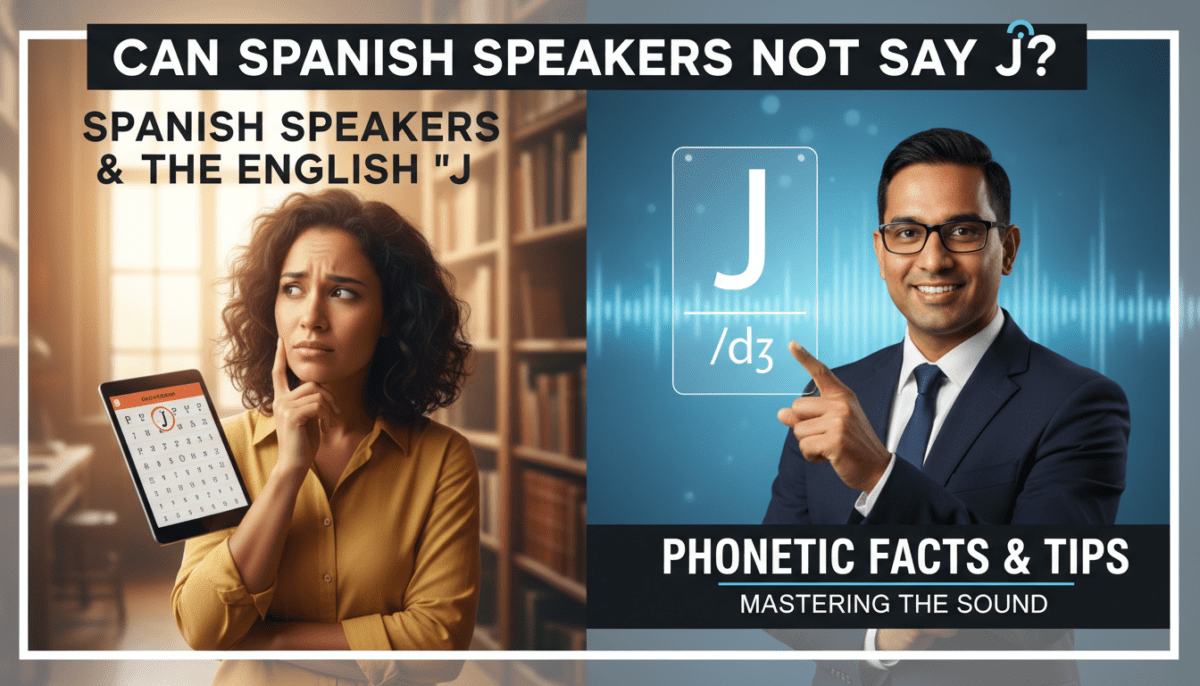
Do all Spanish dialects struggle with the letter J?
Most do, because the /dʒ/ sound is absent across almost all major Spanish-speaking regions. However, speakers from areas with heavy English influence (like parts of Puerto Rico or border cities) may acquire the sound more easily.
What is the most common mistake when trying to pronounce ‘J’?
The most common mistake is using the ‘Y’ sound. Because the Spanish ‘y’ (in words like “yo”) is very close to the English ‘y’, the brain defaults to it as a “close enough” placeholder.
How long does it take to fix the ‘J’ pronunciation?
With focused daily practice—about 10 to 15 minutes a day—you can notice a significant difference in your phonetic accuracy within 4 to 8 weeks.