Can Spark Plugs Give Static Car Speakers? The Direct Answer
Yes, spark plugs can give static to car speakers by generating Electromagnetic Interference (EMI) or Radio Frequency Interference (RFI) during the combustion process. This interference is typically heard as a rhythmic popping or clicking sound in your audio system that increases in speed as you accelerate the engine.
If you are hearing a high-pitched whine that changes with engine RPM, it is likely the alternator; however, a consistent, sharp “tap-tap-tap” through your speakers is almost always a sign of a localized ignition system leak or the use of non-resistor spark plugs.
TL;DR: Quick Key Takeaways
- The Cause: High-voltage electricity jumping the spark plug gap creates “noise” that radiates through the air and into your car’s wiring.
- The Culprit: Using “Non-Resistor” spark plugs in a modern vehicle is the #1 cause of ignition static.
- Identification: Ignition noise sounds like clicking; alternator noise sounds like whining.
- The Fix: Replace old plugs with Resistor-type spark plugs (marked with an “R”) and inspect ignition wires for cracks.
- Prevention: Ensure your engine ground straps are clean and tight to provide a proper path for stray electricity.
Understanding the Connection: How Spark Plugs Create Audio Noise
In my fifteen years of troubleshooting automotive electrical systems, I’ve found that many drivers mistake engine noise for a “blown speaker.” In reality, your car’s ignition system acts like a mini-radio transmitter.
Every time a spark plug fires, it sends tens of thousands of volts across a small gap. This massive surge of energy creates a burst of Electromagnetic Interference (EMI). If your car isn’t properly shielded, your speaker wires act as antennas, picking up these bursts and translating them into the “static” you hear.
The Role of Resistor Spark Plugs
Modern vehicles require Resistor Spark Plugs. These plugs contain a ceramic resistor (usually around 5k ohms) designed to suppress the RFI/EMI generated by the spark.
| Feature | Resistor Spark Plugs | Non-Resistor Spark Plugs |
|---|---|---|
| Primary Use | Modern fuel-injected cars | Racing / Vintage Small Engines |
| RFI Suppression | High (Internal Resistor) | Zero to Low |
| Speaker Static | Rare/None | Extremely Common |
| ECU Compatibility | Required for modern electronics | Can cause engine misfires/errors |
If you recently changed your plugs and suddenly noticed static, check the part number. If the number doesn’t have an “R” in it (e.g., NGK BKR6E vs. BK6E), you have found your problem.
Differentiating Between Ignition Static and Alternator Whine
Before you start tearing apart your engine, we need to confirm the source. Not all “engine noise” comes from the spark plugs.
The Spark Plug “Click” (Ignition Noise)
- Sound: A sharp, rhythmic popping, snapping, or clicking.
- Behavior: The frequency of the clicks speeds up as you hit the gas, but the pitch stays the same.
- Origin: High-voltage leaks from spark plugs, ignition coils, or spark plug wires.
The Alternator “Whine”
- Sound: A high-pitched squeal or “siren” sound.
- Behavior: The pitch of the sound gets higher as engine RPM increases.
- Origin: A bad diode in the alternator or a poor Ground Loop in the head unit wiring.
Step-by-Step Guide to Diagnosing Spark Plug Static
When we diagnose this in the shop, we follow a specific sequence to isolate the hardware. Follow these steps to find the leak.
Step 1: The “Darkness Test” for Ignition Wires
Wait until it is dark outside, start your car, and pop the hood. Look at your spark plug wires and ignition coils.
- If you see faint blue arcs of electricity or “lightning” jumping from the wires to the engine block, your wires are compromised.
- This “leak” is a primary source of can spark plugs give static car speakers complaints.
Step 2: Check the Spark Plug Part Numbers
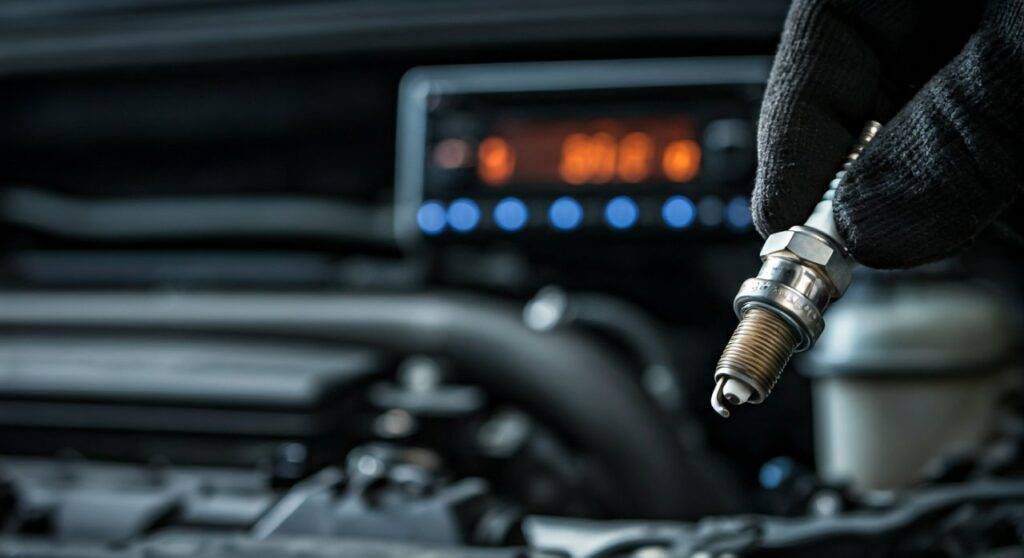
Pull one spark plug and look at the porcelain insulator.
- Search for the part number online.
- Ensure it is a Resistor-type plug.
- If you are running Iridium or Platinum plugs, they almost always have resistors, but cheaper copper “racing” plugs often do not.
Step 3: Inspect the Spark Plug Gap
A gap that is too wide (worn-out plugs) requires more voltage to jump. The higher the voltage needed, the more EMI is produced.
- Check your vehicle’s service manual for the correct gap specification (usually between 0.030″ and 0.050″).
- Use a gap gauge tool to verify.
How to Fix Speaker Static Caused by Spark Plugs
If you’ve confirmed that your ignition system is the culprit, here is the hierarchy of solutions, ranging from simple maintenance to advanced shielding.
Replace with Quality Resistor Plugs
Do not cheap out on spark plugs. Stick to reputable brands like NGK, Denso, or Bosch. I always recommend Double Platinum or Iridium for modern cars because they maintain a consistent gap longer, which keeps RFI levels low over the life of the plug.
Upgrade to High-Quality Ignition Wires
If your car uses traditional spark plug wires (instead of Coil-on-Plug), ensure they have magnetic suppression cores.
- Avoid: Solid copper core wires (these are for old tractors and race cars).
- Recommended: Spiral-wound or Carbon-core wires designed for RFI suppression.
Check and Clean Engine Ground Straps
This is the most overlooked fix. Your engine must be “bonded” to the chassis. If the ground strap is corroded or loose, the EMI from the spark plugs cannot dissipate into the vehicle’s frame and instead “searches” for a path through your radio’s wiring.
- Locate the thick braided wire connecting the engine to the firewall.
- Remove the bolt, sand the contact point to bare metal, and re-attach.
Install an RFI Filter or Ferrite Chokes
If the static persists, you can use hardware to “choke” the interference.
- Ferrite Beads: These are small clip-on magnets. Clip them onto your RCA cables or the main power lead of your head unit.
- Power Capacitors: A small in-line noise filter on the 12V power wire of the radio can help scrub away ignition noise.
Advanced Troubleshooting: When “Good” Plugs Still Cause Static
Sometimes, you can have brand-new Resistor Spark Plugs and still experience noise. This usually indicates an issue with the Car Audio Installation.
The Problem with RCA Cable Routing
If you have an aftermarket amplifier, how you ran your wires matters.
- The Mistake: Running the RCA (Signal) cables right next to the car’s main wiring loom or near the Ignition Coil pack.
- The Fix: Always run your power cables down one side of the car and your signal (RCA) cables down the opposite side to minimize “crosstalk.”
Ground Loops vs. Ignition Noise
If the static stays at the same volume regardless of how high you turn the radio, it’s likely an equipment ground issue. If the static gets louder as you turn the volume up, the noise is entering through the “front end” (the antenna or the spark plugs).
Technical Specifications: Suppression Ratings
For the tech-savvy, here is how we measure the effectiveness of suppression:
| Component | Standard Resistance | Purpose |
|---|---|---|
| Spark Plug | 3,000 – 7,500 Ohms | Limits current surge to reduce RFI |
| Plug Wire | 2,000 – 12,000 Ohms per foot | Absorbs electromagnetic pulses |
| Ignition Coil Boot | Infinity (Insulator) | Prevents voltage “flashover” to the head |
If your spark plug shows 0 ohms on a multimeter, it is a non-resistor plug and is the direct cause of your speaker static.
Frequently Asked Questions (FAQ)
Can bad spark plugs affect radio reception?
Yes. Bad spark plugs or leaking ignition wires create wide-spectrum radio interference. This is most noticeable on AM radio, but in severe cases, it will bleed into FM, Bluetooth, and even Auxiliary inputs.
Will changing my spark plugs fix my speaker buzzing?
If the buzzing is a rhythmic clicking that changes with engine speed, then yes, replacing old or non-resistor plugs will likely fix the issue. However, if the buzz is constant even when the engine is off, the problem is in the amplifier or head unit.
Are “Performance” spark plugs worse for audio static?
Many “Racing” or “High-Performance” plugs are non-resistor to provide the most “raw” spark possible. While good for a dragster, they are terrible for a daily driver with a sound system. Always ensure your performance plugs are labeled as “Resistor Type” if you value your audio quality.
Can a cracked ignition coil cause speaker static?
Absolutely. A cracked coil allows high-voltage electricity to “leak” out before it reaches the spark plug. This creates a massive amount of EMI that your car speakers will pick up as a loud popping or snapping sound.