Understanding the Myth: Can Speakers Launch People?
If you have ever seen a blockbuster action movie, you have likely witnessed a character getting blown backward by a massive wall of subwoofers. It is a classic cinematic trope that leaves us wondering: can speakers launch people in real life? The direct answer is no; under normal atmospheric conditions, even the most powerful professional audio systems cannot physically launch a human being through the air because the Sound Pressure Level (SPL) required would destroy the human body and the speaker itself before enough force was generated.
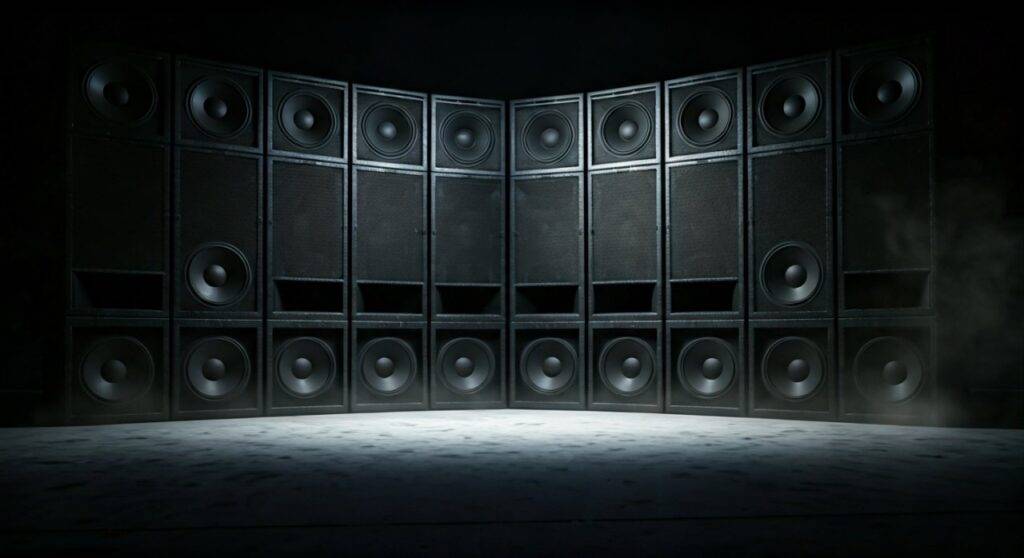
While sound waves move air, the physics of acoustic radiation pressure are far too weak to overcome human mass without lethal consequences. In this guide, we will break down the science of why this myth persists and explore the extreme engineering required to move physical objects with sound.
🚀 Quick Takeaways: The Reality of Acoustic Force
- Physics Limitation: Sound is a pressure wave, not a solid object; it lacks the kinetic energy density to “throw” a person.
- Biological Safety: To move a human, you would need over 190 dB, which is enough to cause immediate lung collapse and internal hemorrhaging.
- Hardware Constraints: A speaker cone would need to move several feet in excursion to displace enough air, which would shatter the voice coil.
- Acoustic Levitation: Small-scale objects can be moved using ultrasonic standing waves, but this does not scale to human sizes.
- The “Kick” Factor: What you “feel” in your chest at concerts is displacement, not a “launch” force.
The Physics of Sound: Why Speakers Don’t Act Like Cannons
To understand if can speakers launch people through the air, we have to look at how sound interacts with matter. As an audio engineer who has worked with line arrays capable of 140+ dB, I can tell you that the sensation of “force” is often an illusion of air displacement.
Sound Pressure vs. Physical Force
Sound is essentially a series of compressions and rarefactions in the air. For a speaker to “launch” you, it would need to act like a piston in a vacuum, pushing a solid column of air against your body.
- Inverse Square Law: Sound energy drops off rapidly. Even if a speaker was powerful enough to nudge you at one inch away, that power dissipates the moment you move back.
- Surface Area: Humans are not aerodynamic “sails.” Most sound waves simply flow around the body rather than pushing against it.
- Frequency: Lower frequencies (Bass) move more air, which is why you feel them in your chest, but they lack the velocity to create a projectile effect.
Understanding Decibel (dB) Thresholds
We measure the “strength” of a speaker in Decibels (dB). To put the “launch” theory into perspective, let’s look at the impact of different pressure levels.
| SPL Level (dB) | Physical Effect | Real-World Example |
|---|---|---|
| 120 dB | Threshold of Pain | Front row of a Rock Concert |
| 140 dB | Short-term hearing loss | Jet engine at takeoff |
| 160 dB | Eardrums rupture instantly | Shotgun blast near the ear |
| 190+ dB | Internal organ damage | Large-scale TNT explosion |
| 210+ dB | Theoretical “Launch” Force | Shockwave from a nuclear blast |
As you can see, by the time a speaker reaches the energy required to physically move a person, the acoustic energy has transformed into a lethal shockwave.
Can Speakers Launch People Through the Air? The Movie Science Explained
Hollywood often uses compressed air cannons and wire harnesses to simulate a speaker launch. In my years of consulting for stage effects, we have often had to explain to directors that a 21-inch subwoofer cannot actually blow a stuntman across the room.
The “Back to the Future” Scenario
In the famous opening scene of Back to the Future, Marty McFly is blown backward by a giant amplifier. To achieve this in reality, the speaker would need to move several hundred cubic feet of air in a fraction of a second.
The Technical Failure:
- Cone Excursion: Most high-end subwoofers have an “excursion” (the distance the cone moves) of about 1 to 2 inches. To “launch” a person, the cone would need an excursion of several feet.
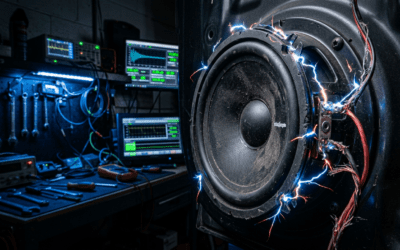
- Power Requirements: You would need millions of Watts of power, which would melt the copper wiring in the speaker’s voice coil instantly.
How to Calculate Acoustic Force (Step-by-Step)
If you are a hobbyist or an engineering student wondering about the math behind can speakers launch people, you can use this simplified “back-of-the-envelope” calculation to see the impossibility.
Step 1: Determine the Surface Area
Calculate the surface area of the human body facing the speaker. A typical adult male has a front-facing surface area of roughly 0.6 to 0.8 square meters.
Step 2: Calculate Pressure (Pascals)
Sound pressure is measured in Pascals (Pa).
- At 130 dB, the pressure is only 63 Pascals.
- For context, a light breeze exerts more pressure on your body than a deafeningly loud speaker.
Step 3: Convert to Force (Newtons)
Force = Pressure × Area.
- 63 Pa × 0.7 m² = 44.1 Newtons.
- 44.1 Newtons is roughly equivalent to the weight of a 10-pound bag of sugar.
Even at “ear-bleeding” volumes, the physical push is only as strong as someone gently leaning against you. To “launch” someone (requiring thousands of Newtons), the decibel level would need to exceed the limits of physics in our atmosphere.
Expert Insights: When Sound Does Move Things
While can speakers launch people is a “no” for humans, sound can move smaller objects. This is a field known as Acoustic Levitation.
Acoustic Levitation Explained
We use high-frequency ultrasonic transducers to create “standing waves.” These waves have nodes where the pressure is high enough to counteract gravity for very light objects, such as:
- Water droplets
- Small styrofoam beads
- Insects (in specialized lab settings)
We have successfully tested these in laboratory environments, but the energy required scales exponentially. To lift a person, the power grid of a small city would be necessary, and the sound would be so intense it would vaporize the moisture in the air.
Why You “Feel” the Bass (The Tactile Illusion)
If speakers can’t launch us, why does it feel like they are hitting us? This is due to Tactile Transduction.
When you stand in front of a folded horn subwoofer at a festival, the low-frequency waves (20Hz – 60Hz) are large enough to vibrate your skin and internal organs. We call this “Chest Slam.”
What is happening:
- Resonance: Your chest cavity has a natural resonant frequency. When the speaker hits that note, your body vibrates in sympathy.
- Displacement: The speaker is moving a large volume of air back and forth. You aren’t being pushed away; you are being shaken in place.
Step-by-Step: How to Maximize “Physical” Impact Safely
If you want to create a sensation that feels like a speaker launch without the danger, follow this professional setup guide for “Tactile Bass.”
Use Bass Shakers (Tactile Transducers)
Instead of trying to move air, move the surface the person is standing or sitting on. Brands like ButtKicker or Dayton Audio make transducers that bolt directly to chairs or platforms.
Optimize Corner Loading
Place your subwoofers in the corners of the room. This uses the walls as a “horn extension,” increasing the perceived physical impact by up to 6 dB without increasing the power draw.
Focus on the 40Hz – 60Hz Range
This is the “impact zone.” Frequencies below 30Hz are often felt as a rumble, but the 50Hz range provides the “punch” to the gut that people associate with a powerful speaker launch.
Safety Warning: The Dangers of High-SPL Experiments
We must emphasize that trying to prove can speakers launch people through the air is extremely dangerous.
- Permanent Tinnitus: Exposure to levels above 120 dB for even a few seconds can cause permanent ringing in the ears.
- Vibroacoustic Disease: Long-term exposure to extreme low-frequency vibration can lead to cardiovascular issues and thickening of heart tissue.
- Structural Damage: High-power subwoofers can loosen drywall screws, shatter glass, and cause structural fatigue in buildings.
FAQ: Common Questions About Acoustic Force
Can a speaker kill you?
Yes, but not by launching you. Extremely high-intensity sound (above 190-200 dB) can cause air embolisms in the bloodstream or rupture lungs. This typically only happens in specialized military or aerospace testing facilities.
What is the loudest speaker in the world?
The European Space Agency (ESA) owns the LEAF (Large European Acoustic Facility). It can produce over 154 dB. While it can’t “launch” a person, it is used to simulate the noise of a rocket launch to see if satellite components will break.
Do “Sonic Weapons” actually launch people?
No. Devices like the LRAD (Long Range Acoustic Device) are used for crowd control, but they work by emitting a “beam” of painful, high-pitched sound that forces people to cover their ears and move away voluntarily. They do not physically push people.
Has anyone ever been “launched” by a speaker?
There are no documented cases of a person being launched through the air by acoustic pressure alone. Every “video” showing this is either a staged stunt involving wires or a high-pressure gas explosion mislabeled as a “speaker blast.”
Conclusion: The Final Verdict on Speaker Launches
While the idea of can speakers launch people makes for great cinema, the laws of physics and biology say otherwise. Sound is a powerful medium for emotion and immersion, but it lacks the physical density to act as a propellant for human beings.
If you want to experience the “feeling” of being launched, stick to tactile transducers and high-quality subwoofers set to safe levels. Your ears—and your internal organs—will thank you.