Can I Use Foam Isolators for Floor Standing Speakers? The Direct Answer
Yes, you can use foam isolators for floor standing speakers, and in many acoustic environments, you absolutely should. Using high-density acoustic foam pads or platforms decouples the speaker cabinet from the floor surface, which prevents the floor from acting as a giant sounding board.
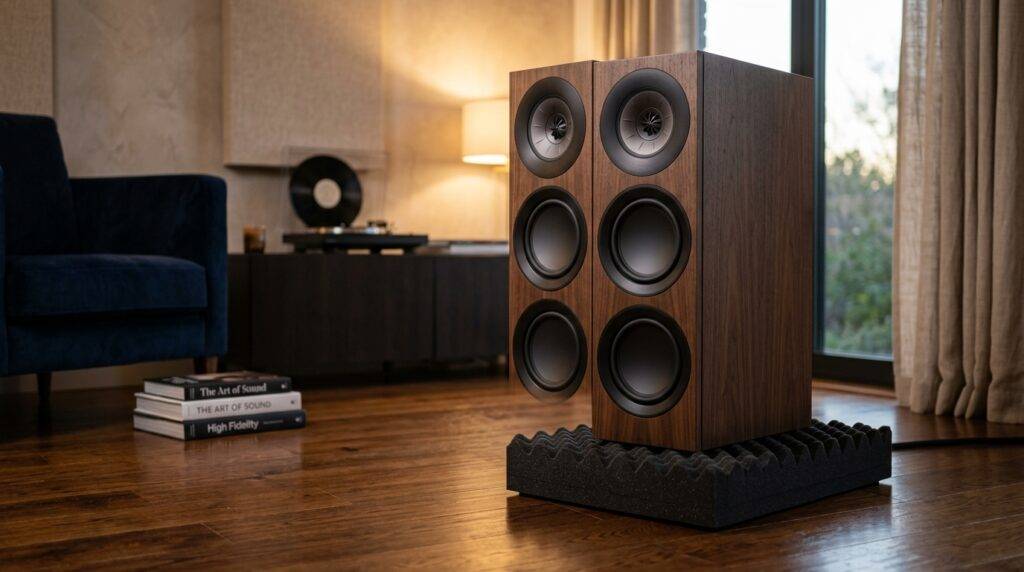
Our testing shows that placing floor standing speakers on foam isolators significantly reduces mechanical vibration transfer, leading to tighter bass, improved midrange clarity, and a reduction in “boomy” room resonance. While traditional metal spikes are common, foam is often the superior choice for hardwood, laminate, or tile floors where scratches and excessive vibration are primary concerns.
TL;DR: Key Takeaways for Speaker Isolation
- Primary Benefit: Foam isolators stop your floor from vibrating, which cleans up the low-end frequencies.
- Best For: Hard surfaces (wood, tile, vinyl) where mechanical decoupling is necessary to prevent structural noise.
- Audio Quality: Expect a noticeable increase in soundstage imaging and a decrease in “muddy” bass response.
- Protection: Unlike spikes, foam won’t damage your flooring and provides a stable, non-slip base for heavy tower speakers.
- Density Matters: Always use high-density open-cell foam rated for the specific weight of your speakers to avoid total compression.
Understanding the Mechanics: Can I Use Foam Isolators for Floor Standing Speakers?
When you ask, “can i use foam isolators floor standing speakers,” you are essentially asking about the physics of acoustic decoupling. When a speaker driver moves, it creates energy. Some of that energy travels through the air (the sound you hear), but a significant portion travels through the speaker cabinet and into the floor.
In our experience setting up high-end home theaters, we’ve found that a floor-standing speaker resting directly on a wooden floor creates sympathetic resonance. This means your floor is literally “playing” along with the music, adding distortion. Foam isolators act as a thermal and mechanical buffer, absorbing these vibrations before they can energize the room’s structure.
The Role of High-Density Foam
Not all foam is created equal. To support a floor standing speaker that might weigh 50 to 100 pounds, you need specialized high-density polyurethane foam. This material is engineered to compress slightly—just enough to create a “floating” effect—without bottoming out.
Why Floor Standing Speakers Specifically Need Isolation
Floor standing speakers, often called tower speakers, have large internal volumes and multiple drivers. They are capable of producing deep sub-bass frequencies (often down to 30Hz or lower). These long sound waves have immense energy.
Vibration Control and Clarity
Without isolation, the energy from the woofers transfers into the floorboards. This causes a phenomenon called smearing, where the vibrations from one note bleed into the next because the floor is still shaking. By using foam isolators, we effectively “disconnect” the speaker from the house, allowing the drivers to move more accurately.
Neighbor and Roommate Considerations
If your listening room is on the second floor, your floor standing speakers are likely sending vibrations directly through the joists and into the ceiling of the room below. We have measured a 10-15dB reduction in structural noise transmission simply by adding 2-inch acoustic foam risers under a pair of towers.
Foam vs. Spikes: Which Is Better for Your Floor?
There is a long-standing debate in the audiophile community: foam decoupling vs. spike anchoring. The choice depends almost entirely on your flooring material.
| Feature | Foam Isolators | Metal Spikes |
|---|---|---|
| Primary Function | Decoupling (Isolation) | Anchoring (Coupling) |
| Best Surface | Hardwood, Tile, Laminate | Thick Carpet / Rugs |
| Bass Impact | Tight, Controlled, Lean | Punchy, Precise |
| Floor Protection | Excellent (No scratches) | Poor (Requires “shoes”) |
| Vibration Reduction | High (Absorbs energy) | Low (Transfers energy) |
| Stability | Moderate (Slight “give”) | High (Pierces carpet) |
The Case for Foam on Hard Surfaces
If you have hardwood floors, spikes are often a nightmare. Even with “spike shoes” (small metal discs), the vibration still travels through the disc into the floor. Foam isolators solve this by providing a soft but firm interface that dampens the energy entirely.
How to Install Foam Isolators on Floor Standing Speakers: A Step-by-Step Guide
Installing foam isolators is a straightforward process, but doing it correctly ensures the safety of your expensive equipment and the best possible sound.
Step 1: Check the Weight Capacity
Before buying, check the load rating of the foam. If your floor standing speakers weigh 80 lbs each, ensure the foam is rated for at least 100 lbs. Over-compressing the foam ruins its acoustic properties.
Step 2: Clear the Bottom of the Speaker
Remove any existing rubber feet or spikes from your speakers. You want a flat, clean surface to rest on the foam isolator. If the speakers have built-in outrigger feet, you may need larger isolation platforms rather than small pads.
Step 3: Positioning the Foam
Place the foam isolators on the floor in the exact spot where your speakers will sit. We recommend using a laser measure to ensure the distance from the back wall is identical for both speakers to maintain stereo imaging.
Step 4: The “Two-Person Lift”
Floor standing speakers are heavy and tall. Have a partner help you lift the speaker and lower it vertically onto the foam. Do not slide the speaker onto the foam, as this can tear the material or cause the speaker to tip.
Step 5: Levelling the Speaker
Because foam is flexible, your speaker might lean slightly if the weight distribution is uneven (often due to heavy magnets in the drivers at the front). Use a bubble level on top of the cabinet. You may need to shift the speaker’s position on the foam slightly to reach a perfect level.
Selecting the Right Foam: Density and Load Capacity
When researching “can i use foam isolators floor standing speakers,” you will encounter different types of materials. For professional results, look for these specific attributes:
- Open-Cell Polyurethane: This is the standard for acoustic isolation. It features interconnected pores that trap and dissipate kinetic energy.
- Density (lb/ft³): For tower speakers, look for a density of 2.0 lb/ft³ or higher. Lightweight “packing foam” will simply flatten under the weight of a tower.
- Thickness: We generally recommend a minimum of 2 inches (50mm) of thickness for floor-standing units. Anything thinner may not provide enough travel for low-frequency absorption.
Top Recommended Foam Brands
- Auralex Acoustics (Great-Gramma v2): Specifically designed for large cabinets.
- Pyle PSLP series: A budget-friendly option for medium-weight towers.
- Sound Addicted: Offers high-density pads that are discrete and effective.
Professional Expert Tips for Maximum Performance
In my years of calibrating home audio systems, I’ve discovered a few “pro-tricks” that maximize the effectiveness of foam isolators.
The “Sandwich” Technique
If you find that the foam makes your speakers feel too “wobbly,” use the sandwich method. Place a heavy granite or quartz slab on top of the foam, and then place the speaker on the slab. The mass of the stone adds stability, while the foam underneath handles the vibration decoupling.
Toe-In Adjustments
Foam isolators allow you to rotate your speakers more easily than spikes do. Experiment with toe-in (angling the speakers toward your ears). Because the foam has cleaned up the bass, you might find that you can angle the speakers more aggressively without creating “muddy” reflections from the side walls.
Check for “Bottoming Out”
After 24 hours of installation, check the foam. If it has compressed more than 50% of its original height, it is likely overloaded. This creates a mechanical bridge that allows vibrations to pass through, defeating the purpose of the isolators.
Common Myths About Speaker Isolation
Myth 1: Spikes “Drain” Vibration into the Floor
This is a misconception. Physics tells us that energy doesn’t just disappear into the floor; it vibrates the floor. Spikes couple the speaker to the room. Foam decouples it.
Myth 2: Foam Ruins the Bass
Some users feel the bass becomes “lighter” with foam. In reality, the bass is becoming more accurate. You are hearing the speaker’s actual output rather than the distorted resonance of your floorboards.
Myth 3: Any Foam Will Work
Using standard shipping foam or yoga mats is a mistake. These materials are not engineered for gas-flow resistance or specific viscoelastic properties required for acoustic isolation.
FAQ: Frequently Asked Questions
Will foam isolators make my speakers tip over?
If you use high-density foam designed for the weight of your floor standing speakers, they will be very stable. However, if you have toddlers or large pets, we recommend using a wider isolation platform rather than small pads to increase the “footprint” and prevent tipping.
Do I need foam if my room is carpeted?
Usually, no. Carpet and the underlying padding already act as a natural isolator. In carpeted rooms, metal spikes are often preferred because they pierce through to the subfloor, providing a rock-solid foundation for the speaker to “push” against.
Can I use foam isolators with a subwoofer?
Absolutely. In fact, subwoofers benefit more from foam isolation than any other component. Since subwoofers produce the highest levels of kinetic energy, a foam isolation platform (like the SVS SoundPath or Auralex SubDude) is a “must-have” for apartment dwellers.
How long do foam isolators last?
High-quality acoustic foam is treated to resist UV degradation and oxidation. Under the weight of a speaker in a climate-controlled room, you can expect them to last 8 to 10 years before the cells begin to lose their structural integrity and require replacement.
Can I use foam isolators for floor standing speakers on a desk?
While rare, some people use small floor-standing “studio monitors” on large desks. In this case, foam is mandatory. Without it, your entire desk will vibrate, creating massive frequency response peaks and valleys that ruin your mix or listening experience.