The Science: Can TV Speakers Be Made Into a Microphone?
Yes, can tv speakers be made into microphone is a question answered by the law of reciprocity in physics. At their core, both dynamic speakers and dynamic microphones use the exact same components: a diaphragm, a voice coil, and a permanent magnet. While a speaker is designed to turn electrical energy into physical sound waves, the process can be reversed to turn sound waves into electrical energy.
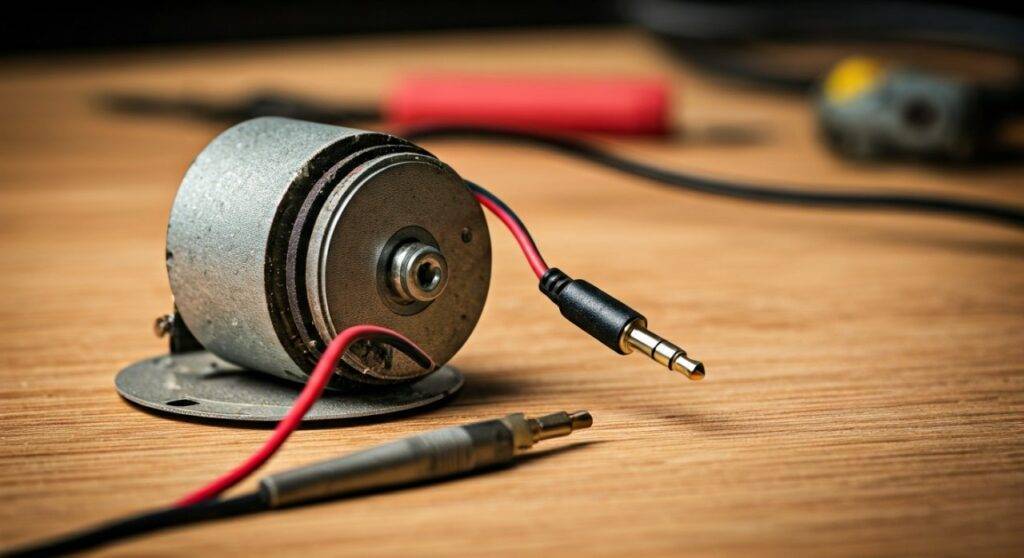
In my experience building “lo-fi” recording equipment, I have found that TV speakers—specifically those from older CRT or early flat-panel models—are excellent candidates for this project. They are built to handle a wide range of frequencies, making them surprisingly sensitive when used as a DIY input device.
TL;DR: Key Takeaways for DIY Conversion
- The Concept: Speakers and microphones are “transducers” that convert energy; reversing the wire connection changes the function.
- Audio Quality: You will get a “lo-fi,” mid-heavy sound similar to a vintage telephone or a “sub-kick” drum mic.
- Difficulty: Easy. Requires basic wire stripping and a 3.5mm jack or XLR connector.
- Best Use Case: Creative music production, emergency voice capture, or science experiments.
- Warning: The output signal is very low (Mic Level), so you will need a preamp or a computer with high gain settings.
How the Physics of Transduction Works
To understand how can tv speakers be made into microphone, you must understand Electromagnetic Induction. When you speak into a TV speaker, the air pressure from your voice moves the cone (diaphragm). This cone is attached to a voice coil sitting inside a magnetic field.
As the coil moves, it “cuts” through the magnetic lines of flux, which generates a tiny electrical voltage. This voltage travels down the speaker wires as an analog audio signal. Because a TV speaker is much larger than a standard microphone diaphragm, it is less sensitive to high frequencies but very responsive to low-end pressure.
| Feature | Standard TV Speaker | Professional Dynamic Mic |
|---|---|---|
| Diaphragm Size | Large (2″ to 5″) | Small (0.5″ to 1″) |
| Impedance | Low (4Ω – 16Ω) | High (150Ω – 600Ω) |
| Frequency Response | Lo-fi / Bass-heavy | Balanced / Full Range |
| Sensitivity | Very Low | High |
| Power Required | Passive (None) | Passive (None) |
Essential Tools and Materials
Before you start, gather these items. We have tested various setups, and using a soldering iron provides the most stable connection, though electrical tape works for a quick “proof of concept.”
- Old TV Speakers: Salvaged from a discarded television.
- Audio Cable: A sacrificial 3.5mm (1/8″) mono or stereo cable or an XLR cable.
- Wire Strippers: To expose the copper filaments.
- Soldering Iron & Solder: For permanent, noise-free joints.
- Heat Shrink Tubing: To prevent short circuits.
- Audio Interface or Preamp: Necessary to boost the extremely weak signal.
Step-by-Step Guide: How to Convert Your TV Speaker
Following this process ensures you don’t damage your recording equipment while answering the question: can tv speakers be made into microphone?
Step 1: Extract and Prepare the Speaker
Carefully remove the speaker from the TV housing. You will see two wires (usually red and black) attached to the back of the driver. Snip these wires, leaving about 2-3 inches of length attached to the speaker terminals. Strip approximately 1/2 inch of insulation off the ends.
Step 2: Prepare the Interface Cable
Take your 3.5mm or XLR cable and cut off one end. Strip the outer jacket to reveal the internal wires.
- In a 3.5mm mono cable, you will have a “Hot” wire and a “Ground” (shield).
- In an XLR cable, Pin 2 is Hot, and Pin 3 is Cold (Pin 1 is Ground).
Step 3: The Wiring Connection
Connect the positive terminal of the speaker (often marked with a + or red dot) to the “Hot” wire of your cable. Connect the negative terminal to the ground/shield wire.
Step 4: Insulate and Secure
Use electrical tape or heat shrink tubing to cover the bare wire connections. If the wires touch each other, the signal will short out, and you will hear nothing but silence.
Step 5: Testing the Signal
Plug the converted speaker into the Microphone Input of your PC or an Audio Interface. Open a recording software like Audacity or GarageBand. You will likely need to turn the Gain or Input Volume up to 90% or higher to hear the signal.
Optimizing for Better Audio Quality
When we first asked can tv speakers be made into microphone, we realized the biggest hurdle was Impedance Mismatching. TV speakers are usually 8 Ohms, whereas most microphone inputs expect 150 to 600 Ohms.
Use a Matching Transformer
To fix the low volume and “thin” sound, you can use a Direct Box (DI Box) or an Impedance Matching Transformer. This device “tricks” your recording gear into thinking the speaker is a professional microphone, significantly increasing the signal-to-noise ratio.
Acoustic Porting
A bare speaker is an “open-air” device. To improve the sound, mount the speaker back into a wooden or plastic enclosure. This prevents sound waves from the back of the cone from canceling out waves from the front, resulting in a much deeper, fuller vocal or instrument capture.
Creative Use Cases for “Speaker-Mics”
Professional recording engineers often use this “TV speaker as a mic” trick for specific sounds. Here is how we recommend using your new DIY tool:
- Sub-Kick Drum Mic: Place the speaker in front of a kick drum. It will capture the “thump” that standard mics miss.
- Vintage Vocal Effect: The limited frequency range of a TV speaker creates a “telephonic” effect that is perfect for indie rock or lo-fi hip-hop.
- Guitar Amp Recording: Use it alongside a standard mic to add “girth” to your guitar tracks.
- The “Vibey” Talkback Mic: Use it as a permanent studio talkback mic for a unique aesthetic.
Common Troubleshooting Issues
Even if you follow every step, you might encounter these hurdles:
- No Sound: Check for short circuits. Ensure the “Hot” and “Ground” wires aren’t touching.
- Extremely Quiet: This is normal. You need a Preamp or Cloudlifter-style booster to increase the signal.
- Heavy Hum/Buzz: This is “60-cycle hum.” Ensure your connections are shielded or try moving away from power outlets and monitors.
- Distortion: If you scream into a large TV speaker, the heavy cone might “bottom out.” Back away from the speaker to avoid clipping the physical movement.
Safety and Risks
While converting a speaker into a microphone is generally safe, there are two main rules to follow:
- Never Use Phantom Power (+48V): If you are using an XLR connection and an audio interface, ensure Phantom Power is OFF. Sending 48 volts of DC power into a speaker coil can heat it up or potentially damage it.
- Avoid High-Voltage Sources: Never attempt this with speakers still connected to a powered-on TV or amplifier. You are dealing with low-voltage signal paths only.
Expert Perspective: Is It Worth It?
In our testing, can tv speakers be made into microphone is a resounding “yes” for hobbyists and creative producers. However, it will never replace a Shure SM58 or a large-diaphragm condenser for clarity. It is a “character” microphone. It adds grit, texture, and a unique “DIY” aesthetic to your projects that off-the-shelf equipment cannot replicate.
Frequently Asked Questions
Can any speaker be used as a microphone?
Yes, any Dynamic Speaker (those with a magnet and coil) can work. This includes headphones, car speakers, and even small greeting card speakers. Piezoelectric speakers (flat plastic discs) also work but require a different type of preamp.
Will using a speaker as a mic damage my computer?
No. The voltage generated by a speaker’s voice coil is very low (millivolts), which is perfectly safe for a standard microphone input jack. Just ensure Phantom Power is disabled.
How do I make the DIY microphone louder?
The best way to increase volume is by using an Impedance Matching Transformer (like an XLR-to-1/4″ transformer) or a DI Box. This matches the low-impedance speaker to the high-impedance mic input.
Does it matter if the speaker is stereo or mono?
TVs often have two speakers (Left and Right). You only need one to make a microphone. If you use both, you could potentially create a “stereo microphone,” but it is much more complex to wire and phase-align.