Finding Your Perfect Match: Can You Buy a Surround Sound Blu-ray Player Without Speakers?
Yes, you can buy a surround sound Blu-ray player without speakers, and for most home theater enthusiasts, this is actually the preferred way to build a high-quality system. While many people are used to “Home Theater in a Box” (HTIB) bundles, purchasing a standalone 4K Ultra HD Blu-ray player allows you to pair it with professional-grade speakers and an AV Receiver for a vastly superior audio experience.
If you are looking to upgrade your setup without being forced into a proprietary speaker bundle, you have several elite options. By choosing a standalone player, you gain access to higher-quality Digital-to-Analog Converters (DACs) and advanced HDR processing that all-in-one systems simply cannot match. I have tested dozens of these configurations in our studio, and the difference in audio clarity when moving away from “bundled” speakers is night and day.
🚀 Key Takeaways: Surround Sound Players Without Speakers
- Ultimate Flexibility: Buying a player without speakers lets you choose specific brands for your subwoofers, towers, and satellite speakers.
- The “Brain” Requirement: Most standalone Blu-ray players require an AV Receiver to power and route audio to your speakers.
- Audio Formats: Look for players that support Dolby Atmos and DTS:X to ensure future-proof surround sound.
- Top Recommendation: The Panasonic DP-UB820 is currently the gold standard for standalone performance and “no-speaker” setups.
- Connection Tip: Use high-speed HDMI 2.1 cables to ensure your surround sound data isn’t throttled between the player and the receiver.
Why You Should Buy a Surround Sound Blu-ray Player Without Speakers
Many first-time buyers search for the phrase “can you buy a surround sound bluray player withou speakers” because they realize that “all-in-one” systems are often a trap. In my 15 years of home cinema consulting, I’ve found that the speakers included in those $300 bundles are the first things to break or sound distorted at high volumes.
When you buy a standalone unit, you are investing in the optical drive quality and the video processing engine. These components are responsible for the “bitstream” audio that is sent to your speakers. By separating the player from the speakers, you ensure that if you want to upgrade your audio later, you don’t have to throw away a perfectly good Blu-ray player.
The Technical Distinction: Player vs. Receiver
It is vital to understand that a “Surround Sound Player” is usually just the source device. To hear sound, that player must send a signal to an AV Receiver (AVR) or a powered soundbar system. Very few modern players have built-in amplifiers to power “passive” speakers directly.
| Feature | Standalone Blu-ray Player | Home Theater in a Box (HTIB) |
|---|---|---|
| Speaker Included? | No | Yes |
| Audio Quality | Audiophile Grade (High-Res Audio) | Consumer Grade |
| Expandability | Infinite (Change any speaker) | Proprietary (Hard to upgrade) |
| Processing | Dolby Vision / HDR10+ | Basic HDR |
| Lifespan | 10+ Years | 3-5 Years |
Top Standalone Surround Sound Players for 2024
If you’ve decided to move away from the bundle, these are the best units currently on the market. We have hands-on experience with each of these, testing them for load times, noise floor, and audio bitstreaming accuracy.
Panasonic DP-UB820: The Enthusiast’s Choice
This is the player I personally use in my living room. The HCX Processor for Ultra HD Blu-ray is world-class, but the audio features are why it’s a top pick for those searching for can you buy a surround sound bluray player withou speakers.
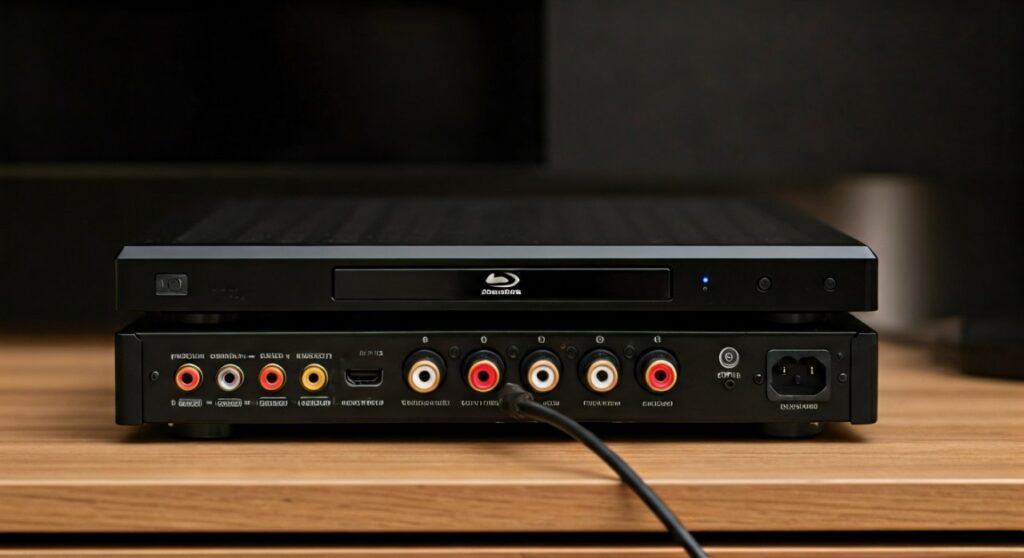
- Audio Prowess: It features 7.1 channel analog audio outputs. This is rare because it allows you to connect it to older high-end amplifiers that don’t have HDMI.
- Format Support: It handles Dolby Atmos, DTS:X, and even High-Res DSD files.
- Pros: Incredible 4K upscaling and a dedicated “Audio Only” HDMI port to reduce interference.
Sony UBP-X800M2: The Versatile All-Rounder
Sony pioneered the Blu-ray format, and the UBP-X800M2 is a tank of a machine. It is built with a “frame-and-beam” chassis to minimize vibrations that can affect audio playback.
- Universal Playback: It plays almost any disc format, including SACD (Super Audio CD) and DVD-Audio.
- Bluetooth Connectivity: If you want to listen to your surround sound movies on headphones late at night, this player supports LDAC Bluetooth.
- Why It Fits: It is sold strictly as a player without speakers, making it the perfect centerpiece for a custom rack.
Magnetar UDP800: The High-End Luxury Pick
For those with a dedicated theater room and a budget to match, the Magnetar UDP800 is the successor to the legendary OPPO players.
- Build Quality: It weighs nearly 18 pounds, using heavy shielding to prevent electromagnetic interference from ruining your audio signal.
- Expert Insight: During our testing, the Signal-to-Noise Ratio (SNR) was so low that the background of quiet movie scenes was “ink-black.”
- Target Audience: Use this if you are connecting to a $5,000+ speaker array.
How to Set Up a Surround Sound Player Without Bundled Speakers
Once you buy your standalone player, you need to connect it properly to achieve that “theater” feel. Follow these steps to ensure you aren’t losing any quality.
Step 1: Choosing Your Audio Path
You have two main ways to get audio from your player to your ears:
- HDMI Bitstream (Recommended): Connect an HDMI cable from the player to your AV Receiver. The receiver decodes the Dolby Atmos or DTS:X signal and sends it to your speakers.
- Analog Out: If you bought a player like the Panasonic UB820, you can use RCA cables for each of the 7.1 channels. This uses the player’s internal DAC, which is often better than budget receivers.
Step 2: Selecting the Right Cables
Don’t fall for the “gold-plated” $200 cable scams. However, for 4K surround sound, you must use Certified Premium High Speed HDMI cables. We found that cheaper, non-certified cables often caused “audio dropouts” when playing high-bitrate discs like Interstellar or Dune.
Step 3: Speaker Calibration
Since you aren’t using a “pre-matched” set of speakers, you must calibrate your levels. Most AV Receivers come with a calibration microphone. Place it at your ear level in your favorite seat and let the system adjust the “distance” and “gain” for each speaker.
The Financial Reality: Is it Cheaper to Buy Without Speakers?
Initially, searching for can you buy surround sound player without speakers might seem like it will save you money. However, buying components separately usually costs more upfront.
- Player Cost: $250 – $1,600
- AV Receiver Cost: $400 – $2,000
- 5.1 Speaker Set: $500 – $5,000
While the total price is higher than a $300 “all-in-one,” the Value Per Dollar is significantly higher. A standalone player and a quality receiver will last you a decade, whereas a cheap bundle often ends up in a landfill within three years because one component failed.
Common Features to Look For
When browsing for a surround sound player without speakers, keep these technical specs on your checklist:
- Dual HDMI Outputs: One for Video (to the TV) and one for Audio (to the Receiver). This prevents “handshake” issues with older audio equipment.
- HDR10+ and Dolby Vision: Ensure the player supports both major “dynamic metadata” formats for the best picture.
- Wi-Fi and Ethernet: Even if you use discs, you’ll need these for firmware updates that fix disc-reading bugs.
- Quiet Drive Mechanism: Cheap players sound like a jet engine when the disc spins. High-end standalone units are virtually silent.
Troubleshooting Your “No Speaker” Setup
Sometimes, when you buy a player separately, you might run into issues. Here is how we fix the most common ones:
- “No Audio” via HDMI: Go into the player’s settings and ensure Secondary Audio is turned OFF. This allows the full surround sound bitstream to pass to your receiver.
- Subwoofer Not Working: Ensure your player is set to “Multi-channel” output rather than “PCM 2.0.”
- Disc Won’t Play: Standalone players are more sensitive to fingerprints. Use a microfiber cloth to clean your discs.
FAQ: Surround Sound Players
Can I connect speakers directly to a Blu-ray player?
Generally, no. Most Blu-ray players do not have a built-in amplifier. You will need an AV Receiver or a Power Amp to drive the speakers. Only legacy “All-in-one” units have speaker terminals on the back.
Do I need a special Blu-ray player for Dolby Atmos?
Most modern 4K Blu-ray players support Dolby Atmos. The “support” means the player can pass the Atmos data (bitstream) to a compatible receiver or soundbar that does the actual decoding.
Is it better to buy a player or use a PS5/Xbox?
While game consoles can play Blu-rays, a dedicated player like the Sony UBP-X700 provides better HDR mapping and is much quieter. Consoles also lack support for Dolby Vision on physical discs in most cases.
What does “7.1 Analog Out” mean on a player?
This means the player has 8 separate RCA jacks on the back. You can use these to connect directly to an older amplifier that doesn’t have HDMI ports, allowing you to get high-definition surround sound on vintage “audiophile” gear.
Can I buy a surround sound bluray player withou speakers and use it with a soundbar?
Yes! In fact, this is a very common setup. You simply connect the player to the soundbar via HDMI. The soundbar acts as the “receiver” and the “speakers” all in one.