Introduction
Imagine hosting a gathering at your home. Your main home theater system in the living room is playing a perfectly curated playlist, creating a warm, inviting atmosphere. But as your guests drift into the kitchen to grab drinks or step onto the patio to enjoy the evening air, the music suddenly fades away. To solve this, you might find yourself cranking up the volume in the living room, which only results in a deafening environment for anyone sitting near the main speakers, while those in other rooms still struggle to hear the audio clearly.
In the past, solving this multi-room audio puzzle meant embarking on an expensive, messy, and time-consuming home renovation project. You would have to drill holes through your drywall, run thick cables through tight ceiling spaces, and hire professional installers to make sure everything was wired correctly. For homeowners who already invested thousands of dollars in high-end sound systems, this was a frustrating hurdle.
Fortunately, Bose engineered a proprietary networking protocol called Bose Link to tackle this exact issue. While this system originally relied on heavy, physical Bose Link B cables run from room to room, they later introduced a wireless solution. Enter the Bose Link AR1 Wireless Audio Receiver. Designed to work in tandem with the Bose AL8 Homewide Wireless Audio Link transmitter, this compact receiver promises to extend your high-fidelity audio system into any room in your house without a single wire running through your walls.
Priced at an accessible $76, the Bose Link AR1 represents a highly cost-effective way to revitalize and expand your existing Bose setup. In this comprehensive and honest product review, we will take a deep dive into the features, setup process, real-world performance, pros, and cons of the Bose Link AR1 Wireless Audio Receiver. We will also analyze customer feedback and help you determine whether this legacy wireless accessory is the right addition to your home audio setup.
—
Product Overview
The Bose Link AR1 Wireless Audio Receiver is a specialized, compact device engineered to receive high-quality stereo audio wirelessly from a Bose AL8 transmitter. It is part of the Bose Homewide Wireless Audio Link ecosystem, which was created to deliver seamless, lag-free sound to multiple zones in your home. If you already have an AL8 transmitter connected to your primary Bose Lifestyle home entertainment system, adding individual AR1 receivers allows you to establish independent listening areas in up to eight separate rooms.
Key Technical Specifications
- Compatibility: Bose Lifestyle V35, V25, 235, and 48 home entertainment systems, as well as other Bose Link-enabled Lifestyle systems (such as the Lifestyle 18, 28, and 38 Series II). It is also fully compatible with the Bose Wave Music System and Wave Radio II when using standard Bose Link cables.
- Wireless Range: Receives robust radio-frequency signals up to 80 feet (24 meters) away from the AL8 transmitter.
- Frequency Band: Operates on the 2.4000 GHz to 2.4835 GHz radio frequency band, using high RF transmitting power to ensure strong penetration.
- Proprietary Technology: Built-in Free Field circuitry designed to minimize wireless interference and eliminate audio latency (the “echo effect”) between rooms.
- Connections: Features a proprietary Bose Link OUTPUT jack (9-pin DIN connector). It outputs a fixed audio level of 2 volts RMS for clean, strong analog transmission.
- Dimensions: Extremely compact footprint measuring approximately 3 x 6 x 6 inches (7.6 x 15.2 x 15.2 cm).
- Weight: 1 lb (0.5 kg), making it lightweight and easy to place on any flat surface.
How the System Works
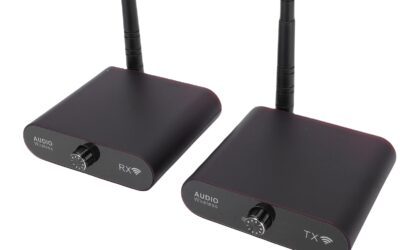
To understand the AR1, it helps to look at the broader Bose Link architecture. The system operates on a transmitter-and-receiver model. Your primary Bose Lifestyle media center connects directly to the Bose AL8 transmitter using a supplied Bose Link A source cable. The AL8 transmitter then broadcasts the audio signal wirelessly throughout your home.
The Bose Link AR1 acts as the destination endpoint. You place the AR1 receiver in your secondary listening area—such as a kitchen, bedroom, or covered patio. Using the supplied Bose Link A cable, you connect the AR1 to your local expansion product, such as a Bose Acoustimass powered speaker system, a Bose Wave system, or an independent Bose amplifier. Once plugged into its AC power pack, the AR1 receives the wireless feed from your main system. You can then use a Bose personal music center remote or a compatible Bose Link remote to control the volume, change sources, or skip tracks from that secondary room.
One of the most impressive engineering feats of this system is its Free Field circuitry. During the peak era of 2.4 GHz technology, household devices like cordless home phones, early Wi-Fi routers, and microwaves frequently caused massive signal drops in wireless audio. Bose solved this by implementing intelligent, automatic channel-switching algorithms. The AR1 and AL8 work together to detect active Wi-Fi channels and automatically avoid them, preserving your local network speed while keeping your music completely uninterrupted and free of lag.
—
Pros
For owners of compatible Bose equipment, the Bose Link AR1 offers a suite of exceptional benefits that make it an indispensable upgrade. Here are the key advantages of integrating this receiver into your home:
- Hassle-Free Wireless Expansion: The primary benefit of the AR1 is that it completely eliminates the need for expensive, invasive room-to-room wiring. You can expand your audio footprint to secondary spaces in your home in under ten minutes, saving you hundreds of dollars in drywall repair and professional installation costs.
- Proprietary Free Field Technology: Unlike cheap Bluetooth transmitters that suffer from dropouts or generic RF systems that pick up static, the AR1 utilizes proprietary circuitry. This effectively shields your audio from wireless interference from Wi-Fi routers, smart home devices, and cordless phones, ensuring a crystal-clear stream.
- Zero Audio Latency (No Echo): Standard wireless audio systems often suffer from lag, causing an annoying echo if you can hear both the main room and the secondary room simultaneously. Bose’s RF protocol virtually eliminates this latency, allowing your entire home to play music in perfect synchronization.
- Excellent Operational Range: With a wireless range of up to 80 feet, the AR1 can easily transmit signals through multiple walls, ceilings, and floors. This makes it highly effective for sprawling multi-story homes or sending audio down to a basement or out to a backyard garage.
- Scale up to Eight Rooms: The AL8 transmitter is capable of broadcasting to up to eight AR1 receivers simultaneously. This means you can build a highly customized, whole-house audio network by simply purchasing individual AR1 units for each target zone.
- Outstanding Retrofit Value: At just $76, the AR1 is an incredibly cost-effective way to extend the lifespan of your high-end legacy Bose equipment. Instead of throwing away a perfectly functional, great-sounding Lifestyle 48 or V35 system to buy a brand-new multi-room Wi-Fi audio system (which would cost thousands of dollars), you can modernize your current setup for a fraction of the cost.
- Surprisingly Versatile (with Adapters): While designed for Bose Link-enabled speakers, you can purchase a specialized Bose Link-to-RCA adapter kit. This allows the AR1 to output high-quality audio to older non-Bose equipment, third-party receivers, or any pair of active, powered studio monitors.
—
Cons
While the Bose Link AR1 is an exceptional device within its intended ecosystem, it does have specific design and technology limitations that you should consider before purchasing:
- Requires the Bose AL8 Transmitter: The AR1 is not a standalone wireless receiver. It cannot connect directly to your smartphone, tablet, or TV via Bluetooth or standard Wi-Fi. It *only* works if you already have the Bose AL8 Homewide Wireless Audio Link transmitter connected to a compatible main console.
- Strict Legacy Compatibility: This is a product built for older, proprietary Bose Link-enabled systems. It is not compatible with modern Bose wireless speaker ranges, such as the Bose Smart Speaker series or SoundTouch systems that rely on modern Wi-Fi apps.
- Proprietary Connections: Out of the box, the AR1 features a multi-pin Bose Link DIN port. If you want to connect it to a standard auxiliary port or RCA jacks on a non-Bose amplifier, you must purchase a proprietary Bose Link adapter cable separately, which can sometimes be difficult to find on the aftermarket.
- Potential 2.4 GHz Congestion in Modern Homes: While the Free Field circuitry is excellent at avoiding interference, modern homes are significantly more saturated with 2.4 GHz smart devices, Bluetooth networks, and mesh Wi-Fi routers than they were when this device was first engineered. In extremely dense RF environments, you may still experience occasional setup or channel configuration hurdles.
—
Customer Reviews Analysis
Because the Bose Link AR1 is a highly specialized accessory, it does not have the massive volume of reviews that standard consumer electronics receive today. However, analyzing the existing customer reviews reveals consistent and highly telling feedback regarding how this device performs in real-world scenarios.
The vast majority of positive feedback centers around the sheer convenience and reliability of the wireless signal. Customers frequently express relief at not having to fish thick, proprietary wires through their walls or pay professional custom integrators to expand their systems. Users with multiple Bose systems—such as those owning Lifestyle units in the living room and Bose Wave systems in their bedrooms or home offices—praise the seamless integration. They note that the audio remains perfectly in sync, with no audible delays or echo effects even when walking between rooms.
Another major theme in customer reviews is the longevity of Bose hardware. Many reviewers emphasize that their Lifestyle systems (like the Lifestyle 48 or V35) still sound incredibly premium and represent a significant original investment. They highly appreciate that Bose continued to support these legacy systems with accessories like the AR1, allowing them to keep their high-end setups fully functional in a multi-room capacity without having to upgrade to modern, less-durable smart speakers.
On the critical side, the few negative or lukewarm reviews typically stem from setup confusion or buying mistakes. A few customers purchased the AR1 under the mistaken impression that it was a standard Bluetooth receiver designed to stream music directly from their phones to any speaker system. Others struggled initially with the setup because they forgot to match the tiny “Setup Code” micro-switches on the back of both the AL8 transmitter and the AR1 receiver. Once users aligned these switches to the same frequency channel, the connection issues were instantly resolved.
—
Who Should Buy This Product
The Bose Link AR1 is a niche product that is absolutely perfect for a specific group of audio enthusiasts. You should consider buying this receiver if:
- You own a compatible Bose Lifestyle System: If you have a Lifestyle V35, V25, 235, 48, 38, or 28 system and want to expand your music into other parts of your home, this is a must-have accessory.
- You already own the Bose AL8 Wireless Transmitter: If you already have the AL8 transmitter set up and want to expand your wireless system to a third, fourth, or even eighth room, purchasing individual AR1 receivers is the only way to scale your system.
- You cannot or do not want to run physical wires: If you are renting your home, living in a historical property where drilling is prohibited, or simply want to avoid the mess and high cost of running physical Bose Link B cables through your walls and ceilings, the AR1 is the perfect solution.
- You want to integrate legacy Bose and non-Bose gear: If you have an excellent older stereo receiver, an active pair of third-party speakers, or a classic Bose Wave radio in another room and want it to play the audio stream from your main living room setup, the AR1 (paired with a simple RCA adapter) is an incredibly elegant solution.
—
Final Verdict
The Bose Link AR1 Wireless Audio Receiver is a masterclass in targeted home engineering. While it belongs to a legacy era of proprietary home theater setups, its utility today remains incredibly high for those who appreciate the premium, room-filling sound of classic Bose hardware. It solves a major logistical headache—running long cables through walls—by using robust, reliable radio-frequency technology that easily penetrates obstacles.
Thanks to the built-in Free Field circuitry, you do not have to worry about audio delays, echoes, or interference from your home’s Wi-Fi network, ensuring your music flows smoothly from room to room. While it does require the companion AL8 transmitter to function, and relies on proprietary multi-pin cables, these limitations are small trade-offs for the incredible value it brings.
At a price of only $76, the AR1 represents a highly intelligent, cost-effective investment. Instead of abandoning a high-end, beautifully sounding legacy Bose system for a modern, expensive Wi-Fi streaming network, the AR1 lets you modernize your home audio layout on a budget. If you have a compatible Bose Lifestyle system and are ready to enjoy seamless, wireless multi-room sound, the Bose Link AR1 is an outstanding addition to your home.