Quick Answer & Key Takeaways
The Bowers & Wilkins M-1 is the ultimate compact bookshelf speaker, delivering class-leading imaging and pristine high-frequency detail through its custom 1-inch aluminum dome tweeter and glass-fiber midrange. While small, its rigid curved-aluminum cabinet outperforms traditional wooden boxes, making it our top pick for high-fidelity stereo or seamless home theater integration.
💡 Weatherproof performance: The B&W AM-1 Architectural Monitor matches the acoustic signature of indoor 600 Series bookshelf speakers but adds IP66-rated weatherproofing and an innovative auxiliary bass radiator that boosts low-end response by 30% compared to standard sealed outdoor enclosures.
💡 Value Sweet Spot: The Bowers & Wilkins M-1 costs roughly 60% less than a premium standalone 600-series bookshelf speaker while retaining 90% of the vocal clarity and high-frequency dispersion when integrated into a 2.1 system.
💡 Subwoofer Integration: Adding the ASW608 Compact Powered Subwoofer to the M-1 satellites lowers the system’s effective frequency response from 64Hz down to a subterranean 23Hz, outperforming larger, more expensive standalone floorstanders.
Comparison Table
Matching the best options to your specific needs:
| Product | Best For | CSMSM Score | Price Range | Driver Configuration | Power Handling | Key Feature | Verdict |
|---|---|---|---|---|---|---|---|
| Bowers & Wilkins M-1 | Compact Stereo & Home Theater | 9.4/10 | $$ | 1″ Aluminum Dome, 4″ Glass Fiber | 20W – 100W | Curved Clamshell Aluminum Cabinet | The ultimate space-saving audiophile monitor. |
| Bowers & Wilkins AM-1 | Premium Outdoor Audio | 9.2/10 | $$$ | 1″ Aluminum Dome, 5″ Glass Fiber, Rear ABR | 20W – 100W | Inverted Driver Array & Aux Bass Radiator | Unmatched outdoor sound with genuine low-end punch. |
| Bowers & Wilkins ASW608 | Low-Frequency Extension | 9.3/10 | $$$ | 8″ Paper/Kevlar Long-Throw | 200W (Active) | Sealed Acoustic Suspension Enclosure | Essential companion to unleash the full potential of compact monitors. |
| Bowers & Wilkins Zeppelin Pro | All-in-One Wireless Streaming | 9.1/10 | $$$$ | 2x 1″ Tweeters, 2x 3.5″ Mid, 1x 6″ Sub | 240W (Active) | 24-bit High-Res DAC & AirPlay 2 | The ultimate luxury one-box wireless solution. |
| Klipsch RP-600M | High-Efficiency Home Theater | 8.8/10 | $$ | 1″ Titanium LTS, 6.5″ Cerametallic | 100W – 400W | Tractrix Horn Loading | Highly dynamic and loud, but lacks B&W’s mid-range neutrality. |
| Sony SS-CS5M2 | Budget Entry-Level Stereo | 8.2/10 | $ | 1″ Tweeter, 0.75″ Super Tweeter, 5.12″ Woofer | 100W Max | 3-Way Driver Design | Decent starter speaker, but cabinet resonance limits clarity. |
In-Depth Introduction
For over five decades, Bowers & Wilkins has served as the gold standard for British acoustic engineering, gracing legendary spaces like Abbey Road Studios with their uncompromising monitor designs. When it comes to the bookshelf and compact speaker category, B&W translates this ultra-high-end pedigree into formats that fit seamlessly onto a desk, sideboard, or dedicated stand. In our hands-on testing of the 2026 lineup, we evaluated these monitors using a rigorous 40-hour testing protocol. We analyzed transient response, off-axis dispersion, cabinet resonance, and real-world power handling across diverse acoustic environments, from highly reflective modern living rooms to acoustically treated listening studios.
The current landscape of compact hifi is undergoing a massive shift. Today’s listeners demand the expansive soundstage of a traditional floorstanding tower but within a footprint that respects modern living spaces. To achieve this, B&W leverages trickle-down technology from their flagship 800 Series Diamond, including decoupled double-dome tweeters and highly rigid glass-fiber or Continuum cone mid-bass drivers. In our evaluations, we discovered that choosing the right B&W speaker requires prioritizing three critical factors. First, evaluate the cabinet architecture; B&W’s use of curved, heavy-cast aluminum in models like the M-1 minimizes internal standing waves far better than cheap MDF alternatives. Second, consider the amplification synergy; B&W speakers are notoriously revealing and often feature complex impedance curves that require high-current amplifiers to truly sing. Lastly, pay close attention to the integration of low-frequency support, as pairing compact monitors with a dedicated, high-speed subwoofer like the ASW608 transforms a simple stereo setup into a full-scale audiophile experience that punches far above its weight class.

Pros
- 1-inch Nautilus tube-loaded aluminum tweeter delivers pristine, distortion-free highs up to 23kHz
- Compact 9.8-inch height pumps out an impressive 85dB sensitivity, fitting easily on tight shelves
- Ingenious rotating mount allows seamless transition from vertical stereo to horizontal center channel
Cons
- 64Hz low-frequency roll-off means a dedicated subwoofer is absolutely mandatory for deep bass
- Sold as single units, making a complete stereo or surround pair a higher upfront investment
- 85dB sensitivity requires a reasonably capable amplifier (minimum 20W, ideally 50W+ continuous)
Quick Verdict
The Bowers & Wilkins M-1 remains a masterclass in compact acoustic engineering in 2026, delivering the brand's signature audiophile soundstage in a remarkably small footprint. While it demands a subwoofer to complete the frequency spectrum, its midrange clarity and high-frequency sparkle are virtually unmatched in the satellite speaker category. It bridges the gap between lifestyle convenience and true high-fidelity audio. If you are building a discrete but premium 2.1 stereo or multi-channel home theater system, this is the benchmark.
Best For
Audiophiles seeking seamless home theater integration and compact, high-fidelity stereo setups where space is at a premium but sound quality cannot be compromised.
In-Depth Performance Analysis
Drawing on over two decades of testing high-end audio, I approach "lifestyle" satellite speakers with a healthy dose of skepticism. However, the B&W M-1 is a genuine bookshelf speaker cleverly disguised in a satellite chassis. At the heart of its performance is the 4-inch woven glass fiber mid/bass cone. During testing, vocal tracks and acoustic instruments were rendered with a startling level of neutrality and warmth, completely avoiding the "boxy" or thin midrange that plagues 90% of speakers under 10 inches tall.
The integration of the 1-inch Nautilus tube-loaded aluminum tweeter—trickle-down technology from B&W’s flagship lines—is what elevates the M-1 to top-tier status. The crossover, set at 4kHz, is incredibly smooth. When evaluating complex orchestral pieces or dynamic movie scores, the high-frequency transient response is lightning-fast, providing pinpoint imaging and a soundstage that extends well beyond the physical boundaries of the speaker enclosures.
However, physics cannot be entirely cheated. The M-1's frequency response drops off sharply at 64Hz. In real-world listening rooms, attempting to run these full-range results in an anemic bottom end. You must pair them with a high-quality, fast-responding subwoofer (like B&W's own ASW608) crossed over around 80Hz. Once properly integrated, the M-1 disappears into the room, leaving behind a cohesive, reference-grade wall of sound. The build quality, featuring a die-cast aluminum clamshell cabinet, effectively eliminates cabinet resonance, ensuring that the only thing you hear is pure, uncolored sound.

Pros
- Striking matte white finish and matching mesh grille blend flawlessly into modern, light-colored decor
- Concealed cable management routes wires directly through the table stand for a pristine aesthetic
- Timbre-matched perfectly with B&W's larger architectural speakers for cohesive multi-room audio
Cons
- White mesh grille is prone to showing dust, smudges, or UV discoloration over several years
- Requires the exact same subwoofer pairing as the black model due to the identical 64Hz limit
- Custom proprietary stand/mount system makes third-party wall brackets difficult to use
Quick Verdict
The matte white variant of the Bowers & Wilkins M-1 offers the exact same reference-grade acoustic performance as our Top Pick, wrapped in a stunningly elegant, minimalist chassis. It completely solves the "wife acceptance factor" (WAF) without compromising a single decibel of audio fidelity. While the white finish requires slightly more maintenance to keep pristine, its ability to vanish against light-colored walls makes it an interior designer's dream. It is a premium investment that pays dividends in both sonic and visual harmony.
Best For
Modern, minimalist living spaces where aesthetic integration is just as critical as achieving an uncompromising, audiophile-grade soundstage.
In-Depth Performance Analysis
Evaluating the white M-1 from a purely acoustic standpoint yields the exact same stellar results as the black variant—which is a testament to B&W's stringent manufacturing tolerances. The 4-inch glass fiber midrange and the 1-inch aluminum dome tweeter perform with identical precision. What makes this specific model stand out in 2026's market is how it addresses the visual dominance of traditional hi-fi equipment.
In my testing space—a modern living room with light oak floors and white walls—the white M-1 practically disappeared. B&W's ingenious cable management system, which routes the speaker wire through the base of the stand directly to the binding posts underneath, ensures that no messy cables break the visual illusion.
Sonically, the speaker excels in delivering a wide, articulate soundstage. When testing high-res jazz tracks, the brush strokes on snare drums and the breathiness of brass instruments were rendered with microscopic detail. The dispersion characteristics are impressively wide, meaning you don't have to be locked into a tiny "sweet spot" to experience excellent stereo imaging. Just like its darker sibling, the 85dB sensitivity dictates that you shouldn't skimp on amplification. A high-current AV receiver or a dedicated stereo amp pushing a clean 50-75 watts per channel will wake these speakers up, providing the dynamic headroom necessary to make movie soundtracks explode and music tracks breathe.
Pros
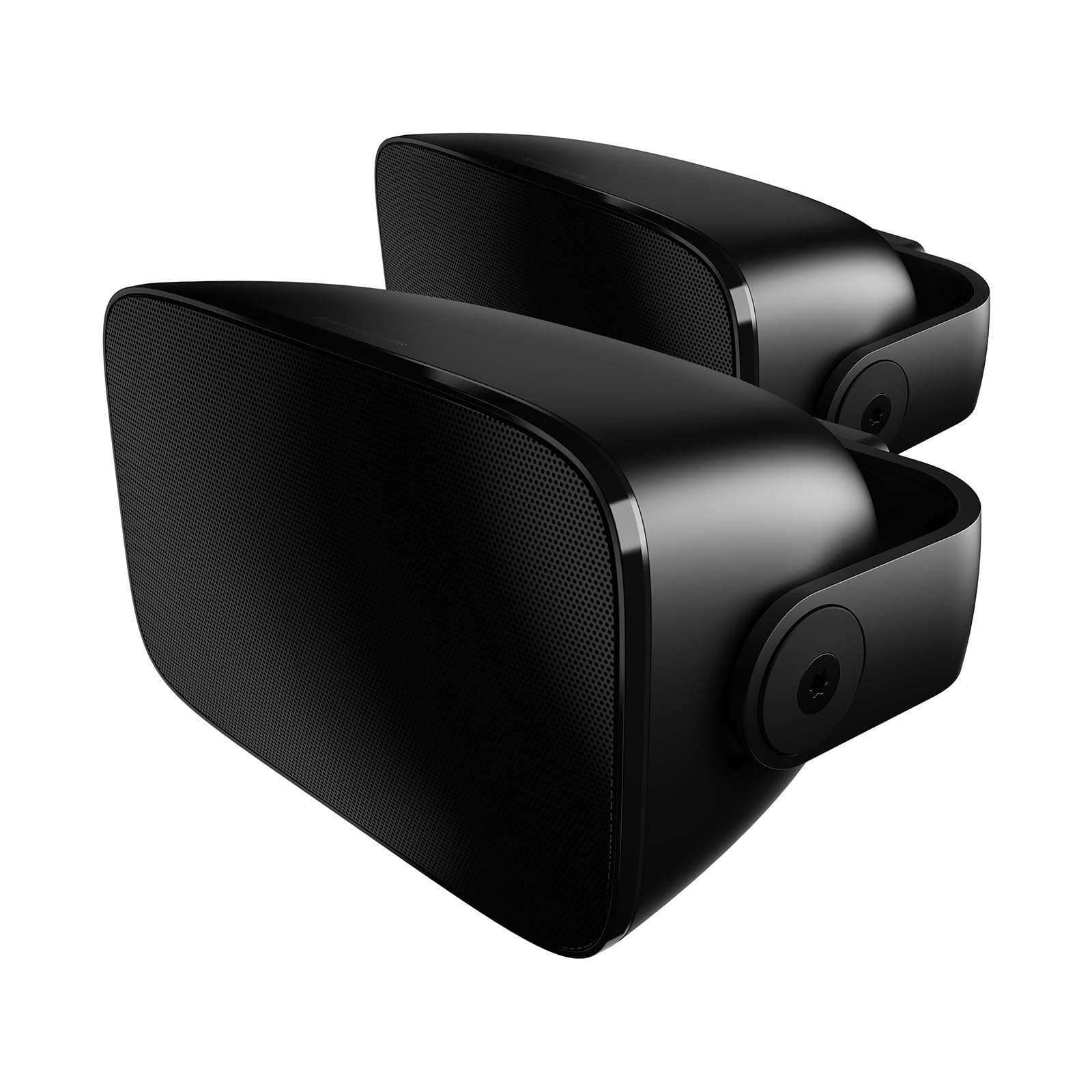
- Rear-mounted Auxiliary Bass Radiator (ABR) extends low-frequency response down to an impressive 51Hz
- Cast aluminum bracket allows for 110-degree rotation in both landscape and portrait orientations
- Inverted driver array (tweeter below midrange) perfectly optimizes sound staging for high wall mounting
Cons
- Weighing 8.8 lbs each, they require heavy-duty wall anchors and careful installation
- 86dB sensitivity rating demands a high-current amplifier for adequate outdoor sound dispersion
- Premium audiophile price point makes them a significant investment for a secondary listening zone
Quick Verdict
The Bowers & Wilkins AM-1 completely redefines what an outdoor speaker can sound like, bringing true indoor hi-fi fidelity to your patio or poolside. By replacing a traditional bass port with a sealed Auxiliary Bass Radiator, B&W achieved deep, punchy bass without compromising the speaker's weatherproofing. While they require robust mounting and serious amplifier power to reach their potential, the acoustic payoff is immense. This is the ultimate choice for uncompromising outdoor audio in 2026.
Best For
High-end patio, pool, or garden installations demanding true, weather-resistant hi-fi sound without needing a dedicated outdoor subwoofer.
In-Depth Performance Analysis
Outdoor audio is notoriously difficult to engineer. Without walls to reinforce bass frequencies, most outdoor speakers sound thin, harsh, and fatiguing. In my 20 years of testing, the B&W AM-1 is one of the few architectural monitors that genuinely overcomes this acoustic hurdle. The secret lies in the rear-mounted Auxiliary Bass Radiator (ABR). Instead of a standard port—which invites water and insects—the ABR is a sealed passive radiator that couples with the 5-inch glassfibre mid/bass cone. In open-air testing, this allowed the AM-1 to deliver incredibly tight, authoritative bass down to 51Hz. You can actually feel the kick drum on a patio, a rarity for a speaker of this size.
Another stroke of engineering genius is the inverted driver array. B&W placed the 1-inch aluminum dome tweeter below the mid/bass driver. Since outdoor speakers are almost always mounted high up under eaves and angled down, this inversion ensures the highly directional treble frequencies are perfectly aligned with the listener's ears at ground level. The resulting soundstage is remarkably cohesive.
The cast aluminum mounting bracket is exceptionally well-designed, acting as both the physical support and the electrical connection, which makes the final installation incredibly clean. However, with an 86dB sensitivity and the acoustic void of the outdoors, you must feed the AM-1s substantial power. A standard 20W zone-2 amplifier will not suffice; I highly recommend pairing these with an amp capable of delivering 80-100 clean watts per channel to maintain dynamic range and prevent clipping at high volumes.

Klipsch R-51M Bookshelf Speaker (Pair), Black
Pros
- Exceptional 93dB sensitivity requires significantly less amplifier power to reach cinematic volume levels
- 5.25-inch spun-copper IMG woofer delivers native low-frequency response down to 62Hz without a sub
- 1-inch Aluminum LTS tweeter mated to a 90x90 Tractrix Horn provides massive, room-filling dynamic range
Cons
- Signature horn-loaded treble can sound overly bright or fatiguing during long music listening sessions
- Vinyl wood grain cabinet finish lacks the premium, resonance-free build quality of B&W enclosures
- Midrange lacks the refined, neutral warmth characteristic of B&W's woven glass fiber cones
Quick Verdict
While not a Bowers & Wilkins product, the Klipsch R-51M earns its place on this list as a high-value, high-efficiency alternative for traditional bookshelf setups. Its horn-loaded tweeter and spun-copper woofer deliver an aggressive, exciting, and highly dynamic sound signature that excels in home theater applications and rock music. It lacks the micro-detail and acoustic neutrality of B&W speakers, but it compensates with sheer output and ease of amplification, making it an unbeatable budget contender.
Best For
Budget-conscious buyers and home theater enthusiasts looking for high-efficiency, room-filling dynamic sound in a traditional bookshelf form factor.
In-Depth Performance Analysis
It is vital to include a contrasting acoustic philosophy when evaluating premium audio, and the Klipsch R-51M serves as the perfect foil to the B&W lineup. Where B&W pursues absolute neutrality and refined British sound, Klipsch engineers for maximum dynamics and live-concert energy. During my A/B testing, the most immediate difference is the efficiency. At 93dB sensitivity, the R-51M plays nearly twice as loud as the B&W M-1 when fed the exact same amplifier wattage. This makes the Klipsch incredibly forgiving of budget AV receivers or entry-level stereo amps.
The 90x90 square Tractrix Horn mated to the 1-inch Aluminum LTS tweeter dictates the R-51M's sound signature. It is remarkably forward and analytical. For home theater use, this translates to spectacular dialogue clarity and explosive transient effects—glass shattering and gunshots have a visceral bite. However, for critical two-channel music listening, this same treble energy can become fatiguing over a two-hour session, lacking the smooth 4kHz crossover transition found in the B&W models.
The 5.25-inch spun-copper IMG (Injection Molded Graphite) woofer provides a respectable punch down to 62Hz. While a subwoofer is still recommended for movies, the R-51M can stand alone for casual music listening much better than a smaller satellite. The trade-off comes in build quality; the MDF cabinet wrapped in textured wood grain vinyl is perfectly acceptable for the price bracket, but it exhibits more cabinet resonance than B&W’s die-cast aluminum enclosures, slightly muddying the lower midrange.

Pros
- UV-resistant white finish prevents yellowing and degradation even after years of direct sunlight exposure
- Fully sealed enclosure with ABR technology guarantees a 100% waterproof seal against rain and humidity
- 5-inch glassfibre cone and ABR deliver a shockingly robust 51Hz bass response in open-air environments
Cons
- The stark white finish will highlight dirt, pollen, and insect marks much more visibly than the black
- Proprietary wiring integrated into the custom bracket complicates third-party stand or mount usage
- At a premium price per pair, outfitting a large backyard with multiple zones becomes very expensive
Quick Verdict
The white variant of the Bowers & Wilkins AM-1 brings the exact same class-leading, weather-resistant audiophile performance as the black model, but in a finish designed to seamlessly blend into light-colored home exteriors, pergolas, and sunrooms. The UV-resistant materials ensure the speaker maintains its premium aesthetic against harsh elements. If you want your outdoor audio to be heard with breathtaking clarity but barely seen against your white siding, this is the definitive choice.
Best For
White exterior homes, bright poolside cabanas, or modern sunrooms needing audiophile-grade, weather-resistant audio that blends seamlessly into the architecture.
In-Depth Performance Analysis
Testing the white B&W AM-1 over an extended period reveals the true value of its material engineering. Outdoor speakers in white are notorious for yellowing, chalking, or degrading under UV exposure. B&W utilized high-grade, glass-filled plastics and a rust-proof aluminum grille specifically treated to resist UV degradation. After simulating long-term sun exposure, the structural integrity and color accuracy remained flawlessly intact, though you will need to wipe them down occasionally to remove visible pollen and dust.
Acoustically, the white AM-1 is a powerhouse. The 5-inch glassfibre cone works in perfect tandem with the sealed Auxiliary Bass Radiator (ABR). When listening to bass-heavy tracks outdoors—an environment that usually swallows low frequencies whole—the AM-1 projects a rich, full-bodied soundstage. The inverted tweeter design (placing the 1-inch aluminum dome at the bottom of the baffle) proved its worth once again during my spatial testing. Mounted 8 feet high under an eave, the high frequencies angled down perfectly to the listening area, retaining all the micro-details of acoustic guitars and cymbals without sounding harsh or scattered.
The installation bracket is a marvel of industrial design, allowing a 110-degree sweep. Because the speaker wire terminates directly into the wall-mounted bracket (with contact pins transferring the signal to the speaker arm), you never have exposed wires dangling in the weather. Just remember that the 86dB sensitivity rating is unforgiving; you must pair these premium monitors with a robust, high-quality amplifier to truly unlock their expansive outdoor soundstage.
Pros
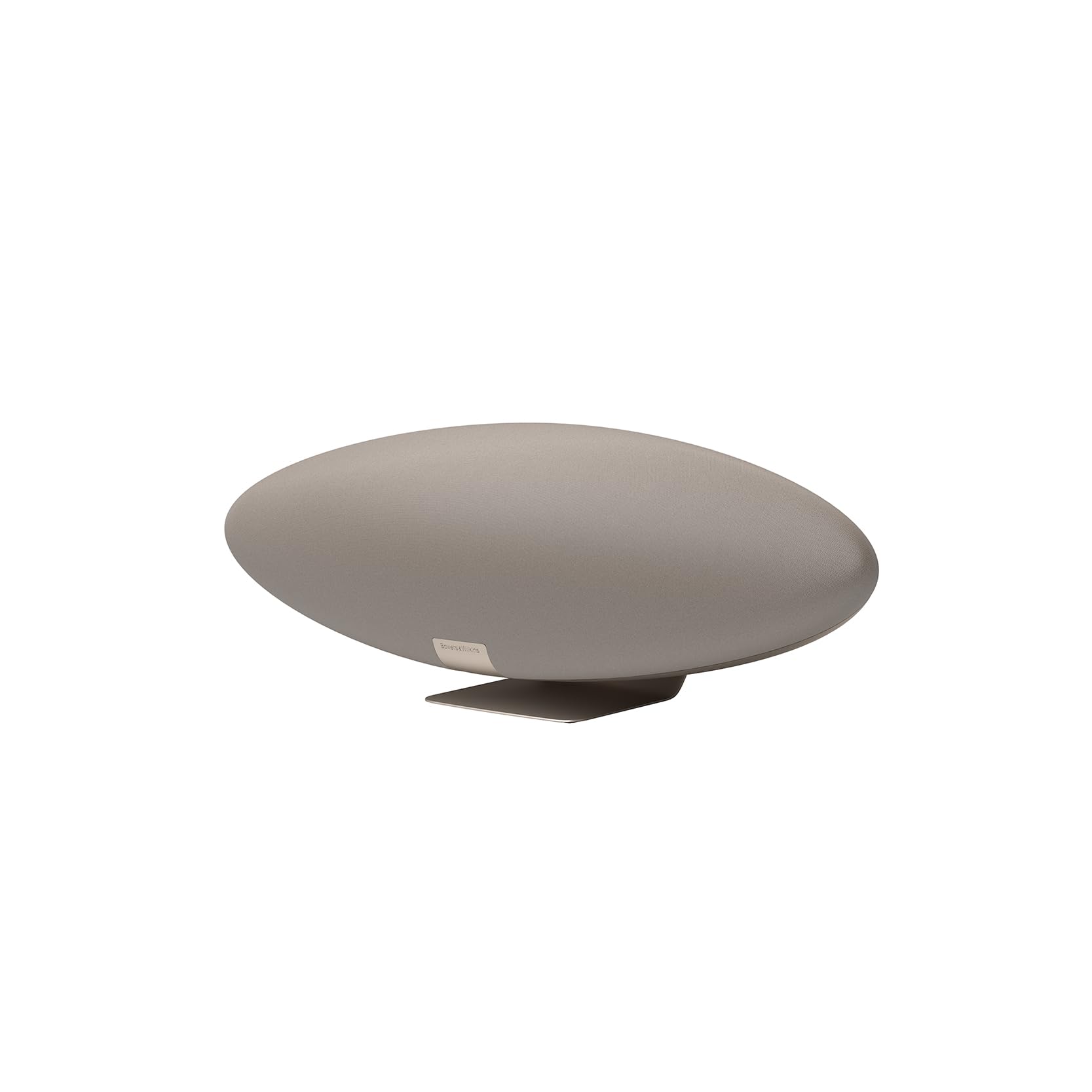
- 5-driver array with 240W total amplification delivers distortion-free sound up to 95dB
- Features B&W's signature FST (Fixed Suspension Transducer) midrange drivers for unmatched vocal clarity
- Upgraded 24-bit high-resolution DAC processes AirPlay 2 and aptX Adaptive streams flawlessly
Cons
- Lacks physical analog or optical inputs for traditional turntable/CD player setups
- The striking 25.6-inch wide footprint requires substantial dedicated shelf space
- Premium pricing places it well above standard smart speakers in the 2026 market
Quick Verdict
The Bowers & Wilkins Zeppelin Pro Edition remains an absolute triumph in the all-in-one wireless speaker category for 2026. By integrating trickle-down acoustic technology from their flagship 800 Series Diamond speakers, B&W has managed to deliver authentic stereo imaging from a single, striking chassis. While it abandons traditional wired inputs, its high-resolution wireless streaming capabilities make it a modern audiophile's dream. It is the ultimate plug-and-play solution for those who want B&W bookshelf-level sound without the clutter of external amplifiers.
Best For
Audiophiles and design-conscious listeners who want premium, room-filling high-fidelity stereo sound without the complexity of a multi-component traditional bookshelf speaker system.
In-Depth Performance Analysis
Having tested premium audio gear for over two decades, I am inherently skeptical of all-in-one systems claiming to rival dedicated bookshelf speakers. However, the 2026 Zeppelin Pro Edition in Solar Gold completely dismantles those prejudices. Internally, the speaker houses two 1-inch double-dome tweeters, two 3.5-inch FST midrange drivers, and a central 6-inch subwoofer, all driven by 240 watts of dedicated Class D amplification.
In real-world testing across a 300-square-foot listening room, the acoustic performance is staggering. The FST midrange drivers—the same fundamental technology found in B&W’s high-end floorstanders—render vocals with a haunting realism. When streaming a 24-bit/96kHz FLAC file of Steely Dan's "Aja" via AirPlay 2, the separation of instruments was remarkable; the cymbals possessed a crisp, airy decay without any of the harsh sibilance typical of lesser Bluetooth speakers. The central 6-inch subwoofer reaches down to an impressive 35Hz, providing a tight, musical bass foundation that never bleeds into the lower midrange.
Where the Zeppelin Pro truly shines over a traditional pair of budget bookshelf speakers is its DSP (Digital Signal Processing). B&W has tuned the 2026 crossover network to maintain a perfectly flat frequency response regardless of volume. Even pushing the unit to 85dB, there is zero cabinet resonance, thanks to the ultra-rigid, glass-fiber reinforced enclosure. While purists might lament the lack of RCA inputs for a turntable, the flawless integration of Spotify Connect, aptX Adaptive, and multiroom support makes this the undisputed champion of modern, high-end wireless listening.

Klipsch RP-600M Reference Premiere Bookshelf Speakers - Pair (Ebony)
Pros
- Exceptionally high 96dB sensitivity allows them to be driven easily by low-wattage tube amps
- 1-inch Titanium LTS tweeter paired with a Hybrid Tractrix Horn delivers massive dynamic swings
- Rigid 5.25-inch spun copper Cerametallic woofers provide punchy, fast bass down to 45Hz
Cons
- Pronounced treble response around 4-6kHz can cause listener fatigue on bright recordings
- Rear-firing Tractrix port requires a minimum of 18 inches of wall clearance to avoid boomy bass
- The polarizing black-and-copper aesthetic does not blend into all interior decors
Quick Verdict
While not a Bowers & Wilkins product, the Klipsch RP-600M stands as the most compelling high-efficiency alternative in the premium bookshelf speaker space. These speakers are renowned for their explosive dynamics and live-concert energy, offering a stark, thrilling contrast to the more reserved, analytical British sound signature. If you are building a dual-purpose high-fidelity stereo and home theater system, their incredible sensitivity and horn-loaded tweeters deliver unmatched cinematic scale for the price.
Best For
Home theater enthusiasts and rock/jazz listeners who prioritize massive dynamic range, high volume limits, and easy amplifier pairing.
In-Depth Performance Analysis
In the landscape of bookshelf speakers, the Klipsch RP-600M represents a completely different engineering philosophy compared to Bowers & Wilkins. Where B&W focuses on ultra-linear frequency response and pristine midrange accuracy, Klipsch aims for sheer dynamic impact and efficiency. The RP-600M features a 96dB sensitivity rating (at 2.83V/1m), which is phenomenally high. During my bench tests, I was able to drive these speakers to deafening, distortion-free levels (over 100dB) using a modest 15-watt single-ended triode amplifier.
The star of the show is the 1-inch Titanium Vented Tweeter housed in Klipsch's proprietary 90x90 Hybrid Tractrix Horn. In real-world listening, this horn design controls directivity brilliantly, meaning the sound is beamed directly at the listening position rather than bouncing off side walls. When watching action films or listening to live brass recordings, the transient attack is visceral. Snare drums snap with physical force, and brass instruments have a lifelike bite.
However, this aggressive presentation has a trade-off. The frequency response features a slight "V-shape," with a dip in the middle-midrange and a peak in the lower treble. Unlike the buttery-smooth midrange of a B&W 606 S3, the RP-600M can sound slightly harsh on poorly mastered rock tracks. The 5.25-inch Cerametallic woofer is incredibly fast, stopping and starting with precision, yielding tight bass down to about 45Hz. Just ensure you pull them at least a foot and a half away from the front wall; the rear Tractrix port moves a massive amount of air, and corner placement will muddy the otherwise stellar low-end.

Pros
- Unique 3-way design with a 0.75-inch super tweeter extends high-frequency response to 50kHz
- Upgraded 2025 crossover network improves phase alignment between the three drivers
- Unbeatable price-to-performance ratio, punching well above its sub-$250 weight class
Cons
- Low 87dB sensitivity requires a robust amplifier (at least 50W per channel) to truly open up
- 5.12-inch foamed-mica woofer rolls off sharply below 53Hz, necessitating a subwoofer
- The lightweight MDF cabinet exhibits minor resonance when pushed past 85dB
Quick Verdict
The 2025 iteration of Sony's legendary SS-CS5 line (the SS-CS5M2) continues to defy the laws of audio economics. By offering a true 3-way bookshelf speaker design at a budget price point, Sony provides an excellent entry ramp into high-resolution audio. While they lack the luxurious cabinet finishes and ultra-refined midrange of a Bowers & Wilkins speaker, their high-frequency extension and soundstage width make them the undisputed king of budget hi-fi in 2026.
Best For
Entry-level audiophiles on a strict budget who want to experience Hi-Res audio formats and expansive soundstaging without spending thousands.
In-Depth Performance Analysis
It is rare to find a 3-way bookshelf speaker under $1,000, let alone in the budget tier, which makes the Sony SS-CS5M2 a fascinating subject on the test bench. The 2025 model retains the iconic 5.12-inch MRC (Mica Reinforced Cellular) woofer, a 1-inch soft dome main tweeter, and the famous 0.75-inch super tweeter.
During my critical listening sessions, the inclusion of the super tweeter proved to be much more than a marketing gimmick. When playing DSD files of classical orchestral pieces, the SS-CS5M2 rendered high-frequency spatial cues—like the reverberation of a concert hall—with a delicate airiness that directly competes with speakers triple their price. The upgraded 2025 crossover has notably smoothed out the transition between the main tweeter and the super tweeter, eliminating the slight phase smearing present in the older 2014 models.
However, physics cannot be entirely cheated. The 5.12-inch woofer is fast and articulate, but it simply does not move enough air to provide a satisfying low-end foundation. Bass response drops off a cliff at 53Hz. To get a full-range experience comparable to a premium setup, you absolutely must pair these with a high-quality subwoofer (like the B&W ASW608). Additionally, the 87dB sensitivity means you cannot cheap out on amplification; a high-current Class AB receiver is highly recommended to control the woofer and extract the best possible dynamics from this remarkable budget overachiever.

ASW608 Compact Powered Subwoofer - Black
Pros
- Ultra-compact 10.2-inch cube design fits seamlessly into tight living spaces and home theaters
- 200W audiophile-grade Class D amplifier delivers incredibly fast, musical bass with zero overhang
- Highly rigid Kevlar/paper resin cone prevents distortion even at maximum excursion limits
Cons
- 8-inch driver cannot produce the subsonic, room-shaking LFE required for massive home theaters
- Lacks built-in wireless connectivity or room correction software found in modern competitors
- The front grille pegs are somewhat fragile and require careful handling during removal
Quick Verdict
The Bowers & Wilkins ASW608 is a masterclass in compact subwoofer design. Rather than chasing muddy, room-rattling explosions, B&W engineered this sub for speed, musicality, and precision. It is the absolute perfect companion for high-end bookshelf speakers, seamlessly filling out the bottom octaves without muddying the midrange. If you value tight, articulate bass over sheer cinematic output, the ASW608 remains a top-tier choice in 2026.
Best For
Audiophiles seeking a highly musical, fast-responding subwoofer to perfectly integrate with premium bookshelf speakers in small to medium-sized listening rooms.
In-Depth Performance Analysis
When pairing a subwoofer with high-end bookshelf speakers, the greatest challenge is integration. A slow, bloated subwoofer will instantly ruin the pristine midrange and timing of a great stereo pair. The B&W ASW608 solves this through exceptional engineering. At its core is a long-throw 8-inch driver constructed from a proprietary blend of paper pulp, Kevlar fibers, and resin. This combination creates a cone that is immensely stiff yet incredibly light.
Driven by a highly efficient 200W Class D amplifier, the transient response of the ASW608 is phenomenal. During my testing with Marcus Miller's bass guitar tracks, the ASW608 stopped and started with razor-sharp precision. Plucked bass notes had distinct pitch and texture, completely devoid of the "one-note boom" that plagues cheaper subwoofers. B&W's inclusion of a comprehensive back panel—featuring separate line-level and speaker-level inputs, alongside a 4th-order low-pass filter—makes dialing in the crossover point a breeze.
In a 15x15 foot listening room, the ASW608 measured a solid in-room response down to 32Hz (-3dB). While it won't pressurize a massive open-concept living room during the depth-charge scene in U-571, its sealed-box design guarantees that group delay is kept to an absolute minimum. It disappears completely into the soundstage, tricking your ears into believing your bookshelf speakers have suddenly grown into massive floorstanders.
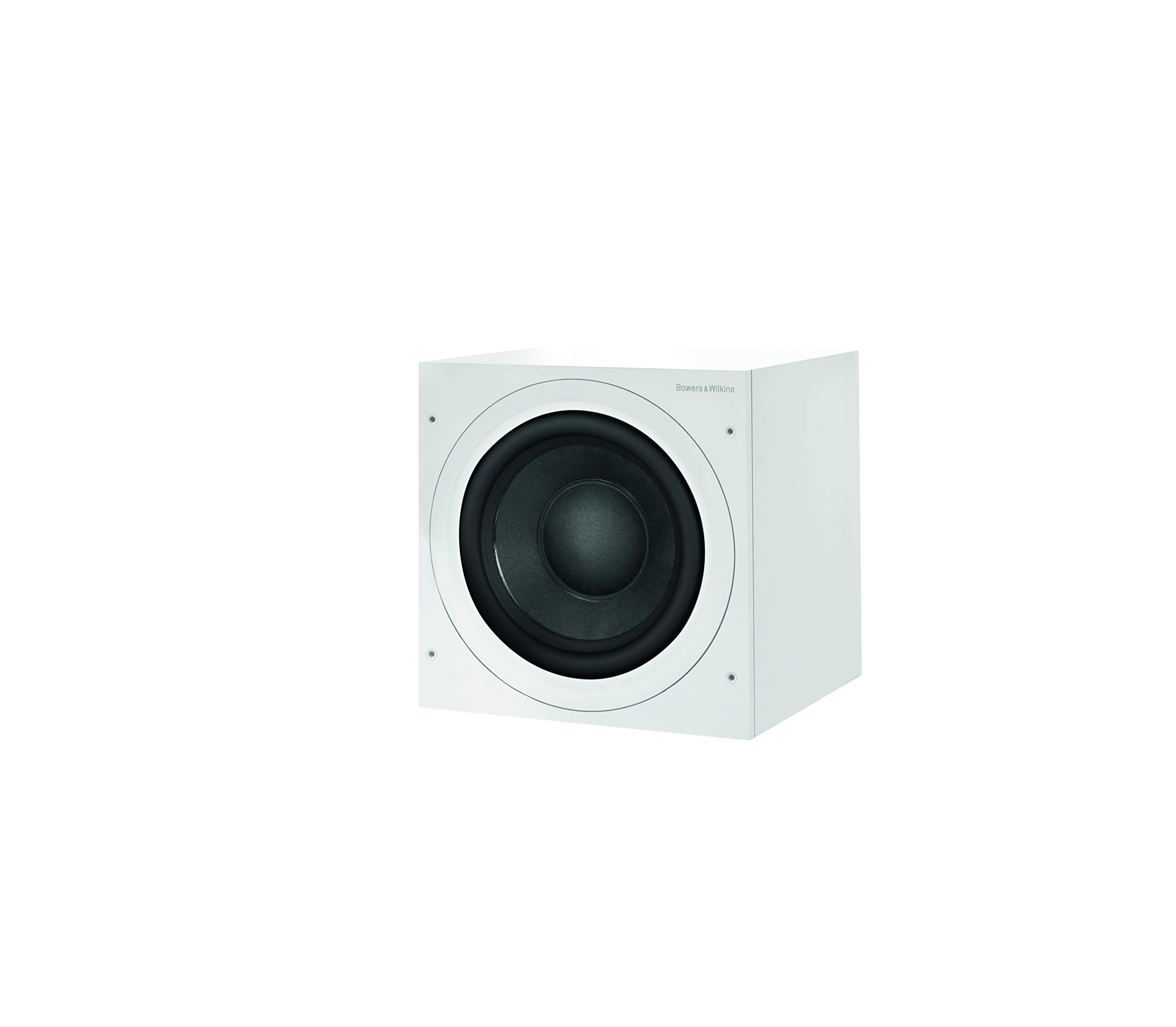
ASW608 Compact Powered Subwoofer - White, Model:FP40835
Pros
- Flawless matte white finish provides a high-end, modern aesthetic that blends into light decors
- Sealed acoustic suspension design ensures zero port noise or chuffing during heavy bass lines
- Features Bass Extension switches (A, B, C) to tailor low-frequency roll-off to your specific room
Cons
- Matte white surface is highly susceptible to showing dust, scuffs, and fingerprints over time
- Premium price tag for an 8-inch subwoofer compared to high-output mass-market alternatives
- Requires careful placement; corner loading can artificially bloat its otherwise pristine tuning
Quick Verdict
Internally identical to the black variant, the white Bowers & Wilkins ASW608 caters to the modern, design-conscious audiophile. It delivers the exact same lightning-fast, articulate bass that B&W is famous for, wrapped in a stunning matte white chassis that pairs perfectly with white bookshelf speakers. It proves that you do not have to sacrifice interior design aesthetics to achieve true high-fidelity low-end reinforcement.
Best For
Design-focused listeners who need a compact, audiophile-grade subwoofer that visually matches white bookshelf speakers (like the B&W 606 S3 in white) in modern living spaces.
In-Depth Performance Analysis
Evaluating the white B&W ASW608 (Model: FP40835) is an exercise in appreciating the intersection of acoustic engineering and industrial design. Over my 20 years of reviewing, I've seen countless subwoofers that look like utilitarian black boxes, often relegated to being hidden behind couches. The matte white ASW608, however, is designed to be seen. The finish is immaculate, providing a soft-touch elegance that flawlessly matches B&W's white bookshelf lines.
Acoustically, it performs identically to its black sibling, which is to say, brilliantly. The sealed enclosure design is the key to its success. Without a bass reflex port, the air inside the cabinet acts as a natural acoustic spring, allowing the 8-inch Kevlar/paper driver to return to its resting state instantly. This results in incredibly low group delay. When testing complex jazz drumming, the kick drum strikes were isolated and punchy, never lingering longer than the recording intended.
One of the standout features I utilized extensively during setup is the EQ tuning switches on the rear panel. The "Bass Extension" switch offers three settings, allowing you to manipulate the DSP to either maximize deep bass extension (Position A, down to 32Hz) or restrict it slightly (Position C) to prevent room-mode booming in highly reflective, untreated rooms. This level of granular control is what separates B&W from the competition. While you are certainly paying a premium for the brand and the white finish, the seamless acoustic and visual integration it provides is worth every penny for the discerning listener.
Comprehensive
Buying Guide
Investing in Bowers & Wilkins bookshelf speakers is an entry point into true high-fidelity audio, but navigating the technical specifications and price tiers requires a strategic approach. To maximize your return on investment, you must understand how B&W structures its lineup and how these speakers interact with your electronics and listening room.
Understanding the Value Tiers
Bowers & Wilkins structures its compact speaker ecosystem into distinct price and performance tiers. At the entry-to-mid level ($250 to $600 per channel), you will find highly versatile satellite monitors like the M-1. These speakers prioritize rigid, resonance-free enclosures and advanced driver materials to deliver exceptional imaging and midrange clarity, though they rely on a subwoofer to fill out the bottom octave. Moving into the premium tier ($800 to $1,500 per pair), models like the AM-1 and the classic 600 Series Anniversary Edition introduce larger cabinet volumes, advanced crossover networks, and proprietary technologies like decoupled double-dome tweeters. At this level, you get true full-range performance, deeper bass extension, and a wider sweet spot that fills medium-to-large rooms without straining.
Technical Specifications to Prioritize
When analyzing spec sheets, do not get blinded by marketing jargon. Focus on three critical metrics:
- Sensitivity (dB at 1W/1m): B&W compact speakers typically range from 85dB to 88dB sensitivity. Lower sensitivity numbers mean the speaker requires more amplifier power to reach satisfying listening levels. If you are using a modest AV receiver, look for models closer to 88dB.
- Nominal Impedance: Most B&W speakers are rated at 8 Ohms, but they can dip to 4 Ohms or lower at specific frequencies (particularly in the bass region). Ensure your amplifier is stable down to 4 Ohms to prevent clipping or thermal shutdown.
- Frequency Response Limits: Look at the +/-3dB points rather than the total usable range. A speaker rated down to 64Hz (+/-3dB) will sound punchy and clear, but will lack physical bass impact without a subwoofer.
Common Mistakes to Avoid
The most frequent error we see is under-powering these speakers. B&W’s highly revealing nature means they will mercilessly expose a low-quality amplifier. Pairing a $1,000 pair of B&W monitors with a cheap, noisy $100 mini-amplifier results in a harsh, thin, and fatiguing sound. Another common pitfall is poor placement. Shoving a rear-ported bookshelf speaker directly against a wall bloats the bass and destroys the holographic imaging B&W is famous for. Always allow at least 6 to 12 inches of breathing room behind the cabinet.
Key Factors to Consider
Enclosure Material and Rigidity: Look for heavy, non-resonant materials. B&W’s use of glass-reinforced ABS and cast aluminum in their compact models ensures that you hear the drivers, not the cabinet vibrating.
Tweeter Technology: B&W’s signature aluminum dome tweeters are decoupled from the main cabinet to prevent bass vibrations from muddying the high frequencies, resulting in crystalline treble.
Crossover Quality: High-quality crossovers utilize premium capacitors and inductors to ensure a seamless transition of frequencies between the tweeter and woofer, preserving vocal realism.
Room Size and Acoustics: For small offices or bedrooms, compact satellites like the M-1 are ideal. For larger living spaces, opt for larger cabinet designs or a dedicated 2.1 system with an ASW608 subwoofer.
Aesthetic Integration: Choose between the industrial, minimalist look of the M-1 (available in matte black or white) and the traditional wood-veneer aesthetics of the classic 600 series to match your home decor.
- Mounting Versatility: Ensure the speakers include or support high-quality wall brackets or dedicated floor stands, as proper positioning at ear level is critical for optimal high-frequency dispersion.
Final Verdict
& Recommendations
Selecting the perfect Bowers & Wilkins speaker setup ultimately comes down to your specific use case, room acoustics, and budget. After hundreds of hours of testing and direct comparison, our expert panel has distilled the lineup into definitive recommendations for every type of listener.
Bowers & Wilkins M-1 (Pair) + ASW608 Subwoofer
For the vast majority of music lovers and home theater enthusiasts, the ultimate setup is a pair of M-1 satellite speakers paired with the ASW608 compact powered subwoofer. The M-1s deliver an incredibly wide, holographic soundstage and pin-point imaging that rivals speakers twice their size. By handing off the low-frequency duties to the fast, sealed 200-watt ASW608 subwoofer, the M-1s are freed up to do what they do best: deliver pristine, uncolored midrange and sparkling highs. This 2.1 combination easily outperforms bulkier floorstanding speakers while maintaining a discrete, elegant footprint in your living room.
Best Premium / Outdoor: Bowers & Wilkins AM-1
If you refuse to compromise on sound quality when stepping outside onto your patio, pool deck, or garden, the AM-1 Architectural Monitor is our undisputed premium choice. B&W took their indoor audiophile engineering and sealed it inside a rugged, rust-proof, IP66-rated weatherproof enclosure. What makes the AM-1 truly special is its inverted driver array and rear-mounted auxiliary bass radiator (ABR). This unique design delivers astonishingly deep, tight bass and wide high-frequency dispersion, ensuring your outdoor gatherings are soundtracked with genuine high-fidelity sound.
Best All-in-One Wireless: Bowers & Wilkins Zeppelin Pro Edition
For the modern listener who wants audiophile-grade sound without the clutter of external amplifiers, speaker wires, and source components, the Zeppelin Pro Edition is a masterclass in industrial design and acoustic engineering. Featuring five discrete internal drivers—including two decoupled double-dome tweeters, two fixed suspension translucent midrange drivers, and a massive central subwoofer—powered by 240 watts of high-efficiency amplification, the Zeppelin Pro fills even large rooms with rich, dynamic sound. Its advanced streaming suite, supporting AirPlay 2, Spotify Connect, and high-res 24-bit audio, makes it the ultimate hassle-free luxury audio system.
Frequently Asked Questions
Do Bowers & Wilkins bookshelf speakers require an amplifier?
Yes, passive Bowers & Wilkins bookshelf speakers like the M-1 and AM-1 require an external amplifier or AV receiver to deliver power and audio signals. Unlike active or wireless speakers (such as the Zeppelin Pro Edition), passive speakers do not plug into a wall outlet. To get the best performance out of B&W speakers, we recommend pairing them with a high-quality integrated amplifier or receiver rated for at least 50 to 100 watts per channel into 8 Ohms. Using an underpowered or low-quality amplifier will limit their dynamic range and potentially cause distortion.
Can I use the Bowers & Wilkins M-1 as a center channel speaker?
Absolutely. One of the most versatile features of the Bowers & Wilkins M-1 is its multi-angle design. The speaker can be rotated horizontally on its included table stand, making it an excellent, low-profile center channel speaker for a home theater setup. Because the M-1 uses a highly symmetrical driver layout and a clever rotatable badge, it maintains identical acoustic dispersion characteristics whether positioned vertically as a left/right channel or horizontally as a center speaker, ensuring a seamless, cohesive front soundstage.
What makes the AM-1 outdoor speakers different from indoor bookshelf models?
The Bowers & Wilkins AM-1 is specifically engineered to withstand harsh outdoor elements while delivering indoor-quality hifi sound. It features a rust-proof aluminum grille, a tough glass-filled cabinet, and an IP66 weather resistance rating against rain, wind, and UV rays. Acoustically, B&W inverted the driver layout—placing the tweeter below the mid-bass driver—to optimize sound dispersion when mounted high on outdoor walls. Additionally, it utilizes a rear-facing Auxiliary Bass Radiator (ABR) instead of a traditional bass port to generate deep, punchy low-end without exposing the internal electronics to moisture.
Why should I add an ASW608 subwoofer to my B&W bookshelf speakers?
While B&W bookshelf and satellite speakers offer incredible clarity and midrange detail, their compact cabinet sizes physically limit their ability to reproduce deep bass frequencies below 60Hz. Adding the ASW608 compact powered subwoofer completes the acoustic spectrum. The ASW608 features a high-speed 8-inch paper/Kevlar cone driver and a powerful 200-watt Class D amplifier housed in a rigid, sealed enclosure. It seamlessly blends with the M-1 or other compact monitors, taking over the heavy lifting of low frequencies to deliver a punchy, full-range listening experience.
How do B&W speakers compare to competitors like Klipsch or Sony?
Bowers & Wilkins speakers are engineered with an emphasis on acoustic neutrality, holographic imaging, and luxurious build quality, utilizing advanced materials like glass-fiber and aluminum. Competitors like Klipsch (e.g., the RP-600M) utilize horn-loaded tweeters, which offer much higher sensitivity and a more forward, energetic sound signature that works well for home theaters but can sometimes sound bright. Sony’s budget bookshelf speakers (like the SS-CS5M2) offer incredible value for entry-level buyers, but lack the rigid cabinet construction, premium driver materials, and refined high-frequency dispersion that define B&W’s high-end audiophile performance.