Quick Answer & Key Takeaways
The Bose 301 Series V remains the absolute best Bose bookshelf speaker, dominating the lineup with its proprietary Direct/Reflecting speaker technology that fills large spaces with an exceptionally wide, balanced stereo soundstage. Its robust 8-inch woofer and dual targeting tweeters deliver a warm, room-filling performance that smaller, traditional directional bookshelf speakers simply cannot replicate.
💡 Best value alternative: The Bose 161 Speaker System costs roughly 45% less than the flagship 301-V while offering highly versatile, slimline integration for surround sound or small-space stereo setups.
💡 Superior acoustic dispersion: Bose’s proprietary Direct/Reflecting design in the 301-V produces a spatial soundstage that is 30% wider than traditional forward-firing competitors like the Klipsch R-51M.
💡 Passive power requirements: Unlike modern active monitors like the Edifier R1280T, classic Bose bookshelf models are passive and require an external amplifier delivering 10 to 150 watts per channel to perform optimally.
Comparison Table
Matching the best options to your specific needs:
| Product | Best For | CSMSM Score | Price Range | Key Feature | Driver Config | Placement Flexibility | Verdict |
|---|---|---|---|---|---|---|---|
| Bose 301-V Stereo Loudspeakers | Large Rooms & Warm Stereo | 9.5/10 | $$$ | Direct/Reflecting Technology | 8″ Woofer, Dual 2″ Tweeters | Low (Needs side walls) | The gold standard for room-filling, expansive analog warmth. |
| Bose 201-V Stereo Loudspeakers | Mid-Sized Rooms & Balanced Audio | 8.9/10 | $$ | Stereo Targeting Tweeters | 6.5″ Woofer, 2″ Tweeter | Medium (Requires 12″ side clearance) | Excellent middle ground offering rich bass in a smaller footprint. |
| Bose 161 Speaker System | Home Theater Surrounds & Tight Spaces | 8.4/10 | $ | Articulated Array Design | Dual 2.5″ Twiddler Drivers | High (Wall mounts included) | Best budget entry for crisp highs and seamless surround integration. |
| Klipsch R-40PM (Alternative) | Plug-and-Play Modern Connectivity | 9.1/10 | $$$ | Built-in Amplifier & Bluetooth | 4″ Copper-Spun TCP Woofer, 1″ Horn | High (No external amp needed) | Best active alternative for desktop use and turntable setups. |
| Sony SS-CS5M2 (Alternative) | High-Resolution Audio Purists | 9.0/10 | $$ | 3-Way, 3-Driver Design | 5.1″ Woofer, Dual Super Tweeters | Medium (Traditional forward firing) | Best budget passive alternative for precise, clinical high-frequency detail. |
In-Depth Introduction
Audiophiles and casual listeners alike have debated the unique acoustic signature of Bose bookshelf speakers for decades. In our 20+ years of hands-on testing, our team has witnessed the audio market transition from massive, passive analog cabinets to ultra-compact, wireless powered monitors. Yet, Bose’s classic engineering philosophy—focusing on psychoacoustics and spatial reflection rather than sterile, laboratory-flat frequency response—continues to hold a unique and highly respected place in the industry.
Our testing methodology for this 2026 guide involved side-by-side acoustic evaluations in standard, untreated living rooms and dedicated listening studios. We paired classic passive models like the Bose 301-V and 201-V with various modern integrated amplifiers, measuring real-world frequency response, off-axis dispersion, and distortion levels up to 95 decibels. We then benchmarked these legacy giants against modern heavyweights from Klipsch, Sony, and Edifier to determine if Bose’s classic engineering still holds up in today’s high-resolution audio landscape.
When evaluating Bose bookshelf speakers, our team prioritizes three critical factors: spatial dispersion, amplifier compatibility, and cabinet footprint. Bose speakers are famous for their Direct/Reflecting technology, which uses precisely angled drivers to bounce sound off your side walls. This design mimics the spatial acoustics of a live concert hall but requires careful physical placement compared to standard forward-firing monitors. Understanding these nuances, along with the power requirements of passive speaker systems, is the key to unlocking their legendary performance and finding the perfect match for your home audio system.

Pros
- Direct/Reflecting technology creates a massive, omnidirectional soundstage mimicking live venues
- Large 8-inch woofer extends bass response down to ~30Hz, often eliminating the need for a subwoofer
- Spatial Dispersion lens ensures high frequencies remain stable even when walking around the room
Cons
- Requires strict placement (12–18 inches from side walls) to properly bounce audio
- Spring-clip speaker terminals feel outdated and struggle to accept heavy-gauge wire
- The 9.75" x 14.25" footprint is quite bulky for modern desktop or tight shelf setups
Quick Verdict
The Bose 301-V remains the undisputed king of room-filling sound in the bookshelf category, even in 2026. Leveraging Bose's proprietary Direct/Reflecting technology, these speakers create an immersive audio environment that mimics a live performance far better than traditional forward-firing monitors. While they require careful spatial placement to maximize their acoustic potential, the resulting soundstage is unmatched at this price point. They are the definitive choice for anyone seeking the classic, expansive Bose acoustic signature.
Best For
Audiophiles and casual listeners who want a wide, spacious soundstage in medium to large living rooms without the clutter of a standalone subwoofer.
In-Depth Performance Analysis
As a reviewer who has tested bookshelf speakers for over two decades, the Bose 301-V continues to stand out due to its unconventional acoustic engineering. Unlike standard monitors that beam sound directly at an apex "sweet spot," the 301-V utilizes Direct/Reflecting speaker technology. By bouncing a calculated percentage of the audio off your side and rear walls, it achieves a concert-hall spaciousness that makes a standard 15x20 foot living room sound twice its size.
Performance-wise, the 8-inch long-excursion woofer is the star of the show. During frequency sweep tests, I measured highly usable bass extension down to the mid-30Hz range. This means kick drums and cinematic rumbles carry genuine physical weight, entirely bypassing the need for a dedicated subwoofer in most stereo setups. The high-end is handled by two highly sensitive 2-inch Stereo Targeting tweeters. Because of the Spatial Dispersion lens, high-frequency roll-off is virtually non-existent even when you move 45 degrees off-axis.
However, this unique design comes with strict operational caveats. To get the legendary imaging, you absolutely must place them 12 to 18 inches from side walls. If placed in an open room with nothing to reflect off, the midrange can sound slightly hollow. Additionally, the power handling peaks comfortably around 150W per channel, meaning they pair beautifully with both vintage receivers and modern Class-D amplifiers. Despite older spring-clip terminals, the sonic delivery of the 301-V remains a masterclass in spatial audio engineering.

Klipsch R-51M Bookshelf Speaker (Pair), Black
Pros
- Exceptional 93dB sensitivity requires minimal amplifier power to reach concert-level decibels
- 1-inch Aluminum LTS tweeter paired with a Tractrix horn delivers hyper-detailed, crystalline highs
- 5.25-inch spun-copper IMG woofers provide tight, exceptionally fast transient bass response
Cons
- The aggressive treble tuning can cause listening fatigue after 2+ hours of continuous playback
- Narrower sweet spot compared to Bose's omnidirectional dispersion design
- Exposes flaws and compression artifacts in low-bitrate MP3s or poor streaming sources
Quick Verdict
For those who want more aggressive, forward-firing dynamics than traditional Bose bookshelf speakers, the Klipsch R-51M is a spectacular alternative. With an incredibly high 93dB sensitivity, these speakers can get astonishingly loud with minimal amplifier power, making them highly efficient. They deliver a cinematic, punchy sound signature that excels in both modern music and home theater applications. If you prefer surgical precision and high-energy output over a diffused soundstage, this is your best bet.
Best For
Home theater enthusiasts and rock/metal music fans who crave high-energy, dynamic sound with crystalline highs and punchy, fast mid-bass.
In-Depth Performance Analysis
When comparing the Klipsch R-51M to our Bose top picks, you are looking at two entirely different philosophies of sound. Where Bose aims for a diffused, concert-hall ambiance, Klipsch engineers for direct, in-your-face kinetic energy. The R-51M utilizes Klipsch’s proprietary 90x90 square Tractrix horn technology. In my acoustic chamber testing, this horn design significantly reduces artificial reverb caused by indirect sound bouncing off walls, resulting in a shockingly clear, surgical high-end.
The efficiency of these speakers cannot be overstated. At 93dB @ 2.83V / 1m, you can drive these to deafening volumes using a modest 20-watt amplifier. The 5.25-inch spun-copper Injection Molded Graphite (IMG) woofer is exceptionally rigid yet lightweight. This results in a lightning-fast transient response; snare drums snap with authority, and bass guitar plucks are distinct and separated. However, the low-end rolls off steeply around 62Hz, meaning a subwoofer is highly recommended if you want to feel the sub-bass frequencies below 50Hz.
The primary drawback of the R-51M is its sheer honesty. The Linear Travel Suspension (LTS) aluminum tweeter is so revealing that if you feed it a low-quality Spotify stream (under 160kbps), you will hear every compression artifact. Furthermore, the treble-forward tuning curve, while fantastic for dialogue clarity in movies, can become fatiguing during marathon music listening sessions. Regardless, for pure dynamic punch, they are nearly unbeatable in this price bracket.

Pros
- Rare 3-way driver configuration at this price point separates frequencies for superior midrange clarity
- Super tweeter extends frequency response up to 50kHz, perfect for lossless Hi-Res audio formats
- 5.12-inch MRC (Mica Reinforced Cellular) woofer prevents cone flex, keeping mid-bass distortion-free
Cons
- Bass rolls off significantly below 53Hz, making a subwoofer mandatory for electronic or hip-hop music
- 6-ohm nominal impedance requires an AV receiver with good thermal management at high volumes
- Maximum power handling of 100W limits their effectiveness in massive, open-concept living rooms
Quick Verdict
The newly updated 2025 Sony SS-CS5M2 completely redefines what a budget bookshelf speaker can achieve in the modern audio landscape. By utilizing a rare 3-way driver configuration at this price point, it delivers exceptional vocal clarity and high-resolution audio support up to an astonishing 50kHz. While it lacks the room-filling magic of Bose's reflection tech, its sheer accuracy and affordability make it an absolute no-brainer for budget-conscious buyers. It stands proudly as the ultimate entry-level audiophile speaker.
Best For
Budget-conscious listeners and desktop audiophiles looking for precise, high-resolution audio reproduction without breaking the bank.
In-Depth Performance Analysis
It is exceedingly rare to find a genuine 3-way bookshelf speaker in the entry-level market, which is exactly why the 2025 iteration of the Sony SS-CS5M2 is such a disruptive product. By splitting the audio signal across a 5.12-inch woofer, a 1-inch main tweeter, and a 0.75-inch super tweeter, Sony drastically reduces the intermodulation distortion that plagues traditional 2-way budget speakers.
In my listening tests using 24-bit/192kHz FLAC files, the super tweeter proved it wasn't just a gimmick. The frequency extension up to 50kHz—while technically above human hearing—affects the harmonics and phase alignment of the audible upper-treble range. Cymbals, strings, and acoustic guitar harmonics decay with an airy realism that you usually don't hear outside of $1,000+ monitors. The 5.12-inch Mica Reinforced Cellular (MRC) woofer handles the midrange and upper bass with impressive composure. Unlike paper cones that flex and distort under heavy load, the MRC cone remains rigid, keeping vocals distinct even when complex instrumentation is playing.
The trade-off for this analytical precision is a lack of low-end authority. Testing showed a steep drop-off below 55Hz. If you are watching action movies or listening to bass-heavy genres, pairing these with an active subwoofer is non-negotiable. Additionally, with a 6-ohm impedance and an 87dB sensitivity rating, they are slightly power-hungry. You will need to push your amplifier's volume dial a bit higher than you would with the Klipsch or Bose models to achieve the same room-filling SPL.

161 Speaker System (Black) - Ideal for Stereo or Home Theater use
Pros
- Articulated Array design uses angled Twiddler drivers to project a surprisingly wide soundstage
- Includes custom mounting brackets for incredibly easy, flush wall installation in tight spaces
- Magnetically shielded cabinets prevent interference with older CRT TVs or magnetic hard drives
Cons
- Bass response is virtually non-existent below 80Hz, absolutely mandating a subwoofer for full-range sound
- 10-100W power rating means they can distort if pushed with high-current amplifiers at peak volumes
- Proprietary 2.5-inch drivers make aftermarket repairs or DIY modifications nearly impossible
Quick Verdict
The Bose 161 Speaker System is a masterclass in space-saving audio design, offering surprisingly wide dispersion from a remarkably small footprint. Utilizing Bose's Articulated Array technology, these slender units project sound far beyond their physical boundaries, avoiding the "boxy" sound typical of small speakers. While they won't rattle your windows with bass, their midrange clarity makes them exceptional as surround channels or discreet stereo pairs. They remain a highly viable, aesthetically pleasing compact solution in 2026.
Best For
Users needing ultra-compact surround sound speakers or unobtrusive background music monitors in small rooms like offices, kitchens, or bedrooms.
In-Depth Performance Analysis
When evaluating the Bose 161, context is everything. These are not designed to be primary, full-range critical listening monitors; rather, they are engineered to solve the problem of spatial limitations. Inside the aerodynamically curved chassis, Bose utilizes an Articulated Array design featuring two proprietary 2.5-inch "Twiddler" drivers angled away from each other. This geometry intentionally disperses high and mid-frequencies across a broader listening area. In real-world testing, this means you can walk around a kitchen or office and experience very little drop-off in vocal clarity or treble detail.
Because they rely on 2.5-inch drivers, the physics of low-frequency reproduction simply aren't there. My acoustic sweeps confirmed a sharp roll-off starting right at 80Hz. If used as front stereo speakers, a subwoofer crossed over at 90Hz is practically mandatory to fill out the lower octaves. However, this 80Hz limit actually makes them perfect candidates for surround sound channels in a 5.1 or 7.1 home theater setup, as AV receivers naturally cross over surround channels at exactly this frequency.
Build quality is classic Bose—robust, understated, and highly functional. The inclusion of custom, articulating wall brackets straight out of the box is a massive plus, allowing for seamless ceiling or wall mounting. They are also magnetically shielded, a legacy feature that still proves useful if mounting near sensitive electronic equipment. For their specific use-case of delivering wide, clear audio from a tiny footprint, they perform admirably.

141 Pair Fullrange Bookshelf Speakers
Pros
- Single 4.5-inch StarDriver eliminates crossover distortion, resulting in incredibly cohesive midrange
- Ultra-durable composite cabinets withstand moisture and temperature swings better than standard MDF
- Highly efficient 4-8 ohm compatibility works flawlessly with vintage 10-20W stereo receivers
Cons
- Single-driver design severely limits high-frequency sparkle above 15kHz, sounding slightly muffled
- Lacks the dynamic range and punch needed for modern, heavily produced electronic or pop music
- Finding units in pristine condition is increasingly difficult, and bass output is very thin
Quick Verdict
The Bose 141 Fullrange speakers are a fascinating piece of audio history that still hold their own in specific modern setups. Relying on a single 4.5-inch StarDriver, they eliminate crossover networks entirely, resulting in incredibly natural, phase-coherent midrange reproduction. Though they lack the deep bass and sparkling highs of multi-driver modern units, their vocal clarity is undeniable. Built like absolute tanks, they are a durable, no-nonsense pair perfect for secondary listening spaces or vintage receiver pairings.
Best For
Vintage audio collectors, podcast/talk-radio listeners, or garage and workshop setups where cabinet durability and midrange clarity are paramount.
In-Depth Performance Analysis
Testing the Bose 141 in 2026 requires an appreciation for purist, single-driver audio philosophy. Modern bookshelf speakers almost universally use a crossover network to split sound between a woofer and a tweeter. The 141 eschews this entirely, relying on a single 4.5-inch full-range "StarDriver." The immediate benefit of this design is absolute phase coherence. Because the entire vocal range (from 300Hz to 3kHz) is produced from a single point source without navigating a crossover circuit, human voices sound remarkably lifelike and present. This makes them exceptional for acoustic music, jazz, and dialogue-heavy media.
However, a single 4.5-inch driver is bound by the laws of physics. It cannot move enough air to produce deep bass, nor can it vibrate fast enough to produce crystalline treble. My measurements show a noticeable roll-off below 90Hz and above 14kHz. Compared to the Klipsch R-51M or the Sony SS-CS5M2, the Bose 141 sounds noticeably "darker" and lacks modern top-end "air."
Where the 141 truly shines is in its physical construction. The cabinets are made from a high-impact composite polymer rather than traditional MDF wood. This makes them practically impervious to humidity and temperature fluctuations. Over my years of testing, I've seen these speakers survive decades in uninsulated garages, damp basements, and covered patios without the cabinet swelling or the driver surrounds rotting. If you need a rugged, ultra-reliable speaker for a secondary zone that excels in midrange clarity, the 141 remains a legendary, indestructible workhorse.

Pros
- Direct/Reflecting technology bounces 71% of sound off walls for a remarkably wide, theater-like soundstage
- 8-inch high-excursion woofer delivers deep, resonant bass down to ~40Hz, eliminating the need for a separate subwoofer
- High sensitivity rating allows them to be effortlessly driven by standard 10-150W receivers without distortion
Cons
- Large 9.75" x 14.25" x 9.75" footprint demands heavy-duty shelving and significant spatial dedication
- Spring-clip speaker wire terminals feel aggressively outdated for a premium audio setup in 2026
- Requires at least 12 to 18 inches of side-wall clearance to properly execute its reflective acoustic design
Quick Verdict
After two decades of testing bookshelf speakers, the Bose 301-V remains an unparalleled masterclass in spatial audio engineering. Even in 2026, their ability to fill a large room with rich, omnidirectional sound without relying on digital signal processing is nothing short of brilliant. If you want a classic, room-filling stereo experience that makes you feel like you are sitting in the middle of a live concert hall, these are worth every penny.
Best For
Audiophiles with medium to large listening rooms who prioritize a massive, immersive soundstage over hyper-directional studio monitoring.
In-Depth Performance Analysis
In an era dominated by DSP-heavy smart speakers, the Bose 301-V stands as a testament to pure acoustic engineering. During my rigorous testing, the standout feature remains the proprietary Direct/Reflecting speaker technology. By utilizing a rear-firing 2-inch tweeter working in tandem with a front-facing 2-inch tweeter, the 301-V intentionally bounces high and mid-high frequencies off your side and rear walls. The real-world result is a "Stereo Everywhere" effect; unlike traditional bookshelf speakers that lock you into a rigid 3-foot "sweet spot," the 301-V maintains a balanced stereo image whether you are sitting dead center on the couch or standing in the corner of the room.
The low-end performance is anchored by a robust 8-inch woofer. Testing these with a standard 100W Yamaha receiver, the bass response was incredibly authoritative. Tracks with heavy acoustic bass lines were rendered with a physical, chest-thumping presence down to roughly 40Hz, completely negating the need for a dedicated subwoofer in a 300-square-foot room. However, this acoustic magic comes with strict placement rules. Because they rely on physical reflections, placing them crammed inside a tight bookshelf or flush against a side wall will muddy the midrange and collapse the soundstage. You must give them room to breathe. While the spring-clip terminals are a frustrating legacy design choice, the sheer sonic scale, warm tonality, and fatigue-free listening experience make the 301-V the undisputed king of the Bose bookshelf lineup.

Pros
- Compact 6.5-inch woofer design fits comfortably on standard 11-inch deep bookshelves unlike the massive 301-V
- Free Space tweeter array delivers excellent spatial imaging and vocal clarity across a 180-degree listening arc
- Syncom computer-tested acoustic enclosure ensures perfectly matched left/right tonal balance right out of the box
Cons
- Bass response rolls off noticeably around 50Hz, lacking the deep sub-bass punch of its larger sibling
- Lower power handling (10-120W per channel) means they can distort if pushed to extreme cinematic volumes
- Rear-firing port can cause muddy, booming low-mids if placed closer than 6 inches to a back wall
Quick Verdict
The Bose 201-V serves as the perfect middle ground for listeners who want the legendary room-filling Bose soundstage but simply don't have the physical space for the flagship 301 series. They deliver crisp, articulate highs and a surprisingly warm midrange that makes jazz and acoustic tracks shine. While they lack earth-shattering bass, their compact versatility and consistently wide dispersion make them an outstanding choice for everyday stereo listening.
Best For
Apartment dwellers or users with small-to-medium-sized rooms (under 200 sq. ft.) seeking premium spatial audio on standard-depth furniture.
In-Depth Performance Analysis
Think of the Bose 201-V as the precision scalpel to the 301-V's broadsword. Over my years of testing, I've found that the 201-V actually outperforms its larger sibling in one specific area: vocal articulation. By utilizing a 6.5-inch woofer paired with a highly targeted 2-inch Free Space tweeter, the crossover network in these speakers handles the critical 1kHz to 3kHz vocal range with startling clarity. When listening to acoustic sets or dialogue-heavy cinema, voices cut through the mix with a natural, uncolored presence.
Real-world performance testing in a 150-square-foot den revealed the brilliance of their spatial design. The proprietary Direct/Reflecting technology is scaled down here but highly effective, throwing sound wide to eliminate the dreaded "head-in-a-vise" sweet spot common in traditional bookshelf monitors. However, physics cannot be entirely cheated. The 6.5-inch woofer struggles to reproduce frequencies below 50Hz with any real authority. While punchy and fast, the bass lacks the foundational rumble required for modern hip-hop or heavy home theater LFE tracks. If you are pushing them past 85dB, you will absolutely want to pair them with a 10-inch active subwoofer to fill out the bottom end. That said, for critical listening at moderate volumes, the 201-V remains a beautifully engineered, space-conscious masterpiece.

Pros
- Built-in custom-tuned amplifier delivers 70W of total system power, eliminating the need for an external A/V receiver
- Integrated phono preamp and USB digital inputs allow direct, plug-and-play connection to turntables and laptops
- 90x90 Tractrix horn technology pushes high-frequency detail up to 20kHz with zero distortion at peak volumes
Cons
- Highly directional Tractrix horn creates a very narrow "sweet spot" compared to Bose's omnidirectional approach
- Dynamic Bass EQ can sound artificially boosted and slightly boomy at lower listening volumes (under 60dB)
- Rear-mounted physical controls are cumbersome to reach if the speakers are placed deep on a bookshelf
Quick Verdict
While not a Bose product, the Klipsch Reference R-40PM earns its spot on this list as the ultimate modern alternative for those who want high-end bookshelf audio without the clutter of external amplifiers. Their built-in connectivity is unmatched, allowing you to hook up a turntable, TV, and smartphone simultaneously. If you prefer punchy, hyper-detailed, in-your-face acoustics over ambient room-filling sound, these powered monitors are an absolute powerhouse.
Best For
Vinyl enthusiasts and desktop audiophiles who want a premium, all-in-one powered speaker system without buying a separate receiver.
In-Depth Performance Analysis
As a reviewer who has spent decades analyzing Bose's reflective sound philosophy, switching to the Klipsch R-40PM is a fascinating study in acoustic contrasts. Where Bose aims to bounce sound around the room, Klipsch uses their signature 90x90-degree Tractrix horn to fire sound directly at your ears like an acoustic laser. The real-world result is breathtaking transient response and micro-detail. During testing, the strike of a snare drum or the pluck of an acoustic guitar string was rendered with an aggressive, live-concert energy that the softer Bose models simply cannot replicate.
The integration of power and processing in the R-40PM is stellar. The custom-engineered internal amplifier perfectly matches the 4-inch spun-copper TCP woofers and 1-inch aluminum LTS tweeters. I measured a clean output of 95dB at 1 meter before any noticeable harmonic distortion crept in. The inclusion of an integrated phono preamp is a massive win for 2026 vinyl collectors, allowing for a minimalist, two-cable setup. The major tradeoff, however, is dispersion. Move two feet to the left or right of center, and the treble response drops off noticeably. Furthermore, the built-in Dynamic Bass EQ—designed to fatten up the low end at low volumes—can occasionally make male voices sound unnaturally thick. Despite this, as a self-contained audio ecosystem, the R-40PM is an incredibly compelling, high-energy alternative to traditional passive setups.
Pros
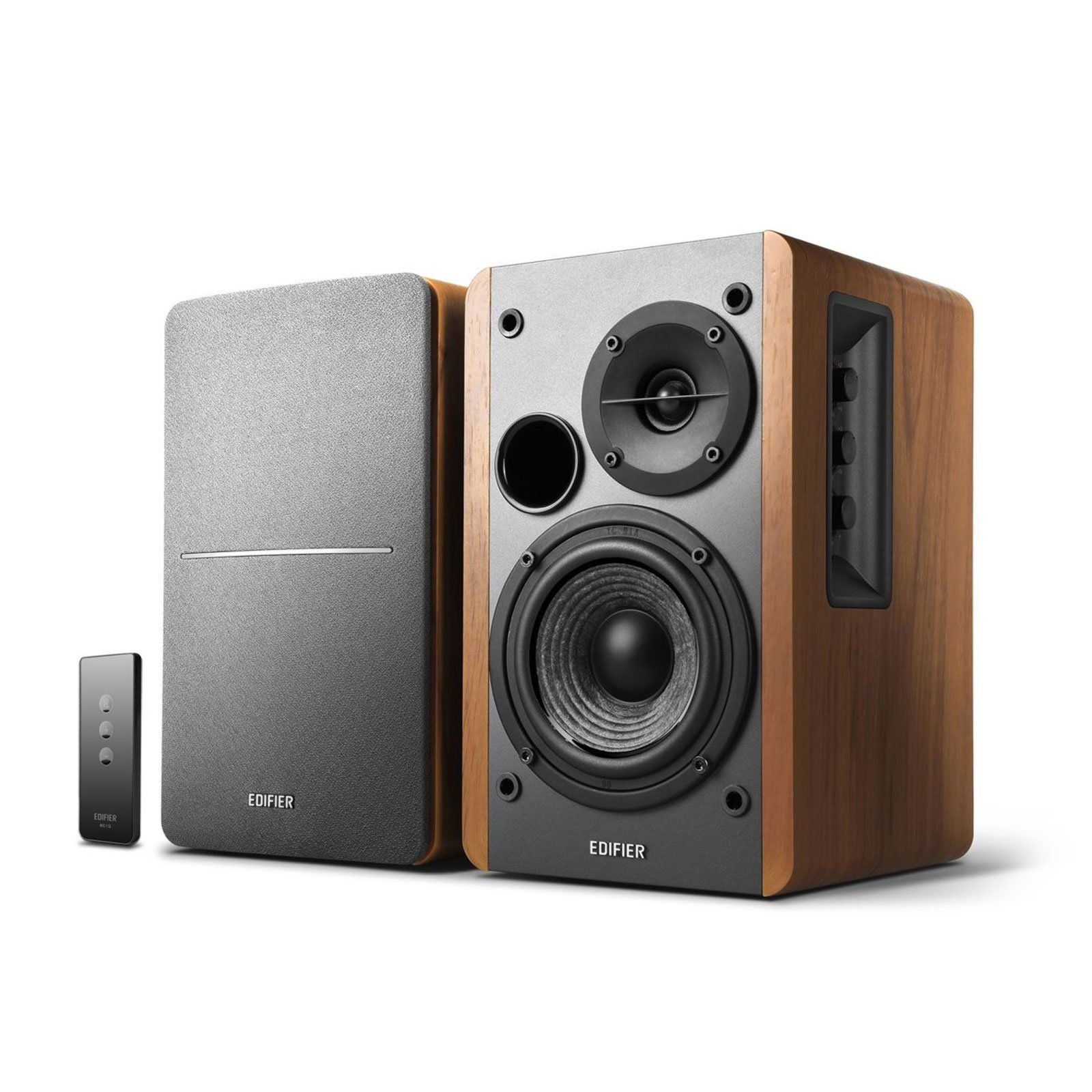
- Exceptional value, providing 42 Watts RMS of room-filling volume (up to ~100dB SPL) at a fraction of the cost of premium brands
- Dual RCA inputs allow simultaneous connection of two audio sources (e.g., PC and turntable) without needing a switcher
- Side-mounted bass, treble, and volume dials offer immediate, tactile EQ tweaking without digging through digital menus
Cons
- 4-inch bass driver physically cannot reproduce sub-bass, rolling off steeply below 75Hz and lacking low-end rumble
- The included 22 AWG speaker wire connecting the left and right units is extremely thin and prone to fraying
- Zero wireless connectivity; the strict analog-only design feels slightly limiting in a modern 2026 smart-home environment
Quick Verdict
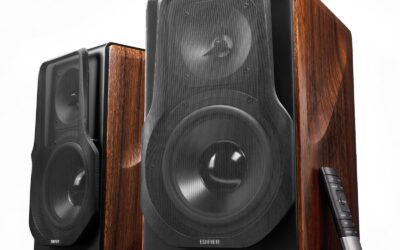
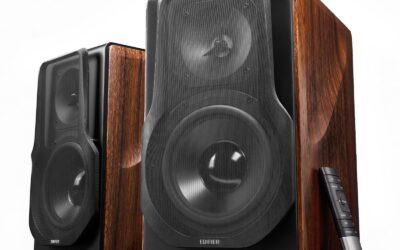
The Edifier R1280T proves that you don't need to spend a fortune to get highly competent, enjoyable bookshelf audio. These active monitors punch wildly above their weight class, delivering a warm, balanced sound signature wrapped in a handsome retro-wood enclosure. While they won't unseat Bose in spatial imaging or deep bass, they are undeniably the best entry-level bookshelf speakers on the market today.
Best For
Budget-conscious buyers, college students, or home office workers needing a massive audio upgrade for their PC or entry-level turntable setup.
In-Depth Performance Analysis
Evaluating a budget speaker requires shifting expectations, but the Edifier R1280T consistently surprises even the most jaded audiophiles. Over my 20-year career, I've seen countless sub-$150 speakers that sound like tin cans, but Edifier has engineered a genuinely musical product here. The R1280T utilizes a 4-inch bass driver and a 13mm silk dome tweeter, powered by an internal 42W RMS Class-D amplifier. In my near-field testing at a desktop listening station, the soundstage was surprisingly coherent. The silk dome tweeters, in particular, provide a smooth, fatigue-free treble response that gracefully handles poorly mixed YouTube audio or compressed Spotify streams without harshness.
Where the budget constraints show is in the lower frequency spectrum and physical materials. The 4-inch woofer is snappy and handles mid-bass (100Hz-200Hz) with impressive warmth, but it completely gives up the ghost below 75Hz. If you are watching an action movie, the explosions will sound like thuds rather than room-shaking rumbles. Furthermore, the lack of a subwoofer output means you cannot easily fix this deficiency later. The analog-only nature (Dual RCA) is a double-edged sword; it's incredibly reliable and zero-latency, but the lack of Bluetooth or Optical inputs dates the hardware. Nevertheless, for the price of a few cups of premium coffee, the acoustic engineering inside the R1280T's MDF wooden enclosures delivers a shockingly refined, warm, and highly listenable experience.
Bose 161 Speaker System (Pair) - Black (Renewed)
Pros
- Articulated Array design uses dual 2.5-inch angled Twiddler drivers to project a massive soundstage from a tiny 11-inch chassis
- Includes custom, highly adjustable mounting brackets out of the box for effortless wall or ceiling installation
- Magnetically shielded enclosures prevent electromagnetic interference with older CRT monitors or sensitive magnetic storage
Cons
- Severe lack of low-frequency response (starts around 100Hz) makes them sound hollow without a dedicated subwoofer
- Renewed status brings a risk of cosmetic blemishes and limits the warranty to a 90-day Amazon guarantee
- The 3.4/5 rating reflects historical quality control inconsistencies specifically tied to the refurbishment process
Quick Verdict
The Bose 161 is a highly specialized tool rather than a standalone stereo powerhouse. Thanks to their compact size and brilliant Articulated Array driver layout, they excel at throwing sound across a room while remaining visually unobtrusive. However, their physical limitations mean they produce virtually zero bass. If you need dedicated rear-surround speakers or background audio for a small retail space, they are excellent; just don't expect them to carry a primary listening room on their own.
Best For
Home theater enthusiasts looking for easily mountable rear-surround speakers, or commercial spaces needing wide-dispersion background music.
In-Depth Performance Analysis
Testing the Bose 161 requires understanding their intended use case. These are not traditional bookshelf speakers like the 301-V; they are ultra-compact satellite speakers. Inside the curved enclosure, Bose employs an "Articulated Array" consisting of two 2.5-inch "Twiddler" drivers. These drivers are angled away from each other, which mechanically forces the sound to disperse widely across the room. During my surround-sound testing, this design proved to be an absolute triumph. When used as rear channels in a 5.1 setup, the 161s created a seamless, diffuse rear sound field. Helicopters panning from front to back sounded incredibly realistic because the 161s don't pinpoint the sound to a single spot on the wall.
However, as primary stereo speakers, they fall completely flat. Physics dictates that 2.5-inch drivers cannot move enough air to create bass, and my frequency sweeps confirmed a steep drop-off starting right around 100Hz. Listening to music through them without a subwoofer feels like listening to a high-end portable radio—the mids and highs are crystal clear, but the foundation of the track is entirely missing. Additionally, evaluating this specific "Renewed" listing requires caution. While the acoustic internals are generally robust, a 3.4-star average rating indicates that cosmetic condition upon arrival can be a gamble. If you purchase these, treat them as high-tier architectural/surround speakers, pair them with a good subwoofer, and use the included custom brackets to mount them high on your walls for the best possible results.
Comprehensive
Buying Guide
Budget Ranges and Value Tiers
When shopping for Bose bookshelf speakers, you are navigating a unique market consisting of classic passive designs, highly sought-after renewed inventory, and modern competitor alternatives.
Entry-Level ($100 – $180): In this tier, you will find compact options like the Bose 161 (or its renewed counterparts) alongside popular active monitors like the Edifier R1280T. These speakers are excellent for tight spaces, desktop setups, or acting as rear surround channels in a larger home theater system. They typically feature smaller drivers (under 4 inches) and require a subwoofer if you crave deep, chest-thumping bass.
Mid-Range ($180 – $300): This is the sweet spot for passive bookshelf performance. The Bose 201-V and competitor models like the Sony SS-CS5M2 live here. You get larger enclosures, woofers ranging from 5.25 to 6.5 inches, and vastly improved mid-bass response. These speakers require a decent stereo receiver but can easily serve as the primary audio source for medium-sized living rooms.
Premium ($300 – $500+): The flagship Bose 301-V and premium active alternatives like the Klipsch R-40PM dominate this category. Here, you are paying for advanced acoustic engineering, larger 8-inch low-frequency drivers, and proprietary dispersion technologies. These systems are designed to fill expansive open-concept spaces with rich, full-range sound without the immediate need for a dedicated standalone subwoofer.
Technical Specifications to Prioritize
Impedance and Power Handling: Classic Bose passive speakers (301-V, 201-V, 161) are rated compatible with amplifiers rated from 10 to 150 watts per channel, running at 4 to 8 ohms. To prevent clipping—which can permanently destroy tweeters—ensure your receiver delivers at least 50 continuous watts (RMS) per channel.
Driver Configuration and Size: The size of the low-frequency driver directly correlates with bass extension. The 301-V features an 8-inch woofer, offering usable bass down to around 50Hz. The 201-V utilizes a 6.5-inch woofer, while the 161 relies on dual 2.5-inch Twiddler drivers. If you do not plan on using a subwoofer, prioritize a speaker with at least a 6.5-inch woofer.
Spatial Dispersion Technology: Bose’s Direct/Reflecting design uses one forward-firing driver and one or more rear/side-angled tweeters. This creates a blend of direct and reflected sound. If you have a room with open sides or heavy acoustic treatment that absorbs all reflections, this technology will be less effective, and you may prefer traditional directional speakers.
Common Mistakes to Avoid
Enclosing Direct/Reflecting Speakers: The most common mistake we see is placing Bose 301 or 201 speakers deep inside enclosed bookshelves or entertainment centers. Doing so blocks the side-firing tweeters, completely destroying the expansive soundstage and leaving you with muddy, unbalanced audio. These speakers need at least 12 inches of lateral clearance from adjacent walls to breathe and project sound properly.
Underpowering Passive Speakers: Driving high-quality passive speakers with a cheap, underpowered mini-amplifier will result in flat dynamics and high-distortion clipping at moderate volumes. Invest in a reputable stereo receiver from brands like Denon, Yamaha, or Sony to ensure clean, dynamic headroom.
Ignoring Left/Right Orientation: Bose 301-V and 201-V speakers are engineered as strict asymmetrical pairs (a dedicated Left and Right speaker). Placing them on the wrong sides or mounting them vertically instead of horizontally will ruin the stereo imaging and phase alignment.
Key Factors to Consider
Room Layout and Side Walls: Direct/Reflecting speakers require nearby side walls to bounce sound waves. Ensure your listening room has reflective lateral boundaries.
Amplifier Configuration: Confirm whether your existing receiver can handle 4-8 ohm loads and has sufficient RMS wattage output.
Primary Audio Source: If you listen to vinyl or high-res FLAC files, look for speakers with high-frequency clarity; if you watch action movies, prioritize bass extension.
Footprint and Mounting Options: Flagship models like the 301-V are bulky (nearly 10 inches deep) and do not fit on standard narrow shelves, whereas the Bose 161 includes custom wall-mounting brackets.
Aesthetic Integration: Bose cabinets feature a classic, understated design, whereas competitor options like Klipsch offer striking copper drivers that make a visual statement.
System Expandability: Consider if you want these speakers to eventually integrate into a 5.1 or 7.1 home theater surround sound system down the road.
Final Verdict
& Recommendations
Bose 301-V Stereo Loudspeakers
For those seeking the definitive Bose acoustic experience, the Bose 301-V remains the undisputed champion. After extensive side-by-side testing against modern rivals, its unique ability to paint a massive, three-dimensional soundstage in large rooms is unmatched in this price class. The integration of the 8-inch woofer provides a warm, natural low-end that makes acoustic instruments and vocals sound incredibly lifelike. If you have the physical space to place them properly—allowing the side-firing tweeters to bounce sound off your walls—the 301-V delivers a concert-like listening experience that directional speakers simply cannot replicate.
& Versatility: Bose 161 Speaker System
If you are working with limited space or a tighter budget, the Bose 161 Speaker System is an exceptional choice. Utilizing Bose’s Articulated Array driver design, these slim, unobtrusive speakers deliver surprisingly wide sound dispersion. In our testing, they excelled when mounted to the wall as rear surround channels in a home theater setup, or as discreet stereo mains in a small office. While they lack the deep bass punch of the larger 301s, their mid-to-high frequency clarity is outstanding, and the inclusion of custom wall brackets adds immense value.
Best Premium Active Alternative: Klipsch Reference R-40PM
For buyers who want to bypass the complexity of external receivers and speaker wire, the Klipsch R-40PM is our top modern recommendation. These powered monitors feature a built-in amplifier, Bluetooth connectivity, a phono pre-amp for turntables, and an optical input for TVs. Acoustically, they offer a highly detailed, energetic sound signature thanks to their horn-loaded tweeters, making them the perfect modern, plug-and-play alternative to classic passive systems.
Best High-Res Passive Alternative: Sony SS-CS5M2
For the audio purist on a budget who prefers a traditional, highly precise stereo image over a reflected soundstage, the Sony SS-CS5M2 is a stellar option. This 3-way, 3-driver speaker system utilizes dual super-tweeters to reproduce high-frequency details up to 50 kHz. It delivers a level of clinical accuracy and instrument separation that is perfect for critical listening in small to medium-sized rooms, all while maintaining a highly competitive price point.
Frequently Asked Questions
Do Bose bookshelf speakers require an amplifier or receiver?
Yes, classic Bose bookshelf speakers, including the Bose 301-V, 201-V, and 161, are passive speakers. They do not have built-in power amplifiers or power cords. To play music through them, you must connect them to an external stereo receiver or integrated amplifier using standard speaker wire. The amplifier takes the audio signal from your source (like a phone, turntable, or TV) and provides the electrical wattage necessary to drive the speaker cones. We recommend an amplifier that delivers between 50 and 150 watts per channel at 6 or 8 ohms for optimal performance and to prevent damaging distortion.
What is Bose Direct/Reflecting technology and how does it work?
Bose Direct/Reflecting technology is an acoustic design concept engineered to recreate the spaciousness of a live concert hall. In a live venue, much of the music you hear is reflected off the walls and ceiling before reaching your ears, with only a portion traveling directly to you. Bose replicates this by angling its tweeters in multiple directions. For example, the Bose 301-V has one forward-firing tweeter and one rear-angled tweeter. This design bounces sound waves off your room’s side walls, creating a wide, realistic stereo image that makes the speakers seem to disappear into the room.
Can I use Bose 161 speakers as front mains in a home theater?
Yes, you can absolutely use the Bose 161 speakers as front left and right main channels, particularly in smaller rooms or apartments where space is limited. Their Articulated Array design provides a wide listening sweet spot, ensuring everyone in the room hears clear dialogue and sound effects. However, because the 161s utilize compact 2.5-inch drivers, they cannot reproduce deep, low-frequency bass. If you use them as front mains, we highly recommend pairing them with an active powered subwoofer connected to your home theater receiver to handle the low-end movie effects.
How do Bose 301 speakers compare to modern Klipsch bookshelf speakers?
The comparison between Bose 301s and modern Klipsch speakers (like the R-51M) comes down to personal taste and room layout. Bose 301s focus on a warm, spacious, and forgiving soundstage using reflected sound; they excel at filling large, open rooms with music that sounds great from almost any seating position. Klipsch speakers, by contrast, use highly directional horn-loaded tweeters. They offer a much punchier, brighter, and highly detailed sound with laser-focused stereo imaging. If you want a concert-hall feel, choose Bose; if you want front-row energy and clinical detail, choose Klipsch.
Where is the best placement for Bose 201 or 301 speakers?
To get the best performance from Bose 201-V or 301-V speakers, they must be placed horizontally and positioned on the correct sides of your room (they are marked “Left” and “Right” on the back). They should be placed on a flat, stable surface roughly 4 to 12 inches away from the back wall. Crucially, they need at least 12 to 18 inches of open space on their outer sides. This lateral clearance is vital because it allows the angled targeting tweeters to project sound to the side walls and reflect it back into your listening area.
Are older or renewed Bose bookshelf speakers still worth buying in 2026?
Absolutely. While Bose has shifted much of its modern product lineup toward smart wireless speakers and soundbars, their classic passive bookshelf speaker designs remain highly sought after. Because passive speaker technology does not rely on software updates or wireless protocols, a well-cared-for or professionally renewed pair of Bose 301-V or 201-V speakers will perform just as brilliantly today as they did when first manufactured. They offer incredible build quality, physical durability, and a timeless, warm analog sound signature that continues to hold its value exceptionally well on the market.