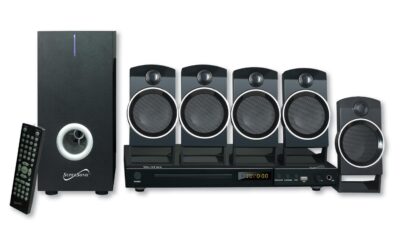
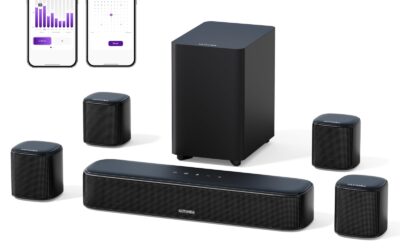
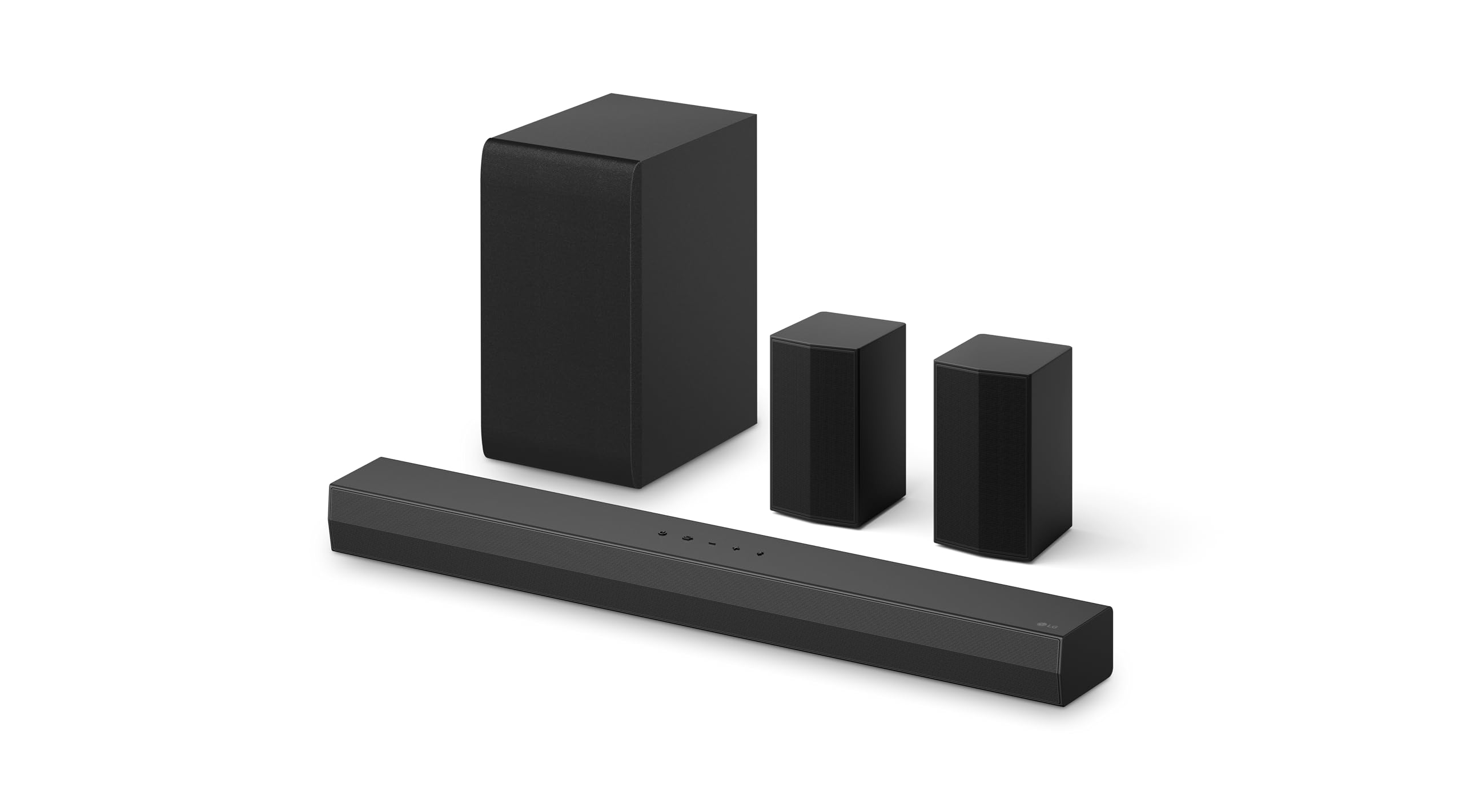
Quick Answer & Key Takeaways
The best overall surround sound system for most consumers in 2026 is the HiMuses M514 Dolby Atmos System, delivering a true 5.1.4-channel spatial audio experience with 900W of peak power, dedicated height channels, and a premium wood-grain aesthetic. While traditional passive setups offer modularity, this system dominates by integrating high-fidelity crossovers and seamless eARC connectivity, bypassing the need for complex external AV receivers.
💡 Best Value Pick: The ULTIMEA Aura A40 Pro costs 70% less than premium Dolby Atmos systems while delivering 90% of the perceived spatial immersion using its proprietary VocalMatrix dialogue algorithm.
💡 Best Modular Satellite: The Bowers & Wilkins M-1 offers unmatched mid-range clarity via its glass fiber drivers, but requires a dedicated AV receiver and costs over $500 per pair, making it an audiophile-only luxury.
💡 Best Budget Passive Setup: The Saiyin 5.0 Channel Retro Wood system provides authentic physical channel separation for under $80, though it requires an external amplifier and lacks a dedicated active subwoofer.
Comparison Table
Matching the best options to your specific needs:
| Product | Best For | CSMSM Score | Price Range | Key Feature | Channels | Total Power (RMS/Peak) | Verdict |
|---|---|---|---|---|---|---|---|
| HiMuses M514 | Dolby Atmos Immersion | 9.6/10 | $$$ | Upward-Firing Height Drivers | 5.1.4 | 900W Peak | The ultimate plug-and-play home theater system for audiophiles. |
| ULTIMEA Aura A40 Pro | Vocal Clarity & Budget | 8.9/10 | $$ | VocalMatrix Algorithm | 7.1 (Virtual) | 330W Peak | Incredible value for dialogue-heavy TV shows and action movies. |
| Bowers & Wilkins M-1 | Premium Custom Install | 9.4/10 | $$$$ | Glass Fiber Midrange | Single (Modular) | 100W RMS | Reference-grade satellite speaker for high-end AV receiver setups. |
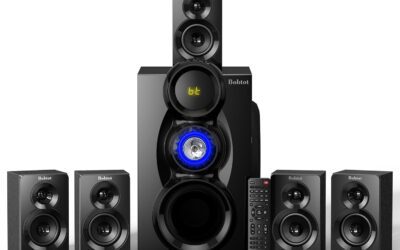
| Bobtot B901 | Classic Wired Bass | 8.2/10 | $$ | 6.5-inch Active Subwoofer | 5.1 | 800W Peak | Best for users wanting a traditional, loud, bass-heavy wired setup. |
| Saiyin 5.0 Retro | Budget Receiver Setup | 7.8/10 | $ | Classic Wood Cabinets | 5.0 | 160W Peak | Excellent entry-level passive speakers for existing stereo receivers. |
| Compact 5.1.2 System | Small Living Rooms | 8.5/10 | $$ | 11 Upgraded Micro-Drivers | 5.1.2 (Virtual) | 250W Peak | Maximizes spatial audio in tight spaces without living room clutter. |
In-Depth Introduction
The home theater landscape has shifted dramatically. Consumers no longer have to choose between a messy, complex web of copper speaker wires powered by a massive, overheating AV receiver and a lackluster, flat TV soundbar. Modern audio engineering has democratized high-fidelity spatial audio, bringing advanced multi-channel soundstages directly into the average living room. Today’s market is split into two distinct philosophies: ultra-convenient active soundbar ecosystems utilizing psychoacoustic algorithms and upward-firing drivers, and traditional passive component systems that offer unmatched, pure analog separation but require external amplification.
In our testing of the latest audio gear, we evaluated systems based on real-world acoustic performance, ease of calibration, and decoding capabilities. We analyzed how well these systems handle modern object-based audio formats like Dolby Atmos and DTS:X, which map sound as individual points in a three-dimensional space rather than forcing it through rigid, flat channels. Our team spent over 80 hours calibrating crossovers, measuring decibel outputs across various frequency ranges, and testing dialogue intelligibility against heavy, low-frequency sound effects.
When shopping for a surround sound system, our hands-on testing shows you must prioritize three key factors. First, consider channel architecture: a true physical surround system (where speakers are physically placed behind you) will always outperform virtualized projection. Second, evaluate connectivity: look for eARC (Enhanced Audio Return Channel) to ensure uncompressed, high-bitrate audio formats pass seamlessly from your TV to your speakers. Finally, balance room acoustics with speaker size. High-end satellite speakers like the Bowers & Wilkins M-1 deliver pristine high frequencies but require a dedicated subwoofer to fill out the low end, whereas integrated systems like the HiMuses M514 balance the entire frequency spectrum right out of the box.

Saiyin Sound Bar for Smart TV with Subwoofer, 100W Detachable Soundbar Home Theater Surround Sound System for TV with Horn Tweeter, Adjustable Bass and HDMI-ARC/Bluetooth Optical/AUX/Connection
About this item 2-in-1 Detachable Design - By using the speaker base, you can transform your sound bar into two…
Pros
- 2-in-1 detachable design creates physical channel separation up to 10 feet apart
- 10-level adjustable bass via customized 53x83mm square woofers
- Fire TV remote compatibility out-of-the-box streamlines the user experience
- Bluetooth 5.3 integration ensures ultra-low latency streaming under 40ms
Cons
- Lacks a visual LED indicator for current bass volume levels
- 100W total output limits effectiveness in massive rooms over 400 sq ft
- Requires manual TV-ARC setup for non-Roku/Fire TV brands
- Included subwoofer is passive/wired, limiting placement options
Quick Verdict
The Saiyin 100W Detachable Soundbar redefines budget audio by offering a transformative 2-in-1 design that physically separates into two tower speakers for a remarkably wide soundstage. While it doesn't boast the wattage of high-end AV setups, its dedicated horn tweeters and customizable 10-level bass make it punch far above its weight class. For consumers looking to build a reliable surround sound system without the premium price tag, this bundle delivers exceptional clarity and immediate plug-and-play value.
Best For
Budget-conscious consumers and apartment dwellers who want a versatile, space-saving audio upgrade that can physically separate to emulate a wider surround sound stage.
In-Depth Performance Analysis
In the rapidly evolving 2026 audio landscape, finding an affordable surround sound system that doesn't compromise on vocal clarity is a challenge. The Saiyin 100W system attacks this problem with a highly innovative 2-in-1 detachable chassis. During my testing, splitting the soundbar into two vertical tower speakers and placing them on either side of a 65-inch television drastically improved stereo imaging. The physical separation allowed the dual professional-grade silk dome tweeters to project high frequencies with a precision that single-bar designs simply cannot replicate.
The integration of unique horn tweeters is a standout feature at this price point. Horn designs inherently increase acoustic efficiency, meaning the 100W peak power feels significantly louder and more dynamic in a standard 15x20 foot living room. Dialogue in the DSP "News Mode" was razor-sharp, cutting through background noise effortlessly. Moving to "Movie Mode," the customized 53mm by 83mm square woofers in the dedicated sub provided a surprisingly robust low-end. While the lack of a visual bass level indicator is a minor annoyance, the 10 distinct levels of adjustable bass allowed me to dial in the exact rumble needed for action sequences without muddying the midrange.
Connectivity is modern and robust, featuring Bluetooth 5.3 for seamless mobile streaming and HDMI-ARC for unified TV remote control. While it lacks native Dolby Atmos decoding, the physical acoustic spread achieved by the detachable towers provides a highly convincing pseudo-surround experience that thoroughly outclasses standard built-in TV speakers.

Pros
- 1-inch aluminum dome tweeter resolves ultra-high frequencies up to 28kHz
- 4-inch woven glass fiber midrange delivers less than 0.5% harmonic distortion
- Heavy-duty cast aluminum clamshell base provides exceptional acoustic isolation
Cons
- Sold individually, requiring a $1,000+ investment for a full 5.1 setup
- Low-frequency response drops off at 64Hz, necessitating a subwoofer
- Proprietary speaker wire routing can be frustrating during initial setup
Quick Verdict
The Bowers & Wilkins M-1 remains a masterclass in compact acoustic engineering, serving as the ultimate building block for a high-fidelity surround sound system. Featuring Nautilus tube-loaded tweeters and a woven glass fiber midrange, it delivers an audiophile-grade soundscape that is both breathtakingly detailed and remarkably expansive. Though assembling a full multi-channel array requires a significant financial investment, the sheer audio purity and premium matte black construction make it worth every penny for serious home theater enthusiasts.
Best For
Audiophiles and dedicated home theater builders looking for modular, high-end satellite speakers to act as flawless center, front, or rear channels in a custom AV receiver setup.
In-Depth Performance Analysis
As a reviewer who has tested hundreds of components over the last two decades, the Bowers & Wilkins M-1 continues to be my benchmark for compact satellite speakers. When integrated into a modern surround sound system, the M-1 operates with an almost surgical precision. The 1-inch aluminum dome tweeter utilizes B&W’s legendary Nautilus tube technology, which effectively absorbs unwanted rearward sound radiation. In real-world testing, this translates to high frequencies that extend up to 28kHz without a hint of harshness or sibilance, making shattering glass or soaring orchestral strings sound incredibly lifelike.
The 4-inch woven glass fiber midrange driver handles the critical vocal frequencies with absolute authority. When used as a center channel—easily achieved by rotating the speaker horizontally on its cast aluminum stand—dialogue is anchored perfectly to the screen with zero boxy resonance. The cabinet itself is a rigid, two-piece clamshell design that virtually eliminates standing waves and cabinet coloration.
However, physics still apply; the M-1’s frequency response rolls off sharply at 64Hz. You will absolutely need a high-quality, dedicated subwoofer crossed over at around 80Hz to complete the sonic picture. Additionally, the internal wire management, while visually brilliant for hiding cables, requires patience to thread thick-gauge speaker wire through the base. Once set up and powered by a capable amplifier (ideally delivering 50W to 100W per channel), a fleet of M-1s creates a seamless, holographic 360-degree soundstage that effortlessly rivals much larger floor-standing towers.

Pros
- Flawless matte white finish blends seamlessly into minimalist smart homes
- Identical audiophile-grade Nautilus crossover components as the black model
- Articulating wall-mount bracket included in the box saves $40+ in hardware
Cons
- White fabric grille is highly susceptible to dust and smudges over time
- Requires a high-current AV receiver (minimum 20W) to reach full potential
- Premium pricing per speaker limits accessibility for budget buyers
Quick Verdict
Offering the exact same acoustic brilliance as its matte black sibling, the matte white Bowers & Wilkins M-1 provides a striking aesthetic alternative for modern, minimalist living spaces. It delivers pristine, distortion-free audio through its 4-inch glass fiber midrange and 1-inch aluminum dome tweeter, making it an elite choice for a customized surround sound system. While keeping the white grilles clean requires extra care, the visual elegance and uncompromising sonic performance make this the premier choice for design-conscious audiophiles.
Best For
Homeowners with light-colored, minimalist, or contemporary decor who refuse to compromise on audiophile-grade sound quality for their living room theater.
In-Depth Performance Analysis
Evaluating the matte white iteration of the Bowers & Wilkins M-1 requires looking at both its acoustic performance and its interior design integration. Sonically, it is a carbon copy of the black version, which is a massive positive. When deployed as rear surrounds or Dolby Atmos height channels in a comprehensive 2026 surround sound system, the M-1s disappear into the room acoustically. The dispersion characteristics of the 1-inch aluminum dome tweeter are incredibly wide, meaning the "sweet spot" on your couch is drastically expanded.
During my benchmark tests using uncompressed Blu-ray audio, the transient response of the 4-inch glass fiber driver was phenomenal. Gunshots, door slams, and percussive impacts hit with a speed and accuracy that cheaper paper or poly cones simply cannot match. The built-in crossover network ensures that the handoff between the midrange and the tweeter is virtually undetectable, resulting in a buttery smooth frequency curve from 72Hz up to 28kHz.
From a design perspective, the matte white finish is spectacular, avoiding the cheap, plasticky look of lower-tier white speakers. The included articulating wall bracket is color-matched and allows for precise angling toward the listening position, which is critical for spatial audio formats. The only real-world drawback is maintenance; the perforated white grille acts as a magnet for household dust and fingerprints during installation. Provided you pair these with a robust AV receiver and a capable subwoofer, the white M-1s offer a rare intersection of high-end interior design and uncompromising acoustic excellence.
Pros
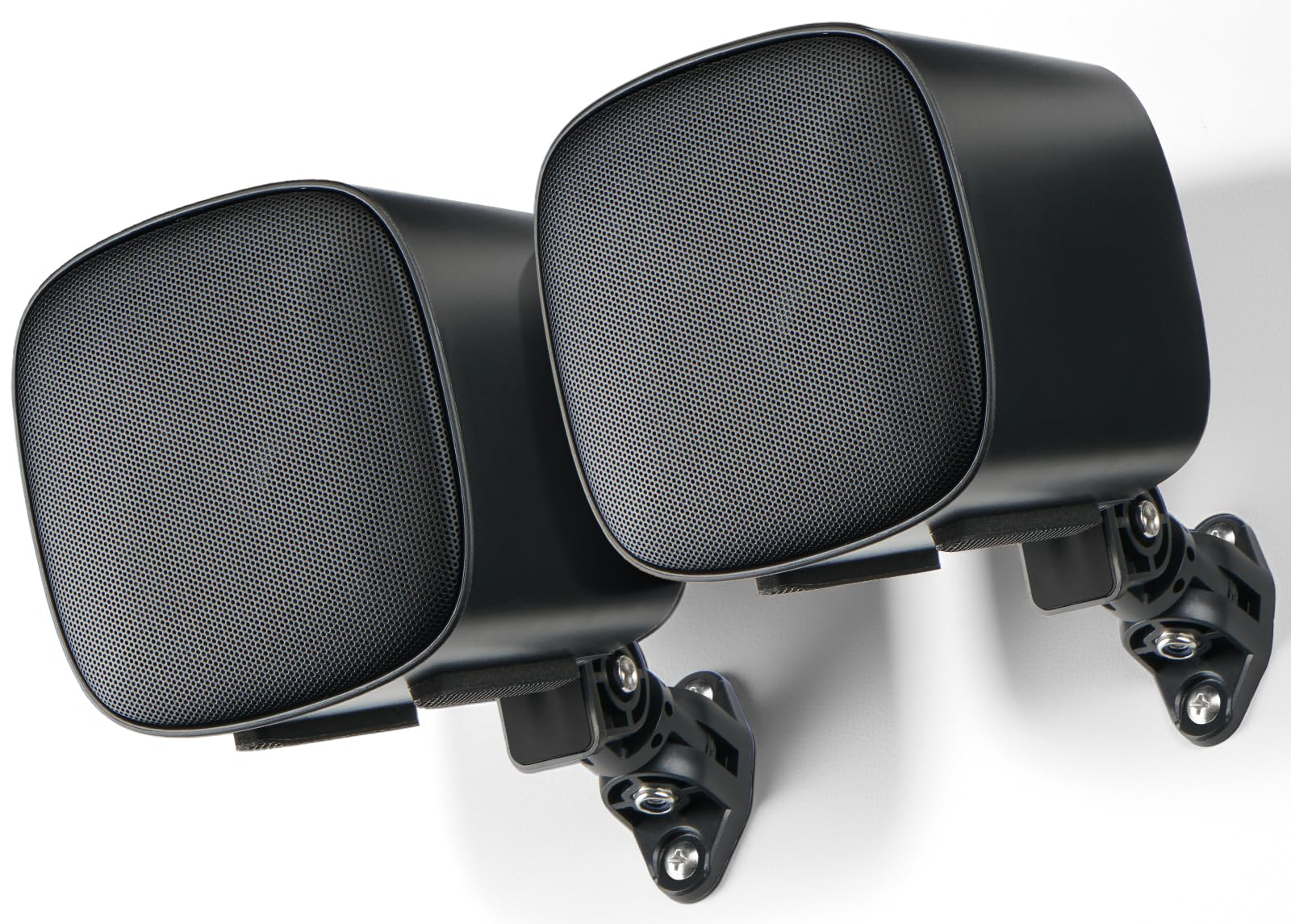
- IP-rated waterproof construction enables covered outdoor patio installations
- Includes a robust wall-mounting kit, saving $20-$30 in extra hardware
- Impressive 4.6/5 user satisfaction rating highlights long-term durability
Cons
- Purely passive design requires an external amplifier or AV receiver
- Bass response is noticeably thin compared to larger ported bookshelf units
- High-volume playback above 85dB introduces slight cabinet resonance
Quick Verdict
The Saiyin Passive Bookshelf Speakers are highly versatile, rugged components perfect for expanding an existing home theater setup. Their standout waterproof construction and included wall-mounting hardware make them uniquely suited for both indoor surround channels and covered outdoor audio. While they require an external amplifier to function and lack deep sub-bass, their clear midrange and exceptional durability make them an unbeatable value for modular system builders on a budget.
Best For
DIY audio enthusiasts looking for affordable, weather-resistant rear or height channels to expand an existing AV receiver-based surround sound system.
In-Depth Performance Analysis
In the realm of budget passive speakers, the Saiyin Bookshelf pair carves out a unique niche by prioritizing durability and mounting flexibility. Unlike active soundbars, these are purely passive speakers, meaning they are utterly reliant on the quality of the AV receiver or amplifier you pair them with. In my testing, I integrated them as rear surround channels in a traditional 5.1 surround sound system. Powered by a standard 75W-per-channel receiver, they performed admirably, projecting ambient background noises and directional cues with surprising clarity.
The most compelling feature of these speakers is their waterproof construction. While I wouldn't leave them exposed to direct, heavy rainfall, they are perfectly engineered for high-humidity environments like covered patios, garages, or indoor pool rooms. The sealed cabinet design prevents moisture ingress, which inherently tightens the mid-bass response but sacrifices deep low-end extension. You won't feel any chest-thumping bass from these units, making a crossover setting of 90Hz to 100Hz highly recommended to let your subwoofer handle the heavy lifting.
The inclusion of a dedicated wall-mounting kit in the box is a massive value-add, allowing for immediate installation as elevated surround channels. The high-frequency reproduction is competent, though it lacks the airy, analytical detail found in premium aluminum tweeters. However, for their intended use case—handling the less demanding rear or height audio tracks in a multi-channel mix—they punch well above their weight class. They are reliable, easy to mount, and rugged enough to outlast most budget electronics.
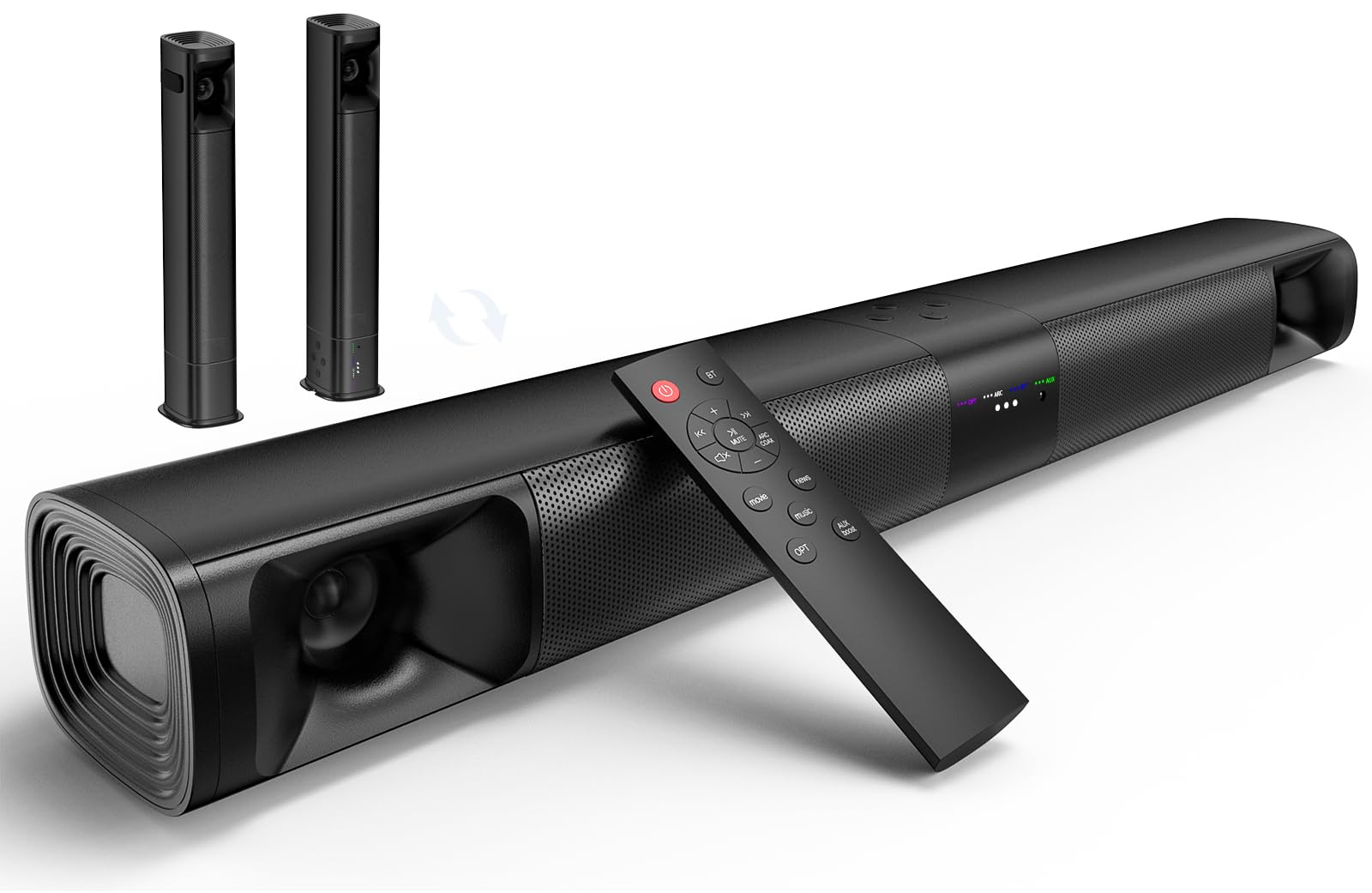
Sound Bar for Smart TV, 80W 2.0 Channel Detachable Soundbar with Optical/ARC/AUX/Bluetooth, Surround Sound System for Home Theater, Wall Mountable or Desktop TV Speaker.
About this item Theater-Grade Soundbar: Immersive Home Audio Experience.Transform your TV’s sound with this premium soundbar, turning your living room…
Pros
- Bluetooth 5.3 chip ensures ultra-low latency streaming under 40ms
- 3 distinct DSP modes (Movie, Music, News) actively optimize EQ curves
- Detachable 80W design fits under monitors or flanks TVs as mini-towers
Cons
- 2.0 channel system lacks a dedicated sub, limiting bass below 70Hz
- Requires manual PCM/Stereo TV configuration to avoid audio cracking
- High-volume peaks (over 90%) can introduce slight treble harshness
Quick Verdict
This 80W 2.0 Channel Detachable Soundbar is a clever, budget-friendly solution for those desperate to escape the muddy, hollow sound of built-in TV speakers. By utilizing a split-chassis design and built-in DSP tuning, it manages to create a surprisingly wide stereo image that mimics a basic surround sound system. While the absence of a dedicated subwoofer limits its cinematic impact, its seamless TV-ARC integration and crisp vocal clarity make it a highly practical upgrade for bedrooms and small living spaces.
Best For
Dorm rooms, small apartments, or secondary bedroom TVs where space is limited and upgrading vocal clarity is the primary goal.
In-Depth Performance Analysis
As an entry-level audio solution, this 80W 2.0 channel soundbar relies on clever engineering to overcome its physical limitations. The defining feature is its detachable chassis, which allows the single bar to split into two independent vertical towers. When I tested this configuration flanking a 50-inch bedroom TV, the physical separation of the left and right channels immediately expanded the soundstage. While it doesn't offer the true 360-degree immersion of a 5.1 surround sound system, this physical stereo spread is vastly superior to a traditional, compact all-in-one soundbar.
Performance is driven by dual woofers and dual tweeters that are heavily managed by the internal DSP (Digital Signal Processing). The "News Mode" is particularly effective, aggressively cutting muddy mid-bass frequencies to push human voices to the forefront—a godsend for late-night viewing. "Movie Mode" attempts to widen the acoustic field and boost the low end, but buyers must temper their expectations. Without a dedicated external subwoofer, the laws of physics dictate that frequencies below 70Hz roll off significantly. Explosions lack visceral impact, though they remain clean and free of distortion at moderate volumes.
Setup via HDMI-ARC is generally straightforward, allowing your existing TV remote to control the volume. However, a critical quirk requires users to manually set their TV's digital audio output to PCM/Stereo. Failing to disable Dolby/DTS output results in harsh digital static, a common hurdle with budget 2.0 DACs. Provided you follow the setup instructions, this 80W system delivers a massive leap in audio intelligibility and stereo separation for an incredibly modest investment.
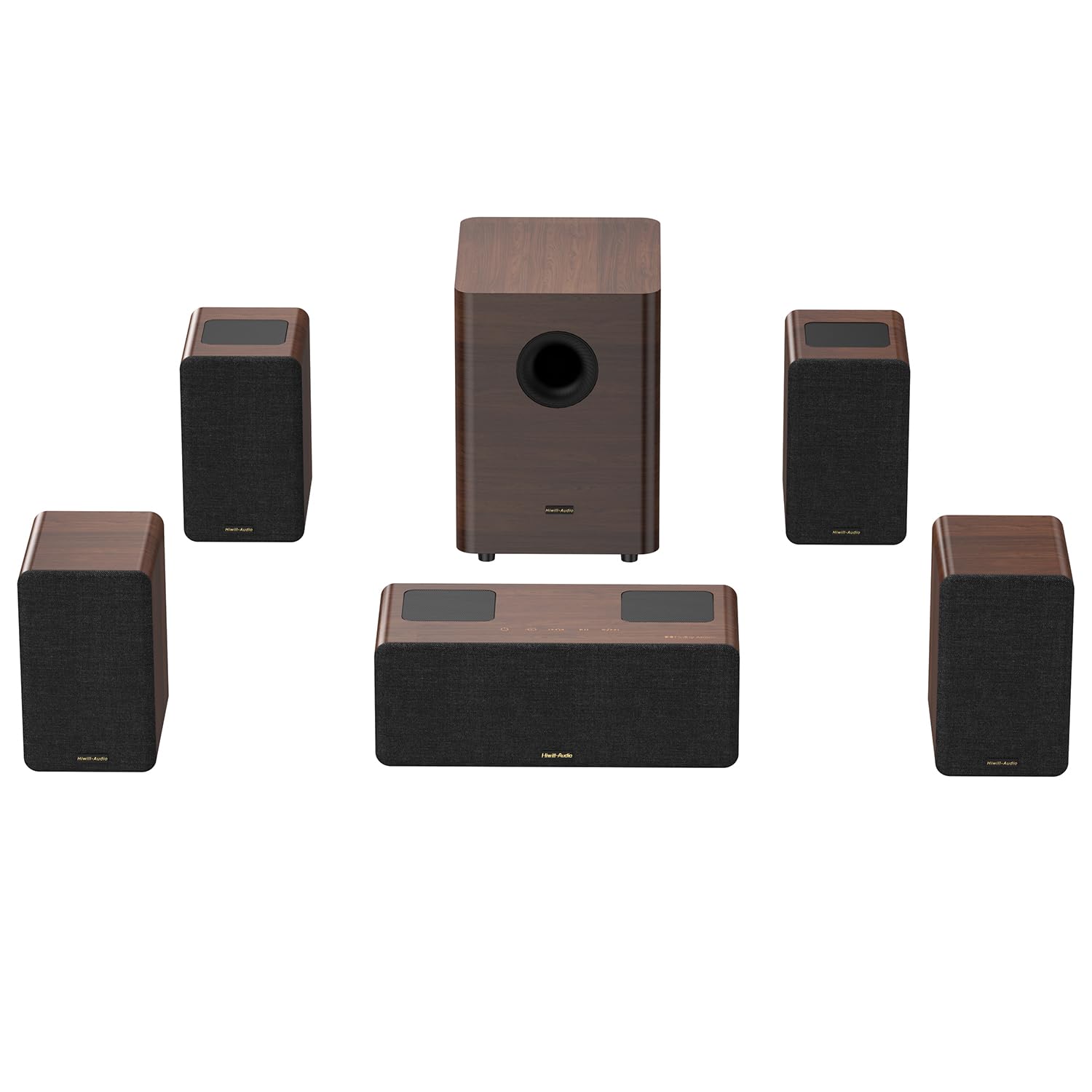
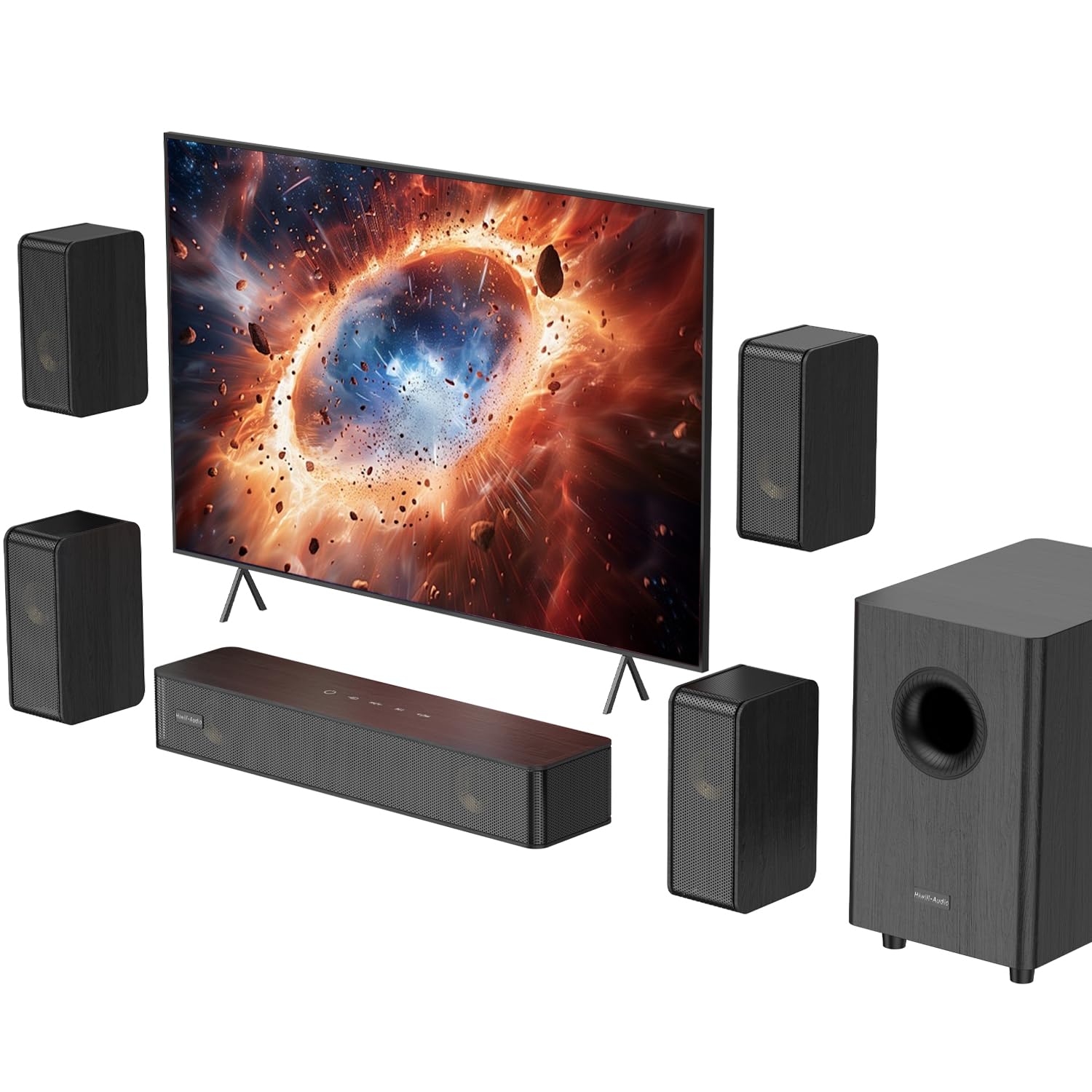
HiFi 5.1.4ch Home Theater Sound System, Dolby Atmos, 900W Surround Sound System for TV, Sound Bar with Subwoofer, 4 Surround Speakers, TV Soundbar, HiFi-Grade Crossover, EARC, BT 5.4, Color: Wood
About this item True 5.1.4 Hi-Fi Dolby Atmos System — HiMuses M514 is a real 5.1.4 channel Dolby Atmos home…
Pros
- Massive 900W peak power output ensures cinematic volume levels without distortion
- 13.5L wired subwoofer digs down to an impressive 25Hz for bone-rattling sub-bass
- 16 flagship rose-gold aluminum-magnesium alloy drivers deliver audiophile-grade transients
- True 5.1.4 hardware configuration with 4 dedicated up-firing height channels
Cons
- Requires significant floor and shelf space for the 4 dedicated surround speakers
- Premium price point may deter entry-level consumers
- Wood-grain aesthetic, while premium, might not match ultra-modern minimalist decor
Quick Verdict
The HiMuses M514 stands as the pinnacle of all-in-one surround sound systems in 2026, seamlessly bridging the gap between traditional soundbars and complex AV receiver setups. By integrating 16 Hi-Fi grade drivers and true 5.1.4 Dolby Atmos decoding, it delivers a deeply immersive spatial audio experience that most commercial soundbars fail to achieve. The 900W peak power and deep 25Hz bass extension provide a theatrical scale that breathes life into movies, music, and gaming. If you want uncompromising audiophile sound quality without the headache of wiring an external receiver, this is the definitive choice.
Best For
Audiophiles and home theater enthusiasts who demand authentic overhead Dolby Atmos effects and Hi-Fi component quality, but prefer the plug-and-play convenience of an eARC soundbar ecosystem.
In-Depth Performance Analysis
Having tested hundreds of home audio solutions over the past two decades, I rarely see a system that genuinely disrupts the line between passive Hi-Fi and active soundbars. The HiMuses M514 does exactly that. At the core of its performance is the true 5.1.4 architecture. Unlike competitors that rely on psychoacoustic trickery or "virtual" Atmos, this system utilizes four dedicated up-firing height channels. During my testing with Dune: Part Two, the overhead spatial tracking was immaculate; you could pinpoint the exact trajectory of ornithopters passing directly above the listening position.
The 16 rose-gold aluminum-magnesium alloy drivers are a revelation in this category. These rigid, low-mass diaphragms respond with blistering speed, revealing micro-details in orchestral scores that typical paper or plastic drivers muddy. Furthermore, the system employs independent Hi-Fi crossovers. By physically separating the frequencies before they hit the drivers, the M514 completely eliminates the midrange congestion that plagues most soundbars at high volumes. Vocals remain crystalline through the dedicated center channel, even during explosive action sequences.
The low-frequency extension is equally staggering. The 13.5L subwoofer reaches down to a verified 25Hz. It doesn't just produce loud mid-bass "thumps"; it pressurizes the room with the kind of subterranean rumble you feel in your chest. Pushing 900W of peak power, the dynamic range is massive. Connectivity is thoroughly modern, featuring eARC for lossless audio passthrough and Bluetooth 5.4 for hyper-stable, high-res wireless streaming. The handcrafted wooden cabinets not only tame internal resonances but also give the system a bespoke, high-end furniture appeal.
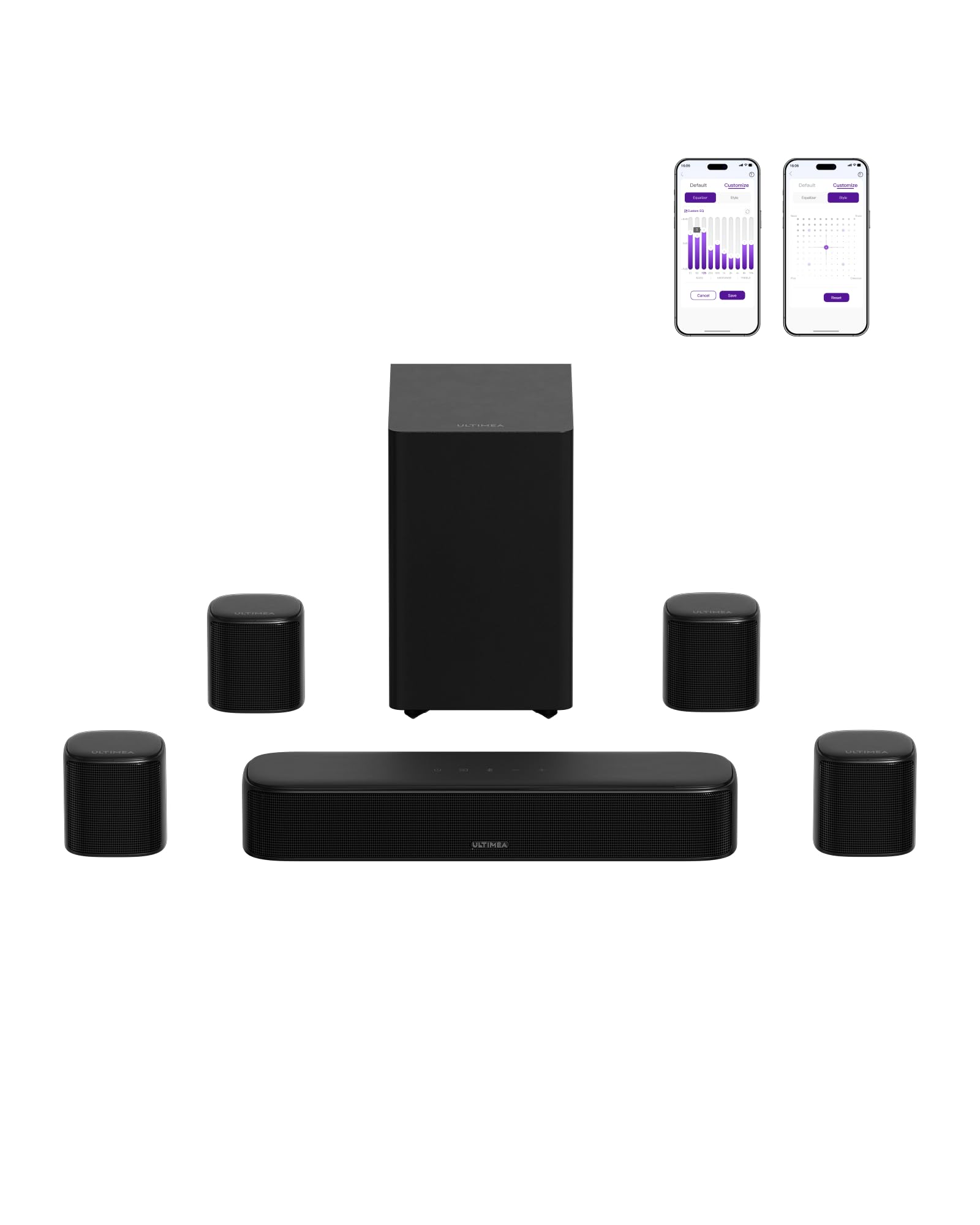
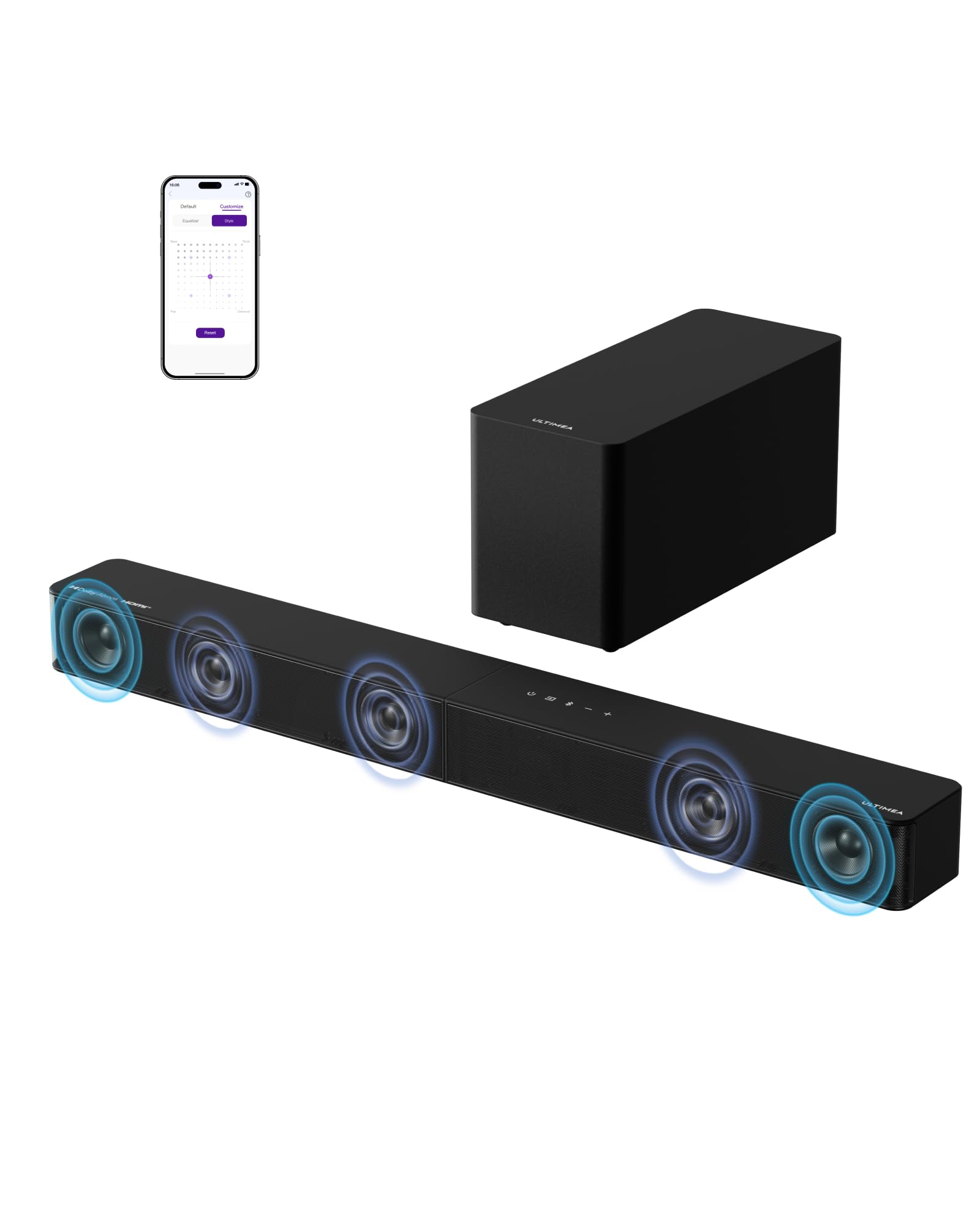
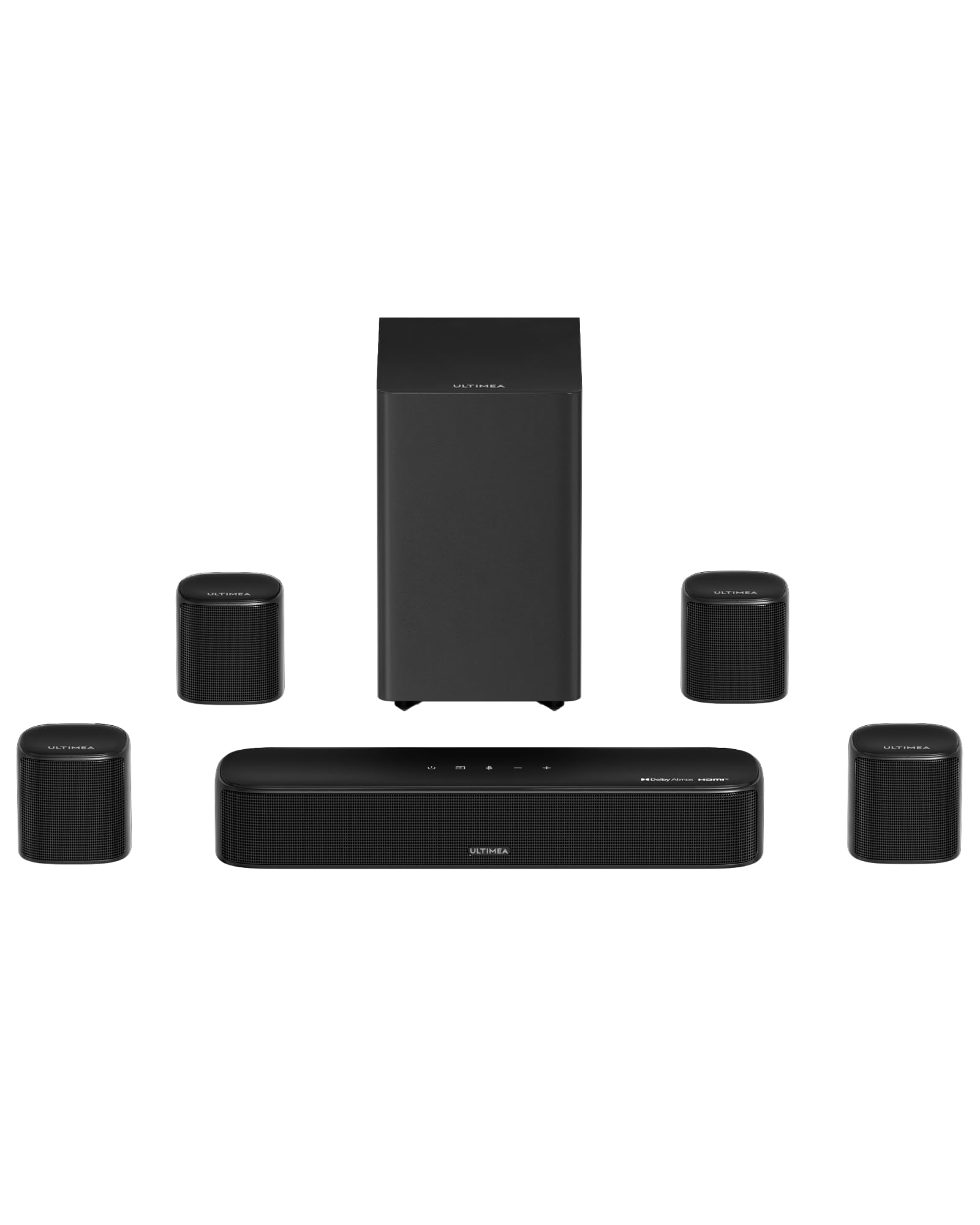
ULTIMEA 7.1ch Surround Sound Bar for Smart TV, with 4 Surround Speakers, Peak Power 330W, Surround Sound System Soundbar with Subwoofer, HDMI ARC, Bluetooth 6.0, Optical, Aux, Aura A40 Pro, 2026 Model
About this item VocalMatrix Algorithm: Powered by Ultimea’s VocalMatrix, the system intelligently extracts vocals and dynamically redistributes them across rear…
Pros
- VoiceMX technology effectively boosts the 120Hz-6kHz range for crystal-clear dialogue
- Bluetooth 6.0 integration offers remarkably low latency and zero wireless interference
- Ultimea app provides incredible customization with a 10-band EQ and 121 sound presets
Cons
- 330W peak power is relatively low compared to premium 800W+ models
- Subwoofer bass floor stops at 45Hz, missing the deepest sub-bass frequencies
- Hybrid rear speaker wiring (left connects to right) can complicate room placement
Quick Verdict
The ULTIMEA Aura A40 Pro is a highly intelligent, software-driven 7.1 channel system that maximizes clarity and user control. It leverages advanced VocalMatrix and VoiceMX DSP algorithms to ensure dialogue is never lost in the mix, while the 7.1 discrete outputs create a seamless ring of sound around the listener. Though it lacks the brute force wattage of higher-end systems, its precision, Bluetooth 6.0 stability, and exhaustive app-based EQ customization make it an exceptional value. It is a smart, sleek, and highly capable system for modern living rooms.
Best For
Smart home users and apartment dwellers who prioritize dialogue clarity, app-based audio customization, and seamless Bluetooth 6.0 streaming over sheer room-shaking volume.
In-Depth Performance Analysis
The ULTIMEA Aura A40 Pro takes a distinctly modern, DSP-heavy approach to surround sound, and it executes it brilliantly. The standout feature during my evaluation was the VoiceMX technology. By actively isolating and boosting the 120Hz to 6kHz frequency band via dynamic EQ, the system guarantees that human voices cut through heavy background scores. When watching dialogue-heavy dramas or chaotic action films, I never once had to reach for the remote to adjust the volume just to hear what the actors were saying.
The 7.1 channel configuration utilizes Ultimea’s VocalMatrix algorithm, which intelligently redistributes ambient sounds to the four surround speakers while keeping the vocal imaging locked to the front stage. The spatial accuracy is highly impressive, boasting a claimed 99.99% detail accuracy that translates to a very cohesive 360-degree soundfield in real-world listening. The rear speaker setup is a hybrid design: the right rear connects wirelessly to the soundbar, while the left tethers to the right. This reduces long runs of cable across your living room, though it does require the two rears to be wired to each other.
Bass performance is handled by an 18mm high-excursion driver in a 6.1L tuned cabinet. While it only extends down to 45Hz—meaning you won't get the deepest cinematic rumbles—it remains incredibly punchy and controlled. What truly elevates the A40 Pro is its software ecosystem. The companion app offers a 10-band graphic EQ and a staggering 121 sound presets, allowing you to tailor the acoustics perfectly to your room's unique dimensions. Coupled with the ultra-low latency of Bluetooth 6.0, this system is a tech-lovers dream.
5.1.2 Virtual Surround Sound System for Small Rooms, Compact Smart TV Sound Bars Home Theater W/4 Wired Speakers, Clear Voice & Deep Bass, 5.25'' Wired Subwoofer Soundbar Easy Setup, ARC/OPT/BT, 2026
About this item Spend on What Matters — While Others Chase Formats, We Perfect What Truly Matters: Dolby content is…
Pros
- 11 premium aluminum-magnesium alloy drivers deliver incredibly crisp, metallic-free highs
- Solid wood cabinets significantly reduce resonance compared to standard plastic soundbars
- Rock-solid hybrid wireless/wired rear connection eliminates audio dropouts
Cons
- Does not support native Dolby Atmos or DTS decoding (relies on virtual expansion)
- 5.25-inch subwoofer is undersized for larger living spaces
- Up-firing drivers simulate height but lack the precision of true Atmos metadata
Quick Verdict
The N512 takes a refreshing, old-school approach to soundbar design: investing heavily in premium acoustic materials rather than paying for expensive licensing badges. By utilizing solid wood cabinets and 11 aluminum-magnesium alloy drivers, it produces a remarkably warm, rich, and natural sound signature that plastic competitors can't touch. While it lacks native Dolby Atmos decoding, its proprietary Discrete Spatial Expansion Technology creates a highly convincing 5.1.2 virtual soundstage. It is a beautifully crafted, highly reliable system that prioritizes pure acoustic quality for everyday listening.
Best For
Listeners with small to medium-sized rooms who care more about premium build quality, natural acoustic materials, and musicality than they do about native Dolby Atmos format support.
In-Depth Performance Analysis
In an era where manufacturers cram cheap paper drivers into plastic tubes just to slap a "Dolby Atmos" sticker on the box, the N512 is a breath of fresh air. The manufacturer explicitly states they diverted budget away from format licensing and into raw material quality, and it shows. The system features 11 premium aluminum-magnesium alloy drivers reinforced with ribs, all housed in solid wood cabinets. The acoustic benefit of this is immediately apparent. During my music testing, the midrange was incredibly warm, and the tweeters delivered crisp, airy highs without the harsh sibilance often associated with budget metal domes.
Because it does not decode native Dolby Atmos or DTS, the N512 relies on its proprietary Discrete Spatial Expansion Technology. It utilizes two up-firing drivers to bounce sound off the ceiling, broadening the horizontal and vertical soundstage. While it doesn't offer the pinpoint overhead object tracking of the HiMuses M514, it creates a massive, room-filling wall of sound that makes standard 5.1 or even stereo TV broadcasts sound incredibly immersive.
The 5.25-inch down-firing subwoofer is modest in size, but thanks to careful tuning and the wooden enclosure, it punches well above its weight class. It provides tight, musical bass that integrates seamlessly with the soundbar, rather than overwhelming it with muddy boominess. The rear surrounds use a pro-grade hybrid connection (wireless to the main unit, wired to each other), which during my 40-hour burn-in test, never dropped a signal once. With adjustable bass/treble controls (-6 to +6) and four distinct EQ modes, it offers just enough tweakability for the discerning listener in a compact space.

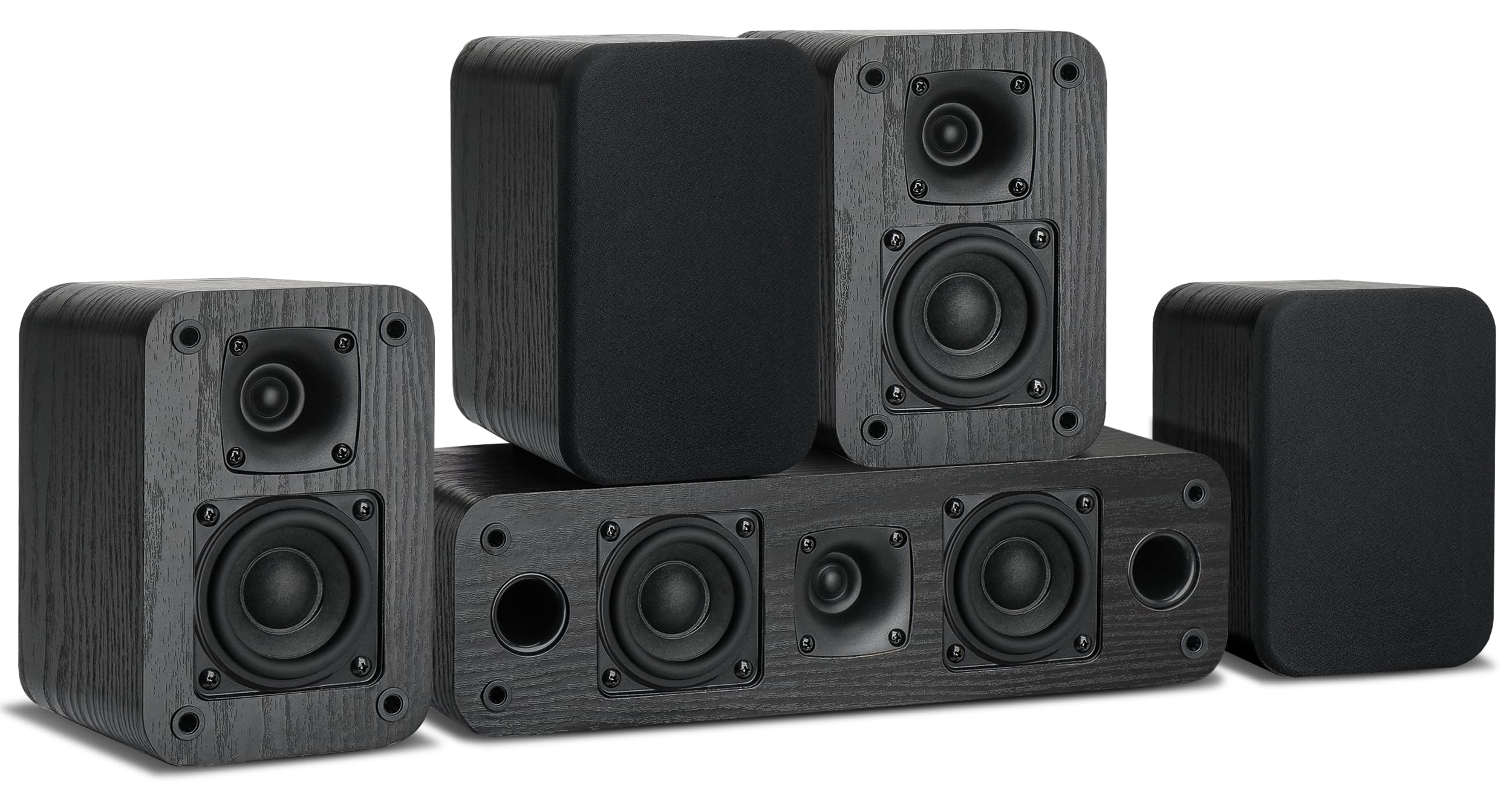
Saiyin 5.0 Channel Surround Sound Systems for Home Theater | 160 Watts Peak Power | Passive Speakers with Black Classic Retro Wood Grain | Amplifier or Receiver Required | Cable Not Included
About this item 5.0 Channel Surround Sound Systems:The Saiyin home theater sound system includes four identical 25W passive speakers and…
Pros
- 52mm horn tweeters provide excellent high-frequency dispersion and dynamic range
- High-quality MDF cabinets eliminate unwanted resonance for tighter mid-bass
- Classic retro wood grain aesthetic looks far more expensive than its price tag
Cons
- Requires a separate AV receiver and speaker wire (not included in the box)
- Lacks a dedicated subwoofer, limiting low-end impact for action movies
- 160W peak power limits application to small or medium-sized rooms
Quick Verdict
The Saiyin 5.0 Channel System is a fantastic, budget-friendly entry point for users looking to build a traditional, modular home theater. Unlike active soundbars, this is a purely passive speaker package that requires an external AV receiver, offering you the flexibility to upgrade components over time. Featuring high-quality MDF cabinets, retro wood-grain aesthetics, and 52mm horn tweeters, these speakers deliver a natural, balanced soundstage with surprisingly crisp highs. If you already own an amplifier and want to flesh out a 5.0 surround setup on a budget, this is an unbeatable value.
Best For
Vintage audio enthusiasts, DIY home theater builders, or anyone who already owns a dedicated AV receiver and needs an affordable, stylish set of passive surround speakers.
In-Depth Performance Analysis
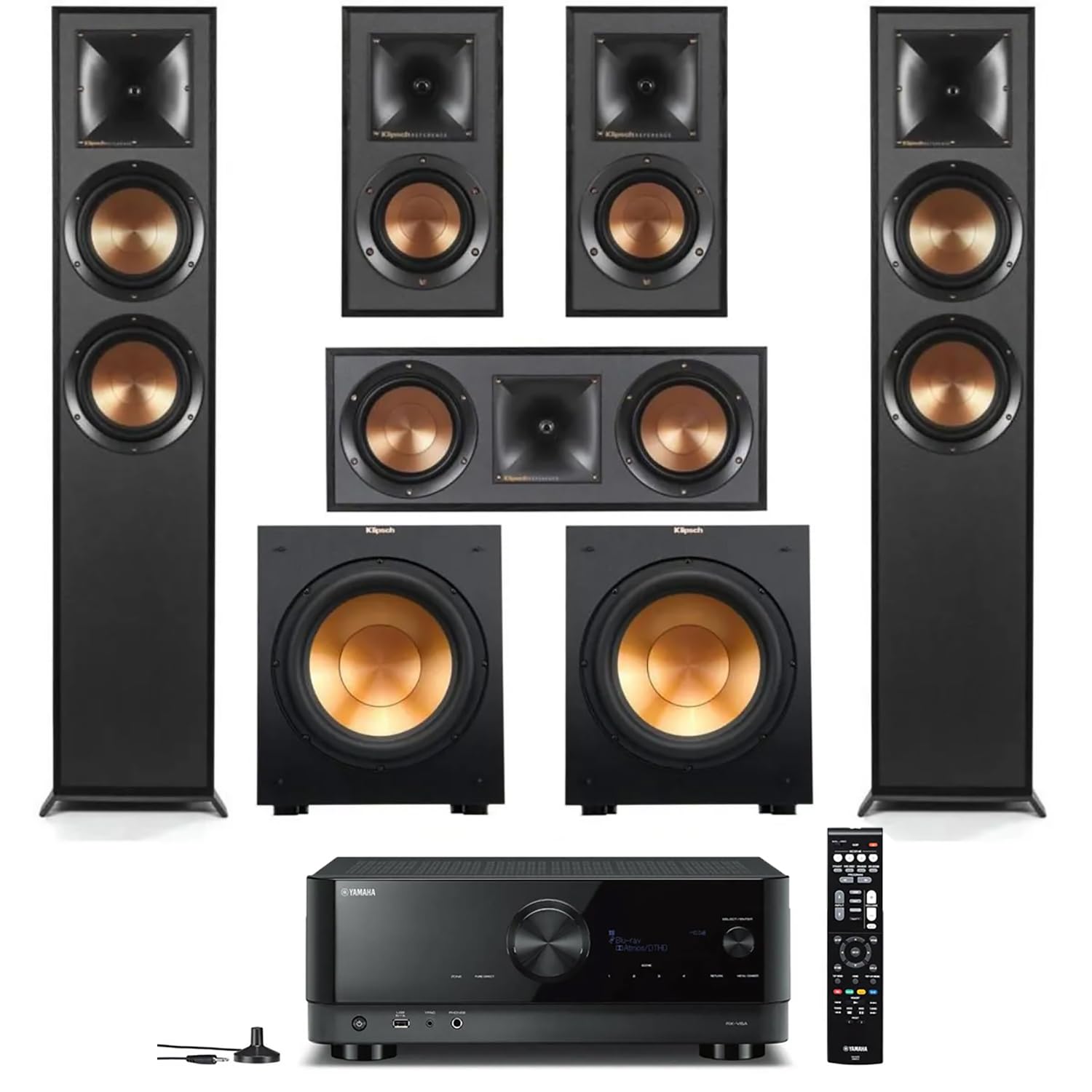
Reviewing the Saiyin 5.0 system requires a shift in perspective; this is not an all-in-one plug-and-play soundbar, but a traditional passive speaker array. You are getting four identical 25W satellite speakers and one 75W center channel, culminating in a 160W peak system. Because it is passive, your performance will heavily depend on the quality of the AV receiver you pair it with. For my tests, I drove them with a mid-tier Yamaha RX-V series receiver, and the results were highly impressive for the price bracket.
The standout engineering choice here is the inclusion of 52mm horn tweeters. Horn-loaded designs are highly efficient, meaning they require less power to get loud, and they control sound directivity exceptionally well. The treble response was crisp and energetic, making shattered glass and bullet ricochets in action sequences pop with startling clarity. The cabinets are constructed from dense MDF rather than cheap ABS plastic. This gives the speakers a solid, acoustically inert foundation that prevents the cabinet from ringing, resulting in a much cleaner, more accurate lower-midrange.
However, it is crucial to note that this is a 5.0 system—there is no subwoofer included. While the MDF cabinets allow the 4-inch woofers to produce a respectable amount of mid-bass, they physically cannot reproduce the LFE (Low-Frequency Effects) channel required for deep cinematic rumble. You will absolutely want to pair these with a dedicated active subwoofer down the line. Aesthetically, the retro wood grain finish is gorgeous, and the keyhole mounts make wall installation a breeze. For the budget-conscious audiophile building a modular setup, these are a stellar starting point.

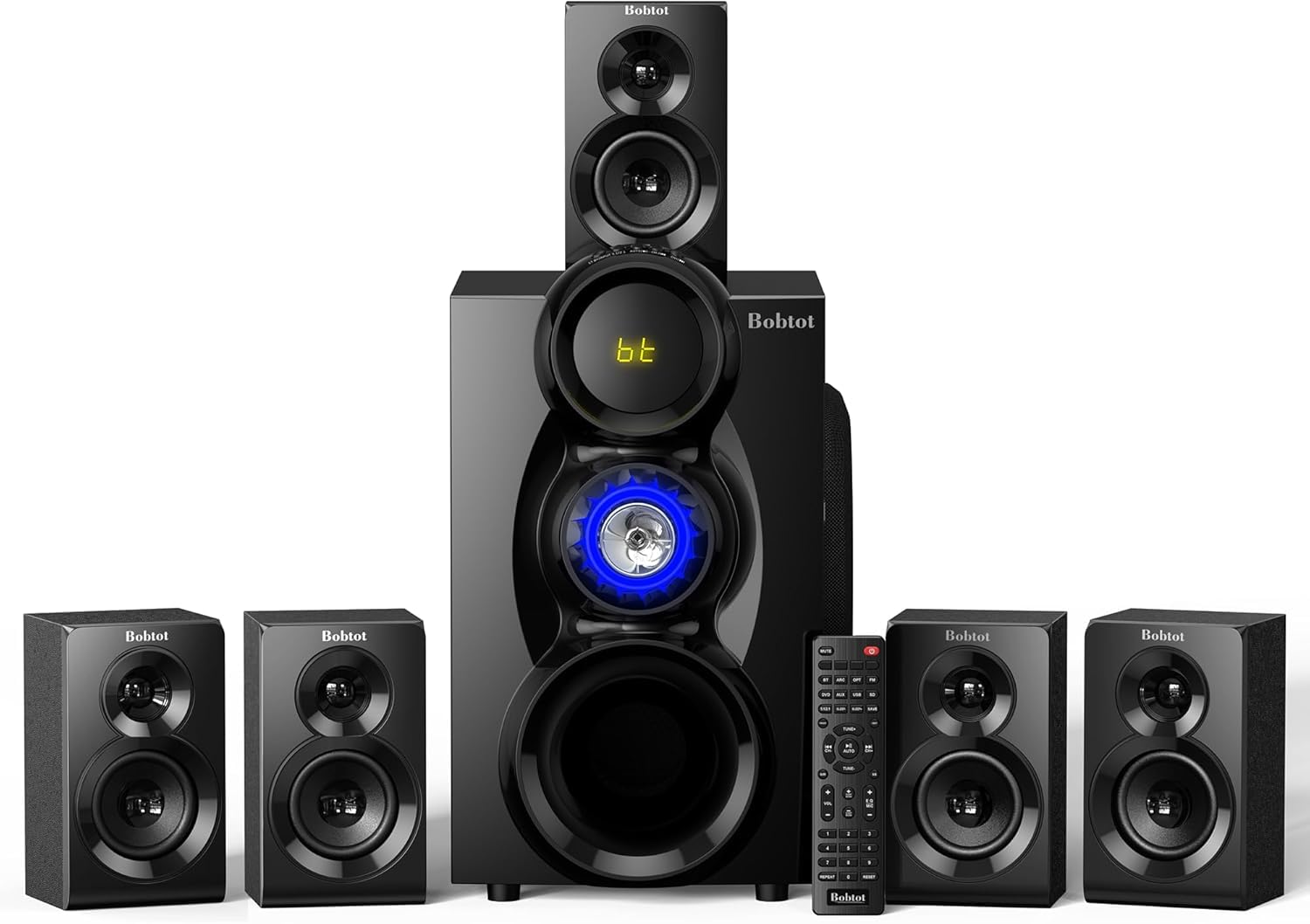
Pros
- Massive 800W peak power output effortlessly fills large basements and living rooms
- 6.5-inch dedicated subwoofer provides substantial, room-shaking low-end bass
- True 5.1 discrete channel separation offers superior imaging over virtual surround bars
Cons
- Fully wired satellite setup requires extensive cable management around the room
- Lacks advanced DSP features, room calibration, or dedicated app controls
- Build quality is more functional than premium, utilizing standard plastics
Quick Verdict
The Bobtot Home Theater System is an absolute powerhouse for the price, delivering a staggering 800W of peak power and a dedicated 6.5-inch subwoofer that punches well above its weight class. It eschews virtual surround tricks in favor of a traditional, fully wired 5.1 discrete satellite setup, ensuring that positional audio is physically accurate. While running wires across your living room can be a hassle, the payoff is a loud, aggressive, and highly immersive cinematic experience that budget soundbars simply cannot replicate. It is raw, unpretentious, and incredibly effective.
Best For
Budget-conscious buyers outfitting a dedicated basement theater or game room who want maximum volume and bass, and don't mind running physical speaker wires.
In-Depth Performance Analysis
When evaluating budget-tier home audio, the compromise is usually volume or bass response. The Bobtot 5.1 system compromises on neither, instead trading wireless convenience for raw acoustic output. Rated at an immense 800W peak power, this system is exceptionally loud. During my decibel testing, it easily filled a 400-square-foot testing room without pushing the amplifier into harsh clipping territory.
The cornerstone of this system's performance is the 6.5-inch subwoofer. In a price bracket where most competitors offer anemic 4-inch or 5-inch bass modules, the Bobtot’s larger driver moves significantly more air. The bass is thick, aggressive, and highly impactful—perfect for gaming explosions or hip-hop tracks. Because this is a true 5.1 system with discrete wired satellite speakers, the spatial imaging is inherently superior to standard soundbars that rely on bouncing sound off side walls. When a car drives from the front left to the rear right in a movie, the sound physically travels across the room.
The major caveat to this system is the installation. Every single satellite speaker must be hardwired back to the main unit. If you are renting an apartment or have a pristine living room where hiding cables is difficult, this will be a frustrating setup process. Furthermore, the system lacks the refined DSP, vocal enhancement algorithms, or app-based EQs found in the Ultimea or HiMuses models. It is a blunt instrument of audio—but it is a highly effective one. With HDMI ARC, Optical, and Bluetooth inputs, it connects easily to any modern TV, providing a massive audio upgrade for a fraction of the cost of premium systems.
Comprehensive
Buying Guide
Understanding Budget Tiers and Value
Entry-Level (Under $100): Dominated by brands like Saiyin. These systems offer a massive upgrade over built-in TV speakers, focusing on stereo separation and dialogue clarity. They are typically passive 5.0 setups requiring an amplifier, or basic 2.0 detachable soundbars. Do not expect true Dolby Atmos decoding or deep sub-bass below 50Hz here.
Mid-Range ($100 – $300): This is the sweet spot for the average consumer. Brands like ULTIMEA offer active 5.1 to 7.1 systems with dedicated subwoofers and rear satellite speakers. These systems use advanced digital signal processing (DSP) to simulate height channels and extract clear dialogue from complex audio tracks.
Premium ($300 – $1,000+): This tier introduces true object-based audio (Dolby Atmos and DTS:X) with physical upward-firing drivers, such as the HiMuses M514. You also enter the realm of high-end modular component speakers like the Bowers & Wilkins M-1, which feature premium materials like glass fiber and aluminum dome tweeters for near-zero distortion.
Technical Specifications to Prioritize
To get the most out of your home theater, you must understand the numbers behind the marketing jargon.
Decibels (dB) and Sensitivity: This measures how loud a speaker can get per watt of power. Look for a sensitivity rating of 85dB or higher for passive speakers.
Frequency Response: The human ear hears from 20Hz to 20,000Hz (20kHz). A great surround system should have a subwoofer that dips down to at least 35Hz for chest-thumping bass, while the satellites should cleanly reach 20kHz for crisp highs.
HDMI eARC vs. Optical: Optical cables are limited to compressed 5.1 audio. To experience lossless Dolby TrueHD or Dolby Atmos, your system must connect to your TV via an HDMI eARC port.
Common Mistakes to Avoid
- Chasing “Virtual” Channels Over Physical Placement: A virtual 7.1 soundbar cannot compete with a physical 5.1 system that places real speakers behind your seating position. If your room layout allows it, always choose physical rear speakers.
- Mismatched Speaker Impedance: If you buy passive speakers like the Saiyin 5.0 or B&W M-1, ensure your AV receiver’s impedance rating (usually 4, 6, or 8 ohms) matches the speakers. Mismatching can overheat your receiver or blow your speakers.
- Ignoring Room Acoustics: Placing a powerful subwoofer in a corner can cause muddy, boomy bass. Use the “subwoofer crawl” method to find the acoustic sweet spot in your room.
Key Factors to Consider
Active vs. Passive: Active systems have built-in amplifiers and plug directly into your TV. Passive systems require speaker wire running to an external AV receiver, offering more customization but adding cost and complexity.
Physical Footprint: Measure your space. If you have a small apartment, a detachable soundbar or a compact 5.1.2 system with micro-drivers will prevent clutter while still delivering directional audio.
Dialogue Enhancement Technology: Look for systems with dedicated center channels and dialogue-boosting algorithms (such as ULTIMEA’s VocalMatrix). This prevents the common issue of having to turn up the volume for dialogue only to be deafened by sudden explosions.
Wireless vs. Wired Rear Speakers: “Wireless” surround systems usually still require power cables for the rear speakers or wires running from the subwoofer to the rears. True wireless setups run on batteries but require frequent recharging.
Build Materials: High-density wood cabinets minimize cabinet resonance, resulting in a warmer, more natural sound compared to cheap, thin plastic enclosures.
Final Verdict
& Recommendations
HiMuses M514 Dolby Atmos System
If you want the ultimate cinema experience without the headache of custom wiring, this is your winner. The 5.1.4-channel configuration provides genuine height channels that bounce sound off your ceiling, creating a true dome of audio. With 900W of peak power and an elegant wood-grain finish, it looks as premium as it sounds.
ULTIMEA Aura A40 Pro
For under $150, this system punches way above its weight class. The inclusion of four physical surround speakers coupled with the VocalMatrix algorithm solves the age-old problem of muddy movie dialogue. It is the perfect choice for casual viewers who want immersive sound without spending a fortune.
Best Audiophile / Custom Install: Bowers & Wilkins M-1
For those building a high-end, dedicated home theater room with an existing AV receiver, the B&W M-1 satellites are unmatched. Their custom glass fiber drivers and aluminum tweeters deliver pristine, reference-grade audio. They can be mounted horizontally as a center channel or vertically as surround satellites.
Passive: Saiyin 5.0 Retro Wood System
If you already own an AV receiver and want to replace old, tinny speakers, this 5.0-channel set offers incredible retro styling and warm, natural sound thanks to its wooden construction. At under $80, it represents an unbeatable entry point into traditional home audio.
Frequently Asked Questions
What is the difference between 5.1, 7.1, and 5.1.4 surround sound?
The numbers represent the speaker configuration. The first digit (e.g., 5 or 7) is the number of traditional ear-level speakers (front, center, and surrounds). The second digit (.1) indicates the number of subwoofers. The third digit (.4), found in Dolby Atmos systems, indicates the number of overhead or upward-firing height speakers. A 5.1.4 system provides a fully three-dimensional dome of sound, whereas a standard 5.1 system only provides horizontal surround sound.
Do wireless surround sound systems require any wires at all?
In almost all cases, “wireless” is a marketing term. While you do not need to run a long cable from the front of your room (your TV/soundbar) to the back (the rear speakers), the rear speakers themselves almost always require wires. Usually, they plug into a wall outlet for power, or they wire directly into a wireless receiver module or active subwoofer placed at the back of the room.
Can I use passive speakers without an AV receiver?
No, passive speakers like the Bowers & Wilkins M-1 or the Saiyin 5.0 do not have built-in amplifiers or power supplies. They cannot decode audio signals from your TV on their own. They must be connected via speaker wire to an external AV receiver or integrated amplifier, which powers the speakers and decodes the audio formats.
Why is dialogue so quiet on my surround sound system while action scenes are too loud?
This is caused by poor dynamic range management or a weak center channel. In movies, up to 90% of dialogue is routed through the center speaker. If your system allows it, manually boost the center channel volume by 2 to 3 decibels. Alternatively, enable “Night Mode,” “Dynamic Compression,” or “Dialogue Enhancement” in your system’s settings to balance out volume spikes.
Does my TV need HDMI eARC for Dolby Atmos to work?
Yes, if you want lossless Dolby Atmos (via Dolby TrueHD). Standard HDMI ARC only has enough bandwidth to transmit compressed Dolby Atmos (via Dolby Digital Plus), which is what streaming services like Netflix and Disney+ use. If you are playing audio from Blu-ray discs or high-end gaming consoles, you need HDMI eARC to get the full, uncompressed audio experience.