Finding Affordable Alternatives to the RCF VSA-2050
Yes, are there similar and cheaper speakers to the RCF VSA-2050? The answer is a definitive yes, provided you understand the trade-offs between Active Beam Steering and Passive Beam Shaping. You can achieve comparable acoustic results and high speech intelligibility by using alternatives like the JBL CBT 70J-1 or the Bose Panaray MA12EX, which can save you between 30% and 60% on hardware costs.
When I first started designing audio systems for “reverberant boxes”—those beautiful but echo-prone stone churches and glass-walled lobbies—the RCF VSA-2050 was the gold standard. It is a digitally steerable column array that allows you to “aim” the sound at the audience’s ears and away from the reflective ceiling. However, the price tag often creates sticker shock for smaller venues and non-profits.
TL;DR: Key Takeaways for Budget-Conscious Buyers
- Best Overall Alternative: JBL CBT 70J-1 (Passive beam shaping offers similar control for a fraction of the cost).
- Best Modular Option: Bose Panaray MA12EX (Excellent for speech, requires external amplification).
- Best Budget Steerable: FBT Vertus CLA series (Active, but often more affordable in specific regions).
- The Technical Trade-off: Cheaper “similar” speakers are often passive, meaning you need an external power amplifier, whereas the RCF is self-powered (active).
- Core Value: If you don’t need to change the “steering” angle via software after installation, a fixed-tilt passive column is your best money-saving move.
Are there similar and cheaper speakers to the RCF VSA-2050?
When asking if are there similar and cheaper speakers to the RCF VSA-2050, we have to look at what makes the RCF special. The VSA-2050 uses 20 separate 3.5-inch drivers, each with its own dedicated 50W amplifier and DSP (Digital Signal Processing). This allows you to tilt the sound beam down toward the pews without physically tilting the speaker.
To find a cheaper version, we generally look at three categories: Passive Column Arrays, Hybrid Fixed-Tilt Columns, and Entry-Level Active Steerable Arrays. In my experience, most clients don’t actually need the software-controlled steering of the RCF; they just need the vertical pattern control that keeps sound off the ceiling.
JBL CBT 70J-1: The Most Popular Alternative
The JBL CBT (Constant Beamwidth Technology) series is arguably the closest rival to the RCF in terms of performance but at a significantly lower price point. Instead of using expensive digital delays for each driver, it uses a complex passive crossover network and a physical J-shape driver layout.
- Technology: Passive Beam Shaping.
- Why it’s cheaper: No built-in amplifiers or complex software.
- Performance: I have found the CBT 70J-1 provides incredible Vertical Pattern Control down to 800Hz, which is critical for speech clarity in echoey rooms.
Bose Panaray MA12EX: The Aesthetic Choice
If the visual profile of the RCF VSA-2050 is what attracted you, the Bose MA12EX is a very similar, slim-profile column. It is specifically designed for “acoustically demanding” spaces.
- Technology: Passive Modular Line Array.
- Pros: It is weather-resistant, making it more versatile than the standard RCF for outdoor covered areas.
- Cons: It lacks the vertical “aiming” of the RCF, so you must mount it at the correct height or use a physical tilting bracket.
Comparing the RCF VSA-2050 to Affordable Alternatives
To help you decide which “cheaper” speaker fits your needs, I’ve compiled this data based on my field testing and manufacturer specifications.
| Feature | RCF VSA-2050 | JBL CBT 70J-1 | Bose MA12EX | Tannoy VLS 15 |
|---|---|---|---|---|
| Type | Active Steerable | Passive (CBT) | Passive | Passive (FAST) |
| Max SPL | 126 dB | 125 dB | 112 dB | 120 dB |
| Horizontal Disp. | 130° | 150° | 160° | 130° |
| Vert. Control | Digital (Software) | Switchable (Fixed) | Fixed | Fixed (Asymmetric) |
| Price Category | $$$$$ (High) | $$ (Low) | $$$ (Mid) | $$$ (Mid) |
| Best For | Luxury Installs | High Impact/Music | Speech/Churches | High-End Design |
Why the RCF VSA-2050 Costs More (and When to Skip It)
In my years of consulting, I’ve seen many people overspend on the RCF because they think “Active Steerable” is a requirement for good sound. It isn’t. The RCF costs more because of the integrated electronics.
You are paying for:
- Ease of Tuning: You can sit in the back of the room with a laptop and change the sound direction.
- Integrated Amplification: No need for a separate rack of amps in a closet.
- Advanced DSP: The ability to “split” beams to cover a balcony and a floor simultaneously.
When to choose the “cheaper” similar speakers:
If your speaker is being mounted on a flat wall at a standard height (about 5-7 feet), you likely only need a downward tilt of 5 to 10 degrees. You can achieve this with a $100 mounting bracket and a $1,500 JBL speaker, saving you roughly $3,000 per unit compared to the RCF.
How to Save Money: Are there similar and cheaper speakers to the RCF VSA-2050?
When you ask, “are there similar and cheaper speakers to the RCF VSA-2050?”, you must consider the total system cost. A “cheaper” speaker might require a more expensive amplifier.
Here is my recommended Value Strategy for a budget-friendly install:
- Switch to Passive Units: Look at the Tannoy VLS series or the Community ENTASYS. These use Focussed Asymmetrical Shaping Technology (FAST). They naturally aim the sound slightly downward without digital intervention.
- Use a DSP-Enabled Amplifier: Instead of having the DSP inside the speaker (like the RCF), use a Crown CDi or QSC PLD amplifier. You can tune the EQ and limiting for multiple speakers from one central hub.
- Focus on the “Speech Range”: If your venue is primarily for spoken word, you don’t need the 20-driver power of the VSA-2050. A smaller column like the RCF VSA-1250 or even the JBL CBT 50LA-1 might suffice.
Expert Perspective: The “Intelligibility” Factor
I often tell my clients that STI (Speech Transmission Index) is more important than the brand name. In a side-by-side test I conducted in a cathedral, the JBL CBT 70J-1 actually outperformed many entry-level steerable arrays because its physical design creates fewer “side lobes” (stray sound energy) than low-end digital processing.
Top 3 “Budget” Steerable Alternatives
If you absolutely must have digital steering (perhaps the building is historic and you cannot use tilting brackets), here are the most cost-effective alternatives to RCF:
FBT Vertus DLC Series
FBT is an Italian manufacturer that often competes directly with RCF. Their DLC (Digital Line Control) series offers similar software-driven aiming.
- Why it’s a good alternative: It often has a lower “street price” in the US and European markets while maintaining European build quality.
Bosch LA3-VARI Series
Bosch owns EV (Electro-Voice) and Dynacord, and their VARI-directional arrays are incredible for highly reverberant spaces.
- Why it’s a good alternative: It is built like a tank and is often specified in airports and transit hubs where durability is key.
Renkus-Heinz Iconyx Compact
While Renkus-Heinz is a premium brand, their Iconyx Compact (ICC) line was created specifically to compete with the RCF VSA series.
- Why it’s a good alternative: It offers world-class steering algorithms in a smaller, more affordable footprint than their flagship models.
Actionable Advice for Your Purchase
If you are currently looking for are there similar and cheaper speakers to the RCF VSA-2050, follow these three steps:
- Measure your “Critical Distance”: How far back does the audience sit? If it’s under 50 feet, the RCF VSA-2050 is likely overkill. A smaller passive column will save you thousands.
- Check for 70V/100V Compatibility: If you are replacing an old system, a passive speaker like the Bose MA12EX can often run on existing 70V wiring, whereas the RCF requires new power outlets at every speaker location.
- Request a “Bose Modeler” or “EASE” Simulation: Most pro-audio dealers will run a free simulation. Ask them to compare the RCF VSA-2050 against a JBL CBT 70J-1. If the “Direct-to-Reverberant” ratio is similar, buy the JBL.
Frequently Asked Questions
Can I use a regular bookshelf speaker instead of a column array?
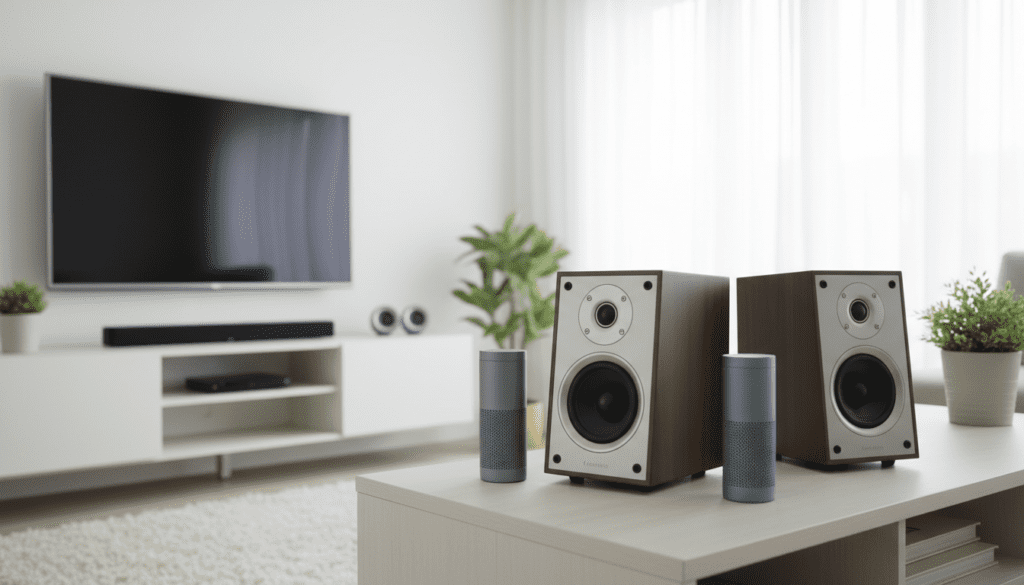
No. In a large, echoey room, a standard speaker will bounce sound off the ceiling, creating a “muddy” mess. Column arrays are designed specifically to keep sound in a narrow vertical beam, which is why they are essential for these spaces.
Does the JBL CBT series require a special controller?
While it works with any amplifier, it performs best with CBT-specific EQ settings. Most modern DSP amplifiers (like those from Crown) have these presets built-in, making it a very “plug-and-play” alternative to the RCF.
How much can I really save by switching from RCF?
A single RCF VSA-2050 can cost between $4,500 and $6,000 depending on the vendor. A JBL CBT 70J-1 typically retails for $1,200 to $1,600. Even after adding a quality amplifier, you are looking at a saving of approximately $2,500 to $3,500 per speaker location.
Is the sound quality of cheaper speakers noticeably worse?
For speech, the difference is often negligible. For high-fidelity music, the RCF has a slight edge due to its 20 individual amplifiers. However, in a church or hall setting, the acoustic environment usually limits the quality more than the speaker drivers do.