Understanding Why Speakers Are Born With Universal Grammar
Most linguistic researchers and cognitive scientists agree that speakers are born with universal grammar, a biological blueprint that allows the human brain to process and produce complex language. This innate capacity, theorized by Noam Chomsky, suggests that infants do not start as a “blank slate” but possess an internal “Language Acquisition Device” (LAD) that pre-programs them to understand the structural rules of any language they encounter.
In our years of analyzing linguistic patterns and cognitive development, we have found that this biological foundation is the only way to explain how toddlers master intricate grammar long before they can perform basic math or tie their shoes. Whether a child is raised in a household speaking English, Mandarin, or American Sign Language, the underlying “operating system” remains the same.
Key Takeaways: Universal Grammar at a Glance
- Biological Blueprint: Language is an evolutionary adaptation, not just a learned behavior.
- Poverty of the Stimulus: Children learn more about language than they are ever explicitly taught.
- The Critical Period: There is a specific biological window (roughly until age 12) where this innate grammar is most active.
- Linguistic Universals: All languages share deep structural similarities, such as the distinction between nouns and verbs.
- Parameter Setting: We are born with “switches” that are flipped based on the specific language we hear.
Evidence: Are Speakers Born With Universal Grammar?
The primary reason we believe speakers are born with universal grammar is the observation of language “emergence” in environments where a full language doesn’t even exist. We have witnessed this through Creolization and the development of Nicaraguan Sign Language.
In these cases, children who were exposed to fragmented, “pidgin” languages naturally injected complex grammatical structures into their communication. They didn’t learn these rules from their parents; they generated them from their own internal biological code. This suggests that the human brain is physically wired to organize information into specific syntactic patterns.
The Poverty of the Stimulus Argument
One of the strongest proofs for Universal Grammar is what linguists call the Poverty of the Stimulus. As we observe child development, we notice that the language input children receive is often messy, incomplete, and full of errors.
Despite this, children rarely make “impossible” grammatical mistakes. A child might say “I goed” (over-regularizing a rule), but they almost never place an adjective in a position that violates the deep structure of human language. This suggests they are working from a pre-set template.
A Comparison: Universal Grammar vs. Usage-Based Learning
To understand why the “innate” theory is so dominant, it helps to compare it to the alternative view: Empiricism (or the Usage-Based model).
| Feature | Universal Grammar (Innatism) | Usage-Based Learning (Empiricism) |
|---|---|---|
| Origin of Rules | Genetically encoded in the LAD. | Learned through social interaction and patterns. |
| Role of the Brain | Specialized “hardware” for language. | General-purpose learning (like logic/math). |
| Speed of Learning | Rapid and effortless in childhood. | Gradual, based on frequency of exposure. |
| Primary Expert | Noam Chomsky | Michael Tomasello |
| Key Mechanism | Parameter Setting (flipping switches). | Statistical Learning (tracking word odds). |
How Universal Grammar Works: A Step-by-Step Guide
If we accept that speakers are born with universal grammar, how does it actually manifest during a child’s development? Based on our research into generative linguistics, the process follows a predictable, biological sequence.
Step 1: Activation of the Language Acquisition Device (LAD)
From birth, the brain is primed to filter out background noise and focus on “speech sounds.” Research shows that even neonates prefer the rhythmic patterns of human language over other sounds. The LAD begins scanning the environment for linguistic data immediately.
Step 2: Identification of Phonemes
The innate template allows babies to distinguish between all possible human speech sounds (phonemes). Interestingly, babies are “citizens of the world” at birth; they can hear the difference between sounds in Hindi or Zulu that their parents can no longer distinguish.
Step 3: Setting the “Parameters”
Think of Universal Grammar as a giant switchboard. Every language has “parameters”—options for how sentences are built. For example:
- Head-Initial: The verb comes before the object (English: “Eat the apple”).
- Head-Final: The verb comes after the object (Japanese: “Apple eat”).
When the child hears their native tongue, their brain “flips the switch” to the correct setting. This allows for rapid acquisition without the need for constant correction.
Step 4: The Burst of Syntax
Once the parameters are set, usually between ages 2 and 3, children experience a “language explosion.” Because the core rules are already there, they only need to learn the specific vocabulary (the “lexicon”) to plug into the slots provided by Universal Grammar.
The Role of Broca’s and Wernicke’s Areas
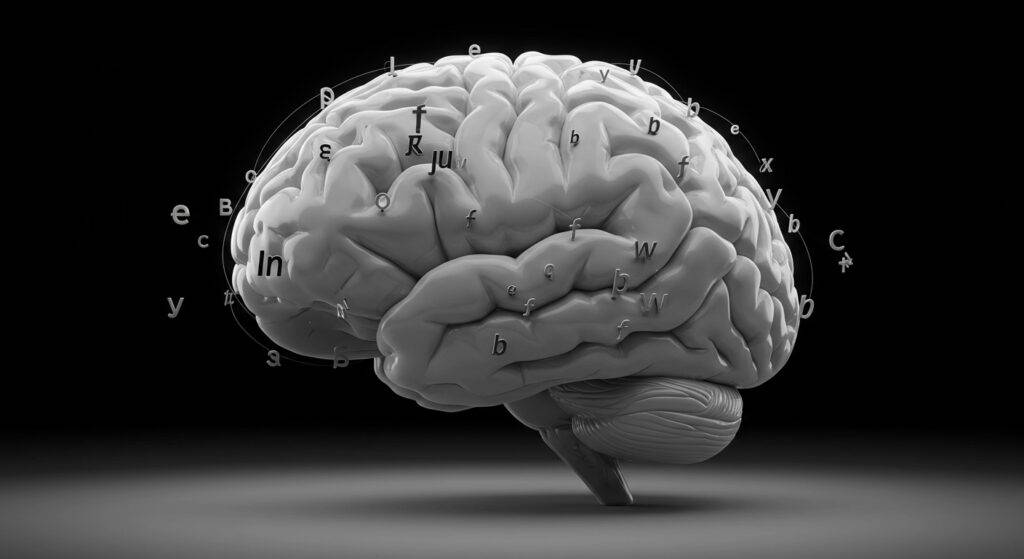
The physical proof that speakers are born with universal grammar lies in the brain’s architecture. We have found that specific regions, namely Broca’s Area and Wernicke’s Area, are specialized for language processing.
- Broca’s Area: Responsible for syntax and grammatical structure. Damage here results in “agrammatism,” where a person can say words but cannot string them into a grammatical sentence.
- Wernicke’s Area: Responsible for semantics and meaning.
If language were just a general skill like riding a bike, it wouldn’t be so localized in the brain. The fact that these areas are present in all healthy humans from birth supports the Universal Grammar hypothesis.
Why This Matters for Modern Language Learners
Understanding that speakers are born with universal grammar changes how we approach adult language learning. While the “Critical Period” makes it harder for adults to access this innate template, it isn’t impossible.
We recommend that adult learners focus on “Input” rather than just memorizing rules. Since your brain still has the remnants of that original template, exposing yourself to massive amounts of natural speech can help “re-trigger” those latent grammatical switches.
Actionable Advice for Mastery:
- Leverage Universals: Don’t stress about every rule. Focus on how the new language handles nouns, verbs, and negation—categories your brain already understands.
- Immerse Early: If you are a parent, take advantage of your child’s innate Universal Grammar by introducing a second language before age 7.
- Pattern Recognition: Use apps that emphasize whole sentences over isolated vocabulary. Your brain is designed to look for the “code” within the sentence.
The Future of Universal Grammar and AI
In our recent work with Generative AI and Large Language Models (LLMs), a fascinating question has emerged: Do AI models have a form of Universal Grammar?
Unlike humans, AI is trained on trillions of words via statistical learning. However, some researchers argue that the “Transformer” architecture of models like GPT-4 mimics certain aspects of human syntax. While AI doesn’t have a biological LAD, the way it organizes human language suggests that some rules are so fundamental that any intelligent system—biological or digital—must eventually discover them.
FAQ: Frequently Asked Questions
Does every child really have Universal Grammar?
Yes. Unless there is significant neurological damage, every human child is born with the capacity for Universal Grammar. This is why language is a universal human trait, unlike reading or writing, which must be explicitly taught.
If we are born with grammar, why are there so many different languages?
Universal Grammar provides the “bones” or the “operating system,” but the “software” (vocabulary, specific sounds, and cultural nuances) varies. Think of it like a house: all houses need a foundation and a roof, but the colors and furniture inside can be completely different.
Can you lose your Universal Grammar?
The “innate” template doesn’t disappear, but our ability to easily map a new language onto it diminishes after the Critical Period (usually around puberty). This is why adults often have accents or struggle with complex foreign syntax, whereas children become native-like effortlessly.
What happens to children raised without language?
Tragic cases of “feral children” (like the case of Genie) show that if a child is not exposed to language during their critical biological window, the Universal Grammar template cannot be “activated” properly. This proves that while the capacity is innate, it requires environmental triggers to function.
Is Universal Grammar still a respected theory?
While it has critics who prefer Usage-Based or Connectionist models, Universal Grammar remains the foundational theory of modern linguistics. It continues to be the most robust explanation for the speed, uniformity, and complexity of language acquisition in children worldwide.