Understanding the Format: Are There Two Speakers Debate Canada?
Yes, there are typically two speakers per side in a standard Canadian debate. This format, known as Canadian Parliamentary (CP) Style, features a two-on-two structure consisting of the Government (proposing the motion) and the Opposition (opposing the motion).
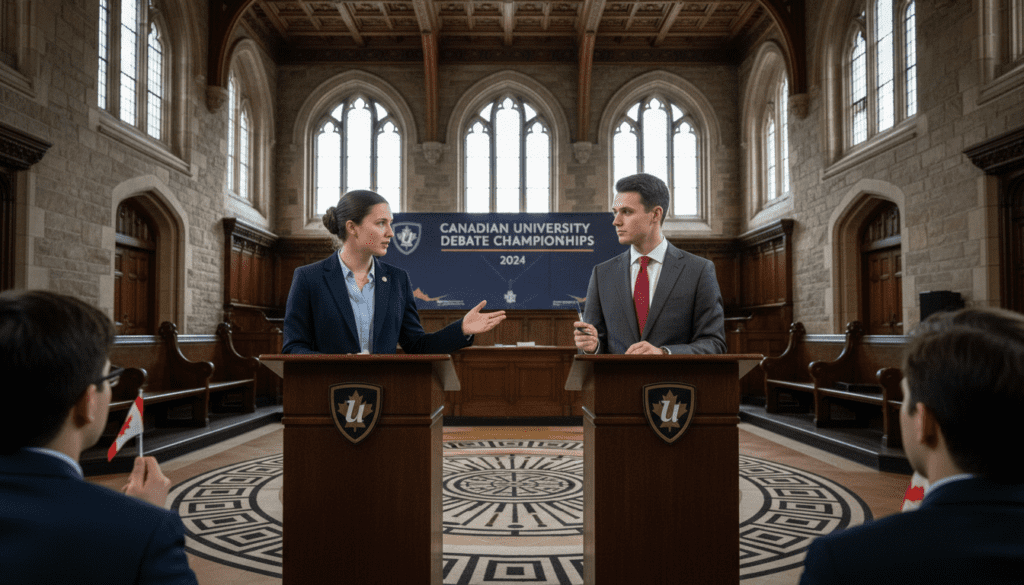
Having coached university teams across Ontario and British Columbia, I have found that this two-person dynamic is the cornerstone of the Canadian competitive circuit. Unlike the four-team British Parliamentary style, the two-speaker format allows for deeper clash and more personal engagement between the two sides. Whether you are competing in a CSDF (Canadian Student Debating Federation) high school tournament or a CUSID (Canadian University Society for Intercollegiate Debating) event, mastering the two-speaker synergy is essential for victory.
Key Takeaways for Canadian Debate
- Format Name: Most domestic competitions use Canadian Parliamentary Style.
- Team Size: Exactly two speakers per side (four debaters total per room).
- The Government: Consists of the Prime Minister (PM) and the Minister of the Crown (MC).
- The Opposition: Consists of the Leader of the Opposition (LO) and the Member of the Opposition (MO).
- Speaking Order: The debate follows a specific sequence where the Government opens and closes the round.
The Structure of a Two-Speaker Canadian Debate
In the Canadian circuit, the question of “are there two speakers debate Canada” is answered by the specific roles assigned to each individual. Each speaker has a unique set of responsibilities that must be fulfilled to win the ballot.
The Government Bench (Propositions)
The Government’s job is to define the motion and provide a compelling case for why the “house” should support it. Because there are only two speakers, the workload is split between constructive arguments and defensive rebuttals.
- The Prime Minister (PM): This speaker delivers the first and last speeches of the round. They define the terms, set the “model” (if it is a policy debate), and outline the primary contentions.
- The Minister of the Crown (MC): This is the “heavy lifter.” They must defend the PM’s points against the Opposition’s first attack and introduce new constructive matter to bolster the Government’s case.
The Opposition Bench (Negations)
The Opposition must prove that the Government’s case is either logically flawed, morally wrong, or practically impossible.
- The Leader of the Opposition (LO): This speaker provides the first direct clash. They must respond to the PM’s case immediately and lay out the Opposition’s counter-philosophy.
- The Member of the Opposition (MO): This speaker consolidates the Opposition’s stance. They provide the final new arguments for their side and engage in deep rebuttal of the Government’s secondary points.
| Feature | Canadian Parliamentary (CP) | British Parliamentary (BP) | World Schools Style |
|---|---|---|---|
| Speakers Per Side | 2 Speakers | 2 Speakers (but 4 teams) | 3 Speakers |
| Total Debaters | 4 | 8 | 6 |
| Primary Use | Canadian Universities/High Schools | International Tournaments | Global High School Level |
| POIs Allowed? | Yes | Yes | Yes |
| Heckling? | Traditionally Yes (in Canada) | No | No |
Step-by-Step Guide: Succeeding with Two Speakers
When you realize there are two speakers in a Canadian debate, you must learn how to coordinate with your partner effectively. Communication is the difference between a “rank 1” and a “rank 4” finish.
Step 1: Divide Your Roles Based on Strengths
Not all debaters are built the same. Usually, the more organized, “first-principle” thinker takes the Prime Minister or Leader of the Opposition role to set the foundation. The more aggressive, “rebuttal-heavy” speaker often takes the Member/Minister role to handle the heat of the clash.
Step 2: Master the “Reply” Dynamic
In the Canadian two-speaker format, the Prime Minister and the Leader of the Opposition give “Reply Speeches” (also called the Rebuttal). This is a shorter 3-minute speech at the end of the round. I always advise my students to use this time to identify the “three key themes” of the debate rather than repeating their initial points.
Step 3: Coordinate Your Contentions
You cannot have two speakers saying the same thing. If the Prime Minister focuses on the economic benefits of a carbon tax, the Minister of the Crown should focus on the social or environmental necessity. This ensures your team covers more “ground” and gives the judge more reasons to vote for you.
Why the Two-Speaker Format Dominates Canada
The reason there are two speakers in Canadian debates is rooted in the tradition of the Westminster Parliamentary System. Our domestic style mimics the House of Commons, where a specific Government faces a specific Opposition.
First-Hand Insight: The Power of the “Tag-Team”
In my experience judging the Hart House Invitational, I’ve noticed that the best two-speaker teams function like a single mind. They pass notes constantly, they “protect” each other during Points of Information (POIs), and they never contradict their partner’s definitions. If you and your partner are not “on the same page,” the Opposition will use those inconsistencies to dismantle your case.
The Importance of POIs and Heckling
One unique aspect of the two-speaker Canadian style is the level of interaction. Points of Information are questions or statements offered by the opposing side during a speech.
In Canada, we also allow “Heckling” in many university-level CP rounds. These are short, witty, one-word interjections like “Shame!” or “Hear, Hear!” that add flavor and rhetorical pressure to the round.
Essential Skills for the Two-Speaker Format
To excel when there are two speakers in a Canadian debate, you need to sharpen specific tactical skills.
The Art of the Definition
The Prime Minister has the “right of definition.” This means they get to decide what the debate is actually about. If the motion is “This House would ban smoking,” the PM can define it as a ban in public spaces or a total nationwide ban.
Strategic Rebuttal
Because you only have one partner to back you up, your rebuttal must be efficient. Do not try to answer every single sentence the other side says. Instead, group their arguments into “Logical Fallacies” or “Impact Gaps.”
Time Management
Most Canadian rounds follow a 7-7-7-7-4-4 or 5-5-5-5-3-3 timing structure (in minutes).
- Constructive Speeches: 7 minutes.
- Reply Speeches: 4 minutes.
With only two people to fill this time, you must ensure your “case construction” is deep enough to last the full duration without “fluffing.”
Common Challenges in the Two-Speaker System
While the two-speaker format is streamlined, it presents specific hurdles that I see many Canadian novices struggle with.
Avoiding “The Knives”
“Knifing” is when a speaker contradicts their own partner. For example, if the Prime Minister says a policy is “free,” and the Minister of the Crown says it will “cost a small fee,” the team has knifed themselves. This is an automatic loss in most high-level Canadian tournaments.
Handling the “LO” Constructive
The Leader of the Opposition has a difficult job. They must rebut the PM while also building their own constructive case. If you are in the LO position, I recommend spending 3 minutes on rebuttal and 4 minutes on your own positive arguments.
Frequently Asked Questions
Are there two speakers per side in all Canadian debates?
While Canadian Parliamentary (CP) is the standard for domestic tournaments, many Canadian universities also compete in British Parliamentary (BP) style. In BP, there are still two speakers per team, but there are four teams in the room (two Government and two Opposition).
What is the speaking order for two-speaker Canadian debate?
The order is:
- Prime Minister (Constructive)
- Leader of the Opposition (Constructive)
- Minister of the Crown (Constructive)
- Member of the Opposition (Constructive)
- Leader of the Opposition (Reply)
- Prime Minister (Reply)
Can you debate alone in Canada?
Generally, no. Most sanctioned CUSID or CSDF events require a pair. However, some tournaments allow “Ironman” debating if a partner falls ill, where one person delivers both speeches for their side, though they usually cannot win the tournament this way.
How do I find a debate partner in Canada?
Most high schools and universities have a Debate Society or Literary and Debating Society. Joining these clubs is the best way to find a partner who matches your speaking style and competitive goals.
What is the most important rule in Canadian two-speaker debate?
The “Golden Rule” is consistency. You and your partner must present a united front. The judge is looking for a cohesive team effort, not two individual speeches that happen to be on the same side.