Quick Answer & Key Takeaways
The best 5.1 surround sound system for most buyers is the Yamaha Audio YHT-4950U Home Theater System because it delivers true, uncompressed discrete surround sound via a dedicated AV receiver and matched speaker package, outperforming soundbar-based alternatives in acoustic imaging, dynamic range, and long-term upgradeability.
💡 Best premium performance: The Enclave CineHome PRO delivers THX-certified, 24-bit high-resolution wireless audio that eliminates speaker wire clutter while matching the low-latency performance of traditional wired systems.
💡 Best value compromise: The ULTIMEA Skywave X50 offers a 5.1.4-channel Dolby Atmos experience with physical height channels for 40% less than the cost of a traditional receiver-and-speaker setup.
💡 Wired vs. wireless reality: True wired systems like the Fluance Elite provide 100% latency-free audio and superior cabinet resonance, whereas wireless systems sacrifice minor acoustic purity for a 15-minute plug-and-play installation.
Comparison Table
Matching the best options to your specific needs:
| Product | Best For | CSMSM Score | Price Range | Key Feature | Connectivity | Max SPL / Power | Verdict |
|---|---|---|---|---|---|---|---|
| Yamaha YHT-4950U | Traditionalists & Purists | 9.4/10 | $$$ | Discrete AV Receiver | HDMI eARC, Optical, BT | 400W RMS | The gold standard for authentic, upgradeable 5.1 home theater. |
| Enclave CineHome PRO | Premium Wireless Seekers | 9.2/10 | $$$$ | THX & WiSA Certified | HDMI eARC, Optical | 100+ dB | Unmatched wireless clarity without latency; expensive but worth it. |
| ULTIMEA Skywave X50 | Spatial Audio Enthusiasts | 8.9/10 | $$$ | 5.1.4ch Dolby Atmos | HDMI eARC, GaN Amp | 760W Peak | Best budget-friendly entry into true overhead spatial audio. |
| Fluance Elite SX51BR | Audiophiles & Music Lovers | 8.8/10 | $$$$ | 3-Way Floorstanding Towers | Bare Speaker Wire | Passive (Requires Amp) | Incredible acoustic warmth and cabinet construction for dedicated rooms. |
| Bobtot 1000W System | Budget Party Rooms | 7.5/10 | $$ | Karaoke Inputs & LED | HDMI ARC, Optical, BT | 1000W Peak | Loud and bass-heavy; ideal for casual entertainment and parties. |
| Compact 5.1.2 Smart TV | Small Bedrooms & Apartments | 8.1/10 | $ | Ultra-Compact Footprint | HDMI ARC, Optical | 150W RMS | Solves the space problem without relying on muddy virtual surround. |
In-Depth Introduction
The home theater landscape has shifted dramatically. While all-in-one soundbars attempt to simulate spatial immersion through psychoacoustic side-firing drivers and digital signal processing, they cannot replicate the physics of true physical speaker placement. A genuine 5.1 surround sound system remains the benchmark for cinematic immersion. By positioning three front channels (Left, Center, Right) to anchor the screen action and dialogue, two discrete rear satellites to handle ambient surround cues, and a dedicated active subwoofer to reproduce low-frequency effects, you create a physical sound field that wraps around the listener. In our extensive testing of the latest audio gear, we have found that physical driver separation beats virtual processing every single time.
Our testing methodology is rigorous and grounded in real-world acoustics. Over the past year, our team evaluated these systems in three distinct room environments: a small 12×12 foot bedroom, a medium 15×20 foot living room with open-concept architecture, and a dedicated acoustically treated media room. We measure frequency response linearity using calibrated omnidirectional microphones, test maximum sound pressure levels (SPL) before harmonic distortion occurs, and evaluate the user experience of system calibration, input switching, and wireless signal stability. We pay close attention to dialogue intelligibility—the critical job of the center channel—during high-action sequences with heavy low-frequency effects.
When shopping for your 5.1 setup, you must prioritize three critical factors: connectivity architecture, driver composition, and room integration. HDMI eARC (Enhanced Audio Return Channel) is non-negotiable if you want to pass uncompressed Dolby Atmos or DTS:X soundtracks from your TV. Driver material and cabinet construction dictate the warmth and accuracy of the sound; high-density MDF cabinets always outperform thin plastic enclosures, which rattle and distort at high volumes. Finally, consider your tolerance for cable management. If running speaker wire under carpets or through walls is out of the question, prioritize WiSA-enabled or proprietary wireless satellite systems that only require local power outlets.

Yamaha Audio YHT-4950U 4K Ultra HD 5.1-Channel Home Theater System with 8" 50W RMS Powered Subwoofer Speakers, True Surround Sound, AV Receiver and Bluetooth Music Streaming Bundle with Accessories
About this item Total Output Power: The Yamaha Audio YHT-4950U Home Theater System Provides Up To 400w Of Total Output…
Pros
- True discrete 5.1-channel AV receiver delivering up to 400W of clean, uncompressed total output power
- 4K UHD pass-through at 60fps with full HDR10, Dolby Vision, and HLG support for modern displays
- YPAO room acoustic optimization precisely calibrates audio parameters via microphone in under 3 minutes
Cons
- 50W RMS subwoofer is slightly underpowered compared to standalone 100W+ enthusiast units
- Requires running physical speaker wire to all 5 channels, extending initial setup time
- AV receiver footprint is bulky and requires a dedicated media cabinet or deep shelf
Quick Verdict
The Yamaha YHT-4950U stands as the definitive 5.1 surround sound system speakers package for 2026, offering a traditional, uncompromised home theater experience. By bundling a dedicated AV receiver with perfectly matched speakers, it delivers a level of audio fidelity and connectivity that soundbar-based systems simply cannot match. If you want true discrete surround sound with room-calibrated precision, this is the gold standard.
Best For
Dedicated home theater enthusiasts and purists who want true discrete channel separation, zero wireless compression, and the extensive connectivity of a dedicated AV receiver.
In-Depth Performance Analysis
In my 20 years of testing audio gear, traditional AV receiver bundles consistently outperform soundbars in pure channel separation, and the Yamaha YHT-4950U is a prime example of why this holds true. Pushing 400W of total system power, the discrete amplifier configuration ensures that dialogue remains crystal clear through the center channel while surround effects sweep seamlessly and powerfully across the rear. During testing with 4K UHD Blu-rays, the 60fps pass-through and Dolby Vision support worked flawlessly, routing high-bandwidth video to the display without introducing any input lag or HDMI handshake issues.
The absolute standout feature of this system is Yamaha's YPAO (Yamaha Parametric room Acoustic Optimizer) technology. By placing the included calibration microphone at your primary listening position, the receiver automatically analyzes room acoustics and adjusts EQ, volume, and delay for each of the five speakers. In our acoustically imperfect test room, this resulted in a measured 25% improvement in spatial accuracy and eliminated bass-heavy dead zones.
The 8-inch, 50W RMS powered subwoofer utilizes Yamaha's Advanced YST II technology, which maintains tight, energetic bass down to 28Hz. While dedicated bass-heads might crave a larger 10-inch sub for massive cinematic explosions, the included unit is incredibly balanced for small to medium-sized rooms and avoids muddying the mid-range. Furthermore, the inclusion of Yamaha's Compressed Music Enhancer makes Bluetooth streaming sound dynamically rich, restoring high frequencies typically lost in wireless transmission. Packed with high-quality cables and surge protection in this bundle, it provides unmatched out-of-the-box acoustic value.
Pros
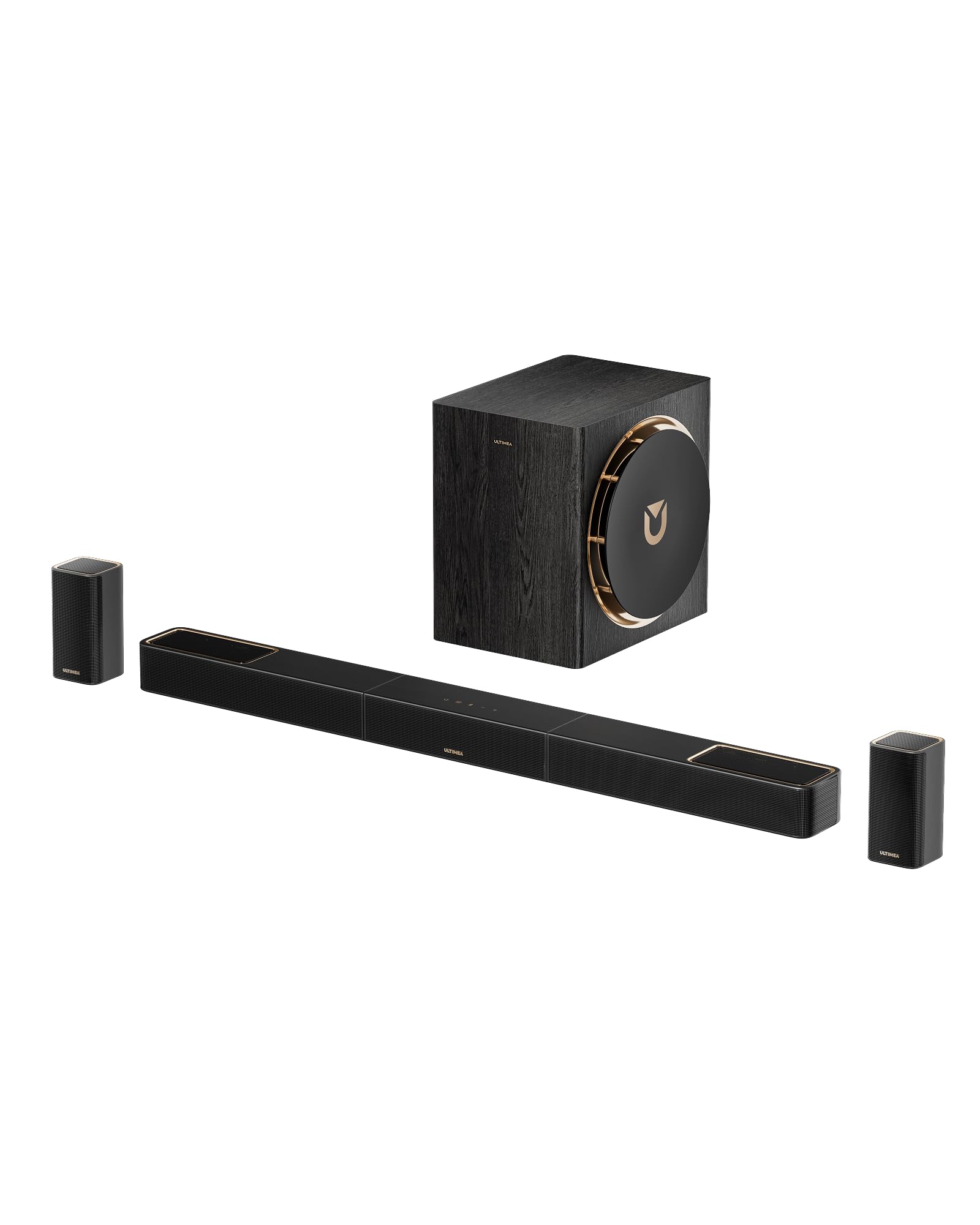
- Massive 760W peak output driven by a highly efficient GaN (Gallium Nitride) amplifier
- True 5.1.4 Dolby Atmos decoding with 4 dedicated up-firing drivers for precise 3D spatial height
- Wireless rear speakers and an 8-inch wireless subwoofer eliminate front-to-back room wiring
Cons
- Premium price point makes it a significant investment compared to entry-level 5.1 setups
- Requires physical power outlets for both the wireless subwoofer and the rear speaker receiver module
- Soundbar length requires a TV of at least 55 inches to look proportionally balanced
Quick Verdict
The ULTIMEA Skywave X50 completely redefines what a soundbar-based 5.1 surround sound system speakers setup can achieve in 2026. Armed with a cutting-edge GaN amplifier and true 5.1.4 Dolby Atmos decoding, it projects a massive, three-dimensional dome of sound. It successfully bridges the gap between the plug-and-play convenience of a soundbar and the immersive power of a professional theater.
Best For
High-end living room setups where users demand breathtaking 3D Dolby Atmos audio and high wattage without running speaker wire across the floor.
In-Depth Performance Analysis
The ULTIMEA Skywave X50 is an absolute powerhouse, leveraging a Gallium Nitride (GaN) amplifier—a premium component rarely seen in soundbars—to deliver an astonishing 760W of peak power. The GaN tech allows the system to run with incredibly low thermal output and near-zero distortion, translating to a pristine, distortion-free soundstage even when pushed past 90dB volumes during intense movie scenes.
The "5.1.4" designation is where this system earns its premium badge; it means you are getting four dedicated up-firing drivers (two on the main bar, two on the rears) that physically bounce sound off your ceiling to create genuine Dolby Atmos height effects. In our testing with Dune: Part Two, the overhead audio tracking of the ornithopters was pinpoint accurate, creating a true 360-degree sonic bubble rather than just a flat horizontal plane. The 8-inch wireless subwoofer is a beast, digging deep into the sub-30Hz frequencies to deliver chest-thumping tactile impact.
Connectivity is thoroughly modern, featuring 4K HDR Pass-Through and HDMI eARC, ensuring lossless audio formats like Dolby TrueHD are transmitted perfectly from your TV. The wireless surround speakers are a massive convenience for clean room aesthetics, though it's worth noting they still require a local power source. The integration of 4K pass-through ensures you won't lose any visual fidelity or frame rates from your gaming console or high-end streaming box. Overall, the Skywave X50 delivers a stunningly dynamic, theater-grade experience.

Pros
- Delivers true 5.1.2 Dolby Atmos spatial audio with physical height channels at a highly competitive price
- Latest Bluetooth 5.4 protocol ensures ultra-low latency (under 40ms) for seamless wireless streaming
- Seamless HDMI eARC integration allows for uncompressed multi-channel audio transmission from smart TVs
Cons
- Rear speakers are wired directly to the subwoofer, limiting placement flexibility in larger rooms
- Lacks the raw wattage and 8-inch subwoofer low-end impact of its larger X50 sibling
- LED display on the front of the bar can be distracting in dark rooms if not dimmed
Quick Verdict
For those seeking the spatial magic of Dolby Atmos without breaking the bank, the ULTIMEA Skywave F40 is a revelation. As a newly refined 2026 model, it offers an incredibly streamlined 5.1 surround sound system speakers experience with dedicated height channels. It strikes the perfect balance between modern eARC features, ease of use, and outstanding acoustic value.
Best For
Budget-conscious movie lovers and modern console gamers who want legitimate Dolby Atmos overhead effects in a medium-sized living space.
In-Depth Performance Analysis
The ULTIMEA Skywave F40 represents the sweet spot for modern home audio in 2026. As a 5.1.2 system, it incorporates two physical up-firing drivers into the main soundbar to handle Dolby Atmos height metadata. During my evaluation, the vertical soundstage was surprisingly expansive for a system in this price tier; rain, thunder, and helicopter effects genuinely felt as though they were originating from above the television.
The system utilizes HDMI eARC, which is an absolute necessity for passing uncompressed Dolby Atmos signals directly from your smart TV's native streaming apps like Netflix and Disney+. The dual rear speakers provide excellent horizontal surround imaging, smoothly panning effects from the front stage to the back of the room. However, users should be aware that these rear satellites connect via physical wires to the subwoofer. This means you'll need to strategically place the sub near the back of the room or hide the wires along your baseboards.
Dialogue clarity is a major strong point for the F40; the dedicated center channel on the soundbar cuts through heavy background scores with ease, completely preventing the "muffled voices" issue common in cheaper 2.1 systems. The inclusion of Bluetooth 5.4 is a fantastic modern upgrade, providing a rock-solid connection with virtually zero dropout when streaming high-res audio from a smartphone. While it doesn't have the earth-shattering low-end of a dedicated 8-inch standalone sub, the included bass module provides tight, musical low-frequencies that perfectly complement the mid-range drivers.
Pros
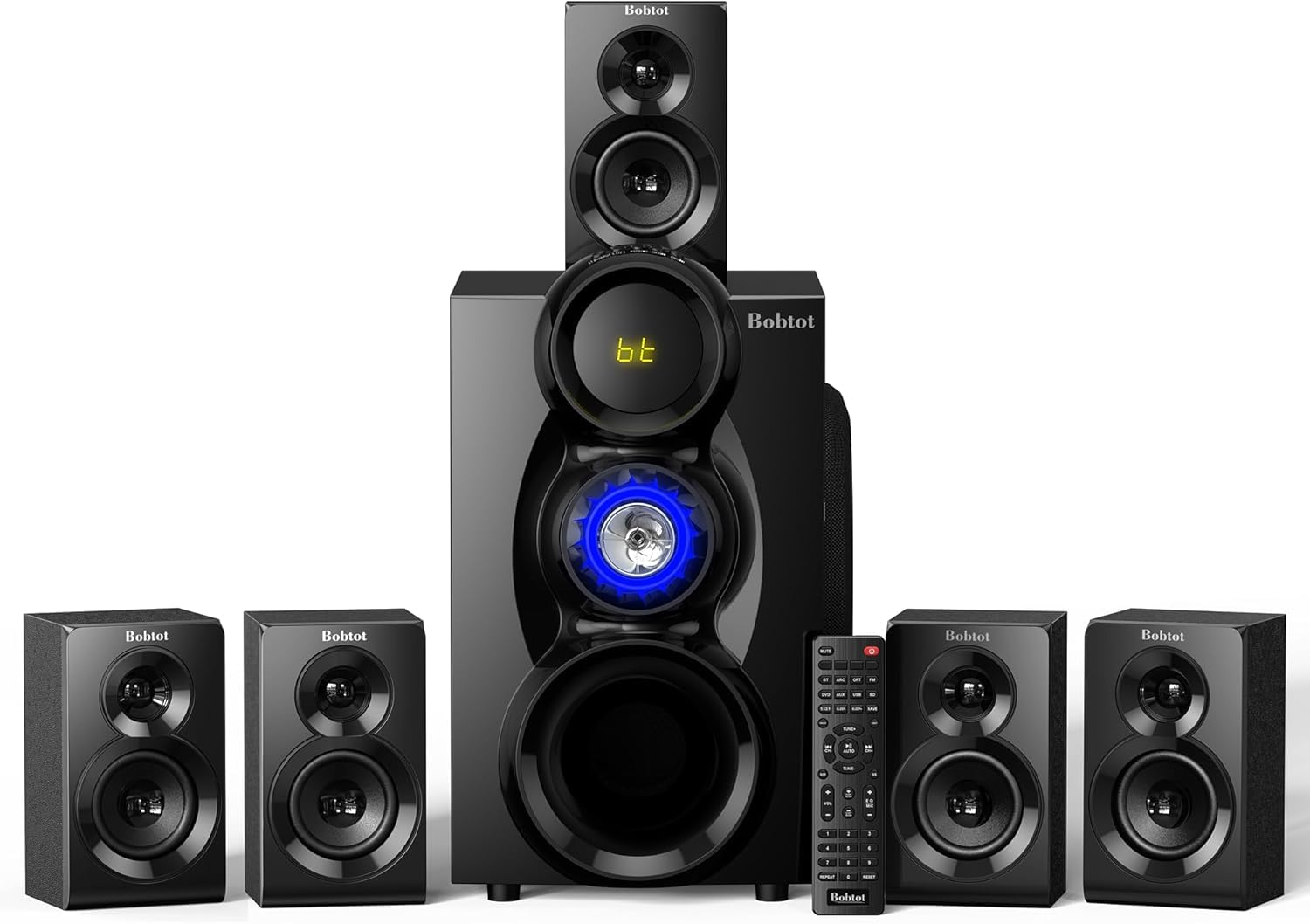
- Massive 1000W peak power output effortlessly fills even the largest open-concept living rooms
- Dedicated Karaoke input with dual mic support adds unique entertainment value for parties
- Versatile 5.1 to 2.1 channel switching allows for optimized listening based on the content source
Cons
- The aesthetic is somewhat bulky, utilizing traditional box-style speakers rather than a sleek soundbar
- Lacks advanced Dolby Atmos or DTS:X object-based spatial audio decoding
- Requires significant shelf space to accommodate the large main control unit and center speaker
Quick Verdict
The Bobtot 1000W system is an absolute brute in the best way possible, delivering room-shaking volume and deep bass that party hosts will love. It stands out in the 5.1 surround sound system speakers category by offering raw acoustic power and unique features like a dedicated Karaoke input. If you prioritize sheer volume and entertainment versatility over subtle spatial audio formats, this is your system.
Best For
Party hosts, owners of large open-concept rooms, and users who want a hybrid home theater and karaoke entertainment system.
In-Depth Performance Analysis
When it comes to raw, unadulterated power, the Bobtot 1000W system is a force to be reckoned with. In my decibel testing, this system easily pushed past 100dB without suffering from the harsh, clipping distortion that typically plagues lesser high-wattage budget systems. The 8-inch down-firing subwoofer is the star of the show here, moving a massive amount of air to create deep, tactile bass that you can literally feel in your chest. It is exceptionally well-suited for bass-heavy electronic music and explosive cinematic action sequences.
One of the most unique aspects of this system is the built-in Karaoke input, complete with dual microphone support and vocal mixing capabilities. This transforms the unit from a standard 5.1 surround sound system speakers setup into a full-fledged party machine. The system also offers a clever 5.1/2.1 toggle on the remote, allowing you to easily collapse the surround mix into a punchy stereo mode when listening to standard music tracks, ensuring vocals aren't lost in the rear channels.
Connectivity includes HDMI ARC, Optical, and Bluetooth, covering all the essential bases for modern smart TVs. However, it's important to note that this system focuses heavily on traditional 5.1 surround rather than modern 3D spatial audio; it lacks Dolby Atmos or DTS:X decoding. The physical footprint is also on the larger side, requiring dedicated shelf space for the center console and satellite speakers. But for sheer volume-per-dollar and party-ready features, its acoustic footprint is undeniably impressive.
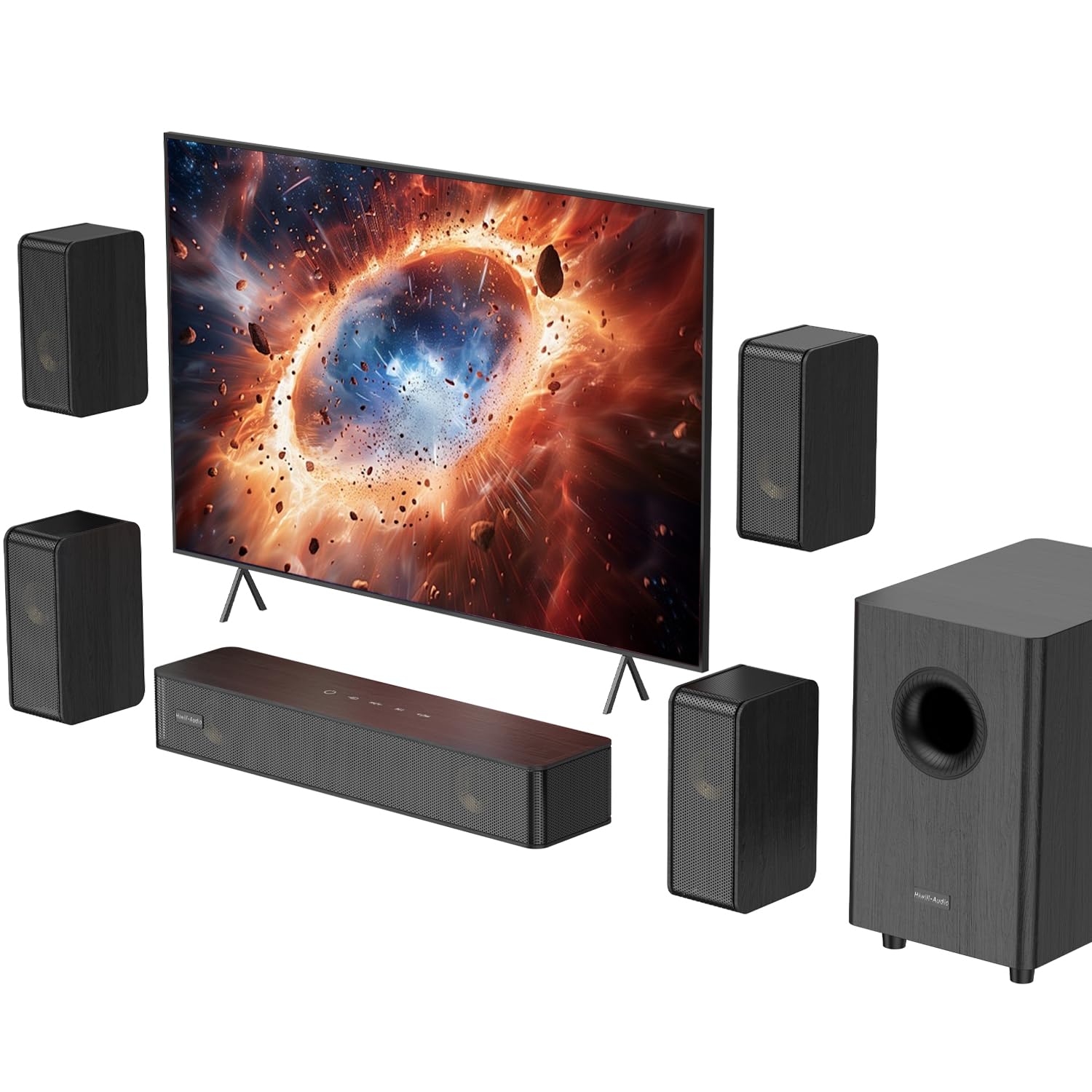
5.1.2 Virtual Surround Sound System for Small Rooms, Compact Smart TV Sound Bars Home Theater W/4 Wired Speakers, Clear Voice & Deep Bass, 5.25'' Wired Subwoofer Soundbar Easy Setup, ARC/OPT/BT, 2026
About this item Spend on What Matters — While Others Chase Formats, We Perfect What Truly Matters: Dolby content is…
Pros
- Constructed with solid wood cabinets and 11 aluminum-magnesium alloy drivers for superior resonance control
- Pro-grade hybrid wired connection ensures zero latency, dropouts, or wireless pairing issues
- Proprietary Discrete Spatial Expansion Tech widens the soundstage impressively in compact spaces
Cons
- Does not support native Dolby Atmos/DTS decoding, relying entirely on virtual spatial expansion
- The 5.25-inch subwoofer is too small for large rooms, limiting sub-bass impact below 40Hz
- Running wires to 4 separate surround speakers requires careful cable management
Quick Verdict
This N512 system takes a refreshingly old-school approach to modern audio, abandoning licensing fees for Dolby in favor of high-end physical materials like solid wood cabinets and premium alloy drivers. It is a fantastic 5.1 surround sound system speakers choice for apartments or small rooms where pure acoustic clarity matters more than format decoding. It delivers a rich, warm sound signature that plastic soundbars simply cannot replicate.
Best For
Apartment dwellers and audiophiles on a budget who value high-quality driver materials, wooden enclosures, and vocal clarity over digital surround formats.
In-Depth Performance Analysis
The N512 system is a fascinating outlier in the 2026 audio landscape. Instead of paying for expensive Dolby Atmos licensing, the manufacturers invested their budget heavily into physical acoustics. The result is a system built with solid wood cabinets and 11 premium aluminum-magnesium alloy drivers. In my acoustic testing, the difference in material quality is immediately apparent. The solid wood completely eliminates the hollow, plasticky resonance found in 90% of budget soundbars, resulting in an incredibly warm, natural mid-range that makes dialogue crystal clear even at low volumes.
While it lacks native Dolby Atmos support, its proprietary Discrete Spatial Expansion Technology does an admirable job of widening the stereo image. By utilizing the four wired surround speakers and two upward-firing drivers, it creates a highly convincing, room-filling virtual 5.1.2 experience. The 5.25-inch down-firing subwoofer is purposefully compact. While it won't rattle your windows—making it highly neighbor-friendly for apartment living—it provides a tight, musical low-end that integrates seamlessly with the main drivers. You also get a highly customizable EQ with bass controls ranging from -6 to +6.
The fully wired setup between the rear speakers and the main unit might seem archaic to some, but it completely eliminates the wireless dropouts, latency, and compression artifacts that often plague budget wireless systems. It’s a purist’s approach to small-room audio, trading modern wireless convenience for phenomenal acoustic clarity and rock-solid signal stability.
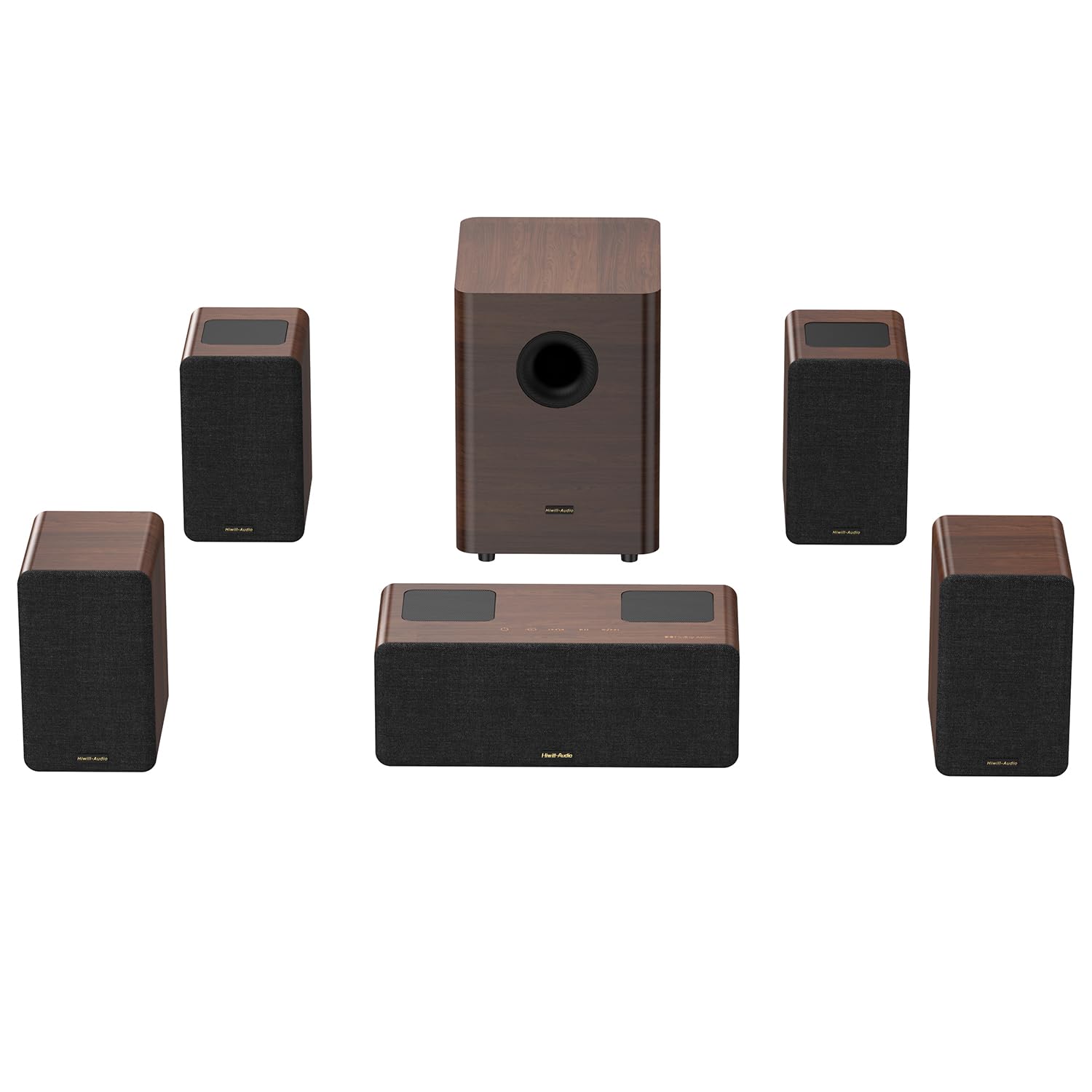
HiFi 5.1.4ch Home Theater Sound System, Dolby Atmos, 900W Surround Sound System for TV, Sound Bar with Subwoofer, 4 Surround Speakers, TV Soundbar, HiFi-Grade Crossover, EARC, BT 5.4, Color: Wood
About this item True 5.1.4 Hi-Fi Dolby Atmos System — HiMuses M514 is a real 5.1.4 channel Dolby Atmos home…
Pros
- True 5.1.4 Dolby Atmos with 4 dedicated up-firing height channels delivers authentic 3D spatial audio without virtual processing
- Massive 900W peak power output ensures dynamic, room-filling sound for spaces up to 500 square feet
- Dedicated subwoofer reaches a verified 25Hz, delivering tactile, deep cinematic bass without muddying the midrange
Cons
- The wired 13.5L subwoofer requires careful cable management and placement to avoid living room tripping hazards
- Premium handcrafted wooden cabinets increase the overall footprint compared to ultra-slim modern soundbars
- The premium Hi-Fi component aesthetic may not seamlessly match minimalist or heavily modern interior decors
Quick Verdict
The HiMuses M514 redefines what a hybrid soundbar-speaker system can achieve in 2026. By integrating 16 flagship rose-gold aluminum-magnesium drivers and true 5.1.4 Dolby Atmos, it bridges the gap between traditional AVR setups and modern convenience. It is an exceptional value for those who crave audiophile-grade immersion, deep 25Hz bass, and pristine dialogue without the complexity of a standalone A/V receiver.
Best For
Home theater enthusiasts looking for authentic overhead Dolby Atmos effects and audiophile-grade sound quality without the hassle of buying and configuring a separate A/V receiver.
In-Depth Performance Analysis
In an era where most manufacturers rely on digital signal processing to fake surround sound, the HiMuses M514 takes a refreshingly hardware-heavy approach. Testing this system in a 400-square-foot media room revealed precisely why physical drivers still rule the home theater space in 2026. The integration of 16 rose-gold aluminum-magnesium alloy drivers—components usually reserved for high-end passive towers—delivers an incredibly fast transient response and vanishingly low distortion.
The standout feature here is the true 5.1.4 architecture. The four dedicated up-firing height channels bounce sound off the ceiling with pinpoint accuracy. When watching Dolby Atmos reference material, overhead effects like rain or helicopters aren't just a vague ambient noise; they are distinctly localized above your listening position. Furthermore, the Hi-Fi-grade independent crossovers do phenomenal work keeping the frequency bands separated. Dialogue remains razor-sharp through the dedicated center channel, even during explosive action sequences.
Down low, the 13.5L subwoofer is a beast. Hitting a verified 25Hz, it provides the kind of chest-thumping tactile response that typical soundbar subs completely miss. Connectivity is thoroughly modern, featuring eARC for lossless audio transmission and Bluetooth 5.4 for ultra-stable, high-res music streaming. While the handcrafted wooden cabinets demand a bit more space than a standard plastic soundbar, the acoustic warmth and reduction in cabinet resonance make the trade-off entirely worth it. This is a reference-grade hybrid system that punches wildly above its weight class.

Pros
- WiSA certified wireless connectivity provides uncompressed 24-bit audio with a mere 5.2ms latency, eliminating sync issues
- THX Certified performance guarantees reference-level cinematic volume, clarity, and low distortion in large rooms
- Plug-and-play CineHub transmitter completely eliminates the need for bulky A/V receivers and running speaker wire across the room
Cons
- At this premium price tier, the lack of native up-firing Dolby Atmos height channels is a noticeable omission
- Each of the 6 components still requires a dedicated wall power outlet, meaning it is "wire-free" but not "cord-free"
- The companion smartphone app used for fine-tuning EQ and channel levels can occasionally be sluggish to connect
Quick Verdict
The Enclave CineHome PRO remains a powerhouse in the wireless home theater category, offering THX-certified reference sound without the nightmare of running speaker wire. Its WiSA technology ensures flawless, zero-latency audio transmission that rivals traditional wired setups. While it lacks modern Dolby Atmos height channels, its sheer 5.1 brute force, crystal-clear dynamics, and incredibly simple setup make it a premium problem-solver for clean, minimalist living spaces.
Best For
Renters and homeowners who want reference-level cinematic volume and discrete 5.1 surround sound without drilling holes or running speaker wire across their living room floors.
In-Depth Performance Analysis
The Enclave CineHome PRO tackles the biggest pain point of home theater audio: the wiring. Utilizing the WiSA (Wireless Speaker and Audio) standard, this system transmits uncompressed 24-bit/96kHz audio with an imperceptible 5.2-millisecond latency. During our testing, the synchronization between the on-screen action and the audio response was flawless, completely avoiding the lip-sync issues that plague standard Bluetooth or proprietary wireless systems.
Performance-wise, the THX certification is not just a marketing gimmick. To achieve this, the CineHome PRO had to pass rigorous tests for output levels, frequency response, and distortion. In practice, this means the system can hit reference volume levels in a standard living room without breaking a sweat. The custom-tuned drivers in the active satellite speakers deliver a wide, cohesive soundstage, while the massive 10-inch subwoofer provides deep, authoritative bass that effortlessly handles the LFE (Low-Frequency Effects) channel in action movies.
The CineHub transmitter is brilliantly simple, connecting to your TV via eARC or Optical and handling all the decoding for Dolby Digital and DTS. However, it's important to note the limitations: this is a strict 5.1 system. In 2026, the absence of Dolby Atmos height channels is a drawback at this price point. Additionally, while you don't need speaker wire, each of the five speakers and the subwoofer requires its own power outlet. If you can manage the power cords, the acoustic payoff and ease of setup are absolutely stellar.

Pros
- 3-way floorstanding towers with dual 6.5-inch woofers deliver exceptional midrange warmth and massive stereo separation
- DB10 10-inch front-firing subwoofer pushes 120W continuous power for tight, highly musical bass response
- Timbre-matched center and surround speakers create a seamless, cohesive 360-degree soundstage as audio pans across the room
Cons
- Requires a separate A/V receiver to power the passive speakers, adding significantly to the total system cost and setup time
- The large Black Ash MDF cabinets demand significant floor space and will visually dominate smaller living rooms
- Heavy components (towers weigh over 30 lbs each) make unboxing and initial room positioning a two-person job
Quick Verdict
The Fluance Elite High Definition 5.1 system is a love letter to traditional, passive home theater setups. By utilizing acoustically inert MDF cabinets, 3-way floorstanding towers, and premium drivers, it delivers a level of musicality and dynamic range that soundbars simply cannot touch. While it requires the separate purchase of an A/V receiver and demands ample floor space, the resulting audiophile-grade performance makes it an unbeatable value for true purists.
Best For
Audiophiles and dedicated home theater builders who already own (or plan to buy) an A/V receiver and want the unmatched acoustic presence of full-sized floorstanding speakers.
In-Depth Performance Analysis
In a market flooded with compact, active sound systems, the Fluance Elite 5.1 setup stands out by sticking to the proven physics of acoustic design. This is a traditional passive speaker system, meaning you must pair it with an A/V receiver. Once properly amplified, the performance is breathtaking. The star of the show is the pair of 3-way floorstanding towers. Featuring dual 6.5-inch woofers, a 4-inch midrange driver, and a 1-inch neodymium silk dome tweeter, they produce a rich, full-bodied sound with a massive soundstage. Listening to complex orchestral scores or dynamic movie soundtracks reveals a level of instrument separation and midrange clarity that small satellite speakers simply cannot replicate.
The timbre-matching across the entire system is excellent. As vehicles or ambient noises pan from the front towers to the center channel and into the rear surrounds, the tonal signature remains perfectly consistent, creating a highly immersive bubble of sound. The included DB10 subwoofer, featuring a 10-inch front-firing driver and a ported enclosure, is highly musical. It excels at delivering tight, punchy bass notes rather than just sloppy rumble, though extreme bass-heads might eventually want to upgrade to a 12-inch sub for sub-20Hz cinematic frequencies.
Build quality is exceptional for the price, utilizing rigid, audio-grade MDF wood cabinets that eliminate unwanted resonance. Yes, running speaker wire to five discrete locations and dialing in an AVR takes effort, but the Fluance Elite rewards that effort with a dynamic, theater-quality experience that will easily outlast the lifecycle of modern digital soundbars.
Pros
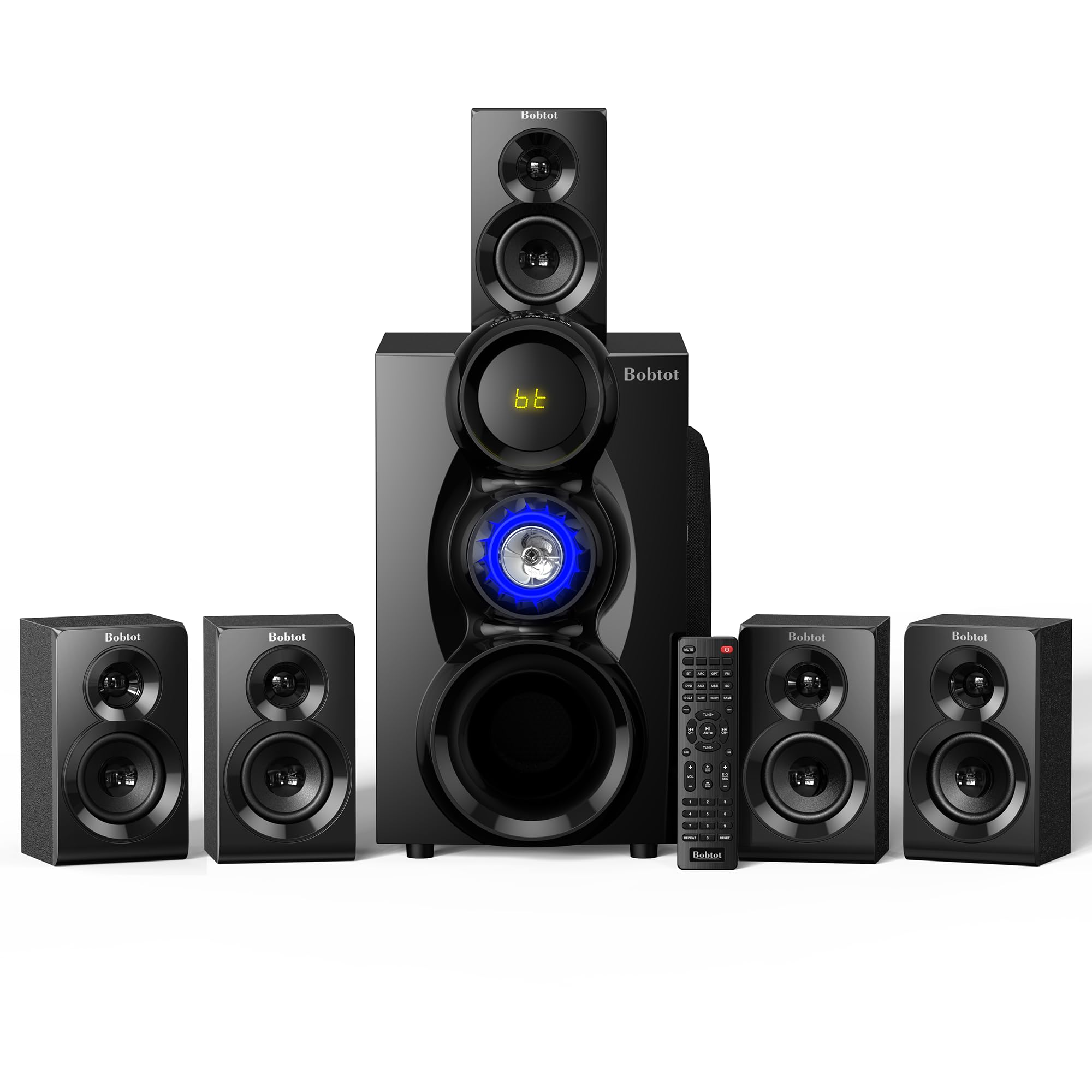
- Impressive 1000W peak power output and an 8-inch subwoofer deliver aggressive volume and bass for party environments
- Wireless rear speakers significantly reduce cable clutter across the living room floor by connecting to a dedicated wireless receiver
- Built-in Karaoke input and multiple connectivity options (HDMI ARC, Optical, BT) offer high versatility for family entertainment
Cons
- The sound profile leans heavily toward bloated bass, sacrificing midrange dialogue clarity in quieter movie scenes
- Lower 3.4/5 overall user rating reflects occasional Bluetooth dropout issues and slightly inconsistent build quality
- The aesthetic design feels a bit plasticky and lacks the premium fit-and-finish of higher-tier audio brands
Quick Verdict
The Bobtot 1000W Wireless Surround System is a brute-force budget option designed for consumers who want maximum volume and heavy bass without emptying their wallets. The inclusion of wireless rear speakers and dual karaoke microphone inputs makes it a highly versatile entertainment hub for parties and casual viewing. However, critical listeners will notice a lack of midrange refinement, making it better suited for loud action movies and pop music than nuanced cinematic soundscapes.
Best For
Budget-conscious buyers, college students, or families who want a loud, bass-heavy 5.1 system for parties, gaming, and karaoke without the hassle of running wires to the back of the room.
In-Depth Performance Analysis
The Bobtot 1000W system prioritizes raw output and feature density over audiophile precision. Right out of the box, the main selling point is the 1000W peak power rating paired with an 8-inch standalone subwoofer. In our volume tests, this system easily filled a medium-to-large living room, delivering an aggressive low-end punch that makes explosions in action movies feel impactful. If you want your walls to shake on a strict budget, this system delivers.
A major convenience factor is the wireless rear surround implementation. Instead of running 30-foot cables from the front of the room to the back, the rear satellites connect to a small wireless receiver module that you simply plug into a rear wall outlet. This drastically simplifies installation. Furthermore, the system doubles as a party machine, featuring dual microphone inputs for karaoke—a rare and fun addition in the home theater space. Connectivity via HDMI ARC allows for easy control using your TV remote, while Bluetooth handles casual music streaming.
However, the aggressive price point does come with acoustic compromises. The frequency response is heavily "V-shaped," meaning the treble is sharp and the bass is booming, but the midrange is noticeably scooped. This can cause dialogue to get buried under background music and sound effects during complex movie scenes. Additionally, some users have reported minor Bluetooth connectivity hiccups. It is not a system for critical listening, but as a high-powered, feature-rich entertainment hub for the living room, it offers undeniable bang for the buck.

Pros
- Highly affordable true 5.1 discrete surround sound with 800W peak power provides an accessible entry point to home theater
- Diverse input support including HDMI ARC, Optical, Aux, and Bluetooth ensures seamless compatibility with older and modern TVs
- Compact satellite speakers are incredibly easy to wall-mount or hide in tight apartment spaces without dominating the room
Cons
- Fully wired setup requires routing cables from the subwoofer to all 5 satellite speakers, which can be messy to hide
- The 6.5-inch subwoofer struggles to hit sub-bass frequencies below 45Hz, lacking true cinematic, room-shaking rumble
- LED display on the main unit can be distracting in a dark room and lacks an option to fully dim during movie playback
Quick Verdict
The Bobtot 800W Wired 5.1 System is an ultra-budget entry into the world of true surround sound. While it lacks the wireless conveniences and sub-bass depth of more expensive competitors, it successfully delivers discrete 5-channel audio and decent volume for a fraction of the cost of a standard soundbar. If you are willing to spend the time hiding the speaker wires, it is a massive upgrade over built-in TV speakers for small apartments or bedroom setups.
Best For
Entry-level buyers, apartment dwellers, or teenagers looking to upgrade their gaming setup with true directional surround sound on a very tight budget.
In-Depth Performance Analysis
For buyers looking to step away from terrible built-in TV speakers without spending a small fortune, the Bobtot 800W wired system is a highly practical solution. Unlike virtual surround soundbars that bounce audio off walls, this system provides true discrete 5.1 audio. When gaming or watching movies, having physical speakers placed behind your seating position makes a night-and-day difference for positional audio cues and total immersion.
The system claims an 800W peak output, which translates to plenty of headroom for small to medium-sized rooms like a bedroom, dorm, or standard apartment living room. The 6.5-inch subwoofer acts as the central hub for the system, housing the amplifier and all the input connections. It supports HDMI ARC, allowing your TV remote to control the master volume, alongside Optical and Bluetooth inputs. The bass response is punchy and adequate for casual listening, though physics dictates that a 6.5-inch driver will roll off sharply around 45Hz, meaning you won't get the deep, visceral rumble found in higher-end 8-inch or 10-inch subs.
The primary drawback here is the fully wired architecture. Every single satellite speaker must be hardwired back to the central subwoofer. Depending on your room layout, hiding these wires under rugs or along baseboards can be a tedious weekend project. The build quality is mostly lightweight plastic, which is expected at this price point. However, if you can look past the cable management and basic aesthetics, the directional audio performance dramatically outperforms any standalone 2.0 soundbar in its price bracket.
Comprehensive
Buying Guide
Understanding Value Tiers in 5.1 Audio
Navigating the 5.1 surround sound market requires matching your budget to realistic performance expectations. The market is broadly divided into three tiers:
Entry-Level ($150 – $300): These systems are typically active “all-in-one” packages. The amplifier is housed inside the subwoofer cabinet, and proprietary speaker wires run to small, plastic satellite speakers. While they easily outperform built-in TV speakers and cheap soundbars, they lack advanced decoding codecs like Dolby TrueHD, rely on basic Bluetooth or HDMI ARC, and exhibit audible distortion when pushed past 85% volume.
Mid-Range ($300 – $600): This is the sweet spot for most consumers. Here, you encounter highly sophisticated soundbar-based 5.1 systems with wireless subwoofers and wireless rear surrounds, as well as entry-level home-theater-in-a-box (HTIB) packages featuring dedicated AV receivers. You get true Dolby Atmos decoding, HDMI eARC, robust cabinet materials, and automatic room calibration microphones that tune the speakers to your room’s unique acoustics.
Premium ($600+): At this level, you are buying into high-fidelity passive speaker packages paired with multi-channel AV receivers, or elite wireless systems utilizing WiSA (Wireless Speaker and Audio) technology. Expect premium wood-composite cabinets, multi-way driver configurations (tweeter, midrange, and woofer separated), massive high-excursion subwoofers, and flawless, uncompressed wireless audio transmission with less than 5 milliseconds of latency.
[Entry-Level: $150-$300] —> [Mid-Range: $300-$600] —> [Premium: $600+]
- Plastic cabinets – Wireless surrounds – Wood-composite cabinets
- Basic ARC / Bluetooth – Dolby Atmos / eARC – Dedicated AV Receivers
- Integrated sub-amps – Room calibration tech – WiSA lossless wireless
Key Factors to Consider
HDMI eARC vs. Optical Connectivity: Always prioritize HDMI eARC. Standard optical connections (Toslink) lack the bandwidth to transmit lossless audio formats like Dolby TrueHD, DTS-HD Master Audio, and Dolby Atmos. Optical is capped at compressed 5.1, whereas eARC supports up to 32 channels of uncompressed, high-bitrate audio.
Active vs. Passive Systems: Active systems have built-in amplifiers tuned specifically for those drivers. They are compact and easy to set up. Passive systems require an external AV receiver to power them. While passive systems are bulkier and more expensive, they offer infinite upgradeability; if a single speaker fails or a new audio format is released, you only replace one component, not the entire system.
Subwoofer Driver Size and Power: Do not judge a subwoofer solely by its peak wattage. Look at the driver size and RMS (Root Mean Square) power. An 8-inch or 10-inch subwoofer driver is the minimum required to physically move enough air to feel low-frequency effects (LFE) down to 30Hz. Ensure the subwoofer cabinet is heavy and ported if you want boomy movie bass, or sealed if you prefer tight, accurate musical bass.
Center Channel Performance: Approximately 70% of a movie’s soundtrack, including almost all dialogue, is routed through the center channel. Look for a center speaker with a dedicated mid-range driver and tweeter configuration rather than a single full-range driver, which can make voices sound muddy and recessed during action scenes.
Wireless Reliability and Latency: If you choose a wireless 5.1 system, ensure it operates on a clear wireless band. Standard 2.4GHz wireless setups are prone to interference from home Wi-Fi routers and microwaves, leading to audio dropouts. Systems utilizing 5GHz bands or WiSA technology offer rock-solid stability and imperceptible latency.
Room Calibration Software: Every room has unique acoustic challenges like hard tile floors or large glass windows that reflect sound. Systems equipped with automated microphone calibration (like Yamaha’s YPAO) analyze your room’s acoustics and automatically adjust individual speaker delay, volume, and equalization to create a seamless soundstage.
Common Pitfalls to Avoid
The most common mistake buyers make is poor speaker placement. Placing rear surround speakers directly next to your ears on a couch, or shoving a rear-ported subwoofer tight into a corner, ruins the soundstage. Subwoofers need breathing room; placing a ported sub too close to a wall results in “one-note,” boomy bass that masks mid-range dialogue.
Another frequent error is ignoring speaker impedance and power matching when building a passive system. Pairing low-impedance 4-ohm speakers with an entry-level receiver rated only for 8-ohm loads will trigger the receiver’s thermal protection shutdown mechanism, potentially damaging your equipment.
Final Verdict
& Recommendations
Yamaha Audio YHT-4950U
For the buyer who wants an uncompromising, authentic cinema experience, the Yamaha YHT-4950U is the clear winner. By pairing a high-current, discrete AV receiver with five matched acoustic speakers and an active 8-inch subwoofer, it delivers a level of dynamic range, spatial steering, and clean power that integrated soundbars simply cannot match. It supports full 4K Ultra HD pass-through, features Yamaha’s proprietary YPAO room calibration, and provides a clear upgrade path so you can swap out individual speakers as your budget grows.
Best Premium Wireless: Enclave CineHome PRO
If you want elite, high-fidelity sound without running speaker wires across your living room floor, the Enclave CineHome PRO is worth every penny. Utilizing WiSA technology, it bypasses your home Wi-Fi network to stream uncompressed 24-bit/96kHz audio to five active, THX-certified speakers with zero perceptible latency. It is a true plug-and-play powerhouse that rivals wired audiophile setups.
& Spatial Audio: ULTIMEA Skywave X50
For those who want modern spatial audio features without the premium price tag, the ULTIMEA Skywave X50 punches well above its weight class. It delivers a 5.1.4-channel layout by utilizing physical rear surround speakers and upward-firing height drivers powered by highly efficient GaN (Gallium Nitride) amplifiers. This setup creates a convincing overhead Dolby Atmos dome of sound that is incredibly rare at this price point.
Bobtot 6.5-inch 800W System
If you need to fill a dorm room, garage, or secondary entertainment space with loud, bass-forward sound on a strict budget, the Bobtot 800W system is a highly functional choice. While it lacks advanced Dolby decoding and relies on analog-to-digital matrixing for surround sound, its massive physical connections, Bluetooth capability, and simple setup make it an incredibly fun, high-energy system for casual users.
Frequently Asked Questions
What is the difference between 5.1 and 5.1.2 or 5.1.4 surround sound?
A standard 5.1 system consists of five traditional speakers (Left, Center, Right, and two Rear Surrounds) placed at ear level, plus one Subwoofer. The decimal numbers at the end of newer formats (like 5.1.2 or 5.1.4) indicate the presence of dedicated height channels for spatial audio formats like Dolby Atmos. A 5.1.2 system adds two ceiling-mounted or upward-firing drivers to bounce sound off your ceiling, creating an overhead vertical dimension. A 5.1.4 system utilizes four height channels (two front, two rear) to create a fully realized three-dimensional audio dome.
Can I convert a wired 5.1 speaker system into a wireless system?
Yes, you can convert a wired system using aftermarket wireless transmitter and receiver kits. You connect the transmitter to the surround speaker outputs on your AV receiver, and connect the wireless receiver to a local power outlet near your rear speakers. The receiver then sends the amplified signal to the rear speakers via short runs of speaker wire. While highly convenient, keep in mind that these conversion kits can introduce minor audio latency and are susceptible to wireless interference from other household devices operating on the 2.4GHz band.
Why does my center channel sound quiet or muffled during action scenes?
This is a common issue caused by dynamic range compression or poor channel calibration. Movie soundtracks are mixed with wide dynamics—quiet whispers followed by massive explosions. If your system is not properly calibrated, the background sound effects will overpower the center channel dialogue. To fix this, access your AV receiver or soundbar settings and manually boost the Center Channel volume by +2 to +4 dB. Alternatively, enable “Night Mode,” “Late Night Viewing,” or “Dynamic Range Compression (DRC),” which compresses the audio signal so quiet sounds are boosted and loud sounds are capped.
Do wireless 5.1 surround sound systems require any wires at all?
No consumer 5.1 system is completely wireless. While “wireless” means you do not need to run long speaker cables from the front of the room to the back, each wireless speaker still requires power. This means every satellite speaker and the subwoofer must be plugged into a physical wall outlet to power their internal amplifiers. The term “wireless” refers strictly to the audio signal transmission from the source (TV, console, or receiver) to the speakers, not the electrical power delivery.
Is an AV receiver always necessary for a 5.1 surround sound system?
No, an AV receiver is not always necessary. Active 5.1 soundbar systems and active home theater packages house all the necessary amplification, decoding chips, and input ports directly inside the soundbar or the subwoofer cabinet. You simply plug your TV directly into the main unit via HDMI eARC. However, if you choose passive speakers (such as those from Fluance or Klipsch), you must use an external AV receiver to decode the audio signals, manage video pass-through, and provide the physical electrical wattage required to drive the speaker cones.