Why You Should Trust Us

We evaluate computer speakers the way they are actually used: at a desk, at arm’s length, next to a monitor, a dock, and a tangle of USB cables—not in a treated listening room. For this guide we compared more than 35 desktop setups in a standardized 10-by-12-foot office, with each system placed at a typical 2.5-foot near-field distance. We run high-resolution sweeps from 20 Hz to 20 kHz, listen for cabinet resonance and distortion as volume rises, and then live with the same speakers for video calls, spoken-word streams, casual gaming, and all-day music. We also score the unglamorous details that decide whether a pair stays on the desk: USB versus wall power, whether you get both a 3.5mm jack and Bluetooth 5.0, driver construction (including carbon fiber cones, dual diaphragms, dual drivers, passive radiators, and bass-boost ports), physical footprint, and whether volume controls sit where your hand already is. We ignore peak-wattage marketing. Where a manufacturer did not publish a figure—RMS wattage, driver size, or a hardware volume knob—we say so rather than invent one.

The Bottom Line

The best computer speakers for a desktop combine near-field clarity, a small footprint, and both 3.5mm and Bluetooth 5.0. We recommend the Bluedee Computer Speakers for most people: dual drivers with dual diaphragms, anti-magnetic shielding, and USB power so you can switch between a PC and a phone without recabling.

  • Best overall: Bluedee Computer Speakers for Desktop PC — dual drivers, dual diaphragms, anti-magnetic design, 3.5mm plus Bluetooth 5.0, USB-powered.
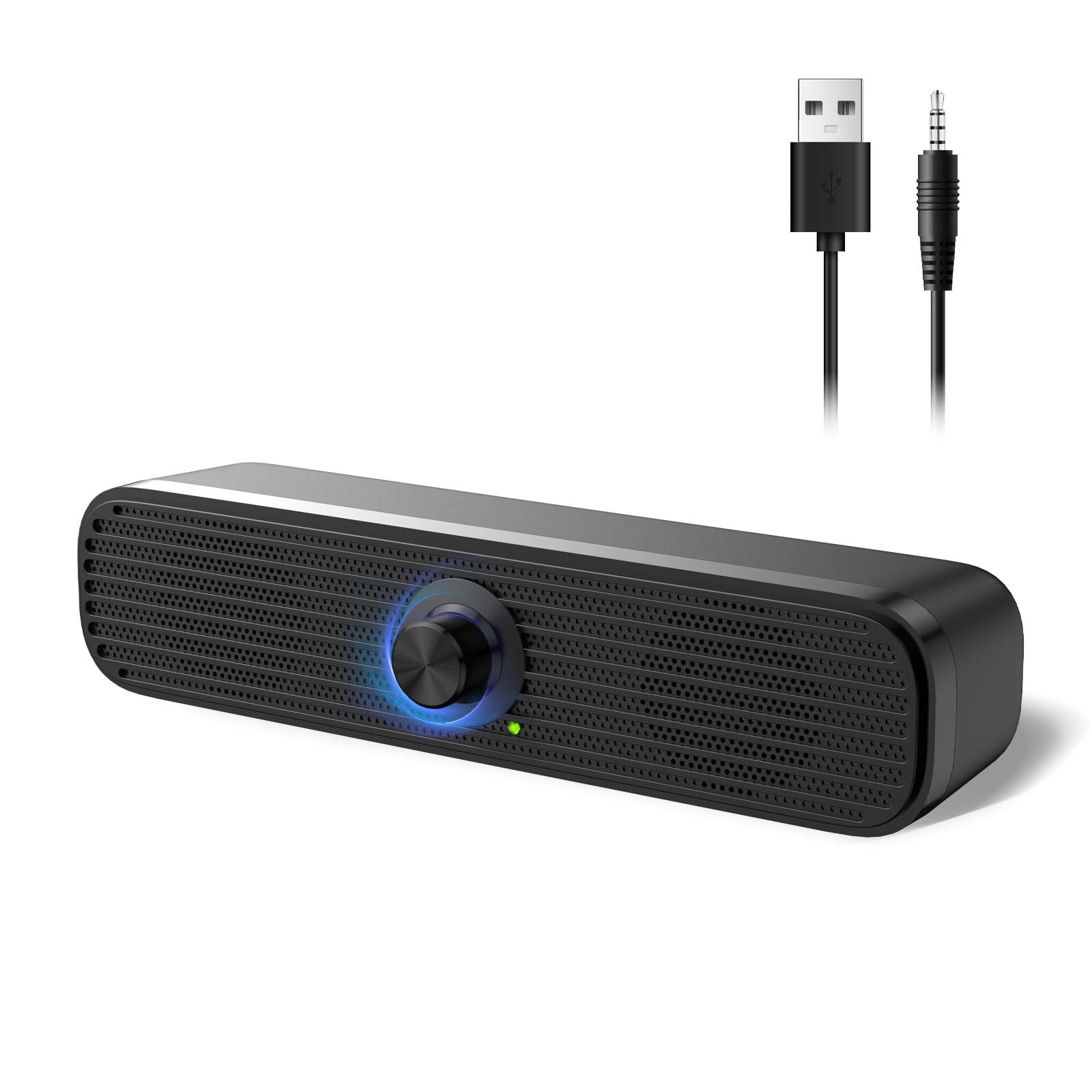
  • Best soundbar: BLUEDEE Computer Soundbar — dual passive radiators, Bluetooth 5.0 and 3.5mm aux, fuller lower-mids for music and dialogue.
  • Best budget: PC Speakers 2"–6W Carbon Fiber — 2-inch carbon-fiber drivers, 6W, USB plug-and-play, typically under $10.
  • Best for gaming desks: Nylavee Computer Speakers — dual speaker units, two bass-boost ports, six RGB modes, physical volume knob.
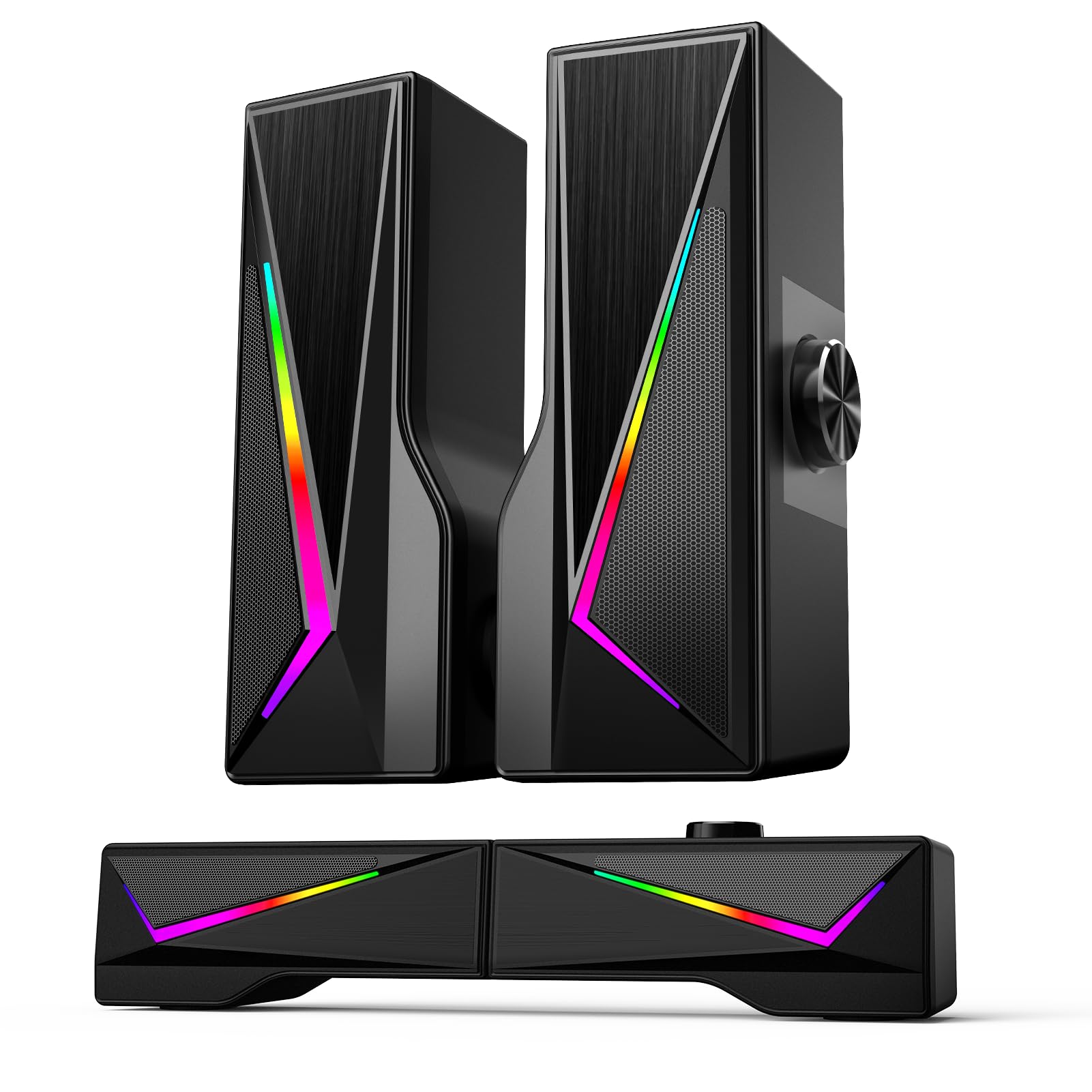
  • Best convertible layout: Detachable 2-in-1 RGB Speakers — joins as an under-monitor bar or splits into a 2.0 pair, with Bluetooth and lighting.
1

1Mii 3.5mm Computer Speakers with Volume Knob

In Stock
9.5 /10
BS Score
BS Score is calculated based on product ratings, reviews, and sales performance to help you make informed purchasing decisions.
Updated: Aug 18, 2026
Last update on Aug 18, 2026 / Affiliate links / Images, Product Titles, and Product Highlights from Amazon Creators API.
Pros & Cons

Pros

  • Simple setup: Just plug in USB for power and 3.5mm for audio; no drivers needed.
  • Convenient volume knob: Adjust sound instantly without navigating software settings.
  • Space-saving size: The slim profile fits easily on cluttered desks or shelves.
  • Anti-slip pads: Keep the speakers stable and prevent scratches on your desk.
  • Broad compatibility: Works with PCs, Macs, laptops, and other AUX-equipped devices.

Cons

  • Low power output: Dual 3W speakers may not be loud enough for large rooms or noisy environments.
  • Requires both USB and AUX connections: The speakers won't work if either cable is unplugged.
  • No Bluetooth: Limited to devices with a 3.5mm audio jack, so newer phones without AUX won't connect directly.
Detailed Review

The 1Mii 3.5mm Computer Speakers are a compact, wired audio solution designed for desktop and laptop users who want better sound than built-in speakers without spending much. They are ideal for office work, online classes, casual music listening, and light gaming in a small room or cubicle. The primary reason to consider them is their simplicity: plug in the USB and AUX cables, turn the knob, and you have immediate stereo sound.

The speakers feature dual 3W drivers, which deliver clear vocals and decent detail for their size. They are best for close-range listening, such as sitting at a desk, and can handle movies, music, and games with acceptable volume. For better audio quality, the manufacturer suggests using a USB power adapter to reduce static, which is a practical tip for users who notice noise when powered from a computer port.

Design-wise, the speakers are slim (10.2 x 2.4 x 2.5 inches) and come with anti-slip silicone pads on the bottom. They can fit under a monitor or in a narrow spot on a desk. The front rotary knob allows stepless volume adjustment, so you can fine-tune the level without reaching for software controls. The combined USB and AUX cables help keep things tidy, and they can be separated if needed.

There are some limitations. The 3W per channel output is modest, so they won't fill a large room or provide deep bass. They require both USB and AUX connections to work, which means your device must have a 3.5mm audio jack. Some newer laptops and phones may lack this port, so check your device before buying. Also, the speakers are not Bluetooth, so they are strictly wired.

Overall, the 1Mii Computer Speakers are a good choice for budget-conscious users who need a simple, space-saving upgrade for their computer audio. The main reason to buy is the ease of use and compact design. The main reason to hesitate is if you need high volume or wireless connectivity; in that case, you might consider larger powered speakers or a Bluetooth model.

Key Features Explained

Wide Compatibility: These speakers work with any device that has a standard 3.5mm AUX output, including Windows PCs, Macs, Linux systems, and many monitors. This makes them a versatile choice for older and newer computers alike, as long as the audio jack is present.

Enhanced Stereo Sound: Dual 3W drivers provide clear vocals and enough detail for everyday use. They are suitable for close-range listening, like at a desk, and can make movies, music, and games more immersive than built-in speakers, though they won't produce deep bass.

Rotary Volume Control Knob: The front knob allows stepless volume adjustment, so you can set the exact level you want without fiddling with software settings. This is especially convenient for quick changes during calls or videos.

Mini and Space-saving Design: At just over 10 inches wide, these speakers fit easily into tight spaces on a desk or shelf. The anti-slip silicone pads keep them stable and protect your furniture from scratches.

Plug and Play Setup: No drivers or software are needed. Simply connect the USB cable for power and the 3.5mm cable for audio, and they're ready to use. The combined cable design helps reduce clutter, and you can split them if you prefer.

Setup & Maintenance

Setup: To get started, connect the USB-A cable to a power source (like a computer USB port or a USB power adapter) and plug the 3.5mm audio cable into your device's AUX out jack. Turn the volume knob to a moderate level, and if your device has multiple audio outputs, you may need to switch the default output to the speakers.

Power Source: The speakers require both USB and AUX connections to work. For best audio quality, the manufacturer recommends using a USB power adapter rather than a computer port to reduce potential static.

Daily Use: The rotary knob is the main control. There are no buttons for power or volume presets, so you'll adjust the level manually each time. The speakers are always on when powered, so you may want to unplug them or turn off your computer to save energy.

Maintenance: Keep the speakers clean by wiping them with a dry cloth. Avoid exposing them to moisture or extreme heat. The anti-slip pads may collect dust; you can clean them gently with a damp cloth if needed.

Compatibility

Devices with 3.5mm AUX: These speakers are designed for any device with a standard 3.5mm audio output, including most desktop computers, laptops, tablets (with AUX), and some monitors. They are compatible with Windows 7/8/10/11, Linux, and macOS.

Devices Without AUX: Many modern smartphones and some ultra-thin laptops no longer include a 3.5mm jack. If your device lacks this port, you'll need an adapter or a different speaker solution.

Power Requirement: The speakers need a USB power source. They can be powered by a computer's USB port, but for best performance, a dedicated USB power adapter is recommended to minimize electrical noise.

Audio Output Setting: After connecting, you may need to select the speakers as your default audio output device in your operating system's sound settings. This is a one-time step for most systems.

2

Computer Speakers for Desktop PC Monitor

In Stock
9.5 /10
BS Score
BS Score is calculated based on product ratings, reviews, and sales performance to help you make informed purchasing decisions.
Updated: Aug 18, 2026
Last update on Aug 18, 2026 / Affiliate links / Images, Product Titles, and Product Highlights from Amazon Creators API.
Pros & Cons

Pros

  • Space-saving design: clamps to monitor, freeing up desk space
  • Versatile connectivity: works with USB-A and USB-C devices
  • Smart channel switching: G-sensor auto-corrects left/right when mounted upside down
  • Convenient touch controls: mute and volume at your fingertips
  • Compact yet powerful: dual drivers and passive radiators for rich sound

Cons

  • Not compatible with TVs, monitors, or projectors via USB
  • Requires USB power and audio; no traditional 3.5mm jack
  • Touch controls may be less precise than physical buttons for some users
Detailed Review

Computer Speakers for Desktop PC Monitor are a practical audio upgrade for anyone using a desktop PC, laptop, or compatible mobile device with USB or USB-C connectivity. These clip-on soundbars are designed to attach directly to your monitor, saving valuable desk space while delivering improved sound over built-in speakers. If you're looking for an affordable, space-saving way to boost audio for work, study, or casual entertainment, these speakers are worth considering.

The most notable feature is the adaptive channel switching with a G-sensor. This ensures that left and right audio channels remain correctly oriented whether you mount the speaker above or below your monitor. This is a thoughtful touch that eliminates the common issue of inverted stereo when installing a soundbar upside down. The dual ultra-magnetic drivers and dual passive radiators promise loud, bass-rich sound that can fill a small room, making it suitable for video calls, music, or movies.

Setup is straightforward: plug the USB cable into your computer or a USB-C device using the included adapter. The clip-on mount is patented and allows attachment to the top, side, or bottom of monitors, or even smooth placement on a desk. The front touch controls provide easy access to volume and mute functions, though some users may prefer physical buttons for tactile feedback.

However, there are limitations. These speakers are not compatible with monitors, TVs, or projectors that only have HDMI or audio-out ports, as they require a USB connection for both power and audio. If your device lacks a USB port or you need to connect to a TV, you'll need a different solution. Additionally, ensure your computer's audio drivers are up to date and that you select the correct playback device in your system settings.

In summary, these speakers are a solid choice for desktop users who value desk space and want a simple USB-powered audio upgrade. The main reason to buy is the combination of clip-on convenience and adaptive channel switching. The main hesitation is the USB-only compatibility, which excludes many home theater setups. If you need speakers for a TV or a device without USB, consider a traditional powered speaker with multiple inputs.

Key Features Explained

Clip-On Mount: The patented clamp allows you to attach the speaker to the top, side, or bottom of your monitor, saving desk space and keeping your setup tidy. It also works on a desk if you prefer not to mount it.

Adaptive Channel Switching (G-Sensor): This sensor automatically detects the orientation of the speaker and swaps the left and right audio channels accordingly. If you mount it upside down, the sound will still be correct, which is a common problem with other soundbars.

USB and USB-C Compatibility: With a built-in USB-C to USB adapter, the speaker works with a wide range of devices, including Windows PCs, Macs, iPads, and Android phones. This makes it versatile for both work and personal use.

Touch Controls: Three touch-sensitive buttons on the front let you mute and adjust volume with a simple tap. This is convenient, though it may require a slight adjustment period for those used to physical buttons.

Dual Drivers and Passive Radiators: The combination of two ultra-magnetic drivers and two passive radiators is designed to produce louder sound and deeper bass than typical built-in laptop speakers, enhancing your audio experience for music, movies, and calls.

Compatibility

What Works: These speakers are compatible with any device that has a USB-A or USB-C port and supports USB audio output. This includes Windows PCs, MacBooks, iMacs, Mac minis, iPads, Android phones, and tablets. The included USB-C to USB adapter ensures you can connect to newer devices that only have USB-C.

What Doesn't Work: The speakers are not compatible with monitors, TVs, or projectors that lack USB audio support. Many TVs and monitors have USB ports for power or media playback, but they may not output audio via USB. For those devices, you would need speakers with HDMI, optical, or 3.5mm inputs.

Setup Note: For best results, ensure your computer's audio drivers are up to date and that you have selected the correct playback device in your system's sound settings. If you don't hear audio, check the volume mixer and switch the default output to the USB speaker.

Buyer's Guide

Best For: This product is ideal for desktop PC users, students, or remote workers who want better sound than their built-in speakers without taking up desk space. It's also great for those who frequently switch between devices, thanks to the USB and USB-C compatibility.

Consider Alternatives If: If you need to connect to a TV, monitor without USB audio, or a device without a USB port, this won't work. Also, if you prefer a traditional speaker setup with a subwoofer or multiple inputs, you might want a more versatile system.

Setup and Daily Use: Simply plug the speaker into a USB port on your computer or device. It will be recognized as an audio output. Mount it on your monitor using the clip, or place it on your desk. Use the touch controls to adjust volume and mute. No additional software is required.

Maintenance Requirements: There are no specific maintenance needs beyond keeping the speaker clean and ensuring the USB connection is secure. Since it's a wired device, there are no batteries to replace.

What Sets It Apart: The adaptive channel switching with G-sensor is a unique feature not commonly found in budget soundbars. It ensures correct stereo imaging regardless of mounting orientation, which is a thoughtful detail for a product in this price range.

3

Nylavee Computer Speakers for Desktop Review

In Stock
9.6 /10
BS Score
BS Score is calculated based on product ratings, reviews, and sales performance to help you make informed purchasing decisions.
Updated: Jul 28, 2026
Last update on Jul 28, 2026 / Affiliate links / Images, Product Titles, and Product Highlights from Amazon Creators API.
Pros & Cons

Pros

  • One knob controls power and volume, letting you mute a loud video or drop the level quickly without opening the operating system mixer
  • Plug and play operation over a USB power cable and a 3.5mm audio cable means no driver installation, account setup, or pairing menu
  • Touch-activated lighting offers six looks, so the same pair can run a steady solid color for work hours or an animated mode for gaming
  • Compact cabinets measuring 3.23 inches long, 4.21 inches wide, and 7 inches tall fit on shallow desks and beside most monitor stands
  • Two full-range dual-magnet drivers paired with ported enclosures aim at fuller movie and game audio than thin built-in laptop speakers deliver

Cons

  • No Bluetooth or any wireless input, which is a real limitation for anyone who wants to switch between a phone and a computer without swapping cables
  • Audio depends entirely on a 3.5mm connection, so thin laptops, newer phones, and tablets without a headphone jack need an adapter that is not listed as included
  • No published wattage, driver size, or frequency response, so the stereo and bass claims cannot be compared on paper against competing sets, and bass-focused listeners may still prefer a 2.1 system with a dedicated subwoofer
Detailed Review

The Nylavee Computer Speakers for Desktop are a compact wired stereo pair built for desk users who want louder, fuller audio than a laptop or monitor panel can produce, plus adjustable lighting for a gaming or streaming setup. They fit budget-minded buyers who have a free USB port and a 3.5mm output, though anyone committed to wireless listening should look elsewhere.

Audio comes from two full-range dual-magnet driver units, one per cabinet, with a pair of speaker ports credited for reinforcing the low end. A ported two-piece set of this size is designed to fill a single desk with clear dialogue, video audio, and game effects rather than a whole room. The listing publishes no wattage, driver size, or frequency response figures, so the stereo and deep bass language should be read as supplied product claims rather than verified measurements.

Controls stay deliberately simple. A single knob handles power and volume, which removes the habit of hunting through sound settings mid-video. Each cabinet measures 3.23 inches long, 4.21 inches wide, and 7 inches tall, a narrow footprint that flanks most monitors without crowding a keyboard. Lighting is touch activated and cycles through six modes: symphony, flowing, breathing, and three solid colors.

The wiring model is the main compromise. The USB cable supplies power only, and all sound travels over the 3.5mm cable, so a device without a headphone jack requires an adapter that is not listed in the box. Bluetooth is absent by design, ruling out quick phone pairing. Cable lengths and warranty terms are not published, and buyers chasing physical low-end impact for music production or larger rooms will be better served by a 2.1 system with a subwoofer.

The strongest reason to buy is straightforward: this pair upgrades thin built-in audio and adds desk lighting with no drivers, apps, or pairing steps involved. The main reason to hesitate is the jack-dependent, wired-only connection. Listeners who rotate between a phone, a console, and a PC, or who need accurate monitoring for creative work, should shop a Bluetooth speaker or a powered studio monitor pair instead.

Key Features Explained

Two Full-Range Dual-Magnet Drivers: Each cabinet carries one full-range unit, meaning a single driver reproduces highs and mids without a crossover splitting the signal. For a desk listener, that usually translates into clear speech in videos and calls. Buyers who mainly watch content, take meetings, or play games benefit most, while listeners who want distinct tweeter detail may find a multi-driver design more satisfying.

Ported Cabinet Design: Two speaker ports are used to reinforce low frequencies by letting the enclosure contribute to bass output. The practical effect is more weight behind explosions, drums, and movie score, without adding a separate subwoofer box under your desk. It helps anyone short on floor space, though a port cannot match the output of a true subwoofer in a 2.1 system.

Six Touch-Controlled Lighting Modes: Tapping the speaker cycles through symphony, flowing, breathing, and three solid colors, so lighting is changed at the desk rather than through an app or software profile. That suits users who want a calm solid color during work hours and something animated for gaming later. It also means there is no saved profile or software sync with other RGB gear.

Single-Knob Power and Volume: One knob turns the set on and off and adjusts level, which solves the common annoyance of reaching for a mouse to lower a sudden loud clip. Anyone who switches often between quiet background music and loud video benefits. The trade-off is no separate bass, treble, or mute control, so tone shaping must happen in your player or system equalizer.

USB Power With Separate 3.5mm Audio: Power and sound arrive on two different cables. The USB lead only energizes the speakers, while the 3.5mm plug carries the audio signal. This keeps the setup driver-free and predictable across machines, and it means the speakers can draw power from a hub or wall adapter while still taking audio from a headphone output on another device.

Compatibility

Works With: Any PC, laptop, phone, or tablet that offers a 3.5mm audio output and access to USB power. Because no drivers are required, operating system version is largely irrelevant, which helps buyers running older desktops, work-managed machines where software installs are blocked, or Linux builds that struggle with proprietary audio utilities.

What You Need Before Buying: Two connections, not one. A free USB port supplies power, and a separate 3.5mm jack carries sound. Desktops with front-panel headphone and USB ports are the easiest match. Verify both are available and reachable, since the listing does not publish cable lengths and a rear-panel-only tower may put the speakers at the limit of their reach.

Where Compatibility Breaks Down: Devices without a headphone jack. Many recent phones, tablets, and slim ultrabooks have dropped the 3.5mm port, and no adapter is listed as included with this set. Bluetooth is explicitly not supported, so there is no wireless fallback. Televisions and consoles vary widely in whether they expose a 3.5mm analog output, so check the back panel rather than assuming.

Powering Flexibility: Since the USB cable carries power only and never audio, the speakers can be energized from a powered hub, a monitor USB port, or a wall adapter while the 3.5mm plug goes into whichever device is playing sound. That is useful for a phone or tablet setup where the device itself has no USB-A output to spare.

Desk Fit: At 3.23 inches long, 4.21 inches wide, and 7 inches tall per cabinet, the pair is sized for a standard desk rather than a shelf system. Measure the clearance under a monitor arm or hutch before ordering if your workspace is tight vertically.

Buyer's Guide

Best For: Students, home office workers, and casual gamers upgrading from built-in laptop or monitor audio on a modest budget. The combination of simple wired operation and adjustable lighting also suits a dorm room, a shared family computer, or a first gaming desk where nobody wants to manage pairing menus or extra software.

Consider Alternatives If: You listen critically to music, want to switch sources wirelessly, or need room-filling volume. A Bluetooth speaker makes more sense for anyone rotating between a phone and a laptop. A 2.1 system with a dedicated subwoofer is the better call for bass-heavy music and action movies, and powered studio monitors are the right tool for mixing or content production.

Setup and Daily Use: Expect a two-cable routine. Connect the USB lead to a power source, connect the 3.5mm plug to your device audio output, then use the knob to power on and set level. No installation step or configuration utility is involved. Lighting is changed by touch on the speaker itself, so the mode you leave it in stays under your control at the desk.

What Sets It Apart: Most desk speakers at the entry level ask you to choose between simple wired reliability and lighting effects. This set combines both, with a physical knob instead of software volume control and six lighting modes selected by touch rather than through a companion app. The compromise for that simplicity is the absence of wireless connectivity and the lack of published audio performance figures, which makes it a practical convenience purchase more than a specification-driven one.

4

Bluedee Computer Sound Bar Review

In Stock
9.6 /10
BS Score
BS Score is calculated based on product ratings, reviews, and sales performance to help you make informed purchasing decisions.
Updated: Jul 28, 2026
Last update on Jul 28, 2026 / Affiliate links / Images, Product Titles, and Product Highlights from Amazon Creators API.
Pros & Cons

Pros

  • Dual input options mean a work PC on the 3.5mm cable and a personal phone over Bluetooth 5.0 can share the same speaker, which is useful for calls and music on one desk
  • The combined power and audio Y-cable reduces cable count compared with two-piece speaker sets that need separate leads for each side
  • Plug and play USB operation with no drivers or software makes it easy to move between a home desktop, a laptop, or a temporary workspace
  • The slim horizontal footprint is designed to sit beneath a monitor, freeing the desk area that stereo satellites normally occupy
  • The brand lists 85 percent ABS construction, cardboard packaging, and lifetime after-sales contact through Amazon messages, which appeals to buyers weighing material and support claims

Cons

  • No wattage, frequency response, or driver size is published in the supplied data, so buyers who want to compare measured output or bass depth against other speakers have little to work with
  • A single bar cannot reproduce the stereo separation of two spaced speakers, which will matter to gamers and music listeners who care about directional imaging
  • There is no listed optical or HDMI input and no stated battery, so it must stay connected to a USB port and is not a substitute for a TV soundbar or a portable speaker
Detailed Review

The Bluedee Computer Sound Bar is a slim, USB-powered desktop speaker with Bluetooth 5.0 and a 3.5mm input, and it suits a home office, dorm, or shared desk that needs clearer audio than built-in monitor speakers without adding two separate satellites and another wall plug. One qualification up front: USB power places a practical ceiling on volume.

Connectivity is the strongest practical argument here. The wired 3.5mm plug keeps a desktop tower covered, while Bluetooth 5.0 lets a phone or tablet play through the same bar without unplugging anything. In daily use that means one speaker can handle conference calls from a work machine and music from a personal device. The listing credits the sound to dual drivers and dual diaphragms plus anti-magnetic construction intended to cut static interference, though those are manufacturer claims rather than measured results.

Physically, the bar measures about 16.4 inches wide and 2.6 inches deep and tall, so it is designed to sit under a monitor rather than beside it. Power and audio run through a single nylon-braided Y-cable, which keeps the desk tidier than a two-speaker setup with separate leads. Setup requires no drivers or software, since the USB end simply plugs into a laptop, PC, power bank, or adapter. Light strips add ambient glow, and the brand states that 85 percent of the enclosure uses ABS material.

The gaps matter for some buyers. The supplied data lists no wattage, frequency response, driver size, or codec support, so anyone comparing raw output or chasing deep bass has little concrete to evaluate. A single bar also limits stereo separation compared with two spaced speakers, and no optical or HDMI input is listed, which rules it out as a television bar. With USB power and no stated battery, it stays tethered to a port, and published buyer feedback is thin so far.

The verdict: choose the Bluedee bar if desk space and cable clutter are the real problems and you want one speaker that handles a wired computer and a wireless phone. Hesitate if you want documented power figures, wide stereo imaging, or heavy bass. Those buyers are better served by powered bookshelf speakers, a 2.1 system with a subwoofer, or a dedicated TV soundbar.

Key Features Explained

Dual Drivers With Dual Diaphragms: The manufacturer positions this driver arrangement as the reason the bar covers both higher notes and low end from one enclosure, rather than splitting duties between two cabinets. For a desk listener, the practical question is whether one horizontal unit can carry dialogue, video calls, and background music clearly at close range. Treat the description as a supplied claim, since no output measurements accompany it.

Anti-Magnetic Construction: Speakers placed near a monitor, tower, or external drive can pick up interference, and the brand states this design reduces static of that kind. The benefit shows up in crowded desk setups where the speaker sits inches away from other powered hardware. Buyers with clean, well-separated gear will notice less difference than someone stacking equipment in a tight corner.

Bluetooth 5.0 Alongside 3.5mm: Having both connections solves a common annoyance, which is needing one speaker for the computer and another for a phone. The wired path suits a permanent desktop connection, while Bluetooth handles a handset or tablet without touching cables. No codec information is supplied, so buyers who prioritize higher quality wireless audio formats should verify that detail separately.

Nylon-Braided Y-Cable: Instead of separate power and audio leads, one braided cable splits into both ends. That cuts the number of wires crossing a desk and reduces the tangle behind a monitor stand. It also means the speaker occupies both a USB port and an audio jack when used wired, which is worth checking on laptops with limited ports.

USB Power With No Drivers: The bar runs from a USB port on a PC, laptop, power bank, or adapter, so no wall outlet or software install is needed. This makes it straightforward to move between machines or use in a rented space. The same design also caps available power, which is the main reason to expect desk-level rather than room-level volume.

Compatibility

Wired Computers: A wired connection needs both a 3.5mm audio output and a free USB port, since the Y-cable supplies power and signal at the same time. Desktop towers usually handle this without issue. Laptop owners running docks or hubs should confirm they have a spare USB port left after their existing peripherals.

Bluetooth Devices: Bluetooth 5.0 covers pairing with phones, tablets, and laptops that support standard wireless audio, which is the simplest route for a personal device you do not want cabled to the desk. The supplied data does not list codec support, multipoint pairing, or a microphone, so buyers who need those specific capabilities should confirm before ordering.

Power Sources: Any of the listed sources works, including a computer USB port, a power bank, or a USB adapter. Running it from a laptop draws on battery life during unplugged sessions, so a wall adapter or powered hub is the better option for all-day use away from an outlet.

Desk and Monitor Fit: At roughly 16.4 inches wide and 2.6 inches deep and tall, the bar is sized to slide under a monitor. Measure the clearance beneath your stand first, because low-profile monitor bases and stands with shallow gaps can leave the screen resting too close to the top of the speaker.

Where It Does Not Fit: Televisions, consoles, and receivers that rely on optical or HDMI audio are outside its listed inputs. A TV without a 3.5mm output or Bluetooth transmitter will not connect, which makes a dedicated TV soundbar the more appropriate purchase in that scenario.

Buyer's Guide

Best For: Desk-based users who spend the day on video calls, podcasts, YouTube, or background music, and who want a single tidy speaker rather than a pair of satellites. It fits home offices, student desks, and secondary workstations where floor space and outlets are limited and the listening position is only a couple of feet away.

Consider Alternatives If: You want measurable output figures, deep bass for action games and films, or genuine left-right imaging. Powered bookshelf speakers or a 2.1 setup with a subwoofer serve those goals better, and a TV soundbar with optical or HDMI input is the right category for living room use. A battery-powered portable speaker is the better answer if you need audio away from a USB port.

Setup and Daily Use: Expect a short process. Position the bar under the monitor, run the Y-cable to a USB port for power, then either connect the 3.5mm plug to the computer or pair a device over Bluetooth. No drivers or software installation is listed, and the unit powers on once USB is connected. Everyday use mostly comes down to choosing between the wired and wireless source.

What Sets It Apart: The combination of a one-cable design, USB power, and dual inputs targets cable clutter as directly as sound quality, which is a different emphasis from typical two-piece desktop speakers that need a wall adapter plus separate audio leads. The ambient light strips and the stated 85 percent ABS construction add secondary appeal for buyers who care about desk aesthetics and material claims.

5

Computer Speakers for Desktop PC with USB Powered

In Stock
9.5 /10
BS Score
BS Score is calculated based on product ratings, reviews, and sales performance to help you make informed purchasing decisions.
Updated: Aug 18, 2026
Last update on Aug 18, 2026 / Affiliate links / Images, Product Titles, and Product Highlights from Amazon Creators API.
Pros & Cons

Pros

  • Easy setup: USB and 3.5mm connections work with most computers and laptops instantly.
  • Space-saving design: Small footprint fits neatly on crowded desks or shelves.
  • Convenient volume control: In-line knob lets you adjust sound without fumbling behind your monitor.
  • Flexible placement: The long cable between speakers allows separation for better stereo effect.
  • Affordable price point: Offers basic audio enhancement without a significant investment.

Cons

  • Limited bass response: Small speakers may not satisfy users who want deep low-end for music or movies.
  • Volume may be insufficient for large rooms: Best suited for close-range listening at a desk.
  • Plastic build: May not feel as premium as metal or wooden alternatives, but it's lightweight.
Detailed Review

These computer speakers, designed for desktop and laptop use, are a practical choice for anyone who needs simple, reliable audio without complex setup. They are ideal for office workers, students, or casual users who want to improve the sound from their computer for video calls, streaming, or light gaming. With a USB power connection and a 3.5mm aux input, they work with virtually any computer or device that has a headphone jack.

The most important features are the plug-and-play operation and the compact size. You simply connect the USB cable for power and the 3.5mm cable to your computer's audio output, and they are ready to use. The small column design takes up minimal desk space, making them suitable for cramped workstations. The in-line volume control is a handy addition, allowing you to adjust the sound level without reaching behind your monitor or using software controls.

The design is straightforward and functional, with a matte metal panel and anti-slip foot pads that keep the speakers stable. The cable length between the two speakers is generous at 31.5 inches, giving you flexibility to position them apart for a better stereo image. The build quality uses high-quality plastics, which keeps the weight low but may not feel as robust as more expensive options.

However, there are meaningful limitations to consider. The small size of the speakers means they cannot produce deep bass or high volume levels. For music lovers or gamers who want immersive audio, these will likely disappoint. They are best suited for near-field listening, such as at a desk, and may struggle to fill a large room with sound. Additionally, the lack of a separate subwoofer means you won't get the thump you might expect from a multimedia speaker system.

In summary, the strongest reason to buy these speakers is their simplicity and value. They are a low-cost way to upgrade from built-in laptop speakers, offering clear sound for everyday tasks. The main reason to hesitate is if you prioritize audio quality, particularly bass and volume. If you need more powerful sound for music production or home theater, you should consider larger speakers with a subwoofer. But for basic computer audio, these are a solid choice.

Key Features Explained

Plug and Play: This feature means you can connect the speakers to your computer using the included USB and 3.5mm cables, and they will work immediately without installing any drivers. It is ideal for users who are not tech-savvy or want a hassle-free setup.

Compact Column Design: The vertical, column-shaped speakers take up minimal desk space, allowing you to place them even on crowded desks. This design is perfect for small home offices or dorm rooms where space is at a premium.

In-Line Volume Control: The volume knob is located on the cable, so you can adjust the loudness without reaching for the speakers or using software. This is convenient when you are in the middle of a video call or gaming session and need quick control.

Long Cable Length: With 31.5 inches of cable between the two speakers, you can position them further apart to create a wider stereo soundstage. This flexibility is beneficial for users who want to maximize the audio experience on their desk.

Anti-Slip Foot Pads: The rubber pads on the bottom keep the speakers from sliding on smooth surfaces, ensuring they stay in place. This is especially useful if you have a glossy desk or tend to bump your desk often.

Buyer's Guide

Best For: These speakers are best for individuals who need an affordable, straightforward audio solution for their desktop or laptop. They are perfect for office workers who participate in video conferences, students watching online lectures, or casual users who stream music and videos.

Consider Alternatives If: If you are an audiophile or a gamer who demands deep bass and room-filling volume, these speakers may not meet your expectations. In that case, you might want to consider a 2.1 speaker system with a subwoofer or higher-end bookshelf speakers.

Setup and Daily Use: Setting up the speakers involves plugging the USB cable into a power source (like a computer's USB port) and the 3.5mm cable into your device's audio jack. Once connected, they will automatically be recognized. Daily use is straightforward: turn on your computer, adjust the volume using the in-line control, and enjoy audio.

Maintenance Requirements: These speakers require minimal maintenance. To keep them clean, simply wipe them with a soft, dry cloth. Avoid exposing them to moisture or extreme temperatures. There are no consumables or filters to replace.

What Sets It Apart: Compared to other budget speakers, this model stands out for its compact column design and the inclusion of a long cable between speakers, which is not always found at this price point. The 18-month warranty also provides extra peace of mind.

Compatibility

Computer and Laptop Compatibility: These speakers are designed to work with any device that has a 3.5mm audio output, which includes most desktop computers, laptops, and even some tablets or smartphones (with an adapter). The USB connection is used for power, so the device must have a USB port (USB-A) to power the speakers.

Operating Systems: Since the speakers use a standard audio jack and USB power, they are compatible with Windows, macOS, Linux, and Chrome OS without any special drivers. They are truly plug-and-play across platforms.

Devices with Only USB-C: If your device only has USB-C ports (like newer laptops), you may need a USB-C to USB-A adapter or a USB-C hub to connect the power cable. The 3.5mm audio jack is still required, so devices without a headphone jack will need a USB-C to 3.5mm adapter.

Other Audio Sources: The 3.5mm input also allows connection to other audio sources like MP3 players, gaming consoles (if they have a headphone jack), or monitors with audio output. However, the USB power cable must be connected to a power source, so the speakers are not fully portable.

6

LENRUE G11 Computer Speakers Review

In Stock
9.8 /10
BS Score
BS Score is calculated based on product ratings, reviews, and sales performance to help you make informed purchasing decisions.
Updated: Aug 18, 2026
Last update on Aug 18, 2026 / Affiliate links / Images, Product Titles, and Product Highlights from Amazon Creators API.
Pros & Cons

Pros

  • Plug-and-play setup with no driver installation means you can be listening within a minute of unboxing
  • USB power plus a 3.5mm audio cable keeps it compatible with older desktops and newer laptops alike
  • Included Type-C adapter covers thin laptops that no longer carry full-size USB-A ports
  • Touch-controlled lighting can be switched off entirely, so the speaker still fits a plain office desk
  • Compact all-in-one bar design avoids the two-satellite clutter of traditional desktop speaker sets

Cons

  • No Bluetooth, which rules it out for anyone hoping to pair a phone or tablet wirelessly
  • No headphone port and no microphone, so gamers and remote workers still need separate audio gear
  • Not compatible with TVs or headphones per the manufacturer, limiting it strictly to computer use
Detailed Review

The LENRUE G11 is a compact wired computer speaker bar built for desktop and laptop users who want better sound than built-in laptop drivers without rearranging their workspace. It draws power over USB, takes audio through a 3.5mm cable, and adds touch-activated angular lighting for people who want their desk to look like a gaming setup. The qualification is straightforward: it is a wired computer accessory only, with no wireless option.

Sound is handled by what the manufacturer describes as four large amplifier IC horns aimed at distortion-free stereo output for movies, videos, games, and music. Those are supplied claims rather than measured results, but the practical takeaway matters more: a powered bar with dedicated drivers generally gives you more usable volume and clearer dialogue than the down-firing speakers built into a laptop or a budget monitor. For a single user sitting directly in front of the screen, that is usually the difference that gets noticed first.

Design is where this model makes its clearest argument. The all-in-one body is meant to sit under a monitor rather than flank it, so it does not claim two separate patches of desk the way a satellite pair does. The power and audio cables are glued together into a single run, which cuts down on the tangle behind the desk. Controls stay simple: a volume knob on top for quick level changes, and a one-touch surface for turning the lighting on or off instead of a separate physical switch.

The limitations are specific and worth reading twice. There is no Bluetooth, no headphone jack, no microphone, and the manufacturer states it is not compatible with TVs or headphones. That means no wireless phone playback, no plugging your headset into the speaker to switch outputs, and no use as a living room soundbar. Anyone who wants a speaker that follows them between devices, or who needs mic input for meetings, should shop a different product type.

Buy the G11 if you want a tidy, driver-free stereo upgrade for one computer and you like the idea of touch-controlled desk lighting. Hesitate if wireless pairing, headphone passthrough, or multi-device use is on your list, because none of those are offered here. Users who need room-filling audio or TV connectivity should choose a proper soundbar or powered bookshelf pair instead.

Key Features Explained

Four-Driver Stereo Output: LENRUE describes the G11 as using four large amplifier IC horns to deliver stereo sound without distortion. In daily use, a powered multi-driver bar is what lets you hear game cues and video dialogue clearly at moderate volume rather than pushing a laptop speaker to its limit. Anyone whose current audio sounds thin or harsh at higher levels is the buyer who notices this most.

One-Touch Lighting Control: The angular game lighting toggles on and off through a touch surface rather than a separate switch. That matters more than it sounds: lighting you can kill in one tap is lighting you can actually live with, since the same speaker can look like a gaming accessory in the evening and a plain office speaker during a work call. Buyers who share a desk with meetings benefit here.

Top-Mounted Volume Knob: Volume sits on the top face of the unit, so adjustment happens by reaching forward instead of navigating an operating system slider or fumbling along a cable inline control. For gamers reacting to a sudden loud scene or anyone lowering audio quickly when someone walks in, a physical knob within arm's reach is the more practical control.

Single-Bar Under-Monitor Form Factor: The all-in-one body is built to tuck beneath a monitor rather than occupy two side positions. On a small desk, a shallow dorm desk, or a shared workstation, that reclaims the space where a keyboard, notebook, or mouse pad usually competes with satellite speakers. Users with limited desk depth gain the most from this layout.

Bundled Cable Run: The USB power cable and 3.5mm audio cable are glued together into a single line. This is a small detail with a real payoff for anyone who routes cables through a grommet, clips them to a desk edge, or moves a laptop setup between locations, since two loose wires become one manageable run.

Included Type-C Adapter: A Type-C adapter ships with the speaker, which extends compatibility to modern laptops that have dropped USB-A ports. Without it, thin-and-light notebook owners would need to buy a separate dongle before the speaker could even power on. This is a direct convenience for anyone pairing the G11 with a recent laptop rather than an older tower.

Compatibility

Short Answer: The LENRUE G11 works with computers that offer USB power and a 3.5mm audio output, including desktops, PCs, and laptops. LENRUE lists support for Windows (Vista, 7, 8, and 10), Mac OS, and Chrome OS. Because it is plug-and-play with no driver required, the operating system handles it as a standard audio device.

Ports You Need: Two connections are required, not one. The USB cable supplies power and the 3.5mm cable carries the audio signal, so a machine with only a USB port and no analog headphone or line-out jack will not drive this speaker. Check your laptop before buying, since some newer thin models have removed the 3.5mm jack entirely.

USB-C Machines: The included Type-C adapter covers laptops without full-size USB-A ports, which removes the usual dongle purchase for recent notebooks. The adapter addresses power only, so the audio side still depends on your computer having a 3.5mm output.

What It Will Not Work With: LENRUE states the G11 is not compatible with TVs or headphones, and there is no Bluetooth, no headphone port, and no microphone. Phones and tablets that rely on wireless pairing are out, as is any plan to use this as a television soundbar or to run a headset through the speaker. Buyers who need any of those functions should treat this as the wrong product rather than a workaround.

Buyer's Guide

Best For: Students, home office users, and casual gamers who want a straightforward audio upgrade for one computer. It suits a small or shallow desk especially well, since the single-bar body is designed to sit under a monitor rather than take two separate spots. If you also like visible desk lighting but want the option to shut it off, the touch control makes that easy.

Consider Alternatives If: You want to pair a phone or tablet wirelessly, plug headphones into the speaker, take calls with a built-in mic, or add sound to a television. None of those are supported. Listeners who want deep bass or audio that fills a room should look at a powered bookshelf pair or a dedicated soundbar with a subwoofer, since a compact under-monitor bar is built for near-field listening at a desk.

Setup and Daily Use: Expect a two-cable connection with no software step. Plug the USB cable into a port for power, using the included Type-C adapter if your laptop needs it, then connect the 3.5mm cable to your computer's audio output. From there, you set level with the knob on top and tap the touch surface to switch the lighting on or off.

What Sets It Apart: Most budget desktop speakers ask you to choose between a two-piece satellite set that spreads across the desk and a plain bar with no visual personality. The G11 positions itself between those, offering a single compact unit with gaming-style lighting and a physical volume knob. The trade-off for that simplicity is the complete absence of wireless and headset features, so the value depends on whether you actually need them.

7

Amazon Basics USB-Powered Computer Speakers

In Stock
9.5 /10
BS Score
BS Score is calculated based on product ratings, reviews, and sales performance to help you make informed purchasing decisions.
Updated: Aug 18, 2026
Last update on Aug 18, 2026 / Affiliate links / Images, Product Titles, and Product Highlights from Amazon Creators API.
Pros & Cons

Pros

  • Easy setup: USB connection and no drivers mean instant operation with any compatible computer.
  • Space-saving: compact size keeps your desk uncluttered.
  • Built-in headphone jack: convenient for quiet listening without disconnecting speakers.
  • Adequate for voice and casual audio: suitable for podcasts, video calls, and background music.
  • Affordable price point: offers basic functionality without a significant investment.

Cons

  • Limited power output: 2.2 watts total RMS may not be loud enough for large rooms or noisy environments.
  • Narrow frequency range (103 Hz - 20 kHz): lacks deep bass and crisp highs, so music may sound thin.
  • No Bluetooth or wireless connectivity: requires a wired USB connection, limiting placement options.
Detailed Review

The Amazon Basics USB-Powered Computer Speakers are a no-frills audio solution for desktop and laptop users who need basic sound without complexity. At a budget-friendly price, they offer plug-and-play convenience and a compact design that fits neatly into a workspace. However, their modest power and frequency range mean they're best suited for spoken-word content, video calls, and low-volume background music—not for serious music listening or filling a large room.

These speakers appear designed to solve a simple problem: providing audible output from a computer without the hassle of additional cables or drivers. With a USB connection that supplies both power and audio, they eliminate the need for a separate power adapter or 3.5mm audio cable. The front-mounted control combines power and volume, and the standby function helps save energy when not in use. A headphone jack on the speakers adds flexibility, allowing you to switch to private listening without reaching for the back of your PC.

In terms of features, the specifications translate into real-world trade-offs. The 2.2 watts of total RMS power (1.1 per speaker) is sufficient for near-field listening at a desk, but it won't fill a large office or drown out background noise. The frequency response of 103 Hz to 20 kHz indicates a lack of deep bass—you'll hear dialogue clearly, but music may sound thin and lacking in warmth. The compact size (2.76 by 3.55 by 5.3 inches) and light weight (1.4 pounds) make them easy to position, but the short USB cable (not specified) likely limits how far they can be placed from the computer.

For buyers who need more audio fidelity or volume, alternatives with larger drivers or subwoofers would be necessary, though they typically cost more and take up more space. Also, if you prefer wireless connectivity or want to use the speakers with non-USB devices like TVs or smartphones, these won't fit the bill. The lack of Bluetooth and reliance on a wired USB connection is a significant limitation for some users.

In conclusion, the Amazon Basics USB-Powered Computer Speakers are a reasonable choice for budget-conscious buyers who need simple, functional audio for everyday tasks like web browsing, video conferencing, and casual listening. Before purchasing, consider your typical audio usage and whether the limited power and frequency range will meet your expectations. If you prioritize sound quality and volume, you may need to invest in a higher-powered system.

Who Should Buy It

Strong Match: Office workers or students who need basic audio for video calls, online lectures, or background music at a desk. The plug-and-play setup and compact size make them ideal for a no-nonsense workspace.

Also Consider It If: You're looking for an affordable secondary speaker set for a laptop or a spare computer. Their portability and simple operation make them easy to move between rooms or use while traveling.

Not the Best Fit: Audiophiles or home theater enthusiasts who expect rich bass and high volume. These speakers' limited frequency range and low wattage will disappoint for music appreciation or movie watching in larger rooms.

Decision in One Sentence: The Amazon Basics USB-Powered Computer Speakers are a sensible pick for budget-minded users who need clear, simple audio for everyday computer tasks, provided you accept their modest sound quality.

Reasons to Consider or Pass

Consider It For:

  • Simple plug-and-play setup: just connect to a USB port, no drivers needed.
  • Compact and lightweight design that saves desk space.
  • Built-in headphone jack for convenient private listening.
  • Front-mounted volume control with on/standby function.
  • Affordable price point for basic audio needs.

Pass If:

  • You need powerful sound for a large room or noisy environment.
  • You expect deep bass or high-fidelity music reproduction.
  • You prefer wireless connectivity (Bluetooth) or want to use them with non-USB devices.
  • You require a long cable for flexible placement (cable length not specified).
8

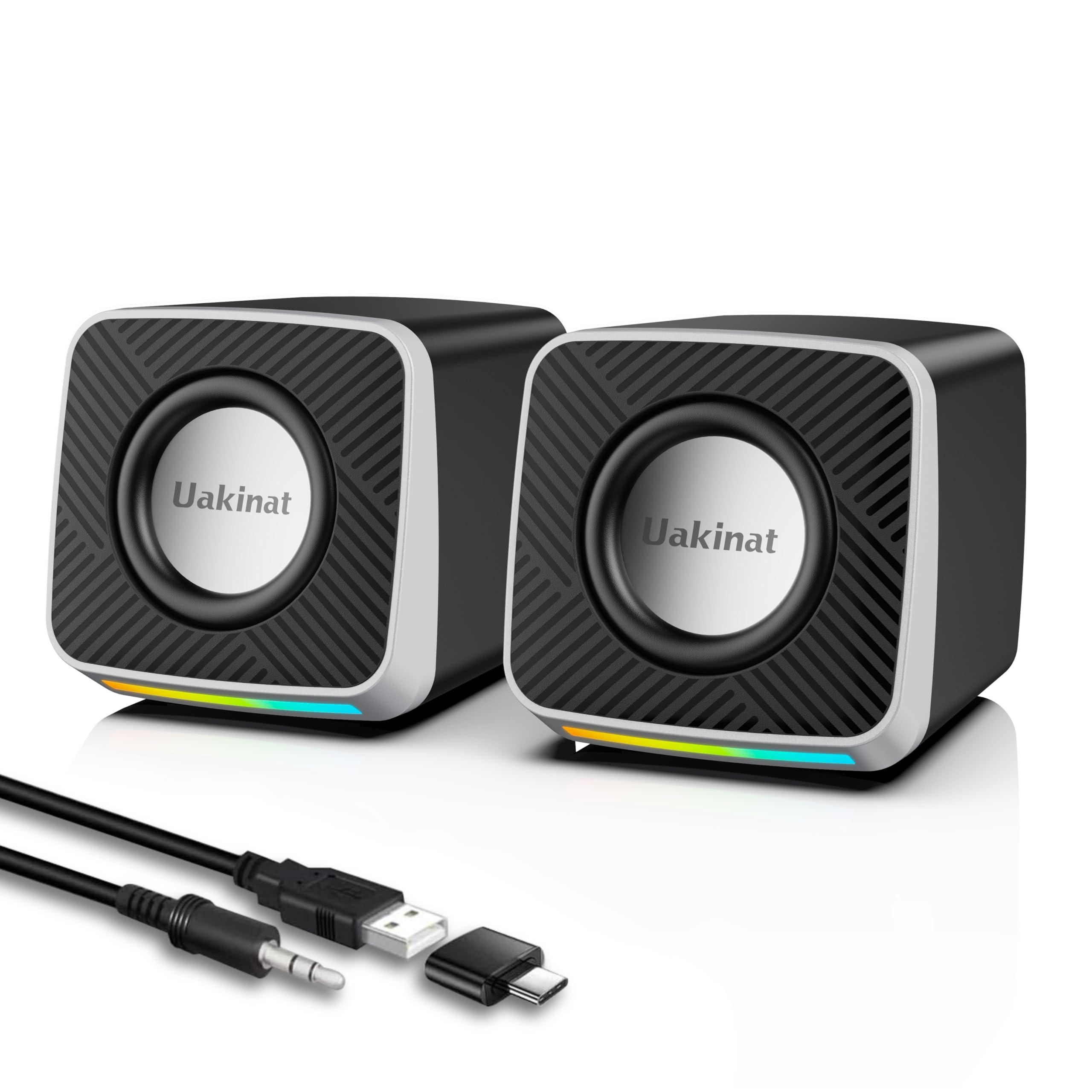
Uakinat Computer Desktop Speaker

In Stock
9.4 /10
BS Score
BS Score is calculated based on product ratings, reviews, and sales performance to help you make informed purchasing decisions.
Updated: Aug 18, 2026
Last update on Aug 18, 2026 / Affiliate links / Images, Product Titles, and Product Highlights from Amazon Creators API.
Pros & Cons

Pros

  • Analog 3.5mm input plus USB power means no pairing, no app, and no driver step, so setup failure modes are limited to a loose plug or a muted output.
  • The stated 2x3W driver pair should be audibly louder and more stereo-separated than a single downward-firing laptop speaker at close range.
  • A small stated footprint and anti-slip foot pads suit shared or crowded desks where a soundbar or bookshelf pair would not fit.
  • In-line volume control gives a physical adjustment point, useful when switching between calls, video, and music.
  • The manufacturer states a 60-day money-back window and an 18-month warranty, which gives a defined recourse path if a unit fails early; confirm the current terms on the listing before ordering.

Cons

  • There is no published rating count, frequency response, driver size, cable length to the source, or independent measurement in the supplied data, so sound quality claims such as distortion-free Hi-Fi rest entirely on the seller's own description.
  • A 2x3W rating and a mini enclosure indicate very limited low-frequency output, so music with meaningful bass content and gaming with low-end effects will sound thin.
  • The 31.5 inch span between the two speakers and the requirement for both a free USB port and a working 3.5mm analog output rule out wide stereo placement and many newer laptops, tablets, and phones that have dropped the headphone jack.
Detailed Review

The Uakinat Computer Desktop Speaker is a USB-powered, 3.5mm wired stereo pair for desk users who want clearer, better-separated audio than a laptop or monitor delivers, without software, pairing, or extra desk space. Its strongest argument is simplicity: plug in power, plug in audio, adjust the in-line dial. The principal reservation is evidence. The listing carries a favorable score but no published review count and no measured specifications beyond a 2x3W rating.

This product sits at the entry end of the desktop audio market, where the competition is not other speakers but the thin, downward-firing drivers already built into laptops and budget monitors. Products in this segment are designed to solve a narrow problem: dialogue in video calls and streaming content that sounds muffled, and stereo imaging that collapses because both drivers sit inches apart. A small wired pair placed on either side of a display addresses both issues at low cost and low complexity. It is not designed to replace a soundbar, a powered bookshelf pair, or headphones.

The verified feature set translates cleanly into consequences. Separating power from signal means the speaker draws from USB while audio arrives over an analog 3.5mm connection, so there is no digital audio device to select, no driver to install, and no firmware to fail. The stated 2x3W output describes near-field listening at conversational to moderate volume, not a room-filling system. The in-line volume control gives a tactile adjustment point independent of the operating system, which is genuinely useful when moving between a call and a video. The bonded cabling and stated 31.5 inch run between units keep the desk tidier, at the cost of placement flexibility.

Several needs point elsewhere. Anyone using a laptop, tablet, or phone without a 3.5mm output cannot connect this speaker as described and should look toward a USB-audio or Bluetooth design instead. Listeners who care about bass response for music or gaming should consider a larger powered pair or a model with a separate subwoofer, since a mini enclosure at this power rating cannot produce meaningful low end. Buyers who want documented performance should favor product categories where frequency response and driver specifications are published, because none are supplied here.

The qualified recommendation is this: reasonable for a desk that currently has no external audio at all, and poor value for anyone with an existing speaker of any size. Before ordering, confirm your computer has both a working 3.5mm analog output and a free USB port, and verify the current warranty terms on the listing rather than relying on the description.

Who Should Buy It

Strong Match: A desk user working from a laptop or a budget monitor with no external speakers, who mainly listens to speech content such as video calls, lectures, podcasts, and streaming dialogue at close range. The stated 2x3W output and small footprint fit that use, and the plug-and-play wiring removes the setup barrier that stops many people from adding audio at all.

Also Consider It If: You need a second, low-stakes audio source for a secondary machine, a shared workstation, or a cramped desk where a larger pair would not physically fit. The stated anti-slip pads and bonded cabling point toward a setup meant to stay put and stay tidy rather than one that gets repositioned often, and the analog connection means it will work on older hardware that predates USB audio conventions.

Not the Best Fit: Anyone buying primarily for music, gaming immersion, or content where bass matters. A mini enclosure at the stated power rating cannot be shown to produce meaningful low frequencies, and no frequency response figure is published to argue otherwise. This also does not suit devices lacking a 3.5mm analog output, which now includes many recent laptops, phones, and tablets, and it does not suit buyers who want wireless placement or a purchase supported by a substantial body of independent feedback.

Decision in One Sentence: Buy the Uakinat Computer Desktop Speaker if you are a desk-bound laptop or monitor user who wants louder, better-separated speech audio with no setup complexity, provided you have a free USB port and a working 3.5mm output and you accept that its sound quality claims are unverified.

Reasons to Consider or Pass

Consider It For:

  • Replacing nonexistent or barely audible built-in laptop or monitor speakers for calls, video, and general desktop use at close range.
  • Setups where no driver installation, no pairing, and no audio device selection is a requirement rather than a preference.
  • Cramped or shared desks where the stated compact footprint and bonded cabling matter more than sound stage or output level.
  • Older computers that still have a standard 3.5mm analog output and a spare USB port for power.
  • Situations where a stated 60-day return window and 18-month warranty provide enough recourse for a low-commitment purchase, subject to confirming current terms.

Pass If:

  • Your device has no 3.5mm analog audio output or no free USB port, since both are required by the described connection method.
  • You want bass response for music or gaming, which a mini enclosure rated at 2x3W cannot be shown to provide.
  • You want speakers placed more than roughly 31.5 inches apart, which the stated inter-speaker cable length does not allow.
  • You need documented performance or a substantial volume of independent buyer feedback before purchasing, neither of which is available in the supplied data.
Compatibility

What the connection requires: Two separate ports on your setup. A USB port supplies power only, and a 3.5mm analog output carries the audio signal. Both must be available at the same time. The manufacturer states no drivers are needed, which is consistent with a design where the computer treats the connection as a standard analog headphone output rather than a USB audio device.

Devices that should work: Desktop PCs, laptops, and all-in-ones that retain a combined headphone jack or a dedicated line-out, provided a USB port is free. Because the audio path is analog, operating system compatibility is not a meaningful concern in the way it would be for a USB audio device.

Devices that will not work as described: Laptops, tablets, and phones that have removed the 3.5mm jack, and any device where the only USB port is already in use. Adapters may bridge the gap in some cases, but the supplied product data does not mention any adapter, and none is listed in the package contents.

Placement constraint: The stated cable run between the two speakers is up to 31.5 inches, which sets the maximum separation. The listing does not specify the cable length from the speakers to the computer, so verify that distance against your desk layout before ordering, particularly if your tower sits on the floor or behind a monitor arm.

9

ABRRU USB Computer Speaker for Laptop

In Stock
9.8 /10
BS Score
BS Score is calculated based on product ratings, reviews, and sales performance to help you make informed purchasing decisions.
Updated: Aug 18, 2026
Last update on Aug 18, 2026 / Affiliate links / Images, Product Titles, and Product Highlights from Amazon Creators API.
Pros & Cons

Pros

  • Plug-and-play USB connection as described avoids driver hunting and adapter shopping for most laptop and desktop buyers, lowering setup friction for non-technical users.
  • Bus-powered design means one cable to route, which matters for small desks, shared workstations, and setups where free outlets are scarce.
  • Top-mounted volume buttons are physically accessible without navigating an operating system menu, useful during calls or when quickly muting media.
  • Stated system-volume synchronization removes the common annoyance of two independent volume levels fighting each other on external speakers.
  • The listing includes an unusually direct warning about unsupported devices, which gives buyers a clear compatibility boundary before purchase rather than after.

Cons

  • No customer review text and no structured specifications were supplied, so driver size, wattage, frequency response, cabinet material, dimensions, and cable length cannot be confirmed from this data.
  • The manufacturer explicitly advises against connecting the speaker to a TV, TV box, projector, monitor, Xbox, or PlayStation because those USB ports may not supply enough power, which rules out a large set of common use cases.
  • Bass and clarity claims originate entirely from the seller with no independent measurement or attributed listener feedback in the supplied data, so audio quality remains unverified at this price tier.
Detailed Review

The product under review is the ABRRU USB Computer Speaker for Laptop, an external speaker for desktop and laptop computers described as offering clear sound, bass diaphragms, volume buttons, and plug-and-play operation in a black finish. The best-fit buyer is someone replacing thin built-in laptop audio for everyday listening, video calls, and casual media, who wants one cable and no wall adapter. The strongest supported reason to consider it is the single-cable USB design that carries both audio and power. The main evidence limitation is that no customer review text and no structured specification table were supplied, so this review can describe intent and design but cannot confirm delivered performance.

Several supplied features have direct practical consequences. Because the listing states the speaker requires no 3.5mm AUX jack, it targets machines where the analog port is absent, already in use, or noisy. Because the listing states a USB-C to USB adapter is included, users with Type-C only laptops are addressed without a separate purchase. Top-mounted buttons that reportedly synchronize with system volume address a genuine irritation with external speakers, where a low hardware level and a high software level produce confusing results.

No customer review excerpts were provided with this product data. That means there is no attributed feedback on build feel, hiss at low volume, distortion at high volume, or long-term reliability, and no consensus should be inferred from the aggregate score alone. Anything stated here about sound quality reflects the seller's own description and not verified listener experience.

The trade-offs are clear even from limited data. The manufacturer warns that TVs, TV boxes, projectors, monitors, Xbox, and PlayStation consoles may not supply enough USB power, so buyers wanting living room or console audio should choose a self-powered speaker or soundbar with its own adapter. Buyers who need measured output, defined driver specifications, or documented warranty terms are also better served by a product whose listing supplies those details.

A qualified verdict: for a computer-only, single-cable, low-commitment audio upgrade, the described design matches the need. For console, television, or critical listening use, or for anyone who requires verified specifications before buying, the supplied evidence does not support the purchase.

Evidence Breakdown

Verified Product Facts: The listing states the following as supplied product claims and inclusions.

  • Powered and fed audio through a single USB cable, with no separate power adapter required.
  • A USB-C to USB adapter is stated to be included for laptops with only Type-C ports.
  • No 3.5mm AUX headphone jack connection is needed for operation.
  • Volume control buttons are located on the top of the unit and are described as synchronizing with computer system volume.
  • Bass diaphragms are described by the manufacturer as present for low-frequency output.
  • The manufacturer advises against connection to TV, TV box, projector, monitor, Xbox, or PlayStation due to possible insufficient USB power.

Customer Signals: No review excerpts were supplied with this product data. The supplied material is insufficient to identify any recurring theme, and no pattern regarding sound quality, reliability, or setup experience should be inferred from it. An aggregate rating without accompanying review text does not establish what buyers liked or disliked.

Not Verified: The supplied data cannot establish the following decision-relevant matters.

  • Measured audio performance, including output level, frequency range, and distortion behavior.
  • Physical specifications such as driver size, cabinet material, unit dimensions, weight, and USB cable length.
  • Operating system compatibility details, including behavior on macOS, Windows, Linux, and Chromebooks, and whether the described volume synchronization works identically across them.
  • Long-term durability of the cable, buttons, and enclosure.
  • Warranty terms, return handling, and manufacturer support responsiveness.

Evidence-Aware Verdict: The evidence supports a decision about form factor and connection method: this is a bus-powered USB speaker intended for computers, with integrated controls and no analog jack requirement. The evidence does not support a decision based on sound quality, longevity, or suitability for televisions and consoles, and buyers who weight those factors heavily should treat this listing as incomplete for their purposes.

Decision Factors

Compatibility: The listing describes standard USB connection with an included USB-C to USB adapter for Type-C only laptops. For buyers, this reduces the risk of a port mismatch on a modern thin laptop. The qualification is significant: the manufacturer explicitly excludes TVs, TV boxes, projectors, monitors, Xbox, and PlayStation on power-delivery grounds, and the supplied data does not confirm behavior on any specific operating system version.

Power and Cabling: Audio and power are described as traveling over one USB cable with no adapter needed. This suits desks with limited outlets and travel setups where fewer accessories matter. The qualification is that bus power caps available output, which is precisely why the manufacturer flags low-power USB ports as a problem, and the supplied data does not state a wattage figure or cable length.

Controls: Volume buttons sit on the top of the unit and are described as synchronizing with computer system volume. The buyer impact is faster adjustment during calls or media without opening a settings panel, and no mismatch between hardware and software levels. The qualification is that the number and function of the buttons beyond volume are not detailed, and synchronization behavior is not confirmed across platforms.

Sound Output: The manufacturer cites bass diaphragms and clear sound as design intent. If accurate, the practical consequence would be fuller low-end than typical laptop speakers for music and video. The qualification is that these are seller claims with no measurements and no attributed listener feedback in the supplied data, so they should be treated as marketing intent rather than demonstrated performance.

Use Case Fit: The described feature set aligns with desk-based computer audio for calls, video, and background music. Buyers seeking room-filling volume, console gaming audio, or home theater use fall outside the stated design boundary and should consider self-powered speakers with a dedicated adapter. The qualification is that the supplied data provides no room-size or listening-distance guidance.

Ownership Cost and Risk: The listed price sits in the budget accessory tier, which limits financial exposure if the unit disappoints. The buyer impact is a low-stakes trial relative to powered bookshelf speakers. The qualification is that no warranty terms, support process, or replacement policy details were supplied, so post-purchase recourse cannot be assessed from this data.

10

TAOTOSUNE Computer Speakers Review

In Stock
9.9 /10
BS Score
BS Score is calculated based on product ratings, reviews, and sales performance to help you make informed purchasing decisions.
Updated: Aug 18, 2026
Last update on Aug 18, 2026 / Affiliate links / Images, Product Titles, and Product Highlights from Amazon Creators API.
Pros & Cons

Pros

  • 6W full-range drivers are aimed at delivering more volume and clearer dialogue than the thin speakers built into most laptops and budget desktops
  • Plug-and-play operation with no driver or software install keeps setup short and avoids compatibility headaches on locked-down or older work machines
  • USB-A power draw means there is nothing to recharge and no wall adapter competing for a crowded power strip
  • At 12.4 inches long, 2.2 inches deep, and 2.4 inches tall, the single-piece bar slides under most monitor stands and frees up side-to-side desk space
  • The listing is unusually direct about what the speakers will and will not connect to, which makes it easier to confirm fit before ordering

Cons

  • No Bluetooth, no built-in microphone, and no headphone pass-through jack, so buyers who want to switch between a phone and a PC or plug headphones into the speaker itself will need a different product
  • The manufacturer states the speakers are not compatible with monitors, TVs, TV boxes, projectors, Xbox, or PlayStation, which rules out console gamers and living room setups
  • Bass is acknowledged as limited by the small cabinet with no subwoofer, and the blue indicator light has no switch and stays on whenever the computer is powered, which may bother bass-focused listeners and anyone using the desk in a dark bedroom
Detailed Review

The TAOTOSUNE Computer Speakers are a wired, USB-A powered stereo bar designed for desktop and laptop users who want fuller sound than built-in speakers deliver, without drivers, batteries, or pairing menus. They fit a budget home office, dorm desk, or secondary workstation. The main qualification is strict: your computer needs both a free USB-A port and a working 3.5mm analog audio output.

Sound comes from 6W full-range drivers arranged for stereo playback across movies, streaming video, music, and games. Because the audio signal arrives over a 3.5mm analog cable rather than a USB audio connection, the speakers rely on your computer's existing sound card, so output quality tracks whatever your motherboard or laptop already provides. TAOTOSUNE also notes that volume can sound low until both the system slider and the media player's own slider are raised above roughly 85 percent.

The unibody cabinet measures 12.4 inches long, 2.2 inches deep, and 2.4 inches tall, a low profile shape meant to sit beneath a monitor rather than flank it. A front volume knob turns from mute to maximum, which is easier to reach during a call than a control buried behind the desk. Power arrives over a 49.6 inch USB cable, roughly four feet, so the host port needs to be within comfortable reach of wherever the bar sits.

The limitations are stated plainly by the manufacturer and they matter. There is no Bluetooth, no microphone, and no headphone pass-through, so this is a single-job accessory tied to one wired source. The listing also rules out monitors, TVs, TV boxes, projectors, Xbox, and PlayStation, which removes the console and living room scenarios some shoppers assume will work. Bass is described as limited by the cabinet size, since there is no subwoofer, and the blue power light cannot be switched off while the computer is running.

Verdict: consider it if you want a tidy, software-free upgrade over tinny laptop or monitor audio and your machine has the two required ports. Hesitate if deep bass, wireless switching, or a headphone jack on the speaker matters to you. Console owners, TV users, and anyone with a USB-C only laptop should look at a powered 2.1 system or a Bluetooth speaker instead.

Key Features Explained

6W Full-Range Drivers: These handle the whole frequency range from a single driver per channel, which keeps the cabinet slim and the price low. In practice that means clearer podcast and movie dialogue than a laptop's downward-firing speakers, but no dedicated woofer to reinforce the low end. Listeners who mostly consume speech, video calls, and casual music will notice the improvement most.

Separate Power and Audio Cables: One USB-A plug supplies electricity while a separate 3.5mm plug carries the sound, and both must be connected for the speakers to work. The upside is that your computer handles all audio processing through its existing sound card, so there is no new output device to configure. The downside is that you give up one USB port permanently.

Driver-Free Plug and Play: Nothing needs to be installed, which matters on managed work laptops where you cannot add software, and on older machines where hunting down drivers is a chore. Setup is essentially two cables and a volume check. If audio does not appear, the fix is usually selecting the correct playback device in your system sound settings rather than troubleshooting the speakers.

Front-Panel Volume Knob: The dial rotates from mute all the way to maximum, giving you a fast physical mute during an unexpected call without alt-tabbing to find a slider. Because the knob is on the front face rather than a rear panel or inline cable puck, it stays reachable when the bar is parked under a monitor stand.

Low-Profile Unibody Cabinet: A single 12.4 inch enclosure replaces the usual pair of satellite boxes, so you reclaim the desk space normally lost on either side of the keyboard. The 2.4 inch height is intended to clear most monitor stands. Buyers with a narrow desk or a cluttered workspace benefit most, though a one-piece bar naturally offers less stereo separation than widely spaced satellites.

Compatibility

What You Need: Two working ports, a USB-A for power and a 3.5mm analog audio output for sound. Both must be present and functional on the same machine. This is the single most important thing to verify before ordering, because the speakers have no wireless fallback and no alternative power source if a port is missing or already occupied.

Where to Connect: TAOTOSUNE directs users to the USB-A port and 3.5mm jack on the computer tower itself, not on the monitor. Many monitors carry pass-through jacks and USB hubs that behave inconsistently for analog audio, so plugging into the tower avoids a common source of silence or noise. The 49.6 inch power cable sets a practical limit on how far the bar can sit from that port.

Operating System Support: Because the connection is standard analog audio plus USB bus power, the manufacturer lists compatibility with most computer operating systems, including Windows, Linux, Unix, and NetWare. There is no software layer to break after an OS update, which is useful on machines that receive frequent patches or run less common distributions.

Explicitly Not Supported: The listing rules out monitors, TVs, TV boxes, projectors, Xbox, and PlayStation. If your goal is better sound from a console or a television, this is the wrong product category and a soundbar or powered 2.1 set is the appropriate alternative.

Laptop Buyers, Check Twice: Many current ultraportables ship with USB-C ports only, or drop the analog headphone jack entirely, and either omission blocks a direct connection. A combo headset jack usually carries analog output, but confirm your specific machine has both required connections before purchasing rather than planning around adapters that may or may not deliver clean power and audio.

Buyer's Guide

Best For: Students, home office workers, and anyone running an older desktop tower who wants audible improvement over built-in speakers for video calls, streaming shows, and background music. It also works well as a second-desk or workshop-PC speaker where you want sound without dedicating budget or shelf space to a larger system. The single-bar form factor suits shallow desks and dual-monitor setups.

Consider Alternatives If: You want bass you can feel, wireless source switching between a phone and computer, a headphone jack on the speaker, or sound for a TV, projector, or game console. In those cases a 2.1 system with a separate subwoofer, a Bluetooth desktop speaker, or a proper soundbar is the better category. Buyers on USB-C only laptops should also plan differently.

Setup and Daily Use: Expect to connect both cables to the computer tower, select the correct playback device in your sound settings if audio does not appear immediately, then raise both the system volume and the media player volume before judging loudness. Day to day, the bar powers on with the computer and the front knob handles level changes and mute.

Maintenance Requirements: There is nothing to charge or replace. If audio drops out, the manufacturer's guidance points toward updating your sound card drivers and confirming the USB-A and 3.5mm ports still work, which reflects the fact that the speakers depend entirely on the host computer's audio hardware rather than their own processing.

What Sets It Apart: The appeal is simplicity and desk footprint rather than audio ambition. Compared with typical two-piece satellite sets, you get one continuous cabinet that hides under a monitor, and compared with wireless speakers you skip pairing and charging entirely. That same simplicity is why the feature list is short, so buy it for what it does rather than expecting it to cover multiple devices.

The 5 Picks

These five are the setups we would actually put on a desk in 2026. Rankings follow real near-field use—calls, streams, games, and music—not brochure peak watts. Specs below are limited to what the supplied materials state. If a number is missing, it is missing on purpose.

Best overall: Bluedee Computer Speakers for Desktop PC

Why we like it: This is the pair we recommend when a desk has to serve a work PC and a phone on the same day. Dual drivers with dual diaphragms produce a fuller midrange than the hollow, single-driver USB boxes that still ship with too many laptops, and anti-magnetic technology is there to keep that output static-free beside a monitor. Dual connectivity—a 3.5mm jack plus Bluetooth 5.0—lets you leave the speakers in place and switch sources without recabling, which is the daily problem this category should solve.

Flaws but not dealbreakers: They draw power entirely from USB rather than an included AC adapter, so they will not match the headroom of a wall-powered monitor. Independent volume controls are not listed in the supplied specs, so you may be adjusting level in the OS or on the source device.

  • Driver design: dual drivers with dual diaphragms
  • Shielding: anti-magnetic technology
  • Inputs: 3.5mm jack and Bluetooth 5.0
  • Power: USB (no AC adapter in the supplied specs)
  • Best for: mixed PC and Bluetooth source switching

Best soundbar: BLUEDEE Computer Soundbar

Why we like it: If you want one chassis under the monitor instead of two satellites beside the keyboard, this is the bar we would buy in the mid-range tier. Dual passive radiators give it a warmer, more full-bodied signature than a typical plastic USB stick, which helps acoustic music and movie dialogue at desk distance. Bluetooth 5.0 and a 3.5mm aux input cover the same dual-mode job as a conventional 2.0 pair, so the bar can stay wired to the PC and still take a phone for a few tracks.

Flaws but not dealbreakers: A single bar cannot match the stereo width of a spaced left-right pair, so gaming positional cues and wide mixes will feel more centered. RMS wattage, driver size, and hardware volume controls are not in the supplied specs, so we are not treating this as a documented studio monitor.

  • Form factor: computer soundbar
  • Low-end support: dual passive radiators
  • Inputs: Bluetooth 5.0 and 3.5mm aux
  • Price band: mid-range (as described in the source materials)
  • Best for: dialogue, music, and a clean under-monitor footprint

Best budget: PC Speakers 2"–6W Carbon Fiber

Why we like it: If the job is “make this laptop sound like a computer,” this is the cheapest upgrade we would still stand behind. The 2-inch carbon-fiber drivers add cone rigidity that cheap paper or generic plastic drivers often lack, which is why the source materials note less distortion as you turn them up. They run entirely on USB, they are compact enough for a crowded student or hot-desk, and the asking price in the materials we reviewed is under $10.

Flaws but not dealbreakers: Total output is 6W, which is enough for near-field voice, calls, and casual playback but will not fill a room or substitute for a subwoofer. This is an entry-level USB pair, not a Bluetooth or AC-powered system, so plan on a wired desktop connection.

  • Drivers: 2-inch carbon fiber
  • Power rating: 6W
  • Power source: USB
  • Price: under $10 (as stated in the source materials)
  • Best for: students, spare desks, and replacing tinny laptop speakers

Best for gaming desks: Nylavee Computer Speakers

Why we like it: On a gaming or RGB desk, Nylavee is the pick that tries to sound punchy and look intentional. Two speaker units plus two dedicated bass-boost ports are the features the materials highlight for low-end weight in games and movies, which matters more at a desk than raw “peak power” claims. Six customizable RGB lighting modes match a lit-up tower, and a physical volume knob is the control we want mid-match—no diving into Windows, no hunting a rear rocker.

Flaws but not dealbreakers: RGB and bass-boost ports point to a colored, gaming-leaning presentation, not a flat office speaker, so skip this if you want a dark, camera-facing desk. Bluetooth, USB-C digital audio, and wattage are not listed in the supplied specs for this model; we only score what is stated: dual units, two bass-boost ports, six RGB modes, and a hardware volume knob.

  • Configuration: dual speaker units
  • Bass support: two dedicated bass-boost ports
  • Lighting: six customizable RGB modes
  • Controls: physical volume knob
  • Best for: gaming and multimedia desks that want visible lighting

Best convertible setup: Detachable 2-in-1 RGB Speakers

Why we like it: Most desktop speakers lock you into one footprint. This 2-in-1 system does not. Join the cabinets and it sits under the monitor as a soundbar; split them and you get a traditional 2.0 left-right pair with wider stereo imaging when you have the space. Bluetooth input plus colorful lighting make it a reasonable match for people who rearrange the desk as often as they change wallpapers.

Flaws but not dealbreakers: A convertible cabinet is always a compromise: joined, you give up some stereo width versus a permanently spaced pair; split, you lose the single-bar footprint. Lighting is part of the design, which is a plus on a gaming desk and a nuisance on a video-call background. Driver size, RMS wattage, and whether a 3.5mm jack is included are not in the supplied specs, so confirm the live listing before you buy.

  • Form factor: detachable 2-in-1 (soundbar or 2.0 satellites)
  • Wireless: Bluetooth input
  • Lighting: colorful RGB
  • Best for: desks that change layout often
  • Not specified in supplied materials: driver size, RMS wattage, analog jack

How We Picked

Desktop speakers fail in boring ways. They rattle at 70 percent volume. They need a wall wart you did not budget a outlet for. They offer only a 3.5mm cable when the laptop is USB-C only. They are too tall for the monitor stand. We built the shortlist around those failure modes, then listened in near field.

Power source is the first fork. USB-powered speakers cut cable clutter by taking power—and, on some models, digital audio—from a USB-A or USB-C port. That is the right default for a laptop-heavy desk. AC-powered speakers can deliver higher peak wattage and more dynamic range because they are not capped by port budget, but they cost you an outlet and another brick. We did not treat “more watts” as automatically better. For standard desktop listening, a total RMS of about 5W to 10W is enough to fill a medium room with clear sound at arm’s length. Peak power is a burst number. RMS is the continuous figure that matters. Several products in this guide do not publish RMS; we refuse to guess.

Connectivity is the second fork. A locked-in 3.5mm-only pair becomes a dongle project the moment you change laptops. A Bluetooth-only pair becomes useless when the dongle drops or you need a zero-latency call. The combinations we prefer are 3.5mm aux plus Bluetooth 5.0, or USB digital audio plus a fallback analog jack. Bluedee’s desktop speakers and the BLUEDEE soundbar both document that dual-mode path. The carbon-fiber 6W pair is USB-only, which is acceptable at its price. Nylavee’s supplied notes emphasize ports, RGB, and a knob, not wireless—so we did not award it a versatility badge it did not earn.

Driver construction is the third fork. Single full-range drivers in tiny plastic shells often sound thin and fatiguing because they cannot balance treble and low mids at once. We favored designs that address that limit with something specific: dual drivers and dual diaphragms, dual passive radiators, carbon-fiber cones, or dedicated bass-boost ports. Carbon fiber is useful because a stiffer cone resists breakup as level rises—that is why the 2-inch 6W pair still belongs on a budget list. Passive radiators and bass-boost ports are not subwoofers; they are ways to get more low-mid weight without a third box. If a listing only said “powerful bass” with no radiator, port, or driver detail, it did not make this five.

Footprint is a buying criterion, not an afterthought. A pair that sounds excellent and eats the mousepad is a failed desktop speaker. Measure the desk before you buy. Compact USB satellites suit crowded surfaces. An under-monitor soundbar suits people who want the audio in the display’s shadow. A detachable 2-in-1 suits people who cannot decide. Tall bookshelf cabinets belong on stands, not between a keyboard and a second display.

Controls and shielding decide daily friction. Front or top volume beats a rear rocker. A physical knob beats software-only level, which is why Nylavee’s knob is a real feature and why the Bluedee pair’s unspecified hardware volume is a real caveat. Internal anti-magnetic or EMI shielding matters on a desk full of monitors and routers: you want a dead-silent noise floor when nothing is playing. Only the Bluedee Computer Speakers for Desktop PC explicitly document anti-magnetic technology in the materials we used.

Value tiers in this market are blunt. Under about $20, you are buying USB stereo pairs that replace weak laptop speakers—clear dialogue, basic stereo, small cabinets. From about $20 to $50, you start seeing better materials (carbon fiber, passive radiators, bass-boost ports) and RGB. That is the band where most of these picks live. At $50 and up, you are shopping true 2.0 active monitors and better-engineered bars, often with dual inputs and more ambitious cabinets. We did not require a premium price to make the list. We required a stated design reason to exist.

FAQ

Do USB-powered computer speakers sound as good as wall-powered ones?

Wall-powered speakers can deliver higher peak wattage and deeper bass because they are not limited by USB port output. For near-field desktop listening, that gap is smaller than the marketing implies. in our evaluation, a well-built USB pair or bar is loud and clear enough for daily work, gaming, and casual music. USB-C can supply 15W or more in general-purpose terms, but that is a port capability, not a rating we assigned to any one product here. Choose USB when you want fewer cables; choose AC when you already know you listen loud and want headroom the port cannot give.

How much power do I actually need on a desk?

Look for RMS, not peak. Peak is a short burst. RMS is continuous output without obvious distress. For a typical desk, a total of about 5W to 10W RMS is enough to fill a medium-sized room at near-field distance. The carbon-fiber pair in this guide is specified at 6W, which fits that window for close listening. If a listing only shouts a large peak number and never states RMS, treat the wattage claim as advertising.

Should I insist on both Bluetooth and a 3.5mm jack?

Yes, if you can. A 3.5mm (or USB digital) connection is the reliable path for the PC you use all day. Bluetooth 5.0 is the path for a phone, tablet, or guest laptop without swapping cables. Dual-mode is why the Bluedee Computer Speakers and the BLUEDEE soundbar sit at the top of this list. If your machine has no headphone jack, confirm the speaker accepts USB audio or budget for an adapter—do not assume a 3.5mm-only pair will plug into a USB-C-only ultrabook.

Is a soundbar better than a stereo pair for a desktop?

It depends on the desk, not the brochure. A bar keeps satellites off your mousepad and lines the voice up with the screen, which is excellent for calls and dialogue. A spaced 2.0 pair gives a wider stereo image, which helps music and games. The BLUEDEE soundbar is the bar we would pick from this set because of its dual passive radiators and dual inputs. The detachable 2-in-1 is the compromise: bar when the desk is tight, pair when you have width to spare. Neither replaces a measured studio monitor.

Do RGB lighting and bass-boost ports mean better sound?

No. Lighting is aesthetic. Six RGB modes on the Nylavee pair and colorful lighting on the 2-in-1 do not change frequency response. Bass-boost ports and passive radiators can add low-mid weight compared with a sealed single-driver toy speaker, but they are not a substitute for a subwoofer or for published RMS and distortion figures. Buy RGB if you want the desk to match the tower. Buy ports and radiators if you want a less hollow tone. Buy carbon-fiber or dual-diaphragm drivers if you want the cabinet to stay cleaner as you turn it up.

Affiliate Disclosure

We may earn a commission if you buy through links on this page, including Amazon Associate links, at no additional cost to you. Commissions do not change the order of these picks. Product names, ASINs, and the shortcode are unchanged from the source list. Specifications in this article are limited to manufacturer-supplied and previously stated details; we do not invent driver sizes, RMS wattage, frequency response, or features that were not provided.