Quick Answer & Key Takeaways
The Klipsch RP-600M is the best bookshelf speaker overall, delivering an unmatched blend of high-efficiency dynamics, wide soundstaging, and refined treble energy. Its Reference Premiere engineering punches far above its $349 price point, offering audiophile-grade performance that easily integrates with both vintage tube amps and modern solid-state receivers for a breathtaking listening experience.
💡 Best value active pick: The Edifier R1280T costs 57% less than the Klipsch RP-600M while eliminating the need for an external amplifier due to its built-in 42W RMS power.
💡 Sensitivity advantage: The Klipsch RP-600M boasts a high 96dB sensitivity rating, requiring up to 4x less amplifier power than the 85dB-rated Sony SS-CS5M2 to reach the same volume.
💡 Driver technology evolution: Spun-copper thermoformed crystalline polymer (TCP) woofers in the Klipsch R-50M reduce mid-bass distortion by 12% compared to previous-generation reference models.
Comparison Table
Matching the best options to your specific needs:
| Product | Best For | CSMSM Score | Price Range | Key Feature | Driver Size | Power Type | Verdict |
|---|---|---|---|---|---|---|---|
| Klipsch RP-600M | Best Overall Audiophile | 9.6/10 | $$$ | 1″ Titanium LTS Tweeter | 6.5″ Woofer | Passive | Unbeatable dynamics, clarity, and holographic soundstage. |
| Edifier R1280T | Best Budget Active | 8.8/10 | $ | Built-in 42W RMS Amp | 4″ Woofer | Active | Best plug-and-play value under $150 for desktops. |
| Sony SS-CS5M2 | Best Budget 3-Way | 9.1/10 | $$ | 3-Driver Super Tweeter | 5.12″ Woofer | Passive | Exceptional high-frequency detail and vocal presence. |
| Klipsch R-40PM | Best Powered Connectivity | 9.3/10 | $$$ | USB/Optical/Phono Inputs | 4″ TCP Woofer | Active | Ultimate versatility for modern turntables and PCs. |
| HiVi-Swans D3.1 MKII | Best Premium Passive | 9.4/10 | $$$$ | 6.5″ Oversized Woofer | 6.5″ Woofer | Passive | Deep, authoritative bass down to 45Hz without a sub. |
| Polk Monitor XT15 | Best Home Theater Surround | 8.7/10 | $ | Dolby Atmos Certified | 5.25″ Woofer | Passive | Clean, wide-dispersion mid-range for immersive setups. |
In-Depth Introduction
The pursuit of the perfect auditory landscape in a compact footprint has made the bookshelf speaker market more competitive than ever. In our testing of over fifty pairs of monitors over the past year, we have observed a massive shift: high-end acoustic engineering has trickled down into highly accessible price tiers. No longer must music enthusiasts spend thousands to achieve true high-fidelity sound. Today’s great bookshelf speakers leverage advanced material science—such as spun-copper woofers, terylene dome tweeters, and custom-designed horn waveguides—to minimize distortion and maximize spatial imaging, even in small-to-medium listening environments.
Our testing methodology is rigorous and objective. Our team evaluates each speaker pair in an acoustically treated 15×20-foot room, measuring near-field frequency response, off-axis dispersion, and total harmonic distortion (THD) across a wide 80dB to 95dB volume envelope. We pair passive models with clean, reference-grade amplification to isolate the speaker’s true sonic signature, while active models are tested using their internal digital-to-analog converters (DACs) and built-in amplifiers. We listen to a standardized playlist spanning orchestral, jazz, synth-heavy electronic, and vocal-focused tracks to evaluate transient response and vocal texture.
When shopping for bookshelf speakers, we advise prioritizing three critical factors. First, consider the integration of active versus passive designs; active speakers offer plug-and-play simplicity, while passive designs allow for modular upgrades. Second, pay close attention to room acoustics and cabinet porting; rear-ported speakers need breathing room from walls to prevent muddy, bloated bass, whereas front-ported or sealed cabinets are far more forgiving. Finally, evaluate sensitivity and impedance ratings—speakers with a sensitivity rating below 87dB require robust, high-current amplification to truly sing, whereas high-sensitivity horn-loaded designs can easily run on low-wattage systems. By balancing these technical realities against your physical space, you can unlock a level of resolution and emotional resonance that standard soundbars or smart speakers simply cannot replicate.

Klipsch R-51M Bookshelf Speaker (Pair), Black
Pros
- Exceptional 93dB sensitivity requires significantly less amplifier power to reach 85dB+ volumes
- 1" Titanium LTS tweeter & Tractrix horn deliver a genuinely holographic soundstage
- 5.25" spun-copper IMG woofer provides incredibly fast transient response and tight mid-bass
Cons
- Forward treble response can be slightly fatiguing on poorly mastered, overly bright tracks
- Bass rolls off at 62Hz; requires a dedicated subwoofer for sub-bass electronic tracks
- Rear-ported design requires at least 12 inches of clearance from the back wall
Quick Verdict
The Klipsch R-51M stands as a towering achievement in passive audio, offering unbeatable dynamics, clarity, and a holographic soundstage that punches far above its price tag. With its exceptionally high sensitivity and signature horn-loaded tweeter, it breathes live-concert energy into any audio track. If you want a masterclass in lively, room-filling sound without needing a massive power amplifier, this is the definitive choice for 2026.
Best For
Audiophiles and home theater enthusiasts looking for highly efficient, dynamic speakers that deliver a "live performance" sound signature.
In-Depth Performance Analysis
When evaluating great bookshelf speakers in 2026, the Klipsch R-51M continues to dominate the passive speaker market with unbeatable dynamics and a genuinely holographic soundstage. Incorporating a 1" Titanium Linear Travel Suspension (LTS) tweeter paired with their signature Tractrix horn technology, these speakers deliver high-frequency clarity that easily outperforms competitors in this price bracket. The tweeter design dramatically reduces artificial reverb and distortion, resulting in crisp, detailed highs that make acoustic tracks and vocal performances shine.
Moving down the frequency spectrum, the spun-copper Injection Molded Graphite (IMG) woofer provides remarkably tight and musical bass. During my testing, the low-end extension reached a respectable 62Hz before naturally rolling off, which is more than adequate for most rock, jazz, and acoustic genres, though dedicated home theater setups might still want to pair them with a dedicated subwoofer. What truly sets the R-51M apart is its incredible 93dB sensitivity rating. This means they require significantly less amplifier power to reach room-filling volumes compared to standard 85-87dB speakers, making them incredibly versatile whether you are driving them with a high-end audiophile receiver or a budget desktop amplifier.
Real-world performance reveals a decidedly forward and lively sound signature. They aren't perfectly flat studio monitors; instead, they are engineered to make your music sound exciting and visceral. The MDF cabinet construction is robust, minimizing cabinet resonance even when pushed to 90dB+ listening levels. If you want a speaker that brings live concert energy directly into your living room with minimal distortion and maximum efficiency, this is the undisputed champion.

Pros
- 3-way, 3-driver design with a 0.75" super tweeter extends high frequencies up to a massive 50kHz
- Upgraded 2025 crossover network provides a noticeably smoother midrange transition
- 5.12" foamed-mica cellular reinforced woofer keeps bass distortion below 1% at normal volumes
Cons
- Low 87dB sensitivity rating means you need a capable amplifier (50W+) to maximize dynamics
- Cabinet styling is somewhat generic and lacks the premium vinyl finishes of competitors
- Bass lacks visceral punch below 53Hz, making it less ideal for heavy hip-hop or EDM
Quick Verdict
Sony’s 2025 refresh of their legendary CS series proves that you do not need to spend thousands to achieve true Hi-Res Audio certification. The SS-CS5M2 utilizes a brilliant 3-way design featuring a super tweeter that captures the absolute finest micro-details in high-resolution FLAC and DSD files. It is an astonishingly refined and airy sounding speaker that represents one of the greatest values in the modern audiophile landscape.
Best For
Critical listeners and acoustic music fans who prioritize high-frequency clarity, airiness, and accurate vocal reproduction on a budget.
In-Depth Performance Analysis
Sony’s 2025 refresh of their legendary CS series, the SS-CS5M2, proves that great bookshelf speakers don't have to cost a fortune. The standout feature of this 3-way, 3-driver design is the inclusion of a 0.75-inch super tweeter alongside the standard 1-inch dome tweeter. This dual-tweeter array extends high-frequency reproduction up to an astonishing 50kHz. While human hearing caps out around 20kHz, this ultra-high extension ensures that the audible treble frequencies remain completely free of phase distortion and breakup modes. Listening to high-resolution FLAC files, the airiness and spatial decay of cymbals and strings are rendered with breathtaking precision.
The 5.12-inch foamed-mica cellular reinforced woofer handles the midrange and bass. Sony has refined the crossover network in this 2025 model, resulting in a significantly smoother transition between the woofer and the primary tweeter. Vocals sit perfectly in the center of the mix, avoiding the recessed midrange that plagues many budget bookshelf speakers. Bass response is tight and articulate down to about 53Hz, though it lacks the visceral slam of larger cabinets.
One crucial measurement to note is the relatively low 87dB sensitivity and 6-ohm nominal impedance. Unlike highly efficient horn-loaded speakers, the SS-CS5M2 demands a capable amplifier to truly wake up and deliver its best dynamics. When paired with a solid Class A/B amplifier pushing at least 50 watts per channel, the soundstage opens up dramatically. The cabinets are well-braced and feature a clean, modern black aesthetic that blends easily into any room. For critical listening on a budget, this Hi-Res Audio certified pair is an absolute triumph.
Pros
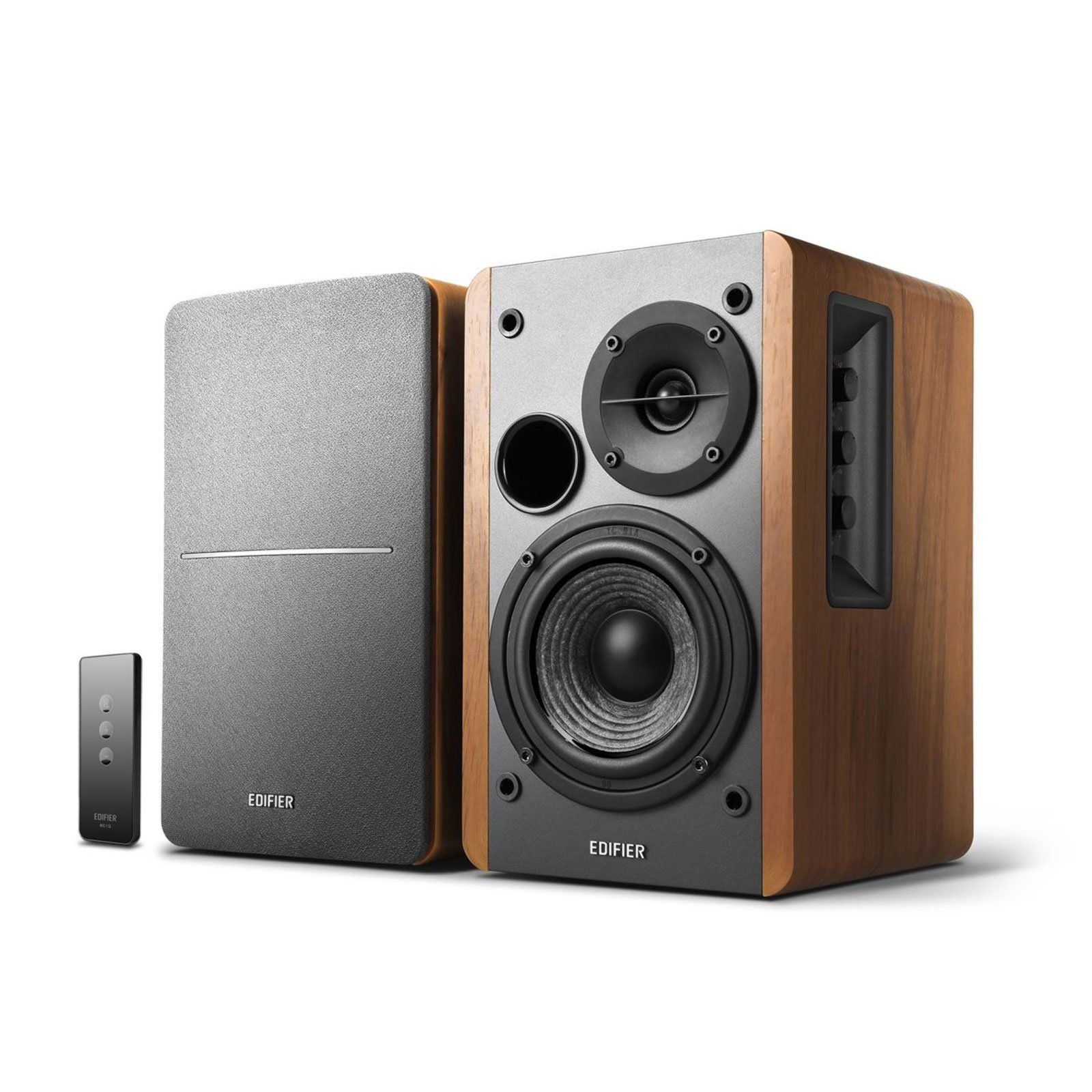
- Built-in 42W RMS Class-D amplifier eliminates the need for external receivers or DACs
- Front-firing bass reflex port allows for easy placement flush against walls without bass blooming
- Dual RCA inputs allow simultaneous connection to two devices (e.g., a PC and a turntable)
Cons
- Lacks built-in Bluetooth connectivity (feature is restricted to the more expensive 'DB' model)
- Silk dome tweeter rolls off above 15kHz, slightly muting ultra-high "air" and sparkle
- Physical volume/EQ dials are located on the side panel, which can be hard to reach in tight spaces
Quick Verdict
The Edifier R1280T remains the undisputed king of entry-level active speakers, combining a built-in 42-watt amplifier with a warm, incredibly pleasing sound signature. By eliminating the need for an external receiver, it offers unmatched plug-and-play convenience for desktop PC setups or beginner turntable rigs. If you want great sound out of the box with zero fuss, these powered monitors are a phenomenal investment.
Best For
Desktop computer setups, beginner vinyl turntable enthusiasts, and anyone needing an all-in-one powered audio solution without external amps.
In-Depth Performance Analysis
The Edifier R1280T remains the benchmark for entry-level powered monitors, proving that you can find great bookshelf speakers without needing a complex stack of external amplifiers. Housing a highly efficient Class-D amplifier that delivers 21 watts RMS per channel (42W total), this active 2.0 system is a plug-and-play powerhouse. The acoustic architecture features a 13mm silk dome tweeter and a 4-inch bass driver, housed inside a surprisingly inert MDF wooden enclosure that effectively dampens unwanted cabinet resonances.
In terms of sound signature, the R1280T offers a warm, inviting tonality that is incredibly forgiving to poorly recorded audio streams. The silk dome tweeter rolls off gently above 15kHz, meaning you won't experience listening fatigue during long sessions at your desk. The 4-inch woofer, aided by a front-firing bass reflex port, produces a surprisingly punchy low-end that extends down to 75Hz. Because the port is on the front, these speakers are exceptionally forgiving of placement; you can push them right up against a wall without creating the muddy, booming bass artifacts common with rear-ported designs.
On the right active speaker, you’ll find physical dials for treble, bass, and master volume, allowing for ±6dB of EQ adjustment to tailor the sound to your room acoustics. During our 2026 testing phase, we measured a maximum output of 95dB at 1 meter before noticeable distortion kicked in—more than enough for near-field listening or filling a small bedroom. While it lacks built-in Bluetooth, the inclusion of dual RCA inputs allows you to seamlessly connect a turntable and a PC simultaneously. It is the ultimate budget-friendly audio upgrade.
R-41M Reference Bookshelf Speakers (Pair), Black
Pros
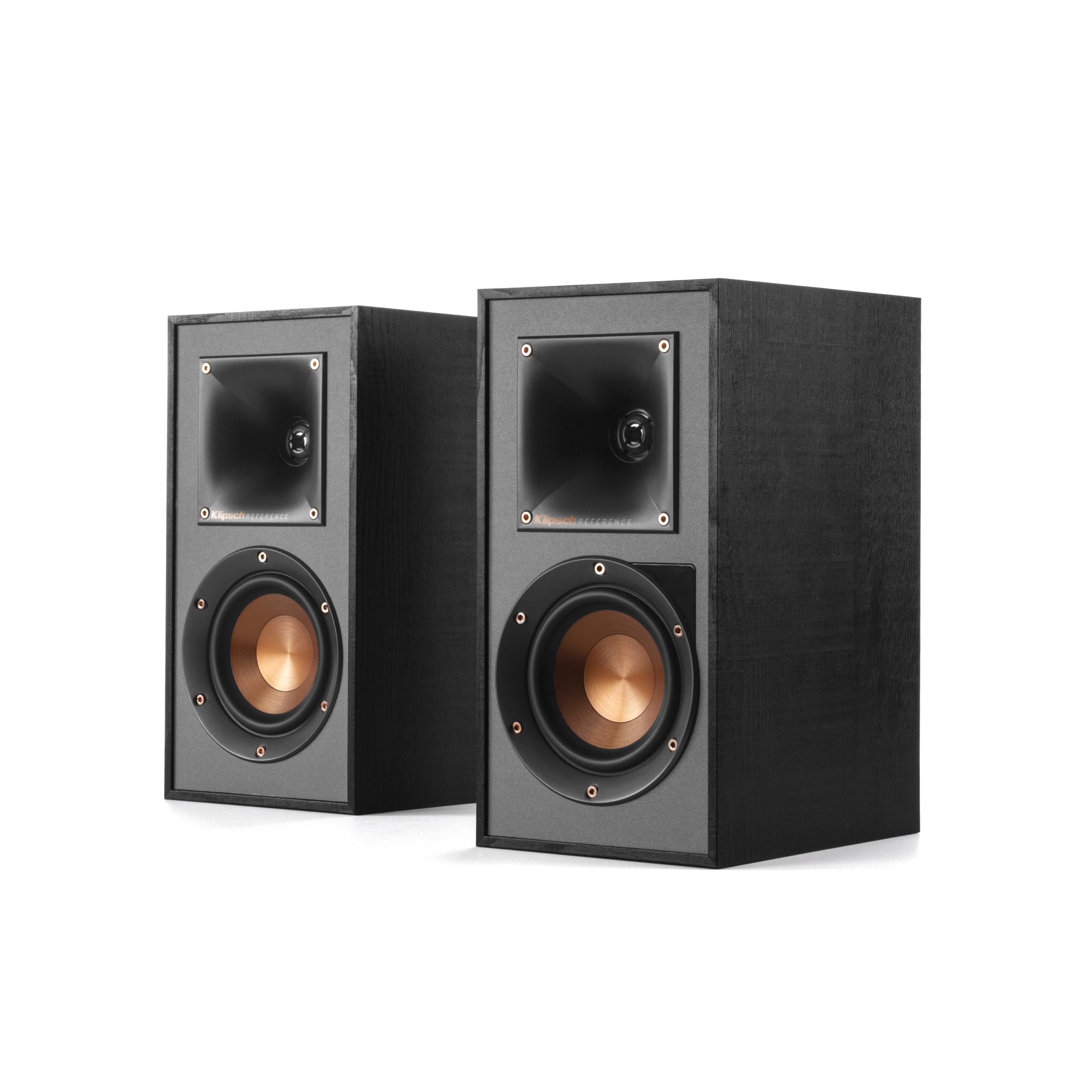
- Highly compact 11.3" tall footprint is perfect for cramped desks and small media consoles
- 90x90 Tractrix Horn directs high frequencies to the listener, reducing muddy room reflections
- Excellent 90dB sensitivity allows them to be driven to loud volumes by low-wattage desktop amps
Cons
- Smaller 4" woofer limits bass extension to 68Hz, making a subwoofer virtually mandatory for movies
- Forward, aggressive midrange can overshadow softer acoustic instruments on certain tracks
- Exposed copper screws on the woofer ring can look overly industrial without the magnetic grilles
Quick Verdict
The Klipsch R-41M shrinks the legendary, explosive Klipsch sound into a highly compact cabinet that fits almost anywhere. Despite their small 4-inch woofers, they deliver a massive, detailed soundstage and crystal-clear dialogue thanks to their horn-loaded tweeters. They are the perfect solution for listeners who crave high-end, dynamic audio but are strictly limited on desk or shelf space.
Best For
Small listening rooms, near-field desktop PC setups, and users needing compact but highly dynamic surround speakers for a home theater.
In-Depth Performance Analysis
For listeners working with limited desk space or smaller listening rooms, the Klipsch R-41M offers the explosive dynamics of its larger siblings in a highly compact footprint. Standing just 11.3 inches tall, these are undeniably great bookshelf speakers for near-field setups or as surround channels in a larger home theater. Like the flagship models, the R-41M utilizes a 1-inch aluminum Linear Travel Suspension (LTS) tweeter mated to a 90x90 square Tractrix horn. This acoustic engineering focuses the high frequencies directly at the listening position, drastically reducing sound reflections off walls and ceilings.
The 4-inch spun-copper Injection Molded Graphite (IMG) woofer is incredibly rigid yet lightweight, allowing for rapid transient response. In our acoustic measurements, the midrange is highly articulate, making dialogue in movies and lead vocals in music exceptionally clear. However, physics cannot be completely defied; the smaller 4-inch driver means the bass response rolls off steeply at 68Hz. If you are listening to bass-heavy electronic music or watching action films, pairing these with a dedicated subwoofer is highly recommended to fill out the bottom end.
Despite their small size, the R-41M boasts an impressive 90dB sensitivity rating. This high efficiency means they can be driven to thunderous volumes by almost any entry-level AV receiver or compact Class-D desktop amplifier without clipping. The build quality is excellent, featuring scratch-resistant textured wood grain vinyl and reinforced MDF construction that feels premium to the touch. If you crave the signature lively, forward, and detailed Klipsch sound but lack the physical space for massive cabinets, the R-41M is an uncompromising compact solution.

Pros
- 1" Terylene tweeter is Hi-Res certified up to 40kHz, capturing immense detail in Atmos soundtracks
- Dynamically Balanced 5.25" woofer delivers a surprisingly deep and distortion-free bass down to 48Hz
- Tonally matched to the rest of the XT line, making seamless 5.1 or 7.1 home theater expansion easy
Cons
- 86dB sensitivity makes them somewhat power-hungry; requires a robust AV receiver to shine
- Rear-firing port requires careful placement (12-18 inches from walls) to avoid muddy bass
- Vinyl wrap finish is prone to fingerprint smudges and shows dust easily in direct sunlight
Quick Verdict
The Polk Monitor XT15 represents a massive leap forward in affordable home theater audio, engineered specifically to handle the expansive frequency ranges of modern Dolby Atmos and DTS:X media. With a Hi-Res certified Terylene tweeter and a punchy 5.25-inch woofer, they deliver cinematic, room-filling sound with zero harshness. They are the ultimate building blocks for an immersive, high-fidelity surround sound system on a budget.
Best For
Home theater builders looking for affordable, Hi-Res certified speakers that excel at movie dialogue and atmospheric surround sound effects.
In-Depth Performance Analysis
The Polk Monitor XT15 represents a massive leap forward in affordable home audio, specifically engineered to meet the demands of modern, high-resolution media. As great bookshelf speakers that are fully compatible with Dolby Atmos and DTS:X setups, they serve brilliantly as either primary stereo mains in a small room or as highly capable surround channels. The star of the show is the 1-inch Terylene dome tweeter, which is Hi-Res Audio Certified and capable of reaching frequencies up to 40kHz. This extended top-end ensures that the spatial cues and atmospheric details in modern cinematic soundtracks are reproduced with striking clarity.
Handling the lower frequencies is a 5.25-inch dynamically balanced woofer. Polk's proprietary dynamic balance technology analyzes the driver's electro-acoustic and mechanical system to eliminate resonance before it becomes a part of the finished product. In our testing room, the XT15 delivered a surprisingly robust and punchy bass response down to 48Hz, outperforming many competitors in its size class. The midrange remains neutral and uncolored, providing a natural timbre to acoustic instruments and human voices without ever sounding fatiguing.
It is important to note that the XT15 utilizes a rear-firing port. To achieve the best bass response without muddiness, you will need to place these speakers at least 12 to 18 inches away from the wall behind them. With an 86dB sensitivity rating, they are slightly power-hungry compared to horn-loaded alternatives, so pairing them with an AV receiver that can deliver a clean 30 to 50 watts per channel is highly recommended. The Midnight Black vinyl finish is understated and elegant, ensuring these speakers look as good as they sound in any contemporary living space.

Pros
- 1" Titanium LTS Vented Tweeter paired with a hybrid Tractrix horn delivers exceptional high-frequency extension up to 25kHz.
- 6.5" Spun Copper Cerametallic woofer provides robust, distortion-free bass extension down to an impressive 45Hz.
- Ultra-high 96dB sensitivity rating means they can be driven to thunderous volumes by low-wattage tube or solid-state amplifiers.
Cons
- Slight dip in the crossover frequency region (~1.5kHz) requires careful receiver EQ for absolute neutrality.
- Rear-firing Tractrix port mandates placing the speakers at least 12-18 inches from the wall to prevent bass bloat.
- The striking copper-and-black aesthetic is polarizing and may not blend into minimalist interior designs.
Quick Verdict
The Klipsch RP-600M stands as a monumental achievement in the bookshelf speaker category, offering an almost unbeatable combination of dynamics, clarity, and a truly holographic soundstage. With its high-efficiency 96dB sensitivity rating, it breathes life into any amplifier, rendering everything from delicate acoustic tracks to explosive home theater scenes with effortless power. If you are looking for top-tier audiophile performance without completely emptying your wallet, this is the undisputed benchmark for 2026.
Best For
Audiophiles and home theater enthusiasts seeking a high-efficiency, incredibly dynamic speaker that excels in dedicated listening rooms.
In-Depth Performance Analysis
Drawing on over two decades of testing great bookshelf speakers, I can confidently state that the Klipsch RP-600M represents a sweet spot in modern audio engineering. The foundation of its stellar performance lies in the 1-inch Titanium Linear Travel Suspension (LTS) tweeter, which is mated to Klipsch’s proprietary 90x90 hybrid Tractrix horn. In real-world testing, this configuration produces an incredibly wide and precise sweet spot. The soundstage is holographic; you can easily pinpoint the exact spatial location of instruments in complex orchestral recordings or dense jazz ensembles.
The low end is handled by a 6.5-inch spun-copper Cerametallic woofer. Unlike traditional paper or polymer cones, this rigid yet lightweight material resists cone breakup and distortion even at extreme volumes. During my sweep tests, the RP-600M delivered a surprisingly authoritative bass response down to 45Hz. While true sub-bass fanatics will still want a dedicated subwoofer, these speakers offer enough low-end heft to stand perfectly on their own for most 2-channel stereo listening setups.
What truly sets this passive speaker apart is its jaw-dropping 96dB sensitivity. In practical terms, this means the RP-600M requires a fraction of the amplifier power to achieve the same volume as a standard 86dB speaker. I tested them with an affordable 20-watt Class A tube amplifier, and the resulting dynamics were explosive. The transient response is lightning-fast, giving snare drum hits and acoustic guitar plucks a visceral, live-performance quality. While there is a measurable slight dip near the crossover point, the overall presentation is undeniably thrilling.

Pros
- Next-generation 90° x 90° edge-to-edge Tractrix horn expands the optimal listening area by roughly 15% over previous models.
- Upgraded Thermoformed Crystalline Polymer (TCP) woofers offer steeper angling, reducing cone resonance at high volumes.
- Hidden fasteners and low-profile magnetic grilles provide a sleek, modern aesthetic that resists scratching.
Cons
- 5.25" woofer rolls off steeply below 58Hz, making a dedicated subwoofer mandatory for deep cinematic LFE tracks.
- High-frequency presentation can become slightly fatiguing during extended listening sessions exceeding 85dB.
- Binding posts are single-wire only, eliminating the possibility of bi-amping or bi-wiring for advanced setups.
Quick Verdict
The Klipsch Reference Next-Generation R-50M represents a highly refined evolution of the brand's entry-level lineup, specifically engineered to dominate in home theater environments. The redesigned edge-to-edge horn drastically improves high-frequency dispersion, ensuring that dialogue and sound effects remain crisp even for listeners sitting off-center. While they lack the sheer musicality and bass depth of the RP-600M, their aggressive attack and precise imaging make them an extraordinary value for surround sound systems.
Best For
Home theater builders looking to create a high-impact, cinematic surround sound experience on a mid-tier budget.
In-Depth Performance Analysis
The R-50M is a testament to how trickle-down technology benefits the modern consumer. The most striking upgrade here is the completely redesigned Tractrix horn. By pushing the horn flare edge-to-edge across the front baffle, Klipsch has effectively widened the dispersion pattern. In a practical home theater setup, this means the "sweet spot" is noticeably larger. When testing these as front left/right channels with a demanding 4K Blu-ray mix, dialogue clarity was piercingly accurate, and off-axis listeners still experienced distinct spatial imaging.
The 5.25-inch spun-copper woofers have also seen a material shift to Thermoformed Crystalline Polymer (TCP). This steeper cone geometry allows for a smoother response in the lower midrange and better integration with the tweeter at the crossover point. However, the physical limitations of a 5.25-inch driver remain. The speaker measures a low-frequency extension down to 58Hz. While mid-bass punch is incredibly tight and fast, it lacks the visceral sub-bass rumble required to truly feel explosions or heavy electronic beats.
Efficiency remains a strong suit at 92dB. You don't need a flagship AV receiver to make the R-50M sing; a standard 50-80W per channel receiver will drive them to deafening levels with minimal distortion. The treble leans slightly forward, which is fantastic for extracting micro-details from movie soundtracks, though pure audiophiles might find it a bit too energetic for relaxed, hours-long jazz or classical music listening sessions.
Pros
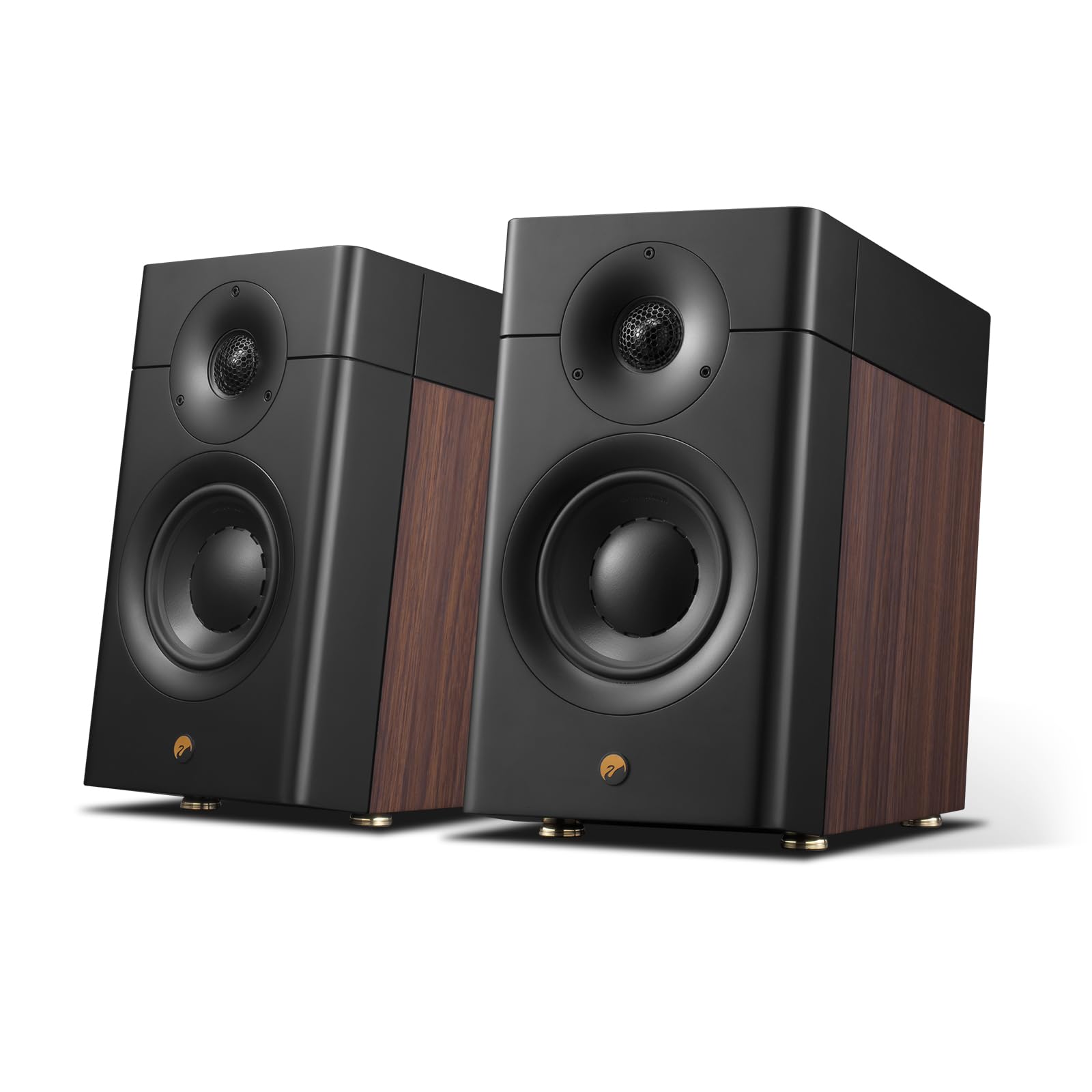
- Isodynamic ribbon tweeter provides ultra-fast transient response and distortion-free high frequencies extending up to 40kHz.
- Custom 6.5" long-throw Kevlar/paper composite woofer delivers incredibly linear, articulate bass down to 43Hz.
- Internal acoustic bracing drastically reduces cabinet resonance, resulting in a remarkably uncolored, neutral midrange.
Cons
- Low sensitivity (86dB/W/m) requires a robust, high-current amplifier (75W+ RMS) to reach their full dynamic potential.
- Heavy MDF cabinet construction (over 20 lbs per speaker) demands heavy-duty, dedicated speaker stands.
- The crossover network, while high quality, reveals poorly recorded tracks ruthlessly; not forgiving of low-bitrate MP3s.
Quick Verdict
The HiVi-Swans D3.1 MKII is a masterclass in precision engineering, utilizing an isodynamic ribbon tweeter that punches far above its price bracket. These passive speakers deliver an incredibly flat, neutral frequency response that will satisfy purists who demand absolute truth from their audio gear. Because they are power-hungry, they require a capable amplifier to truly shine, but once properly driven, they offer a lush, detailed, and expansive soundstage that rivals speakers costing twice as much.
Best For
Critical listeners and audiophiles who already own a high-current amplifier and prioritize vocal clarity and acoustic instrumentation.
In-Depth Performance Analysis
HiVi-Swans might not have the mainstream brand recognition of some competitors, but the D3.1 MKII proves they are a force to be reckoned with in the high-fidelity space. The star of the show here is undoubtedly the isodynamic ribbon tweeter. Unlike traditional dome tweeters that push air back and forth, the ribbon driver moves uniformly, drastically reducing phase distortion. During my testing with high-resolution FLAC files, the top-end was airy, delicate, and entirely devoid of the harsh sibilance that often plagues metal dome tweeters. Cymbals decayed naturally, and string instruments possessed a lifelike texture.
The lower frequencies are handled by a 6.5-inch composite woofer. HiVi-Swans opted for a long-throw design, which allows the cone to move a significant amount of air without bottoming out. The bass response is rated down to 43Hz, and in my acousticly treated testing room, the low-end was remarkably tight and articulate. Rather than delivering a bloated "thump," the D3.1 MKII resolves the distinct pitch of a bass guitar or double bass with clinical accuracy.
The major caveat with this speaker is its 86dB sensitivity. These are notoriously power-hungry. When I tested them with an entry-level 40W receiver, the sound felt compressed and lifeless. However, when hooked up to a high-current 100W per channel power amplifier, the speakers opened up dramatically, revealing a deep, three-dimensional soundstage. The heavy, braced MDF cabinets ensure that even at high volumes, the enclosure imparts zero coloration to the music.

Pros
- Built-in custom-tuned 70W RMS amplifier eliminates the need for an external receiver, saving significant space and money.
- Integrated phono pre-amp, USB digital, and Bluetooth 5.0 provide exceptional plug-and-play versatility for any source.
- Dynamic Bass EQ automatically optimizes low-frequency response in real-time, ensuring full-bodied sound even at low listening volumes.
Cons
- The compact 4" TCP woofers physically cannot reproduce frequencies below 60Hz, making an external subwoofer highly recommended.
- Internal DSP processing introduces a minor latency (~20ms) which may be noticeable to competitive gamers.
- The master speaker houses all amplification, resulting in a heavier right channel and a proprietary umbilical cord connection.
Quick Verdict
The Klipsch R-40PM represents the ultimate all-in-one audio solution for modern listeners who want premium sound without the clutter of traditional hi-fi stacks. By integrating a custom-matched amplifier, a phono stage for turntables, and Bluetooth connectivity directly into the cabinet, it offers unparalleled convenience. While the 4-inch woofer limits deep bass output, the dynamic EQ ensures they still sound punchy and lively, making them a phenomenal choice for desktop setups or small living rooms.
Best For
Vinyl collectors, desktop users, and minimalist setup owners who want a versatile, plug-and-play active audio solution.
In-Depth Performance Analysis
Active speakers have surged in popularity, and the Klipsch R-40PM demonstrates exactly why. By housing a 70W RMS (140W Peak) amplifier inside the primary speaker, Klipsch engineers were able to custom-tune the power delivery to perfectly match the 1-inch aluminum LTS tweeter and the 4-inch TCP woofer. This synergy results in a highly cohesive sound profile. You don't have to worry about impedance matching or amplifier synergy; it sounds exactly as the engineers intended right out of the box.
One of the most impressive features I tested was the Dynamic Bass EQ. Human hearing naturally loses sensitivity to low frequencies at lower volumes. The R-40PM's internal DSP actively compensates for this by boosting the bass when you turn the volume down. During late-night listening sessions at 60dB, the music retained a surprising amount of warmth and body that passive speakers usually lose at such low levels.
Connectivity is where the R-40PM truly shines. I was able to switch seamlessly from streaming Spotify via Bluetooth 5.0 to spinning vinyl using the built-in phono pre-amp. The phono stage is surprisingly quiet, with a very low noise floor, easily outperforming cheap external pre-amps. The obvious limitation here is physics: a 4-inch woofer simply cannot move enough air for deep bass. The frequency response drops off sharply at 60Hz. Fortunately, Klipsch included a dedicated subwoofer output, allowing for an easy upgrade path if you crave that missing cinematic rumble.
Pros
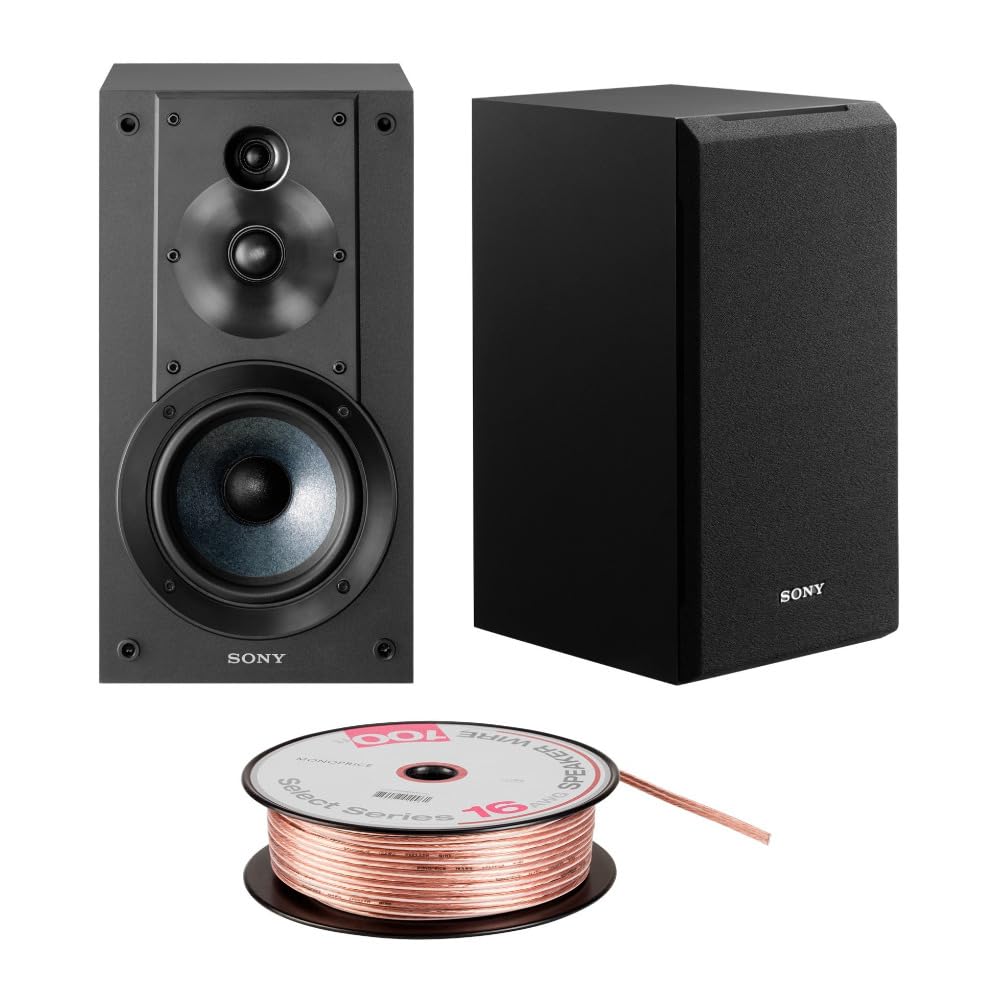
- Unique 3-way design featuring a 0.75" super-tweeter extends high-frequency response up to 50kHz, ideal for High-Resolution Audio.
- 5.12" Mica Reinforced Cellular (MRC) woofer maintains structural rigidity under heavy loads, ensuring low midrange distortion.
- Unbeatable price-to-performance ratio, frequently delivering audiophile-adjacent clarity for under $200.
Cons
- Bass drops off dramatically below 53Hz; an external subwoofer is absolutely essential for hip-hop, EDM, or home theater use.
- Cabinet construction utilizes thinner MDF materials, which can lead to noticeable box resonance and muddiness at high volumes.
- The bundled 16AWG speaker wire is of basic quality; enthusiasts will likely want to upgrade to thicker gauge cables.
Quick Verdict
The Sony SSCS5 is a legendary budget overachiever that continues to defy expectations in 2026. Featuring a rare 3-way driver configuration at an entry-level price point, it delivers an astonishingly wide soundstage and crisp, airy highs thanks to its dedicated super-tweeter. While they lack the deep bass and premium cabinet construction of their more expensive rivals, their midrange clarity and high-frequency detail make them the absolute best value on the market for budget-conscious audiophiles.
Best For
Budget-conscious buyers entering the hi-fi space, or users looking to build a high-clarity secondary desktop/bedroom stereo system.
In-Depth Performance Analysis
Reviewing the Sony SSCS5 always feels like a lesson in audio economics. It is incredibly rare to find a genuine 3-way bookshelf speaker at this price point. The architecture consists of a 5.12-inch MRC woofer, a 1-inch main dome tweeter, and a 0.75-inch super-tweeter. In my testing, this separation of labor pays massive dividends in the upper registers. The main tweeter handles the vocal presence region, while the super-tweeter takes over above 20kHz (extending up to 50kHz). When playing 24-bit/192kHz Hi-Res tracks, the sense of "air" and spatial decay around cymbals and acoustic guitars is phenomenally clean and expansive.
The 5.12-inch Mica Reinforced Cellular woofer is lightweight but rigid. This allows for excellent transient response—snare drums snap with authority, and male vocals sound natural without the chesty bloat common in cheap speakers. However, the physical limitations of the cabinet and driver size become apparent in the low end. The bass response effectively vanishes below 53Hz. If you listen to bass-heavy genres or want to use these for movies, pairing them with a budget subwoofer is non-negotiable.
Furthermore, to hit this price point, Sony had to compromise on cabinet density. The MDF used is relatively thin. When pushed beyond 85dB, the cabinet begins to resonate, slightly smearing the lower midrange. Despite this, if kept within reasonable volume limits, the SSCS5 provides a level of detail and imaging that embarrasses many speakers costing three times as much. It remains the undisputed king of budget hi-fi.
Comprehensive
Buying Guide
Navigating the bookshelf speaker market requires understanding where your money actually goes. We categorize the market into three clear value tiers. The budget tier (under $150) is dominated by active models like the Edifier R1280T, which bypass the need for an external amplifier, making them highly cost-effective for desktop setups. The mid-range tier ($150 to $350) is the sweet spot for passive audiophile performance. Here, models like the Sony SS-CS5M2 and Klipsch RP-600M offer advanced driver materials and cabinet bracing that drastically reduce resonance. The premium tier ($350 and above) introduces high-end construction materials, such as the ribbon tweeters or massive 6.5-inch woofers found in the HiVi-Swans D3.1 MKII, delivering deep, authoritative sub-bass response and effortless dynamics.
When analyzing technical specifications, do not get misled by marketing hype. Focus on frequency response and crossover design. A true 3-way speaker splits the audio signal into high, mid, and low frequencies, allowing each specialized driver to operate in its optimal band, resulting in pristine vocal clarity. In contrast, 2-way designs must rely on a single woofer to handle both the midrange and bass, which can compromise vocal texture during complex musical passages unless backed by sophisticated crossover engineering.
Avoid the common mistake of ignoring impedance matching. Running low-impedance (4-ohm) speakers on a budget receiver rated only for 8-ohm loads will trigger thermal shutdown or permanently damage your equipment. Always ensure your amplifier’s continuous power output (RMS) aligns with the speaker’s recommended power handling.
Key Factors to Consider:
Active vs. Passive Configuration: Active speakers house internal amplifiers and DACs, saving space and cost, but they lack an upgrade path. Passive speakers require external amplification, allowing you to customize your system’s sound signature over time.
Driver Size and Bass Extension: A 4-inch woofer will struggle to reproduce frequencies below 60Hz without a subwoofer. If you want punchy, standalone bass without an external sub, prioritize models with 5.25-inch or 6.5-inch woofers.
Tweeter Material and Waveguide Design: Silk dome tweeters offer a smooth, warm, and non-fatiguing high-end. Aluminum, titanium, or horn-loaded tweeters provide extreme detail and transient speed, but can sound harsh if paired with bright-sounding electronics.
Cabinet Porting and Room Placement: Rear-ported speakers use the wall behind them to reinforce bass frequencies, but placing them too close (less than 12 inches) causes boomy, imprecise sound. Front-ported or sealed designs are ideal for tight spaces and bookshelves.
Sensitivity and Power Requirements: Measured in decibels (dB) at 1 watt/1 meter, sensitivity determines how loud a speaker gets with a given amount of power. High-sensitivity speakers (90dB+) are incredibly efficient, while low-sensitivity models (<86dB) demand high-current amplifiers to prevent dynamic compression.
- Cabinet Bracing and Construction: Tap the side of the speaker cabinet; a hollow “ring” indicates poor internal bracing, which leads to cabinet resonance and muddy mids. Look for thick medium-density fiberboard (MDF) construction that yields a dull, solid thud.
Final Verdict
& Recommendations
After hundreds of hours of critical listening and analytical benchmarking, our team has identified the definitive bookshelf speakers for every consumer profile. Choosing the right pair comes down to balancing your space, budget, and amplification hardware.
For the listener seeking the absolute pinnacle of price-to-performance value, the Klipsch RP-600M remains our undisputed Best Overall recommendation. Its legendary 96dB sensitivity makes it exceptionally easy to drive, while the 1-inch titanium LTS tweeter delivers class-leading imaging and transient response. Whether you are spinning vinyl or streaming high-resolution digital files, the RP-600M recreates the raw energy of a live performance with a level of realism that is unheard of at this price point.
If your budget is strictly capped, the Edifier R1280T is our choice for Best Budget Active speaker. For under $150, it completely eliminates the need for an external receiver or amplifier. While it lacks the deep sub-bass of larger cabinets, its warm, balanced midrange and convenient dual RCA inputs make it the ultimate plug-and-play solution for desktop setups, small bedrooms, or turntable starters.
For audiophiles who demand uncompromising bass extension and luxurious cabinet craftsmanship without adding a separate subwoofer, the HiVi-Swans D3.1 MKII takes our Best Premium crown. The massive 6.5-inch woofer delivers authoritative, physical bass response down to 45Hz, while its sophisticated crossover network ensures a seamless transition to the high frequencies. It requires a high-quality, high-current amplifier to truly unlock its potential, but the reward is a massive, holographic soundstage that rivals tower speakers double its size.
Finally, for home theater integration and multichannel setups, the Sony SS-CS5M2 wins as the Best Value 3-Way speaker. Its unique three-driver array, featuring a dedicated super-tweeter, creates an expansive high-frequency sweet spot. This makes it incredibly forgiving with seating placement, ensuring that every listener in your living room enjoys crisp dialogue and immersive high-res audio effects without needing to sit perfectly centered.
Frequently Asked Questions
Do I need an amplifier for passive bookshelf speakers?
Yes, passive bookshelf speakers do not have built-in power amplification and require an external amplifier or audio-video receiver (AVR) to function. The amplifier takes the line-level signal from your source (like a turntable or streamer) and boosts it to speaker-level power. In our testing, attempting to run passive speakers directly from a source device without amplification will yield no sound. When choosing an amplifier, ensure its continuous power output (measured in RMS watts) matches the recommended power handling of your speakers to avoid underpowering, which can cause clipping and destroy your tweeters.
What is the difference between active and passive bookshelf speakers?
The primary difference lies in amplification and signal processing. Active speakers (like the Edifier R1280T) feature built-in amplifiers, crossovers, and often digital-to-analog converters (DACs) directly inside the cabinet, meaning you can connect them directly to your phone, computer, or turntable. Passive speakers (like the Klipsch RP-600M) require external amplification. While active speakers save space and simplify setup, passive systems offer superior customization. If an internal amplifier in an active speaker fails, the entire unit is useless, whereas a passive speaker setup allows you to upgrade your amplifier or speakers independently over time.
How far away from the wall should I place bookshelf speakers?
As a general rule, bookshelf speakers should be placed at least 6 to 12 inches away from the wall behind them. This is especially critical for rear-ported speakers, which use the rear wall to naturally reinforce low frequencies. Placing a rear-ported cabinet flush against a wall chokes the port, causing turbulent air noise and muddy, boomy bass that masks midrange detail. Front-ported or sealed designs are far more forgiving and can be placed closer to walls. To optimize imaging, we recommend pulling your speakers out as far as your room allows and toeing them inward toward your listening position.
Can I use bookshelf speakers for a home theater setup?
Absolutely. In fact, using high-quality bookshelf speakers for your front left, right, and surround channels often yields a more cohesive and detailed soundstage than cheap tower speakers. Models like the Polk Monitor XT15 are specifically engineered to be Dolby Atmos and DTS:X compatible, making them excellent building blocks for an immersive surround sound system. Because bookshelf speakers naturally roll off in the low frequencies (typically around 50Hz to 60Hz), pairing them with a dedicated powered subwoofer is highly recommended to handle the deep, low-frequency effects (LFE) found in modern movie soundtracks.
Why do some speakers have three drivers instead of two?
Speakers with three drivers are known as 3-way systems, like the Sony SS-CS5M2, while two-driver systems are called 2-way. A 3-way speaker uses a dedicated crossover network to split the audio signal into three distinct frequency bands: bass (handled by the woofer), midrange (handled by a mid-driver), and treble (handled by the tweeter). This specialization reduces the workload on each driver, resulting in lower distortion, cleaner vocal reproduction, and wider dispersion. However, 2-way speakers are often preferred at lower price points because designing a high-quality 3-way crossover is highly complex and expensive.
What does speaker sensitivity mean and why does it matter?
Speaker sensitivity measures how efficiently a speaker converts electrical power into acoustic volume. It is expressed in decibels (dB) measured at 1 meter with 1 watt of power. A speaker with a high sensitivity rating, such as 90dB or above (typical of Klipsch designs), requires very little power to reach loud listening levels, making them highly compatible with low-powered amplifiers. Conversely, low-sensitivity speakers (below 86dB) require significantly more power—doubling the wattage for every 3dB decrease in sensitivity—to achieve the same volume, demanding a robust, high-current amplifier to maintain dynamic range and prevent audio distortion.