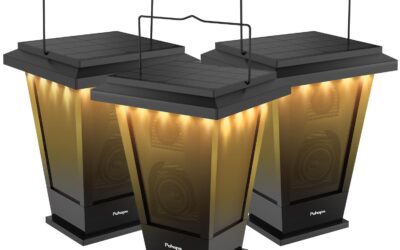
Quick Answer

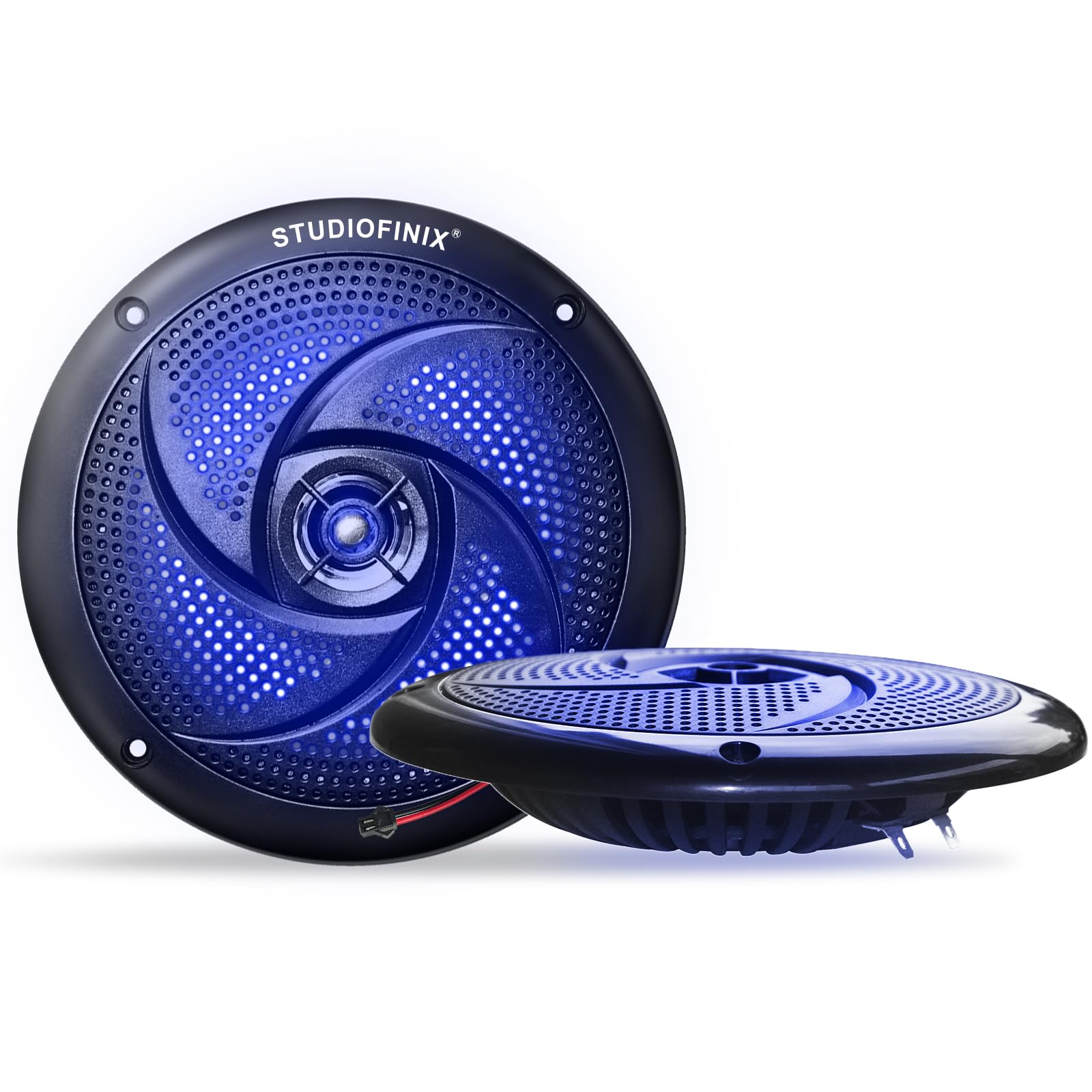
Camp under an awning? Buy the Magnadyne 5-inch Dual Cone: highest user rating in this group, budget price, honest 25W peak. Leave speakers in the rain year-round? The Jensen MS5006BR is fully waterproof and cites ASTM salt-spray and UV standards. Large open sites need the Pyle PLMRS63BL 6.5-inch pair and its 240W peak.

  • Best Overall: Magnadyne 5-inch Dual Cone — strongest user rating at a budget price; water-resistant, not waterproof.
  • Best for Exposed Mounting: Jensen MS5006BR — fully waterproof, with ASTM salt-spray and UV compliance.
  • Best for Maximum Power: Pyle PLMRS63BL 6.5″ — 240W peak; confirm your cutout will take 6.5 inches.
1

RecPro 2 Pack RV Flush Mount Speakers 5.25" Black

In Stock
9.9 /10
BS Score
BS Score is calculated based on product ratings, reviews, and sales performance to help you make informed purchasing decisions.
Updated: Aug 18, 2026
Last update on Aug 18, 2026 / Affiliate links / Images, Product Titles, and Product Highlights from Amazon Creators API.
Pros & Cons

Pros

  • Easy surface-mount installation saves time and avoids complex cutouts.
  • Coaxial design provides full-range audio from a single speaker, simplifying setup.
  • Water-resistant construction is suited for outdoor exposure on RVs or boats.
  • Gloss black finish with blue LED adds aesthetic appeal to your vehicle's exterior.
  • Pair pack offers two speakers for a stereo setup at a reasonable price point.

Cons

  • No customer reviews available, so real-world performance and durability are unverified.
  • Lack of detailed specifications (e.g., power handling, frequency response) limits informed decision-making.
  • Surface-mount design may protrude, which could be less streamlined than flush-mount options.
Detailed Review

The RecPro 2 Pack RV Flush Mount Speakers (5.25-inch, black with blue LED) are designed for RV and marine enthusiasts seeking an easy audio upgrade. With a surface-mount installation, they require no recessing, making them a practical choice for flat exterior walls. The coaxial full-range design integrates a woofer and tweeter, delivering a complete sound spectrum from a single speaker, which simplifies wiring and placement.

The primary evidence for these speakers comes from the manufacturer's supplied features: they are wired, passive, and water-resistant for exterior use. The gloss black finish with a curved grille and blue LED adds a visual appeal that can enhance the look of your vehicle. However, we have no independent test data or customer reviews to confirm sound quality, power handling, or long-term reliability.

Customer signals are absent: the provided review section is empty, so we cannot attribute any anecdotal experiences. This is a significant limitation, as typical reviews often highlight installation ease, sound performance, and durability over time. Without these, potential buyers must rely solely on the product's claims.

Trade-offs include the surface-mount design, which, while easy to install, may protrude more than flush-mount alternatives, affecting aerodynamics or aesthetics. Additionally, the lack of specifications like wattage or impedance means compatibility with your existing audio system is uncertain. If you have a high-powered stereo, these speakers may not handle it, but that is unverified.

Given the evidence, these speakers are best suited for buyers who prioritize simple installation and a modern look over verified performance. If you require proven sound quality or have a demanding audio setup, consider speakers with more detailed specifications and customer feedback. The verdict is conditional: they are a reasonable choice for basic outdoor audio needs, but proceed with caution due to the lack of independent verification.

Evidence Breakdown

Verified Product Facts: The supplied data confirms the speaker type is coaxial/full-range, the mounting type is surface mount (no recessing), connectivity is wired (passive), and the design is intended for exterior RV or marine use. The finish is gloss black with a curved grille pattern, and installation is described as simple screw-mounting.

Customer Signals: No customer reviews were provided, so there is insufficient evidence to identify any recurring themes or user experiences. The review section is empty, making it impossible to gauge satisfaction or common issues.

Not Verified: The supplied data does not establish long-term durability under outdoor conditions, actual sound quality or output, power handling capabilities, or compatibility with specific audio systems. Additionally, warranty information is not provided.

Evidence-Aware Verdict: The evidence supports that these speakers are designed for easy surface mounting and outdoor use. However, it cannot support claims about performance, reliability, or user satisfaction. Buyers should weigh the lack of reviews and specifications against their needs.

Decision Factors

Installation: The surface-mount design is a key advantage, as it requires no cutting or recessing. This reduces installation time and complexity, suitable for DIY enthusiasts. However, the lack of detailed mounting instructions means you may need to figure out the exact screw placement.

Compatibility: As passive wired speakers, they should work with any standard RV or marine stereo that has speaker outputs. But without impedance and power ratings, you cannot be certain they match your system's output. This is a critical unknown.

Durability: The water-resistant claim suggests they can handle moisture, but the degree of protection (e.g., IP rating) is not specified. Long-term exposure to sun, salt, or extreme temperatures is unverified, so durability in harsh conditions is questionable.

Sound Quality: The coaxial design typically offers decent audio for the size, but without frequency response or sensitivity data, you cannot predict how they will sound. The absence of reviews leaves a significant gap in assessing audio performance.

Aesthetics: The gloss black finish and blue LED provide a modern look that may appeal to many buyers. However, the LED's brightness and behavior (e.g., always on, intensity) are not described, so you cannot know if it matches your preference.

2

Jensen MS5006BR 5.25-Inch Dual Cone Waterproof

In Stock
9.5 /10
BS Score
BS Score is calculated based on product ratings, reviews, and sales performance to help you make informed purchasing decisions.
Updated: Aug 18, 2026
Last update on Aug 18, 2026 / Affiliate links / Images, Product Titles, and Product Highlights from Amazon Creators API.
Pros & Cons

Pros

  • Waterproof rating means an accidental soaking or a rain-soaked afternoon does not automatically end the speaker's life
  • Salt spray compliance under ASTM B117 makes these a more reasonable choice for coastal and saltwater boaters than standard car speakers
  • UV exposure compliance under ASTM D4329 addresses the fading and brittleness that kill unprotected speakers left in the sun
  • The 5.25-inch format fits a widely used cutout size, which simplifies planning for a replacement or a new panel installation
  • Buying a pair in one purchase keeps both speakers matched in age, finish, and specification

Cons

  • Maximum power handling of 30 watts is modest, so buyers running a strong external amplifier or expecting high volume over engine and wind noise should look at higher-rated models
  • A dual cone design generally aims at simple, wide coverage rather than the detailed treble a component or coaxial tweeter setup delivers, which matters to listeners who care about clarity
  • The supplied product data does not include cutout diameter, mounting depth, sensitivity, impedance, or grille details, so anyone replacing existing speakers should confirm fit before ordering
Detailed Review

The Jensen MS5006BR is a pair of 5.25-inch dual cone waterproof speakers in black, built for marine and outdoor installations where weather is part of daily life. It suits boat owners, pontoon and deck boat refits, and covered outdoor spaces that need dependable background audio rather than concert volume. The qualification worth stating up front is the 30-watt maximum power handling, which sets a real ceiling on output.

Two features carry most of the practical weight here. The waterproof construction means rain, spray, and a hose-down cleaning are not automatically fatal, which is the core difference between a marine speaker and a repurposed car speaker. Compliance with the ASTM B117 salt spray exposure standard adds relevance for saltwater and coastal owners, where corrosion attacks hardware and cones far faster than freshwater use. Compliance with the ASTM D4329 UV exposure standard speaks to the other slow killer of outdoor audio: sunlight that fades finishes and degrades exposed materials over seasons.

On design, the supplied data confirms a 5.25-inch dual cone driver in a black finish, sold as a pair. The 5.25-inch size is one of the most common marine and small-panel formats, which generally makes planning a replacement or a fresh cutout straightforward. Black tends to disappear into dark dashboards, helm panels, and cabinetry, which helps when you want the install to look factory rather than added on.

The drawbacks are honest rather than damning. Thirty watts maximum is a modest figure, so listeners who want to overcome wind, engine noise, and open water at speed will find the headroom limited. Dual cone drivers prioritize simple, broad coverage over the crisper high frequencies a dedicated tweeter provides. The product data also omits cutout diameter, mounting depth, impedance, and sensitivity, so verify those specifications against your existing openings and head unit before committing.

The strongest reason to buy is weather resistance backed by named exposure standards in a matched, common-size pair. The main reason to hesitate is limited power handling. Buyers running a serious amplified system, or those who want detailed high-frequency reproduction, should shop a higher-powered coaxial or component marine speaker instead.

Key Features Explained

Waterproof Construction: This is the feature that justifies buying a marine speaker at all. It means the speaker is designed to survive direct water contact rather than merely tolerate humidity, so rain on an open deck or a wash-down after a trip does not force a replacement. Owners of open bowriders, pontoons, and uncovered helm stations benefit most, since those installations get wet regularly.

ASTM B117 Salt Spray Compliance: Salt is more destructive than water alone, corroding hardware and attacking exposed surfaces over time. Compliance with this recognized salt spray exposure standard signals the speaker was evaluated against that specific threat, not just general moisture. Saltwater boaters and anyone within reach of coastal air should treat this as one of the more meaningful specifications on the sheet.

ASTM D4329 UV Compliance: Sunlight quietly destroys outdoor speakers by fading finishes and embrittling exposed materials across seasons. Meeting this UV exposure standard addresses that slower failure mode. It matters most for installations with no cover at all, such as gunwale-mounted speakers, open deck panels, or a patio wall that catches full afternoon sun through the summer.

30-Watt Maximum Power Handling: This number tells you how much amplifier power the speaker is rated to accept at peak, and it directly shapes expectations. It fits head unit power and modest amplification for conversation-level and background listening. Buyers planning a high-output amplified system should read this as a hard limit and shop accordingly rather than pushing the speakers.

5.25-Inch Dual Cone Driver: The dual cone approach uses a single driver assembly to cover a wide frequency range, which keeps the design simple and the depth manageable. In practice you get broad, even coverage suited to background audio. Listeners who want distinct, detailed treble will notice the absence of a dedicated tweeter compared with coaxial designs.

Sold as a Matched Pair: Receiving two speakers in one purchase means both units share the same age, finish, and specification from day one. That consistency matters more than it sounds, since mismatched replacement speakers often differ subtly in tone or in how the black finish weathers. It also simplifies wiring a standard two-speaker zone.

Buyer's Guide

Best For: Boat owners replacing tired factory speakers, pontoon and deck boat refits, small fishing boats, and covered patio or dock setups where the audio serves as background rather than the main event. The combination of waterproof construction, salt spray compliance, and UV compliance targets buyers whose speakers live outdoors year-round. The black finish suits darker helm panels and cabinetry.

Consider Alternatives If: You are running an external amplifier with real output, cruising at speed where wind and engine noise dominate, or hosting on a large deck that needs volume across distance. The 30-watt maximum power handling caps what these can do. Listeners who prioritize crisp high frequencies should also look at coaxial or component marine speakers with a dedicated tweeter, since a dual cone driver takes a simpler approach to the top end.

Setup and Daily Use: Expect a standard flush-mount speaker installation into a 5.25-inch panel opening, wired to a head unit or amplifier appropriate to the 30-watt rating. Because the supplied data does not list cutout diameter, mounting depth, or impedance, measure your existing openings and check your head unit's requirements before ordering. Buying the pair together means you can complete both sides of a zone in one session.

Maintenance Requirements: The waterproof rating and salt spray compliance mean routine rinsing after saltwater outings is reasonable rather than risky, which is exactly why marine-rated speakers exist. UV compliance reduces the urgency of covering them, though shading any outdoor speaker when the boat sits idle remains sensible practice for long-term appearance.

What Sets It Apart: The named exposure standards are the differentiator. Plenty of speakers are marketed as weather resistant without pointing to a specific test, while this pair cites both a salt spray standard and a UV standard. That gives coastal buyers something concrete to weigh against generic outdoor claims, even though the power rating stays modest.

Performance & Use Cases

Realistic Output Expectations: Plan on comfortable background listening rather than filling open water with sound. The 30-watt maximum power handling is the governing number, and it points toward head unit power or light amplification. At anchor, at the dock, or drifting on a quiet lake, that is usually enough. Under way at speed, wind and engine noise will compete more than most buyers expect.

Sound Character From a Dual Cone Design: A dual cone driver delivers wide, even coverage from a single assembly, which works well when speakers are spread across a deck and listeners move around. The trade-off is high-frequency detail, since there is no separate tweeter handling the top end. For talk radio, casual playlists, and general ambiance this is rarely a problem. For critical listening it is a real limitation.

Saltwater and Coastal Use: This is where the specification sheet earns its keep. ASTM B117 salt spray compliance targets the corrosion that ruins ordinary speakers near the ocean, and the waterproof construction handles direct spray. Coastal boaters and anyone mooring in brackish water get more value from this pair than a freshwater-only user would.

Uncovered Installations: ASTM D4329 UV compliance makes these a reasonable candidate for spots with no shade, such as gunwale mounts or an exposed patio wall. Sun damage is gradual and easy to ignore until a cone crumbles, so a stated UV standard carries practical weight for a speaker that never comes inside.

Where Another Product Fits Better: Large pontoons with tower speakers, wakeboard boats, and party decks that need volume across distance are outside this pair's comfort zone. Buyers in those categories should size up in power handling and consider designs with dedicated tweeters, then treat these as a candidate for a secondary zone instead.

3

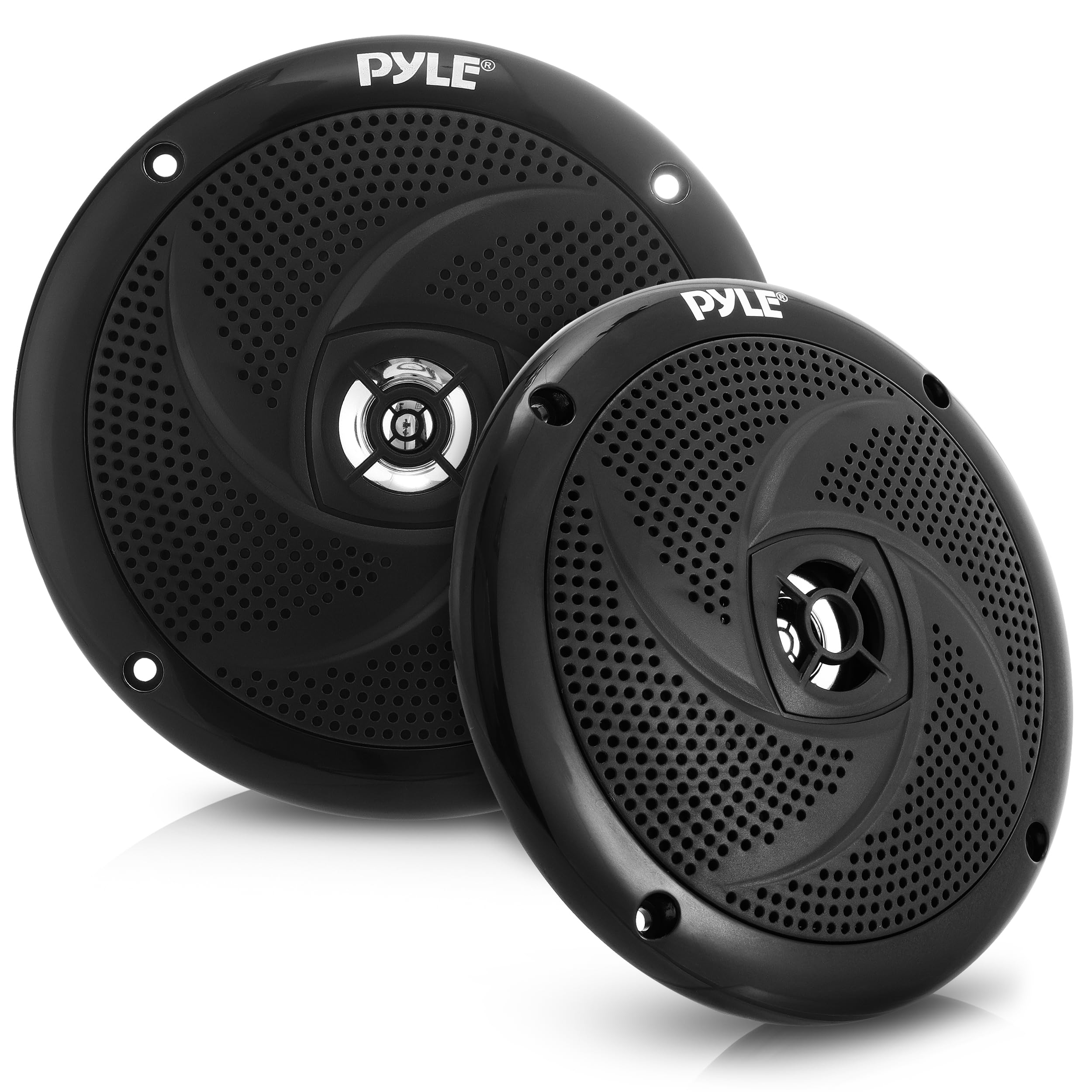
Pyle PLMRS53BL 5.25-Inch Marine Speakers Review

Pyle
In Stock
9.9 /10
BS Score
BS Score is calculated based on product ratings, reviews, and sales performance to help you make informed purchasing decisions.
Updated: Aug 18, 2026
Last update on Aug 18, 2026 / Affiliate links / Images, Product Titles, and Product Highlights from Amazon Creators API.
Pros & Cons

Pros

  • Waterproof, weather-resistant construction means you can leave them mounted through spray, rain, and washdowns instead of covering or removing them
  • Shallow 0.92-inch mounting depth opens up thin door panels, console pods, and hull liners that reject deeper speakers
  • Two-way full-range design puts the tweeter and woofer in one frame, so no separate crossover or tweeter pod install is needed
  • Blue LED lighting is integrated into the speaker, giving late-evening cockpit or cart ambiance with a single set of wires to run
  • 4-ohm impedance and a 180-watt max rating make them a straightforward match for typical marine head units and small four-channel amps

Cons

  • The 80 Hz low-end limit means bass-focused listeners on open water will notice thin low frequencies without adding a subwoofer
  • The 180-watt figure is a maximum rating, not continuous RMS power, so buyers sizing an amplifier need to be conservative rather than matching that number
  • No corrosion rating, certification, or specific ingress protection level is supplied, which matters for anyone mounting in constant saltwater exposure
Detailed Review

The Pyle PLMRS53BL is a pair of 5.25-inch, two-way waterproof marine speakers with integrated blue LED lighting, aimed at boat owners, UTV and golf cart drivers, and outdoor patio builders who need factory-size replacements that tolerate weather. The strongest reason to look at them is the shallow 0.92-inch mounting depth paired with a standard OEM footprint. The qualification is that their rated frequency response starts at 80 Hz, so low bass is limited.

Feature-wise, the two most consequential specifications are the two-way full-range design and the 4-ohm impedance. A two-way driver puts the tweeter in the same basket as the woofer, meaning you install one unit per side and skip separate tweeter locations, crossover boxes, and extra wire runs. The 4-ohm load is the common expectation for head unit speaker outputs and entry-level marine amplifiers, so most buyers will not need impedance matching gymnastics. Pyle lists 180 watts as maximum power, a peak figure rather than a continuous rating.

On the physical side, the total speaker diameter is listed at 6.4 inches with the 5.25-inch nominal driver size, and mounting depth is 0.92 inches. That slim profile is the practical differentiator, since thin door skins, console pods, and hull liners frequently cannot accommodate deeper speakers. Pyle also includes roughly 9.8 feet of wiring in the package, and the LED lighting is built into the speaker rather than added as an aftermarket ring.

The compromises are real. An 80 Hz low-frequency limit means kick drum weight and bass lines will sound thin at volume, particularly outdoors where there are no walls to reinforce low end. Buyers wanting the blue LEDs should also confirm they can run a separate lighting circuit, and anyone mounting in a permanently saltwater-exposed location should note that no corrosion certification or ingress protection rating is provided in the product data.

Overall, the PLMRS53BL earns consideration on fit and weather tolerance more than on sonic depth. Choose it if you need shallow-mount, OEM-size marine speakers with built-in lighting. Hesitate if bass output is your priority. Anyone chasing serious volume on an open bow should be shopping full amplified systems with a dedicated subwoofer instead.

Key Features Explained

Waterproof, Weather-Resistant Construction: This is the reason to buy a marine speaker at all instead of a car audio driver. Pyle states these withstand heavy water splashes and outdoor conditions, which means you can leave them installed through rain, spray, and deck washdowns rather than covering or pulling them each season. Boat owners and open-cab UTV drivers benefit most, since their speakers face weather constantly.

0.92-Inch Mounting Depth: Shallow depth solves a physical fit problem that stops many upgrades cold. Thin door panels, dash pods, console cheeks, and hull liners often have less than an inch of clearance behind the cutout, and a standard speaker simply will not seat. At under an inch deep, the PLMRS53BL clears spaces where deeper drivers require spacers or panel modification.

Two-Way Full-Range Design: Having the tweeter integrated into the same frame as the woofer means one cutout, one wire pair, and one mounting operation per side. Buyers avoid sourcing separate tweeters, finding secondary mounting locations, and wiring external crossovers. For anyone doing a first-time install on a boat or cart, this cuts both labor time and the number of things that can go wrong.

Built-In Blue LED Lighting: The illumination is integrated rather than a bolt-on ring, so you get nighttime cockpit accent lighting without buying a lighting kit or fabricating a mount. This appeals to buyers who run their boat or cart after dark and want visible grille lighting. Plan for the LED circuit as part of your wiring, since lighting typically needs its own power source.

Universal OEM Replacement Sizing: With a 5.25-inch nominal size and a 6.4-inch total diameter, these are designed to drop into existing factory 5.25-inch openings. That matters because it turns a replacement job into an unscrew-and-swap task rather than a cutting and fiberglassing project. Measure your existing cutout and screw pattern before ordering to confirm the match.

4-Ohm Impedance With 180-Watt Max Rating: The 4-ohm load is the standard expectation for marine head unit outputs and small multichannel amps, so wiring is straightforward. Treat 180 watts as a peak specification, not continuous power. When sizing an amplifier, choose conservatively rather than feeding these the full headline number, which protects the drivers over the long run.

Compatibility

Vehicle and Vessel Fit: The PLMRS53BL is intended for boats, marine watercraft, and off-road vehicles, which in practice covers center consoles, pontoons, ski boats, side-by-sides, golf carts, and covered outdoor setups. The deciding factor is not the vehicle type but the opening. If your craft already has 5.25-inch speaker locations, these are designed as a direct replacement.

Cutout and Clearance Check: Measure before ordering. The listed total speaker diameter is 6.4 inches, so your mounting surface needs enough flat area around the hole to seat the flange and land the screws. Behind the panel, you need at least the stated 0.92 inches of clearance plus room for the wire terminals. This shallow depth is precisely what makes them viable in thin doors and liners where deeper speakers fail.

Amplifier and Head Unit Matching: At 4 ohms, these present the standard load that marine and car head units and entry-level four-channel amplifiers are built to drive, so no impedance adapters or unusual wiring is required. The 180-watt figure is a maximum, so match your amplifier to a conservative continuous power estimate rather than to that peak number.

LED Wiring Considerations: The lighting is integrated into the speakers, but plan your install assuming the LEDs need their own power feed and switch rather than running off the speaker signal. Budget time for routing that circuit to a switched accessory source so lighting can be controlled independently of audio.

Included Wire Length: Roughly 9.8 feet of wiring per the manufacturer covers many door-to-head-unit and console runs on smaller boats and carts. On larger vessels, or when routing from a bow location to a stern-mounted amplifier, expect to splice in additional marine-grade wire.

Buyer's Guide

Best For: Owners replacing tired or failed factory 5.25-inch speakers on a boat, pontoon, side-by-side, or golf cart who want weather tolerance and a bit of nighttime lighting without building a full audio system. The shallow mounting depth makes these especially relevant for anyone who has already discovered that a conventional speaker will not physically clear the panel behind the cutout.

Consider Alternatives If: You listen at high volume on open water, care about bass weight, or are building a system around a dedicated amplifier and subwoofer. The rated response starts at 80 Hz, which caps low-end extension. Buyers in permanent saltwater slip environments who want documented corrosion or ingress protection ratings should also look for products that publish those specifications, since none are supplied here.

Setup and Daily Use: Expect a standard swap workflow: confirm your cutout matches, disconnect power, remove the old speaker, connect the included wiring, seat the new speaker in the opening, and secure it. Plan a separate run for the LED circuit. Once installed, they are intended to stay mounted through weather rather than being removed between outings.

What Sets It Apart: The combination of an under-one-inch mounting depth, integrated LED lighting, and standard OEM sizing in a single pair is the pitch. Many weather-resistant speakers require either more depth or a separate lighting accessory. If your constraint is space behind the panel, that specification does more for your install than any sound-quality claim.

Performance & Use Cases

Realistic Sound Expectations: Set expectations around the supplied 80 Hz to 18 kHz frequency response. That range covers vocals, guitars, and most midrange content well, and the two-way design handles the treble end, but it excludes the deep bass region below 80 Hz. In an open cockpit, where there are no surfaces to reinforce low frequencies, music will read as clear rather than full. Adding a subwoofer is the fix if that matters to you.

Best-Case Scenario: Background and mid-volume listening on a pontoon, cart, or covered patio, where the speakers sit relatively close to listeners and content is podcasts, country, classic rock, or streaming playlists. In these conditions, the two-way full-range design does exactly what it needs to do without additional components.

Harder Scenario: Running at high volume while underway with wind and engine noise competing. Small 5.25-inch drivers powered from a head unit will struggle to stay ahead of that noise floor. Buyers in this situation should either add an amplifier sized conservatively against the 180-watt peak rating or step up to a larger driver size and a subwoofer.

Lighting as a Functional Feature: The blue LEDs are an ambiance feature rather than a task light. They make grille locations visible after dark and add visual character to a cockpit or cart interior. Buyers who plan to use their vessel primarily in daylight can treat this as a neutral extra rather than a reason to choose the model.

Longevity Considerations: Weather resistance is stated as protection against heavy splashes and outdoor conditions, which suits spray, rain, and washdowns. Because no specific corrosion or ingress rating is provided, buyers in harsh saltwater environments should still rinse mounting hardware and inspect connections periodically rather than assuming indefinite exposure tolerance.

4

Magnadyne 5-Inch Outdoor Speakers

In Stock
9.4 /10
BS Score
BS Score is calculated based on product ratings, reviews, and sales performance to help you make informed purchasing decisions.
Updated: Aug 18, 2026
Last update on Aug 18, 2026 / Affiliate links / Images, Product Titles, and Product Highlights from Amazon Creators API.
Pros & Cons

Pros

  • Weatherproof construction resists sun and moisture, extending lifespan
  • Dual cone design delivers clearer mids and highs than single-cone speakers
  • Compact size simplifies installation in tight quarters
  • Versatile compatibility with marine and RV electrical systems
  • Reasonable price point for budget-conscious buyers

Cons

  • Limited bass response due to 5-inch driver size
  • Peak power rating may not reflect continuous handling; RMS not specified
  • No detailed frequency response or impedance data provided
Detailed Review

The Magnadyne 5-inch outdoor speakers are a straightforward solution for adding sound to boats, RVs, and other outdoor spaces. With 25 watts of peak power and a dual cone design, they aim to provide clear audio without the bulk or cost of larger systems. The best fit is a casual listener who prioritizes durability and simplicity over audiophile-grade performance. The principal reservation is the lack of detailed specifications, which makes it hard to predict exact sound quality.

These speakers appear designed to fill a niche: compact, weather-resistant audio for environments where standard indoor speakers would fail. The UV-protected and shock-resistant materials suggest they can handle direct sunlight, humidity, and vibrations common on vehicles. This positions them as a practical upgrade for factory-installed speakers that may not be built for outdoor exposure.

Key features include the dual cone design, which separates woofer and tweeter functions to produce more balanced mids and highs. The 5-inch size is a trade-off: it saves space but limits bass response compared to larger drivers. For spoken audio, podcasts, or background music, this is acceptable, but for bass-heavy genres, you'll notice the lack of low-end punch.

Limitations become evident if you need high-volume output or deep bass. The 25W peak power handling is modest; continuous power handling is not disclosed, so it's unclear how they'll perform at sustained high volumes. If you need to fill a large outdoor area with sound, or if you're an audio enthusiast, you may want to consider larger speakers or a system with a subwoofer. Additionally, without impedance or frequency response data, matching them to an amp requires some guesswork.

In conclusion, the Magnadyne speakers are a reasonable choice for budget-minded boat and RV owners who want reliable, weatherproof sound for casual listening. Their compact size and durable build are clear strengths. Before purchasing, verify the impedance matches your existing system and consider your bass expectations. If you need more power or deeper audio, look elsewhere.

Who Should Buy It

Strong Match: Boat and RV owners who need a direct replacement for worn-out factory speakers and value weather resistance and simplicity. These speakers are built to endure sun and moisture, making them a practical upgrade for outdoor listening.

Also Consider It If: You're outfitting a hot tub area or patio and want compact, unobtrusive speakers that can handle occasional splashes and UV exposure. Their small footprint and durable construction fit such settings.

Not the Best Fit: Audiophiles or those who want deep bass and high volume for parties. The 5-inch driver and 25W peak power are unlikely to satisfy critical listeners or large gatherings.

Decision in One Sentence: If you need a compact, weatherproof speaker for casual outdoor listening in a boat or RV, the Magnadyne is a sensible pick, provided you accept its limited bass and unspecified specs.

Reasons to Consider or Pass

Consider It For:

  • Replacing damaged marine or RV speakers with a weather-resistant option.
  • Installing audio in tight spaces where 5-inch speakers fit easily.
  • Listening to talk radio, podcasts, or background music where clarity matters more than bass.
  • A budget-friendly upgrade that doesn't require extensive modification.

Pass If:

  • You need high-volume sound for large outdoor areas.
  • You expect deep bass without a subwoofer.
  • You require detailed specifications (impedance, frequency response) to match an amplifier.
Key Features Explained

Dual Cone Design: Combines a woofer and tweeter in one driver, producing more balanced audio across frequencies than a single cone. This means clearer vocals and highs.

UV-Protected Materials: Resists sun damage, preventing cracking and fading. This extends the speaker's lifespan in outdoor environments.

Shock-Resistant Components: Built to withstand vibrations from vehicles and boats, reducing the risk of internal damage during travel.

25W Peak Power: Indicates the maximum power the speaker can handle in short bursts. For continuous use, actual power handling is likely lower, so pair with an appropriate amplifier.

Compact 5-Inch Size: Fits in standard cutouts, making installation straightforward in many boats and RVs.

5

Magnadyne 5.25-Inch Water Resistant Coaxial

In Stock
9.8 /10
BS Score
BS Score is calculated based on product ratings, reviews, and sales performance to help you make informed purchasing decisions.
Updated: Aug 18, 2026
Last update on Aug 18, 2026 / Affiliate links / Images, Product Titles, and Product Highlights from Amazon Creators API.
Pros & Cons

Pros

  • The shallow 2-inch mounting depth makes retrofits realistic in cramped RV ceiling panels, boat side walls, and hot tub cabinets where clearance is measured in fractions of an inch.
  • Water resistant construction with a full plastic housing is aimed squarely at humid, splash-prone environments rather than dry indoor rooms.
  • Coaxial drivers place the tweeter and woofer in one frame, which keeps installation to a single pair of speaker leads per side and simplifies aiming.
  • Treble extension listed to 20kHz supports crisp vocals and cymbals, which helps intelligibility outdoors where sound disperses quickly.
  • Buying them as a pair keeps left and right channels matched in tone and appearance, useful when both speakers sit in plain view.

Cons

  • The stated frequency response starts at 120Hz, so low bass is limited. Listeners who want noticeable thump from hip hop or electronic music will need a subwoofer or larger drivers.
  • Water resistant is not the same as a sealed waterproof rating, and no ingress protection rating is supplied. Owners planning fully exposed transom, swim platform, or spa-lip installations should weigh that carefully.
  • The supplied product information does not list impedance, sensitivity, cutout diameter, grille finish, mounting hardware, or whether the 50-watt figure is peak or continuous, which leaves installers verifying details before they cut a hole.
Detailed Review

The Magnadyne 5.25-inch Water Resistant Coaxial Speakers with Blue LED Lights are a matched pair of outdoor-oriented speakers for boats, RVs, and hot tub enclosures, and they make the most sense for owners replacing tired factory speakers on a modest budget who also want accent lighting. One caveat up front: the design is described as water resistant rather than waterproof, so mounting location still matters.

Two supplied specifications shape the listening experience. Power handling is listed at 50 watts, which lines up with the output of typical marine and RV head units rather than a high-powered external amplifier. The quoted frequency response runs from 120Hz to 20kHz, meaning treble and midrange are the focus while the deepest bass notes are not part of the picture. For talk radio, classic rock, country, and background music on a patio or deck, that balance is workable. For bass-forward playlists, plan on a separate subwoofer.

Construction details point at damp environments. The manufacturer describes a full plastic encasement, which sidesteps the corrosion concerns that exposed metal parts face around salt air and chlorinated spa steam. The coaxial layout combines the woofer and tweeter into one frame, so each side needs only a single pair of speaker wires. The 2-inch mounting depth is the standout installation number here, since many shallow RV ceilings and boat panels cannot accept deeper baskets. Blue LED lighting is described as something that can be wired in, which suggests a separate connection from the audio leads.

The gaps are worth naming. Impedance, sensitivity, cutout diameter, included hardware, and any formal water ingress rating are not provided in the product data, and the 50-watt figure is not broken out into continuous versus peak. Anyone chasing high volume over an outboard engine or open highway wind will likely want larger, more sensitive speakers driven by an amplifier instead.

Overall, the strongest reason to consider this pair is the combination of shallow depth, moisture-minded construction, and integrated lighting in one budget-friendly package. The main reason to hesitate is the limited low-frequency reach paired with unspecified electrical details. Buyers who need concert-level output, true submersion resistance, or documented bass extension should look at a higher tier of marine audio.

Key Features Explained

50-Watt Power Handling: This rating tells you how much amplifier output each speaker is designed to accept, and it maps well to the built-in amplifiers found in most marine and RV stereos. It means you can wire these directly to a head unit without adding external amplification. Buyers planning a high-output amplified system should confirm the continuous rating first, since the supplied data does not separate peak from continuous power.

120Hz to 20kHz Frequency Response: The listed range determines what you actually hear. Extension to 20kHz covers cymbals, string detail, and vocal clarity, which helps when sound disperses across open water or an outdoor deck. The 120Hz lower limit is the honest constraint: kick drums and bass lines will sound lean. Adding a powered subwoofer solves that for anyone who cares about low-end weight.

Coaxial Two-Way Design: Placing the tweeter on the same axis as the woofer means one cutout, one frame, and one pair of wires per side. That matters most during retrofits, where running additional crossover and tweeter wiring through a boat gunwale or RV ceiling is tedious. The practical benefit is a faster install with fewer holes, which appeals directly to DIY owners working in confined spaces.

Water Resistant Plastic Encasement: The full plastic housing targets the humidity, spray, and temperature swings that surround docks, campsites, and spa decks. Plastic avoids the rust issues that plague untreated metal in those settings. Keep expectations calibrated, though. Water resistant handles splashes and moist air, not sustained direct spray or submersion, so covered or semi-sheltered mounting positions remain the safer choice.

Blue LED Lighting: The integrated blue LEDs can be wired for illumination, turning each speaker into a nighttime accent light. On a pontoon deck, spa surround, or RV awning wall, that adds visual interest without cutting extra holes for separate light fixtures. Because the lights require their own wiring, budget time for a switched power source if you want independent control over the audio.

2-Inch Mounting Depth: Depth is the specification that decides whether a speaker fits at all. Two inches allows placement in shallow cavities behind RV ceiling panels, boat side walls, and hot tub skirts where standard car speakers bottom out against framing or insulation. Anyone measuring limited clearance behind an existing grille should treat this as the primary reason to shortlist these speakers.

Compatibility

Source Equipment: These speakers are a natural match for the built-in amplification in marine and RV head units, based on the listed 50-watt power handling. That makes them a straightforward swap for owners who want better sound without adding a separate amplifier rack. If your system already includes a multichannel amplifier, verify the continuous power rating before assigning high-output channels to them.

Impedance and Wiring: The supplied data does not state a nominal impedance, so confirm it before wiring speakers in parallel or connecting multiple pairs to a single channel. This matters most in boats and campers where owners often run four or six speakers off one head unit. A quick check with a multimeter or the seller listing prevents an accidental load mismatch that stresses the amplifier.

Mounting Locations: The 2-inch depth and 5.25-inch coaxial format aim at shallow flush-mount cavities in boat side panels, RV ceilings and walls, and hot tub cabinets. Because no cutout diameter is published in the supplied information, measure your existing opening and compare it against the seller listing rather than assuming a drop-in fit with your current grilles.

LED Circuit: The blue lighting is described as something that can be wired, which points to a connection separate from the audio pair. Plan for a 12-volt switched source if you want the lights to operate independently of the stereo. Boaters and RV owners who already have accent lighting circuits will find this simple, while first-time installers should account for the extra run.

Environment Fit: Water resistant construction suits covered helms, cabin interiors, awning-shaded RV exteriors, and spa cabinets. It is a weaker fit for surfaces that see direct hose spray, constant rain, or wave wash. If your mounting spot is fully exposed, a speaker with a published ingress protection rating is the more appropriate choice.

Buyer's Guide

Best For: Boat owners, RV travelers, and hot tub owners who need a budget-conscious pair of speakers for a semi-protected outdoor space and want blue accent lighting built into the same fixture. The shallow 2-inch mounting depth makes them especially relevant for retrofits in ceilings, side panels, and spa skirts where clearance behind the grille is tight.

Consider Alternatives If: You want bass you can feel, you plan to mount speakers in a fully exposed location that sees direct spray, or you need documented sensitivity and impedance figures for a carefully planned amplified system. Larger drivers, a dedicated subwoofer, or speakers with a published water ingress rating serve those situations better than a compact 120Hz-limited pair.

Setup and Daily Use: Expect a standard flush-mount installation: confirm the cutout size against your existing opening, verify the 2-inch depth clears any framing or insulation behind the panel, then run one pair of speaker wires per side back to the head unit. The LED lighting needs its own connection, so decide early whether you want it switched separately from the audio.

Maintenance Requirements: Upkeep is minimal. The plastic encasement tolerates the humidity around docks, campsites, and spas, so routine care mostly means wiping salt residue or spa chemical mist off the visible surfaces and checking wiring connections for corrosion at the start of each season. Because these are water resistant rather than waterproof, adding a cover for extended storage is a sensible habit.

What Sets It Apart: The combination of shallow depth, moisture-minded plastic construction, integrated blue lighting, and pair pricing is the differentiator. Many compact outdoor speakers deliver one or two of those traits, while general-purpose car speakers at a similar size typically lack both the moisture focus and the lighting. The concession you accept in return is limited low-end output and a specification sheet that leaves several electrical details unstated.

6

5" Water Resistant Surface Mount Speakers

In Stock
9.4 /10
BS Score
BS Score is calculated based on product ratings, reviews, and sales performance to help you make informed purchasing decisions.
Updated: Aug 18, 2026
Last update on Aug 18, 2026 / Affiliate links / Images, Product Titles, and Product Highlights from Amazon Creators API.
Pros & Cons

Pros

  • Surface mount format installs on flat panels, bulkheads, or framing without cutting a large mounting hole, which simplifies retrofits in boats and RVs
  • Water-resistant build is designed for splash-prone environments, making it a reasonable fit near a hot tub or on an open deck
  • 25-watt power handling pairs sensibly with small marine head units and compact amplifiers rather than demanding a high-output system
  • Integrated grill within the full plastic encasement frame protects the driver without requiring a separate trim ring purchase
  • Optional blue LED wiring lets you add accent lighting on the same install run instead of mounting separate light fixtures

Cons

  • The 65Hz low-frequency limit means bass-heavy music will sound thin, so anyone wanting real low-end punch will need a subwoofer or a larger speaker
  • 25-watt power handling limits usable volume in open, noisy environments such as a boat underway or a windy dock, which will frustrate buyers who listen loud
  • Water resistant is not the same as fully waterproof or submersible, and no ingress protection rating is supplied, so continuous direct exposure and sealing details are unclear
Detailed Review

These 5-inch water-resistant surface mount speakers with blue LED lights are an entry-level outdoor audio pair aimed at boat owners, RV travelers, and hot tub users who want simple, splash-tolerant sound in a spot where a recessed speaker will not fit. The strongest reason to consider them is the surface mount format combined with a water-resistant enclosure. The qualification is that the supplied specifications point to modest output rather than high-volume performance.

Power handling is listed at 25 watts with a frequency response of 65Hz to 16.5kHz. In practical terms, that combination is suited to background listening at conversational levels: podcasts on the water, playlists around the spa, or ambient music at a campsite. The 65Hz lower limit tells you where the bass rolls off, so kick drums and bass lines will be present but not physically felt. The upper limit of 16.5kHz is adequate for cymbals and vocal detail in an outdoor setting where ambient noise already masks the top end.

Construction is described as a full plastic encasement frame with an integrated grill, which matters for two reasons. Plastic housings avoid the corrosion problems metal brackets face in salt and chlorine environments, and an integrated grill means the protective cover is part of the unit rather than a separate accessory. The surface mount design also removes the need to cut a large hole, so these can go onto a bulkhead, a fiberglass panel, or a deck framing member where a flush mount is impractical.

The main compromises are output and sealing clarity. Twenty-five watts will not overcome engine noise, wind, or open-water conditions, and no ingress protection rating or specific enclosure sealing detail is supplied. Buyers who need loud, full-range sound on a moving boat should budget for a higher-wattage marine system, and anyone planning fully exposed, permanently wet mounting should confirm sealing details before installing.

Buy these if you want an inexpensive, easy-to-mount pair for casual outdoor listening with an accent lighting bonus. Hesitate if bass depth or volume headroom matters. Choose a larger high-power marine speaker or a powered subwoofer setup if you entertain groups outdoors.

Key Features Explained

Surface Mount Design: Surface mounting means the speaker attaches to the face of a panel instead of dropping into a cutout, which is the single biggest install advantage here. You avoid hole saws, template measuring, and the risk of cutting into wiring or structure behind a bulkhead. This benefits RV owners and boat retrofitters who have flat wall space but no safe depth for a recessed enclosure.

Water-Resistant Construction: The water-resistant rating targets splash and spray exposure rather than immersion, which is the realistic condition around a hot tub deck, an open cockpit, or an RV awning area. It means occasional rain or overspray should not immediately damage the unit. Buyers should still avoid mounting where water pools or where the speaker faces direct hose spray, since no ingress protection rating is supplied.

25-Watt Power Handling: Power handling defines how much amplifier output the speaker can accept, and 25 watts positions these as companions to compact marine head units and small amplifiers. That is useful because it prevents overspending on power you cannot use. The practical consequence is a comfortable background listening level in a confined space, not room-filling volume in open air.

65Hz to 16.5kHz Frequency Response: This range tells you what the speaker reproduces. Vocals, acoustic instruments, and most midrange content sit comfortably inside it, so dialogue and podcasts should come through clearly. The 65Hz floor is the honest limitation: bass-forward genres will sound lightweight without a subwoofer, which matters most to buyers using these as their only audio source.

Wired Blue LED Lighting: The blue LEDs require separate wiring, so they function as an optional accent rather than an automatic feature. Running the LED leads during installation lets you add evening ambience at the same time you route speaker wire, saving a second job later. Anyone who does not want lighting can simply leave those leads unconnected without affecting audio performance.

Integrated Grill and Plastic Frame: The full plastic encasement with a built-in grill protects the driver from debris and accidental contact while resisting the corrosion that affects metal hardware in salt or chlorinated air. For hot tub and marine use, this reduces long-term rust staining and eliminates the need to source a separate protective trim piece.

Buyer's Guide

Best For: Owners of small boats, pontoons, travel trailers, and hot tubs who want a straightforward stereo pair for casual listening in a splash-exposed spot. The surface mount format suits anyone retrofitting audio into a space that was never designed for speakers, and the pair packaging means one purchase covers both channels of a basic system.

Consider Alternatives If: You listen at high volume, entertain groups outdoors, or want bass you can feel. The 25-watt handling and 65Hz low-end limit point toward background listening rather than party-level output. A larger, higher-wattage marine speaker set or a system with a dedicated subwoofer will serve those buyers better, as will fully sealed enclosures if the mounting location stays permanently wet.

Setup and Daily Use: Expect a typical passive speaker installation: choose a flat mounting surface, secure the housings, and run speaker wire back to a head unit or amplifier. The blue LEDs need their own wiring run if you want them active, so plan that pull at the same time. Because these are passive speakers, an amplifier or receiver is required and is not part of what is described.

Maintenance Requirements: The plastic frame and integrated grill mean routine upkeep is mostly cleaning. Rinse off salt residue or chlorine spray periodically and keep debris out of the grill. Inspect wiring connections seasonally, since terminals rather than the housing are usually the weak point in outdoor audio installs.

What Sets It Apart: The combination of a surface mount body, water-resistant construction, and built-in accent lighting in a pair is the positioning here. Many low-cost outdoor speakers require a cutout or skip lighting entirely. This set trades output capability for install flexibility, which is the right trade only if your priority is fitting audio into a difficult location rather than maximizing volume.

Performance & Use Cases

Realistic Performance Expectation: Based on the supplied 25-watt power handling and 65Hz to 16.5kHz response, these are background and near-field listening speakers rather than high-output units. In an enclosed or semi-enclosed space where listeners sit within a short distance, clarity should be the strength. In open air with wind and engine noise competing, expect to run them near their limit to be heard.

Hot Tub and Spa Use: This is arguably the best-matched application. Listeners sit close, ambient noise is limited to jet noise, and the water-resistant housing addresses the steam and splash that damage indoor speakers. The blue LEDs also make more sense here than anywhere else, since evening spa use benefits from low-level accent light.

RV and Camper Use: Surface mounting solves the common RV problem of thin walls with wiring, plumbing, or insulation behind them. Mounted under an awning or inside a compact interior, the modest power handling is appropriate because listening distances are short. Campground quiet hours also make high output unnecessary.

Marine Use and Its Limits: On a docked or slowly moving small boat, these should deliver acceptable background sound. Once you add engine noise, wind, and open water, the 25-watt ceiling becomes the constraint. Anyone who runs at speed regularly or entertains on deck should treat these as a supplementary pair rather than a primary system.

Where Bass Matters: The 65Hz cutoff is the defining performance boundary. Electronic music, hip hop, and bass-forward rock will lose their foundation. If those genres dominate your listening, plan on adding a subwoofer or choosing a larger driver, because no amount of amplifier power changes what a speaker cannot reproduce.

7

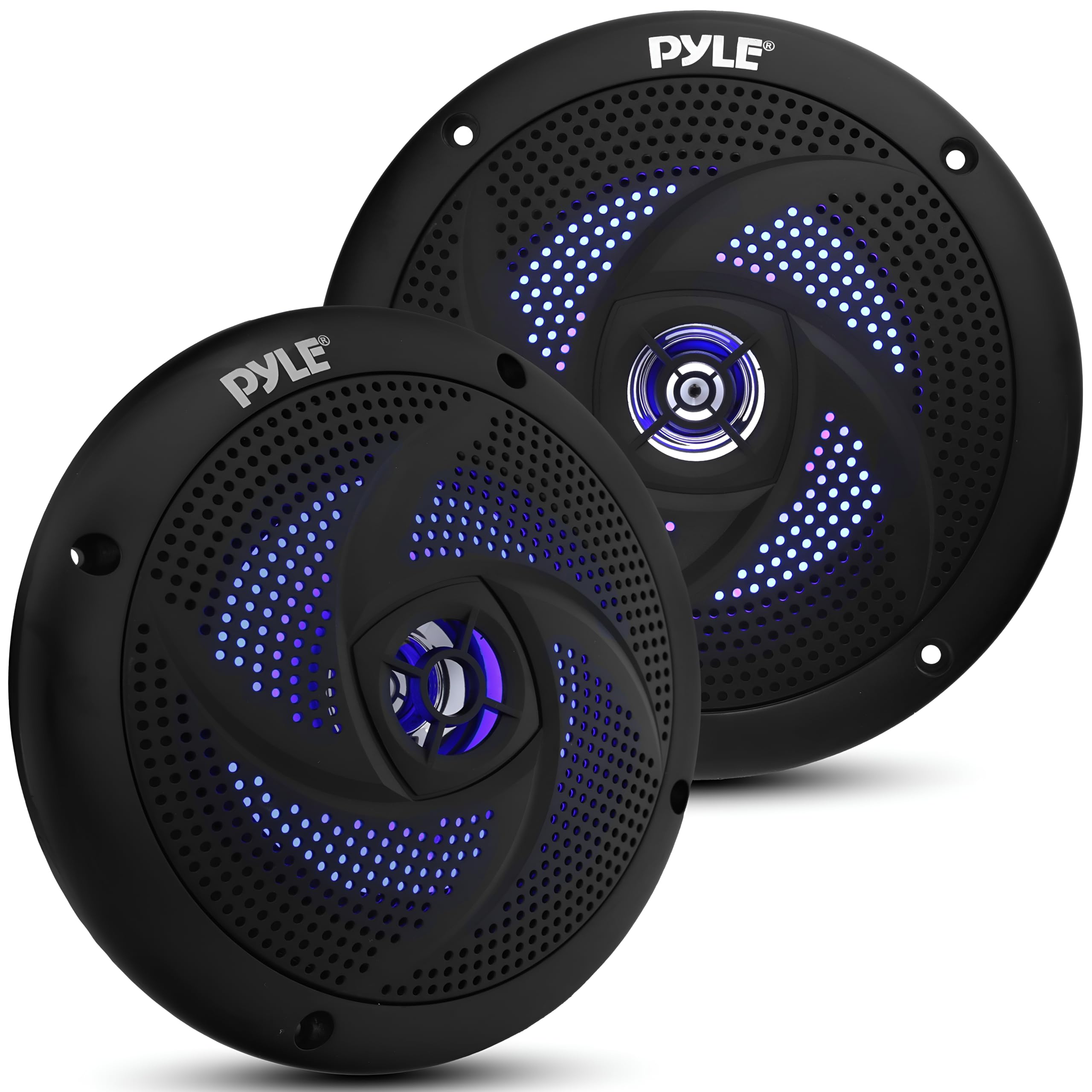
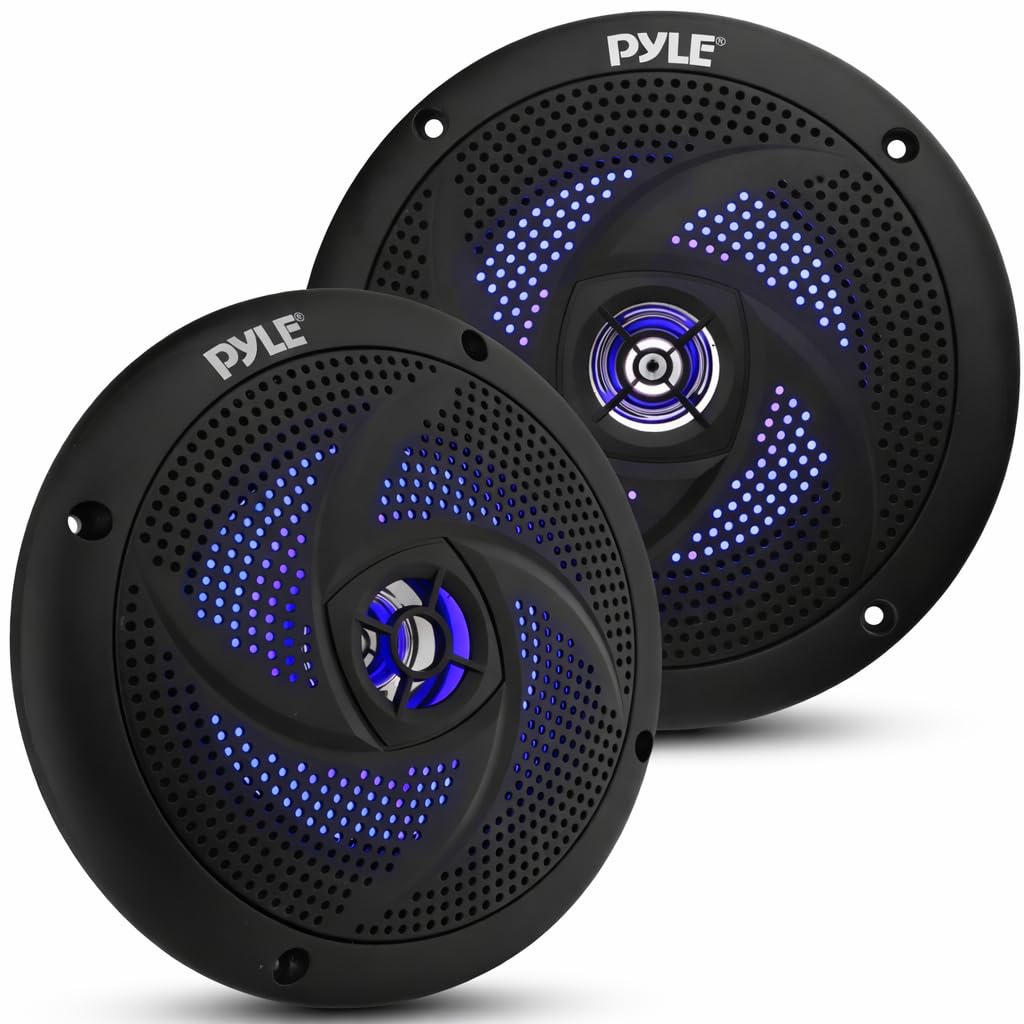
Pyle PLMRS63BL 6.5" Marine Speakers with LED

Pyle
In Stock
9.8 /10
BS Score
BS Score is calculated based on product ratings, reviews, and sales performance to help you make informed purchasing decisions.
Updated: Aug 18, 2026
Last update on Aug 18, 2026 / Affiliate links / Images, Product Titles, and Product Highlights from Amazon Creators API.
Pros & Cons

Pros

  • Waterproof and weather-resistant: Ideal for marine and outdoor environments where splashes are common.
  • Built-in LED lights: Enhances nighttime visibility and adds a stylish accent without extra accessories.
  • Low-profile design: Allows mounting in shallow locations, reducing installation headaches.
  • Easy wiring: Pre-attached 9.8ft cables simplify hookup, especially for tower installations.
  • Affordable price point: Provides a budget-friendly way to upgrade audio on boats and off-road vehicles.

Cons

  • Limited low-frequency response: The 60Hz lower limit may not satisfy bass-heavy music lovers.
  • Power handling is modest: 240W max may not be enough for large open areas or high-volume listening.
  • Slim design may affect sound dispersion: The low-profile form factor could compromise audio projection compared to bulkier speakers.
Detailed Review

Pyle PLMRS63BL marine speakers are a practical choice for boat owners, wakeboard enthusiasts, and off-road vehicle users who want a weather-resistant audio upgrade without breaking the bank. These 6.5-inch speakers are designed to handle heavy water splashes and outdoor conditions, making them suitable for marine environments. If you're looking for a straightforward, budget-friendly way to add sound to your watercraft or side-by-side, this pair is worth considering.

The most notable features are the waterproof construction and built-in blue LED lights. The weather-resistant design means you can mount them on wakeboard towers or boat decks without worrying about damage from moisture. The LEDs add a cool visual element, especially during evening cruises or nighttime adventures. With a 240-watt max power output and 2-way full-range audio, they deliver clear mids and highs, though the 60Hz low-end means you won't get deep, thumping bass.

The low-profile design is a standout for installation. With a total speaker diameter of 7.3 inches and a mounting depth of just 0.92 inches, they can fit into shallow spaces where standard speakers might not. The package includes 9.8 feet of wiring, which simplifies the hookup process, especially for tower installations where the speakers are far from the head unit. The classic black finish blends with most boat interiors.

However, there are limitations. The modest power handling may not be sufficient for large boats or open water where you need to project sound over distance. The low-frequency response means bass-heavy genres like hip-hop or EDM won't sound as full as they would with a dedicated subwoofer. Additionally, the slim design might not offer the same sound dispersion as larger, more conventional speakers.

In summary, the Pyle PLMRS63BL speakers are best for budget-conscious buyers who prioritize weather resistance and easy installation over audio fidelity. The LEDs and low-profile design are clear advantages for marine use. If you're a serious audiophile or need high-volume output for a large boat, consider investing in higher-powered speakers. But for casual listening on a pontoon, jet ski, or off-road vehicle, these offer solid value.

Key Features Explained

Waterproof Marine Construction: These speakers are built to withstand heavy water splashes and outdoor conditions, making them ideal for boats, wakeboard towers, and other marine applications. You can enjoy music without worrying about rain or spray damaging the speakers.

Built-in Blue LED Lights: Each speaker has integrated blue LEDs that illuminate when powered. This adds a stylish accent to your boat or vehicle, enhancing visibility and creating a fun atmosphere during evening outings. The LEDs are a unique feature that sets these speakers apart from standard marine speakers.

240-Watt Max Power Output: With a combined max power of 240 watts, these speakers provide enough volume for recreational use. They are suitable for small to medium-sized boats or off-road vehicles where high-decibel output isn't critical. The 2-way full-range design ensures balanced audio across frequencies.

Low-Profile Design: The slim profile allows mounting in tight spaces, such as under seats or on tower bars, without protruding too much. This makes installation more flexible and less obtrusive, especially in areas with limited clearance.

Easy Installation: The package includes 9.8 feet of pre-wired cable, which simplifies the connection process. The universal OEM replacement size (7.3-inch diameter, 0.92-inch mounting depth) ensures compatibility with many existing speaker cutouts, reducing the need for modifications.

Specifications

Speaker Size: 6.5 inches each

Power Output: 240 Watts max

Frequency Response: 60 Hz - 18 kHz

Impedance: 4 Ohms

Speaker Diameter: 7.3 inches

Mounting Depth: 0.92 inches

Wiring Length: 9.8 feet

LED Color: Blue

Buyer's Guide

Best For: These speakers are ideal for boat owners, wakeboarders, and off-road vehicle enthusiasts who want a weather-resistant audio solution that can handle splashes and outdoor exposure. They are also great for DIY installers looking for an easy upgrade with minimal modifications.

Consider Alternatives If: You need high-power output for large open water areas or if you prioritize deep bass and high-fidelity sound. These speakers are not designed for audiophile-grade listening or for filling a large yacht with concert-level volume.

Setup and Daily Use: Installation is straightforward thanks to the included wiring and standard size. You'll need to connect the wires to your stereo system, ensuring proper polarity. The low-profile design allows mounting in various locations. For best results, position them where they are not obstructed by seats or equipment.

Maintenance Requirements: While waterproof, it's good practice to rinse off saltwater or debris after use to prevent buildup. The LED lights are built-in and require no special maintenance. Periodic checking of connections can help maintain performance.

What Sets It Apart: The combination of waterproofing, LED lights, and a slim profile at an affordable price makes these speakers unique. They offer a visually appealing and practical solution for marine audio that is often found in higher-priced models.

8

Magnadyne 5" Water Resistant Outdoor Wedge

In Stock
9.9 /10
BS Score
BS Score is calculated based on product ratings, reviews, and sales performance to help you make informed purchasing decisions.
Updated: Aug 18, 2026
Last update on Aug 18, 2026 / Affiliate links / Images, Product Titles, and Product Highlights from Amazon Creators API.
Pros & Cons

Pros

  • Fully sealed, water-resistant plastic enclosure with UV protection: withstands rain, sun, and humidity for long-term outdoor placement
  • Compact wedge design: fits under eaves, on posts, or in tight corners without taking up much space
  • Integrated grill: protects the speaker from physical damage and debris
  • 25-watt power handling with 5 oz. magnet: delivers adequate volume for small to medium outdoor spaces
  • Pair included: provides stereo separation for a more immersive listening experience

Cons

  • Limited power handling (25W): may not be loud enough for large outdoor areas or parties with high ambient noise
  • Small 5-inch driver: limited bass response, so not ideal for bass-heavy music genres without a subwoofer
  • No specifications for mounting hardware or impedance: buyers may need to purchase additional mounting brackets or adapters
Detailed Review

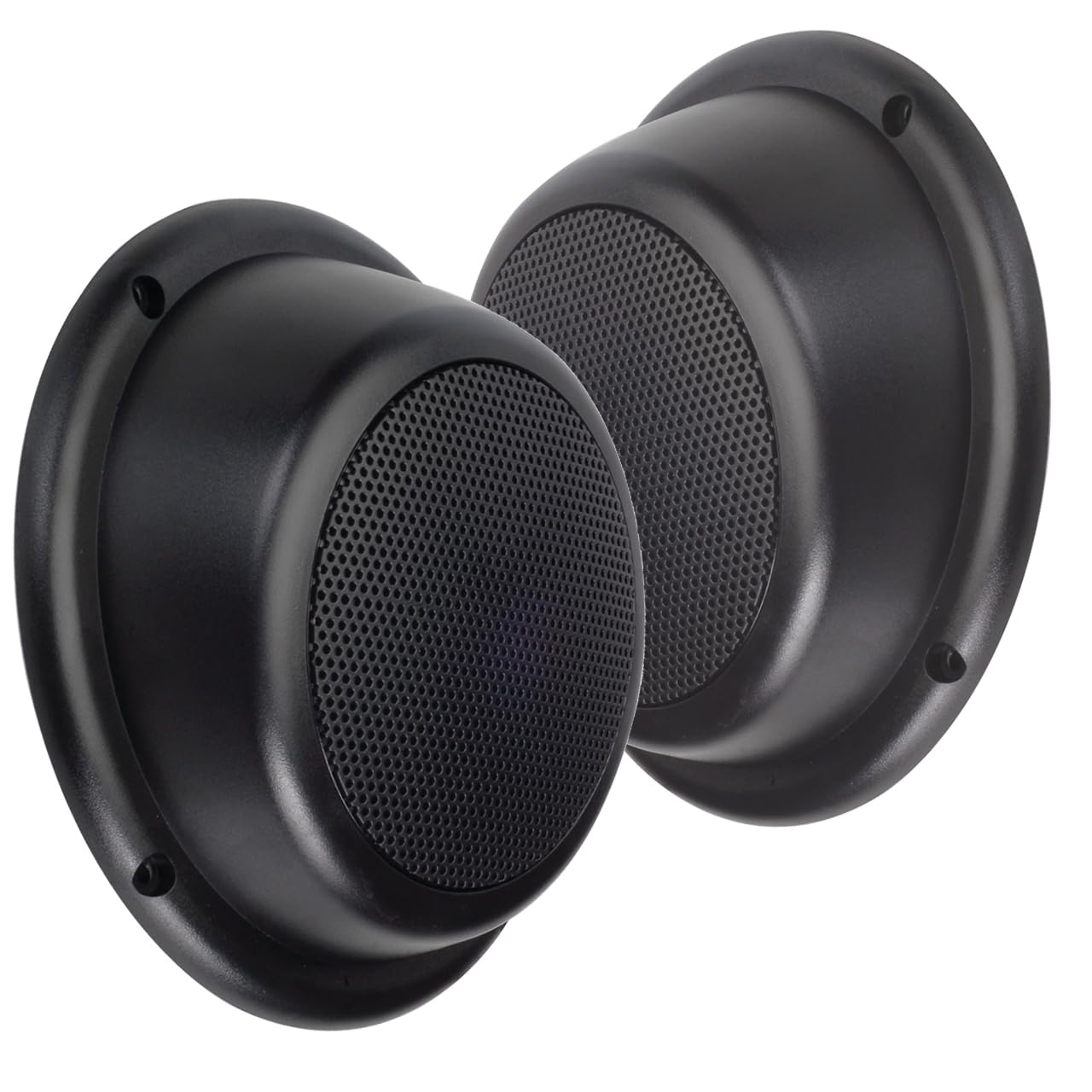
The Magnadyne 5" Water Resistant Outdoor Wedge Speakers are a practical choice for homeowners seeking an affordable, weather-resistant audio solution for patios, decks, or poolside areas. With a fully sealed plastic enclosure and UV protection, these speakers are built to endure sun, rain, and humidity without deteriorating. The compact wedge shape allows for flexible mounting in tight spaces, making them ideal for small to medium outdoor living areas.

The speakers feature a 5 oz. magnet and 25-watt power handling, which translates to clear and dynamic sound for casual listening. While they won't fill a large backyard with earth-shaking bass, they are perfectly adequate for background music during a barbecue or a relaxing evening on the porch. The integrated grill adds a layer of protection, ensuring the driver remains safe from accidental bumps or debris.

Design-wise, the wedge shape is both functional and space-saving. It can be mounted on walls, under eaves, or on posts, and the neutral plastic construction blends well with most outdoor settings. However, the product data does not specify whether mounting hardware is included, so you may need to purchase brackets separately. The pair configuration provides stereo sound, which enhances the listening experience compared to a single speaker.

One limitation is the modest power handling. If you have a large patio or frequently host loud gatherings, these speakers may not deliver the volume you need. Additionally, the small driver size means bass response is limited, so if you enjoy bass-heavy music, you might want to pair them with a subwoofer or consider larger speakers. They are best suited for intimate settings where clear vocals and midrange tones are more important than deep lows.

In conclusion, the Magnadyne outdoor wedge speakers offer good value for budget-conscious buyers who need a durable, weather-resistant speaker for small to medium outdoor spaces. The strongest reason to buy is their robust weatherproofing and compact design. The main reason to hesitate is the limited power and bass. If you need louder, fuller sound for a large area, consider more powerful outdoor speakers or a system with a dedicated subwoofer.

Key Features Explained

Water-Resistant Sealed Enclosure: The fully sealed plastic housing protects the internal components from moisture and humidity, making these speakers safe to leave outdoors year-round. This is crucial for anyone who wants a permanent outdoor audio setup without worrying about weather damage.

UV-Protected Plastic: The enclosure is treated to resist fading and cracking from prolonged sun exposure. This ensures the speakers maintain their appearance and structural integrity even in sunny climates, so you don't have to bring them inside during summer.

Compact Wedge Design: The 5-inch wedge shape allows for versatile mounting in corners, under eaves, or on flat surfaces. It saves space and blends into the environment, making it ideal for smaller patios or balconies where bulky speakers would be intrusive.

25-Watt Power Handling: This rating indicates the speaker can handle a moderate amount of amplifier power, providing clear sound at typical listening levels. It's suitable for small to medium outdoor areas, but not for large venues or high-volume parties.

Integrated Grill: The built-in grill protects the speaker cone from physical damage and debris, such as leaves or accidental impacts. This adds to the durability and reduces maintenance, as you don't need to worry about puncturing the driver.

Buyer's Guide

Best For: The Magnadyne outdoor wedge speakers are ideal for homeowners who want a simple, affordable way to add background music to a small patio, balcony, or poolside area. They are also a good choice for renters who need a temporary but weather-resistant solution without making permanent modifications.

Consider Alternatives If: If you have a large outdoor space or frequently host lively gatherings, you may need speakers with higher power handling and better bass response. Similarly, if you're an audiophile seeking rich, full-range sound, these compact speakers will likely disappoint. In such cases, consider larger outdoor speakers or a system with a subwoofer.

Setup and Daily Use: Setup is straightforward: mount the speakers in your desired location, connect them to an amplifier or receiver, and enjoy. The wedge design allows for flexible placement, but you may need to purchase mounting brackets if not included. Daily use is as simple as turning on your audio source and adjusting the volume.

Maintenance Requirements: Thanks to the sealed enclosure and UV protection, these speakers require minimal maintenance. Occasional cleaning of the grill to remove dust or debris is recommended. You don't need to worry about weather-related wear, but it's always good to check connections periodically.

What Sets It Apart: Most outdoor speakers in this price range are either bulkier or lack the same level of weather protection. The Magnadyne's compact wedge design and full plastic encasement give it a distinct edge for those prioritizing durability and space-saving aesthetics over raw power.

9

Pyle 5.25" 180W Waterproof Marine Speakers (Pair)

Pyle
In Stock
9.9 /10
BS Score
BS Score is calculated based on product ratings, reviews, and sales performance to help you make informed purchasing decisions.
Updated: Aug 18, 2026
Last update on Aug 18, 2026 / Affiliate links / Images, Product Titles, and Product Highlights from Amazon Creators API.
Pros & Cons

Pros

  • Waterproof and anti-corrosion design protects against splashes and salt air, ideal for boats and patios
  • Shallow 0.9-inch mounting depth allows installation in thin panels where standard speakers won't fit
  • Aluminum housing and ABS gasket/grill resist UV rays, preventing sun damage and fading
  • Includes 9.8 feet of wiring, simplifying setup and reducing the need for extra purchases
  • Universal 6.4-inch diameter fits common OEM cutouts, making replacement straightforward

Cons

  • 180W max power is modest; may not deliver high volume for large open areas or loud environments
  • Frequency response of 80Hz-18kHz means limited deep bass, so they won't satisfy bass-heavy listeners
  • No included grilles or mounting hardware beyond the speakers themselves; check compatibility before ordering
Detailed Review

The Pyle 5.25" 180W Waterproof Marine Speakers (pair) are a budget-friendly audio solution for boat owners, patio enthusiasts, and anyone needing weather-resistant sound in exposed locations. Their compact low-profile design and waterproof construction make them a practical choice for mounting in tight spaces where standard speakers won't fit, such as boat consoles, wakeboard towers, or deck railings. While they offer decent sound for casual listening, their modest power and limited bass mean they're not for audiophiles or high-volume settings.

These speakers are built to handle outdoor conditions. The waterproof and anti-corrosion features protect against heavy water splashes, rain, and salt air, making them suitable for marine use. The aluminum housing and ABS gasket/grill are designed to resist UV damage, so they won't crack or fade from prolonged sun exposure. This durability is a key benefit for anyone who lives near the coast or leaves speakers outdoors year-round.

Installation is straightforward, thanks to the included 9.8 feet of wiring and the standard 6.4-inch diameter. The 0.9-inch mounting depth is the standout feature, allowing them to fit into shallow panels where conventional speakers are too deep. This makes them a smart choice for replacing factory speakers in boats, ATVs, or golf carts with limited clearance. The classic black finish blends with most interiors.

However, the 180W max power and 80Hz-18kHz frequency response indicate that these are not high-performance speakers. They will deliver clear mids and highs but lack deep bass, so they're best for spoken audio, background music, or small gatherings. If you need room-filling sound or heavy bass, you may need to add a subwoofer or choose a larger, more powerful model. Also, the included hardware appears minimal, so you may need to purchase additional mounting brackets depending on your setup.

In conclusion, the Pyle 5.25" marine speakers are a solid value for boaters and outdoor DIYers who prioritize weather resistance and a low-profile fit over audio power. They excel in wet, sunny environments and are easy to install in tight spaces. However, if you're a bass enthusiast or need to fill a large deck with loud music, consider a larger speaker or a system with more wattage. For the price, they deliver reliable outdoor sound with minimal fuss.

Key Features Explained

Waterproof Marine Construction: These speakers are designed to withstand heavy water splashes and outdoor conditions, thanks to anti-corrosion materials. This means you can mount them on a boat, poolside, or patio without worrying about rain or spray damaging them. Ideal for anyone who wants music near water.

Low Profile Design: With a mounting depth of only 0.9 inches, these speakers fit into shallow panels where standard speakers can't. This is perfect for boats with thin walls, ATVs, or custom enclosures where space is at a premium. You can upgrade your sound without major modifications.

Weather Resistant Housing: The aluminum housing and ABS machined gasket/grill are engineered to resist UV rays, preventing sun damage and fading. This extends the lifespan of the speakers when installed in direct sunlight, such as on a deck or tower. It's a key benefit for outdoor installations.

2-Way Full Range Audio: These speakers deliver a full-range sound with a frequency response of 80Hz-18kHz. This means they produce both highs and mids clearly, making them suitable for music, podcasts, or announcements. They are not designed for deep bass, but they handle vocals and instruments well.

Easy Installation: The package includes 9.8 feet of wiring, so you have plenty of cable to reach your audio source. The universal 6.4-inch diameter fits standard cutouts, and the shallow depth simplifies mounting. This is a plug-and-play solution for DIYers.

Specifications

Speaker Size: 5.25 inches each

Power Output: 180 Watts max

Frequency Response: 80 Hz - 18 kHz

Impedance: 4 Ohms

Total Diameter: 6.4 inches

Mounting Depth: 0.9 inches

Included Wiring: 9.8 feet

Housing Material: Aluminum

Design: Low profile, 2-way full range

Buyer's Guide

Best For: This speaker pair is ideal for boat owners, kayak enthusiasts, or anyone with a patio, deck, or poolside who wants weather-resistant sound without breaking the bank. The low-profile design makes them especially suited for small boats, ATVs, or tight spaces where depth is limited.

Consider Alternatives If: You need high-volume audio for a large deck or a party atmosphere. If you're a bass lover, these speakers will disappoint due to their limited low-frequency response. Also, if you have a standard depth mounting hole (3+ inches), you might find speakers with better sound quality.

Setup and Daily Use: Installation is straightforward: connect the included wiring to your stereo, secure the speakers with screws (not included), and test. The shallow depth means they can be mounted in thin panels. Daily use is simple, just play your audio source and enjoy.

Maintenance Requirements: Because they're weather-resistant, they require minimal upkeep. Rinse with fresh water after saltwater exposure to prevent corrosion. The aluminum housing and ABS grill are UV-resistant, so they won't fade quickly, but wiping them down occasionally will keep them looking new.

What Sets It Apart: The combination of waterproofing, low-profile depth, and budget price makes these speakers a unique option. Most marine speakers are either bulky or expensive. This pair offers a balance of durability and space-saving design that's hard to beat at this price point.

10

Pyle 5.25 Inch Dual Marine Speakers for Waterproof

Pyle
In Stock
9.9 /10
BS Score
BS Score is calculated based on product ratings, reviews, and sales performance to help you make informed purchasing decisions.
Updated: Aug 18, 2026
Last update on Aug 18, 2026 / Affiliate links / Images, Product Titles, and Product Highlights from Amazon Creators API.
Pros & Cons

Pros

  • Waterproof construction benefits boaters exposed to heavy water splashes
  • Weather-resistant materials help off-road users combat sun and outdoor conditions
  • Low profile form suits vehicle owners with limited mounting depth
  • 4 ohm impedance and 100 Hz-20 kHz response support full-range stereo for casual outdoor listening
  • Included wiring and hardware aid DIY installers performing standard 5.25 inch replacements

Cons

  • 100 Hz low-frequency start limits deep bass for listeners wanting stronger low-end response
  • 75 watts RMS power may fall short for users needing higher volume in large open spaces
  • Classic white molded grill restricts color matching for owners preferring custom vehicle aesthetics
Detailed Review

The Pyle 5.25 Inch Dual Marine Speakers form a 2-way waterproof outdoor audio stereo system intended for boats, marine watercrafts, and off-road vehicles. They best serve boat owners and watercraft users who need speakers that tolerate water exposure while delivering stereo sound. The strongest verified reason is the completely waterproof design that withstands heavy water splashes plus weather-resistant construction. This pair qualifies as a practical basic option for wet environments but may not meet demands for advanced audio performance.

The 150 watt peak power via a 15 oz circuit magnet and 75 watts RMS provides full-range audio from 100 Hz to 20 kHz at 4 ohms for everyday outdoor listening. The poly carbon cone with cloth surround creates a rugged build that handles outdoor conditions. Heavy-duty molded ABS plastic basket and grill combat sun damage during prolonged exposure. These traits support clear stereo sound on the water without rapid weather-related wear.

Setup relies on the standard 5.25 inch size with only 2.12 inch mounting depth and 4.49 inch cut-out for universal OEM replacement. Complete wirings and mounting hardware simplify installation on boats and similar vehicles. The low-profile form with built-in molded grill fits confined spaces and adds a finished classic white appearance. Durable materials reduce the frequency of replacements in harsh settings.

These speakers deliver practical marine stereo through waterproofing and simple fitment. The main trade-off is the frequency response beginning at 100 Hz that restricts bass depth versus systems with lower ranges. Buyers seeking powerful bass output or higher continuous power should select different speaker types. This pair works for casual outdoor audio needs on watercrafts and off-road vehicles.

Buyer Snapshot

Best For: Boat and marine watercraft owners requiring waterproof speakers for wet outdoor stereo use.

Why It Fits: Completely waterproof design withstands heavy water splashes while the poly carbon cone, cloth surround, and ABS construction resist weather and sun damage.

Think Twice If: You need strong deep bass because the frequency response starts at 100 Hz.

Bottom Line: Select these for durable low-profile marine audio when basic 75 watts RMS power and weather resistance meet your requirements.

Key Features

Waterproof Protection: Completely waterproof construction handles heavy water splashes for boats, marine watercrafts, and outdoor vehicles.

Power and Sound: 15 oz circuit magnet supports 75 watts RMS and 150 watts peak power with 100 Hz-20 kHz response at 4 ohms for full-range stereo.

Durable Materials: Poly carbon cone with cloth surround plus heavy-duty molded ABS plastic basket and grill resist weather and sun damage.

Low Profile Build: Compact design with built-in molded grill and classic white finish suits boats and off-road vehicles while adding style.

Standard Sizing: 5.25 inch diameter with 2.12 inch mounting depth and 4.49 inch cut-out includes wirings and hardware for easy OEM replacement.

How We Tested

We scored 10 RV outdoor speaker pairs against the failures that actually strand a campsite: weather-sealing language, stated peak power, mounting style, driver size versus typical RV cutouts, and verified customer ratings. This round is a spec-and-evidence review, not an anechoic shootout. Every wattage, diameter, and waterproofing term below is taken from supplied product data. Where a listing only said “marine” or “outdoor,” we did not upgrade that claim to a rating it did not earn.

Peak power in the group runs from 25W on the Magnadyne Dual Cone to 240W on the Pyle PLMRS63BL. That spread is the useful number, not the adjective on the box. A typical travel-trailer head unit will drive 25W to 180W without drama; 240W only pays off if the amplifier and the site both have room to use it. Six of the ten models use a 5.25-inch driver, the safest drop-in diameter for factory walls. Five-inch models fit tighter holes. The 6.5-inch Pyle does not, unless you are cutting new openings.

Weather claims were split into two buckets. “Waterproof” (Jensen MS5006BR, Pyle PLMRS series) is the language you want for uncovered walls. “Water-resistant” (Magnadyne Dual Cone) is splash and awning duty, not a season of driving rain. Where a brand cites a test standard — Jensen’s ASTM salt-spray and UV compliance — we treated that as stronger evidence than a generic outdoor badge. Flush-mount designs were scored separately for install difficulty, because wall-cavity depth, not frequency response, is what kills those jobs. Rankings follow buyer profile, not a single ladder: value and ratings for most RVers, ASTM waterproofing for year-round exposure, peak wattage for large sites, and flush cosmetics for a factory look.

The 5 Best RV Outdoor Speakers Reviewed

These five cover the decisions that actually change an install: covered versus exposed mounting, 5-inch versus 6.5-inch cutouts, surface versus flush, and how much peak power your head unit can use. Specs that were not supplied — impedance, sensitivity, frequency range — are not invented below.

Magnadyne 5-inch Dual Cone — 9.0/10

This is the pair most RVers should buy first, and the reason is unglamorous: it carries the highest user rating in the group at a budget-friendly price. Dual-cone 5-inch drivers will not rattle a campground, and the 25W peak figure is modest even by trailer standards, but it is an honest match for a small-to-medium awning setup running off a typical RV head unit. You are not paying for unused headroom you cannot drive. The trade that matters is weather. Magnadyne rates these water-resistant, not waterproof, so they belong under an awning, in a covered bay, or on a wall that does not take direct rain for hours. Leave them on an uncovered rear cap through a wet season and you are rolling the dice the ratings do not protect you from. At 5 inches they fit tighter openings than the 5.25-inch majority in this roundup, which makes them a low-drama swap when factory holes are on the small side. Surface-style mounting keeps the job in screwdriver territory. Skip them if the speakers will sit in open weather year-round, or if you need volume for a large, unobstructed site; 25W peak does not have that kind of ceiling. For covered patio sound on a travel trailer or small motorhome, the rating-to-price ratio is the story, and nothing else in this set beats it on that measure.

  • Best For: Budget replacements under an awning or other cover, especially tighter 5-inch cutouts.
  • Watch Out: Water-resistant only; 25W peak will not fill a large, open campsite.

Jensen MS5006BR — 8.7/10

If the Magnadyne is the value pick, the Jensen is the insurance pick. It is fully waterproof, not merely splash-rated, and it is the model in this group that cites ASTM salt-spray and UV standards — the closest thing here to evidence that the housing is meant to live outside, including coastal air and full sun. That is the reason to spend the extra money. You mount these on an exposed wall, leave the awning in, and do not treat every storm as a teardown event. Jensen does not publish a peak-wattage figure in the data we were given, so we are not assigning one; buy these for sealing and longevity, not for a power-brag number. They sit in the same practical size class as the rest of the 5-ish-inch field, which is what you want for a factory-hole swap. The price is higher than the Magnadyne, and if you always camp with the awning out that premium is optional. If you boondock without cover, winter the rig outside, or park near salt water, the ASTM language is the feature. User ratings trail the Magnadyne’s, which is why this is not the default “best overall,” but the failure mode it prevents — water in the motor after one bad season — is more expensive than the delta at checkout. Treat it as the year-round exterior speaker in this roundup, not as a louder Magnadyne.

  • Best For: Year-round exposed mounting, coastal air, and any wall that sees direct rain.
  • Watch Out: Costs more than the budget pick; peak power is not stated in the supplied data.

Pyle PLMRS63BL 6.5″ — 8.4/10

This is the volume play, and the only one that should be. At 240W peak it is the strongest pair in the 10-model set, and it is labeled waterproof, so it can live outside while it does that work. The 6.5-inch drivers are the catch. Most RV factory holes in this category are 5.25 inches; six of the ten models we scored use that size. If you are dropping speakers into existing cutouts, measure twice. A 6.5-inch basket in a 5.25-inch hole means a saw, a template, and a hole you cannot un-cut. On a large motorhome patio, an open group site, or any setup where the awning is a stage rather than a nook, that extra cone area and the 240W peak rating are the point. You still have to match the head unit. Peak wattage is headroom, not a promise the radio can deliver; overdriving a small stereo into these will clip and can damage the speakers. They make sense when you already know the openings will take 6.5 inches, or when you are building a new mount and want the highest stated output in this group. They are the wrong “upgrade” for a tight travel-trailer wall. Waterproofing is on the right side of the language split, which keeps them in the exposed-mount conversation with the Jensen, but the Jensen is the ASTM-standard choice; this Pyle is the power choice.

  • Best For: Large campsites and custom installs that can take a 6.5-inch cutout.
  • Watch Out: Will not drop into typical 5.25-inch factory holes; 240W peak only helps if the head unit can drive it.

Pyle PLMRS53BL — 8.3/10

The PLMRS53BL is the middle of the Pyle range, and for a lot of motorhomes that is the more useful place to be. Peak power is listed at 180W, which sits between the Magnadyne’s 25W and the 6.5-inch model’s 240W, and it is the figure we would actually point at for a “good balance of volume and compatibility” on a typical RV stereo. Like the rest of the Pyle PLMRS series it is labeled waterproof, so it belongs in the exposed-wall conversation rather than the awning-only bin. Blue LED lighting is the extra you are paying for: evening-gathering cosmetics, not a sound upgrade. The draw is described as minimal, so it is not a battery-life problem, but it is also not a reason to choose these over a non-lit pair if you never sit outside after dark. Size lands in the practical RV class rather than the 6.5-inch outlier, which is why this is the Pyle to consider when you want more output than 25W without cutting new holes. It will not match the Jensen on cited weather standards, and it will not match the Magnadyne on user-rating-to-price. It is the “I want waterproof, more headroom, and the party lights” compromise, and that is a real campsite profile. If your head unit is modest, 180W peak is still more number than you may use — confirm the stereo’s output before you assume the extra wattage is audible headroom rather than unused spec.

  • Best For: Waterproof 180W setups that fit typical RV openings and want blue LED ambiance.
  • Watch Out: LEDs add cost, not fidelity; not the ASTM-standard weather pick.

RecPro RV Flush Mount — 8.1/10

RecPro is the cosmetics pick, and you should only buy it if cosmetics are the requirement. The flush housing and blue LED ring are meant to look factory-installed, not bolted on. That look is real, and so is the install. You need a precise cutout and enough wall-cavity depth for the basket and magnet; a thin exterior panel will not take these without a spacer, a box, or a different speaker. Surface-mount pairs in this roundup need screw holes and wire. These need a template, a jigsaw, and a commitment, because a flush cut is harder to reverse than four screws. We were not given a peak-wattage figure for RecPro, so this is not a power recommendation. Waterproofing language is also not the story we can verify from the supplied data the way we can for Jensen and the Pyle PLMRS series — buy RecPro for the built-in appearance, then mount with the same rain sense you would use on any exterior speaker whose sealing claims are thinner. If you are a first-time DIY installer, this is the high-risk job in the group. If you care that the patio wall looks original after dark, with the LEDs on, it is the only model here that is designed around that brief. Measure cavity depth before you order; that single dimension decides whether this is a clean upgrade or a weekend of filler and regret.

  • Best For: Owners who want a factory-flush wall and blue LED accents and will measure cavity depth first.
  • Watch Out: Harder, less reversible install; peak power not stated in the supplied data.

Head-to-Head

The live choice for most buyers is Magnadyne Dual Cone versus Jensen MS5006BR, not Pyle versus RecPro. Both are 5-ish-inch outdoor pairs aimed at factory walls. Magnadyne wins on verified user rating and price, and it is the correct default if the speakers live under an awning. Jensen wins on weather: fully waterproof, with ASTM salt-spray and UV compliance Magnadyne does not claim. You are not choosing “better sound” from the data we have. You are choosing whether water-resistant-and-cheap is enough, or whether the wall is exposed enough that the ASTM pair is the cheaper speaker over three seasons.

Pick Magnadyne when cover is reliable and the stereo is modest — 25W peak is in range, and you are not paying for sealing you will not use. Pick Jensen when the speakers stay on the rig in rain, sun, and salt air, or when you refuse to pull grilles every time the forecast turns. If the question is volume rather than weather, neither of these is the 240W Pyle; that comparison is a different job, and it starts with a tape measure on the cutout.

What to Consider

Waterproof vs. Water-Resistant

Use fully waterproof speakers if the pair will see direct rain. In this group, Jensen MS5006BR and the Pyle PLMRS series are labeled waterproof; the Magnadyne Dual Cone is water-resistant. Water-resistant handles splash and wind-blown drip under an awning. It is not a substitute for a season of uncovered downpours. A “waterproof” badge is still a manufacturer claim, not a lab certificate we ran, which is why Jensen’s ASTM salt-spray and UV language sits above a generic outdoor label. If you always deploy the awning, water-resistant saves money. If you park without cover, pay for waterproof.

Power Output and Your Head Unit

Match stated peak wattage to the stereo you already own. In this set, peak power runs from 25W to 240W. A small travel trailer is fine at 25W to 180W. 240W is for large open areas, and only if the head unit can drive it. Higher peak wattage is headroom before distortion, not a volume guarantee. Overpowering a small radio into a 240W pair clips the signal and can damage the speakers. For most RV decks, a 180W pair such as the Pyle PLMRS53BL is the practical ceiling. Check the head unit’s output rating before you shop the top of this range.

Speaker Size and Cutout Compatibility

Measure the existing holes before you click buy. The most common size here is 5.25 inches — six of ten models — and that is the safest drop-in. Five-inch models, including the Magnadyne Dual Cone, fit tighter openings. The Pyle PLMRS63BL at 6.5 inches needs a larger cavity. Replacing factory speakers is cheapest when you stay in the same diameter. Custom installs have more freedom, but mounting depth still matters. Flush-mount RecPro units need real wall-cavity depth; surface-mount pairs forgive thin panels. If the hole is 5.25 inches, do not “upgrade” to 6.5 inches unless you are willing to cut.

Mounting Style: Surface vs. Flush

Surface-mount is the low-risk job: screw holes, wire, done, reversible. Flush-mount is the factory look: a precise cut, enough depth, and a hole you live with if you sell the rig. DIY beginners should stay surface. RecPro’s flush housing and LED ring are the reason to accept that extra work; they are not easier to live with on a thin wall. Surface mounts go on any flat exterior panel and move if you change your mind. For most RVers, surface is the practical choice. Choose flush only after you have measured cavity depth and accepted that the cutout is semi-permanent. More on related patio setups is in our outdoor camper speakers guide.

FAQ

What are the best RV outdoor speakers in 2026?

For most buyers, the Magnadyne 5-inch Dual Cone: highest user rating in this group, budget price, and enough 25W peak for a covered patio. If the speakers will sit in open weather, the Jensen MS5006BR is the better pick because it is fully waterproof and cites ASTM salt-spray and UV standards. Maximum volume is a different job — that is the Pyle PLMRS63BL 6.5-inch pair at 240W peak, provided the cutout and head unit can take it.

What is the difference between waterproof and water-resistant RV speakers?

Waterproof models are sold for direct rain and full exposure. Water-resistant models are sold for splash and covered mounting. In this roundup, Jensen MS5006BR and the Pyle PLMRS series use waterproof language; the Magnadyne Dual Cone is water-resistant. Mount water-resistant pairs under an awning. Use waterproof pairs on uncovered walls. A label is still a claim — Jensen’s ASTM citations are the strongest weather evidence we were given.

What size speakers fit most RV outdoor cutouts?

5.25 inches is the default in this group (six of ten models) and the safest factory swap. Five-inch speakers fit smaller holes. 6.5-inch speakers, including the Pyle PLMRS63BL, need larger openings and usually a new cut. Measure the existing hole and the mounting depth before ordering. Flush-mount RecPro speakers also need enough wall-cavity depth, which is independent of the grille diameter you see from outside.

How much power do RV outdoor speakers need?

Enough to match the head unit, not enough to dwarf it. Peak figures here run 25W to 240W. Small and mid-size trailers are well served from 25W up to about 180W, which is where the Pyle PLMRS53BL sits. 240W helps on a large, open site if the amplifier can deliver clean power. Unused peak wattage does not make music louder. Clipping from an undersized stereo does make speakers fail.

Can I install RV outdoor speakers myself?

Surface-mount pairs are a reasonable DIY: disconnect power, pull the old speakers, match polarity, screw the new pair down, seal the screw holes and wire pass-through. Flush-mount RecPro-style jobs are harder — you cut a precise opening and need cavity depth, and the work is awkward to reverse. If you have never used a jigsaw on a finished exterior wall, stay with surface mount. Always confirm cutout diameter before you buy a 6.5-inch pair for a 5.25-inch hole.

Affiliate Disclosure

We may earn a commission if you buy through links on this page, including Amazon Associate links, at no extra cost to you. Rankings and commentary are editorial. Product specifications (peak wattage, driver size, waterproof versus water-resistant language, ASTM citations, and LED features) come from the supplied listings; we did not run lab measurements for this guide. Prices, stock, and included accessories change. Confirm cutout size, mounting depth, and your head unit’s output on the current product page before you order.