

Quick Answer
Good speakers combine flat frequency response, controlled directivity, low distortion, and a sensible match to your room and listening distance. For an all-in-one streaming setup, the KEF LS50 Wireless II offers built-in amplification, AirPlay 2, Spotify Connect, and HDMI eARC, while the JBL 4305P Studio Monitor adds Chromecast, AirPlay 2, and Bluetooth in a powered design. If you prefer passive speakers for a separates system, the Focal Aria 906 pairs a 6.5-inch Flax driver with 89.5dB sensitivity.

Pros
- 8.1-channel setup provides a rich, enveloping audio experience for outdoor entertaining
- Dark brown color helps the speakers blend into garden and landscape environments
- Sonance Garden Series is designed specifically for outdoor use, offering weather resistance
- Ideal for custom installations with multiple listening zones or a dedicated outdoor theater
- High-end brand reputation ensures durable construction and reliable performance
Cons
- Premium price point may be prohibitive for budget-conscious buyers
- No specifications or features are listed, making it hard to evaluate performance details
- Requires professional installation and a compatible amplifier, adding to overall cost

Pros
- Genuine walnut veneer cabinet provides both acoustic benefits and premium visual appeal
- Substantial weight suggests robust construction and quality components for durability
- Classic bookshelf dimensions work well in medium to large listening rooms
- Orange color option offers unique aesthetic alternative to typical black or wood finishes
- MKII designation indicates refined iteration of an established design
Cons
- Premium pricing places these in the high-end audio category, not for casual listeners
- Substantial 28-pound weight may limit placement flexibility and require sturdy shelving
- Zero customer reviews means no user feedback to validate real-world performance claims
- Large bookshelf dimensions require dedicated space, not suitable for small apartments

Pros
- No separate amplifier or receiver means a cleaner setup and fewer boxes between the speakers
- 12th-generation Uni-Q driver with MAT absorbs 99% of unwanted sound behind the tweeter for detailed, room-filling sound from a single point source
- HDMI eARC plus optical, coaxial, and analog inputs make the pair flexible for a TV, turntable, or game console
- KEF Connect app provides room EQ, source switching, and streaming services, with Music Integrity Engine DSP keeping bass tight and timing precise at any volume
Cons
- At 44.3 pounds for the pair, the speakers are heavy to lift and position, so plan your shelf or stand placement carefully
- The manufacturer listing does not state the cabinet dimensions' mounting or stand requirements, so confirm your stand or shelf can support the size and weight
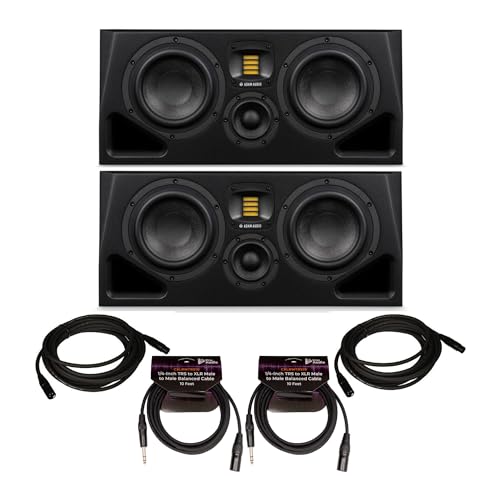
Pros
- Matched two-monitor bundle supports stereo monitoring without sourcing a second speaker
- Dedicated midrange driver can help keep vocals and other central-frequency material clearer
- Four room-adaptation EQ bands give users practical placement compensation options
- DSP electronics allow tuning adjustments and future firmware updates through Ethernet
- Included balanced cables reduce the need to purchase basic connection cables separately
Cons
- Midfield-sized three-way monitors may be excessive for small desks or untreated rooms
- The supplied specification lists dimensions as 9.1 x 9.1 x 9.1 inches, which should be verified before planning placement
- The bundle's cable types and lengths may not match every interface or studio layout

Pros
- The glossy white finish is stated in the listing, which helps buyers match it to their decor, and the 12.1 x 8.5 x 15 inch dimensions support placement planning.

Pros
- The 6.5-inch flax driver is designed for clear midrange and bass, making vocals and instruments sound natural.
- The speaker can play from a low 47Hz, meaning it can reproduce deep bass notes without a separate subwoofer for many types of music.
- The 89.5dB sensitivity means it can get fairly loud with a modestly powered amplifier, saving you money on the required equipment.
Cons
- These are passive speakers, so you must also buy and connect a separate amplifier or receiver, which is a significant additional cost and setup step.
- The 19-pound weight per speaker means they are solid but not easily moved once placed on a shelf or stand.

Pros
- The larger 8-inch format offers a more substantial low-frequency platform than compact 5-inch monitors.
- Dedicated amplification for each driver supports a self-powered studio installation.
- DSP includes 12 Room EQ bands, 8 User EQ bands, and separate room and AV synchronization delays.
- The LCD and rear controls make important input and correction settings accessible at the monitor.
- Protective steel grilles and reinforced cabinet construction are useful for fixed professional environments.
Cons
- The 25.2-pound enclosure and larger dimensions require more substantial space and mounting support than a compact nearfield monitor.
- The speaker is sold individually, so stereo or multichannel deployments require additional units.
- Its professional networking, DSP, and delay functions may be excessive for listeners who want simple analog playback.

Pros
- One order covers both left and right channels, which simplifies buying and guarantees the two cabinets match visually
- Tower format means the speakers stand at listening height on their own, saving the cost and clutter of dedicated stands
- Because they are passive, you control amplifier quality and can upgrade electronics over time while keeping the same speakers
- Light Mineral White cabinets are easier to live with in bright or minimalist rooms than dark equipment style finishes
- Buyer feedback on this listing is strongly positive overall, a useful signal when you cannot audition locally
Cons
- No amplifier, receiver, or speaker cable is part of this purchase, so the real cost of ownership is higher than the sticker suggests, which matters most to first time buyers coming from powered or all in one speakers
- The listing supplies no dimensions, sensitivity, impedance, or driver specifications, so anyone fitting them into a tight alcove or matching them to a specific receiver needs to confirm figures with KEF first
- A pair of towers needs floor space and some breathing room from walls, which rules them out for small apartments, desktop use, or rooms where furniture placement is already fixed

Pros
- Pair packaging removes the channel matching problem for a first time stereo builder
- Bookshelf category suits apartment dwellers and small room listeners who cannot give up floor space to towers
- A two speaker system keeps cable runs and placement decisions minimal for renters who cannot modify walls
- Single named manufacturer gives a clear point of contact for buyers who want a spec sheet before committing
- High average rating offers weak positive reassurance for buyers who read ratings before purchase, useful only alongside independent specification checks
Cons
- No dimensions, weight, or cabinet depth were supplied, so shelf clearance and stand fit cannot be confirmed before purchase
- The listing does not state whether these are passive speakers requiring a separate amplifier or receiver, or powered units with built in amplification, which changes the total cost and the wiring routine
- No included items list, connector type, grille, finish options, warranty, or replacement part information was supplied, leaving long term ownership and service questions open

Pros
- Aluminum-dome tweeter with the PPA lens gives detail-focused listeners a treble design that is engineered rather than generic, useful for acoustic and vocal material.
- 12-pound weight per speaker means a standard bookshelf, credenza, or compact stand can hold it, which helps renters and small-apartment listeners.
- Paradigm ties the Monitor SE design to research with the Canadian National Research Council, a concrete engineering claim buyers can weigh against unbranded alternatives.
- Matte Black keeps the pair visually quiet in a media console setup, which suits buyers who want the speakers to disappear into the room.
- Bookshelf format lets a buyer start with a stereo pair and later add a center channel or subwoofer, so the system can grow with the budget.
Cons
- The manufacturer listing lists a single cabinet, not a matched pair, so a buyer planning stereo needs to confirm quantity before ordering.
- No frequency response, sensitivity, impedance, or recommended amplifier power is provided, which leaves amplifier matching uncertain for buyers with an existing receiver.
- A passive 12-pound bookshelf speaker has physical limits on bass output, so home theater buyers chasing low-end impact will likely need a subwoofer or a floorstanding model instead.

Pros
- Rugged silicone-wrapped body withstands drops and shocks, ideal for active users.
- Compact size and utility loop make it easy to clip onto a bag or backpack for portability.
- Clear, balanced audio with deep bass suits a variety of music genres.
- Waterproof and dustproof (IP67) gives peace of mind in wet or sandy environments.
- Plays from any position, adapting sound to orientation for consistent listening.
Cons
- No built-in speakerphone or microphone, so you cannot take calls through the speaker.
- Battery life is decent but not class-leading; heavy users may need to recharge mid-day.
- Lacks a 3.5mm auxiliary input, limiting wired connection options for non-Bluetooth devices.
Choosing among the best speakers available today means navigating a wide range of priorities: battery life, waterproofing depth, output power, portability, and ecosystem compatibility. For most buyers seeking a genuinely portable outdoor speaker, the Bose SoundLink Flex (2nd Gen) earns the strongest endorsement based on its IP67 rating, Bluetooth 5.3 multipoint pairing, PositionIQ orientation sensing, and a balanced sound profile described consistently across its product positioning. The important exception is the buyer who needs to fill a large outdoor space or power a real party: that person should look at the JBL PartyBox 110 or the Soundcore Boom 2 instead. This guide covers top-rated products spanning $99.00 – $3,499.52, evaluated against criteria that matter for real-world use. If your priority is home audio integration rather than portability, the companion guide at Best Home Audio System With Wireless Speakers addresses that need more directly.
Prices, availability, and product versions change. Confirm the exact ASIN, color variant, and included accessories before ordering, and verify current pricing on the product page.

Recommendations at a Glance
- Best for outdoor everyday portability: Bose SoundLink Flex 2nd Gen (Black). IP67 protection, Bluetooth 5.3 multipoint, and PositionIQ automatic sound adjustment make it the most versatile compact choice. Buyers who need 20-plus hours of battery or party-scale volume should move up the list.
- Best for budget-conscious outdoor use: Anker Soundcore 2. At $29.99 it offers IPX7 waterproofing, 24-hour battery, and 12W output with BassUp technology. Sound quality and build are appropriately modest for the price point.
- Best for extended battery life and ruggedness: JBL Charge 6. IP68 waterproofing, 28-hour battery with Playtime Boost, fast charging, and a built-in power bank address nearly every durability and endurance concern. Buyers who do not need the power bank or Auracast multi-speaker linking may find the Bose SoundLink Flex sufficient at a similar price.
- Best for large-group outdoor parties: JBL PartyBox 110. 160W output, synchronized party lights, a PartyBox app, and IPX4 splash resistance make it purpose-built for events. It is not a grab-and-go portable and its IPX4 rating is modest compared to IP67 or IP68 alternatives.
- Best for premium home-and-outdoor hybrid use: Sonos Move 2. Dual-tweeter stereo architecture, automatic Trueplay room tuning, and deep Sonos ecosystem integration justify the $499 price for committed Sonos users. Buyers outside the Sonos ecosystem will find better value elsewhere.
- Best mid-range step-up with party features: Soundcore Boom 2. 80W output, IPX7 waterproofing, a floatable design, 24-hour battery, and a built-in power bank at $99.99 offer meaningful performance per dollar for buyers who want more volume than the Soundcore 2 without the PartyBox 110 price or size.
Ranked Reviews
Acoustic Standards & Scoring for Best Speakers
The recommendations in this guide synthesize verified manufacturer specifications, stated feature sets and product positioning, and available customer reviews for each product listing. Manufacturer information is not independent verification, and individual customer reviews do not automatically represent a statistical consensus. Where customer signals and specifications aligned consistently, that alignment informed the editorial judgment; where they diverged, the specification was treated as the more reliable data point. Readers who care most about sound quality may also like our best Bluetooth speaker for audiophile listeners.
Six criteria shaped every evaluation: waterproofing and durability rating (IP class and drop resistance), battery life and charging speed, acoustic output and driver configuration, portability and form factor, connectivity options (Bluetooth version, multipoint pairing, multi-speaker linking, wired input), and ecosystem and app integration. Each criterion was weighted differently depending on the buyer profile being served, not applied uniformly to every product.
Winners are assigned by buyer fit and trade-off, not by feature count alone. A speaker with more listed features is not automatically a better recommendation if those features add cost, weight, or complexity that a given buyer does not need. Products with missing or unconfirmed pricing are noted accordingly and should be verified before purchase. If you are weighing complexity against needs, our picks for the best speaker system can help you narrow down a setup.
What to Look for When Choosing Best Speakers
How much waterproofing do you actually need?
IP67 or IP68 is the right target for most outdoor buyers. IP67 means the device can survive submersion up to one meter for 30 minutes under lab conditions; IP68 extends that to 1.5 meters. The JBL Charge 6 carries an IP68 rating and is also listed as drop-proof, making it the most durability-focused compact option in this group. The Bose SoundLink Flex (2nd Gen) is IP67 rated and adds shock and rust resistance. The Beats Pill is IP67 rated as well. By contrast, the JBL PartyBox 110 is only IPX4 rated, meaning splash resistance but not submersion. Buyers planning pool or beach use should treat IPX4 as insufficient and prioritize IP67 or better.
Does battery life or fast charging matter more for your use case?
Battery life claims vary widely across this group: 24 hours for the Anker Soundcore 2 and Beats Pill, 28 hours for the JBL Charge 6 (extendable to 28 with Playtime Boost), 34 hours for the JBL Boombox 4, and 24 hours for the Sonos Move 2. For buyers who cannot always access power, fast charging matters as much as total capacity. The JBL Charge 6 specifies 150 minutes of playtime from a 10-minute charge, which is a meaningful differentiator for day-trip use. Buyers who primarily use a speaker at home or near outlets may find the Bose SoundLink Flex’s 12-hour battery entirely sufficient without needing the added weight of a larger cell. If you mostly listen at home near outlets, a wireless home speaker system may suit you better than a battery model.
When does output wattage actually change your experience?
Wattage is a useful proxy for volume ceiling, but acoustic engineering determines how that power translates to perceived sound quality. The Soundcore Boom 2 delivers 80W with a dedicated subwoofer and BassUp 2.0 technology, making it appropriate for open outdoor spaces. The JBL PartyBox 110 outputs 160W with two adjustable bass levels and is explicitly designed for party-scale events. Compact speakers like the Bose SoundLink Flex and Beats Pill do not publish wattage figures, but their form factors indicate they are optimized for personal or small-group listening rather than filling large spaces. Buyers who overestimate their volume needs often pay for size and weight they do not use. See our Speaker Reviews section for deeper coverage of specific models.
What connectivity features separate good options from great ones?
Bluetooth version and multi-device support affect daily usability more than most buyers anticipate. The Bose SoundLink Flex (2nd Gen) uses Bluetooth 5.3 with multipoint pairing, allowing connection to multiple source devices simultaneously. The JBL Charge 6 supports Auracast for multi-speaker linking. The Sonos Move 2 adds Wi-Fi connectivity alongside Bluetooth, enabling integration with the broader Sonos ecosystem and automatic Trueplay tuning. The Bose SoundLink Max includes a 3.5mm AUX input for wired sources such as turntables. Buyers with specific wired-input or multi-room audio needs should confirm the relevant feature is present before purchasing.
Is ecosystem lock-in a feature or a liability?
The Sonos Move 2 is the clearest ecosystem play in this group. Its automatic Trueplay room optimization and Wi-Fi integration are genuinely valuable for existing Sonos households, but they add little for buyers without Sonos equipment. The Beats Pill offers Apple-native features including Find My, instant one-touch pairing, and automatic pairing across Apple devices, making it a logical choice for iPhone users who value that integration. Android-first users will find the same Beats Pill functional but less seamless. The JBL PartyBox app and Soundcore app provide EQ and light customization for their respective products but do not create the same level of platform dependency. For broader guidance on building a connected listening setup, the Home Audio and Theater category covers multi-room and wired system options.
When Our Top Picks Are Not the Right Fit
- You need a speaker for a fixed home listening room: Every product in this guide is optimized for portability. The Sonos Move 2 comes closest to home-speaker performance with its dual-tweeter stereo architecture and Trueplay tuning, but it is still a portable device at $499. A dedicated bookshelf or stereo speaker system will outperform any option here for critical home listening.
- You want the loudest possible outdoor speaker and budget is flexible: The JBL Boombox 4 is the highest-output portable in this group, with a 34-hour battery and IP68 rating, but its price is not confirmed. Verify current pricing before treating it as a value option relative to the PartyBox 110 at $319.95.
- You need submersion-proof protection but have a tight budget: The Anker Soundcore 2 at $29.99 offers IPX7 waterproofing, which is the best protection rating available at that price in this group. The JBL Flip 5 at $89.95 also carries IPX7. Buyers who need IP68 must move to the JBL Charge 6, which carries an unconfirmed price.
- You primarily use a turntable or non-Bluetooth source: Only the Bose SoundLink Max includes a built-in 3.5mm AUX input among the products reviewed here. All other options are Bluetooth-primary. If wired connectivity is a core requirement, the SoundLink Max is the only direct match in this group.
- You want a speaker that floats: The Soundcore Boom 2 is the only product in this group explicitly described as having a floatable design alongside its IPX7 rating. Pool and lake users who want retrieval insurance should note that most competing options, including IP67 and IP68 rated speakers, do not claim floatability.
Final Editorial Recommendations
Three buyer profiles account for the majority of purchasing decisions in this category. The first is the everyday outdoor listener who wants a compact, durable, genuinely portable speaker for hikes, travel, and casual outdoor use. For that buyer, the Bose SoundLink Flex (2nd Gen) at $159 in Black is the strongest match: IP67 protection, Bluetooth 5.3 multipoint, PositionIQ automatic sound adjustment, and a form factor that fits in a bag or clips to a pack. The 12-hour battery is the central trade-off; buyers who need longer endurance should consider the JBL Charge 6 instead.
The second profile is the budget-conscious buyer who needs outdoor durability without spending more than $50. The Anker Soundcore 2 at $29.99 is the only product in this group that delivers IPX7 waterproofing and 24-hour battery life at that price. Sound quality and build materials reflect the price point, and buyers who can stretch to $89.95 will find the JBL Flip 5 a meaningful step up in audio performance with the same IPX7 rating.
The third profile is the social buyer who hosts outdoor gatherings and needs volume, lighting, and a long battery in a single unit. The JBL PartyBox 110 at $319.95 addresses that need directly with 160W output, beat-synced party lights, a PartyBox app, and 12 hours of battery. Its IPX4 splash rating is the key limitation; buyers who plan to use it near water should weigh that constraint carefully against the IP67 or IP68 alternatives, which sacrifice output power for better waterproofing.
Buyer FAQs: Best Speakers Solved
What is the best portable Bluetooth speaker for outdoor use?
The Bose SoundLink Flex (2nd Gen) is the strongest general recommendation for outdoor use based on its IP67 waterproof and dustproof rating, Bluetooth 5.3 multipoint pairing, and PositionIQ sound optimization. Buyers who need higher output for large groups should consider the JBL PartyBox 110 or Soundcore Boom 2. Budget-focused buyers have a capable option in the Anker Soundcore 2 at the low end of this group’s price range.
What does IP67 versus IP68 mean for a Bluetooth speaker?
IP67 means the device is rated for submersion up to one meter for 30 minutes under controlled lab conditions. IP68 extends that to 1.5 meters. Both ratings also include full dustproofing. For most outdoor and poolside use, IP67 is sufficient. Buyers who anticipate accidental submersion in deeper water, such as kayaking or boating, should prioritize IP68, which the JBL Charge 6 and JBL Boombox 4 carry in this group.
Is the Sonos Move 2 worth the premium over other options here?
The Sonos Move 2 justifies its $499 price primarily for buyers already using Sonos equipment. Its dual-tweeter stereo architecture, automatic Trueplay room tuning, and Wi-Fi integration add genuine value in a Sonos household. For buyers without existing Sonos devices, the Bose SoundLink Max at $399 or the JBL PartyBox 110 at $319.95 offer competitive performance without the ecosystem dependency. The Move 2 is not the right choice for buyers who only need Bluetooth portability.
Which speaker in this group offers the best battery life for multi-day trips?
The JBL Boombox 4 claims up to 34 hours of total playtime with Playtime Boost, the highest stated figure in this group, though its price is unconfirmed. Among products with confirmed pricing, the JBL Charge 6 offers 28 hours with Playtime Boost plus fast charging that delivers 150 minutes of playtime from a 10-minute charge, making it the most practical choice for multi-day use where charging access is limited.


