Can Bose Acoustimass Speakers Work Without a Subwoofer? The Expert Verdict
Technically, Bose Acoustimass speakers can produce sound without their dedicated subwoofer (Acoustimass Module), but it is highly discouraged because they will sound extremely thin, tinny, and lack any midrange or bass. These tiny “cube” speakers are designed to work as a unified system where the module handles all frequencies below 200Hz to 280Hz, meaning the cubes alone cannot provide a full-range listening experience.
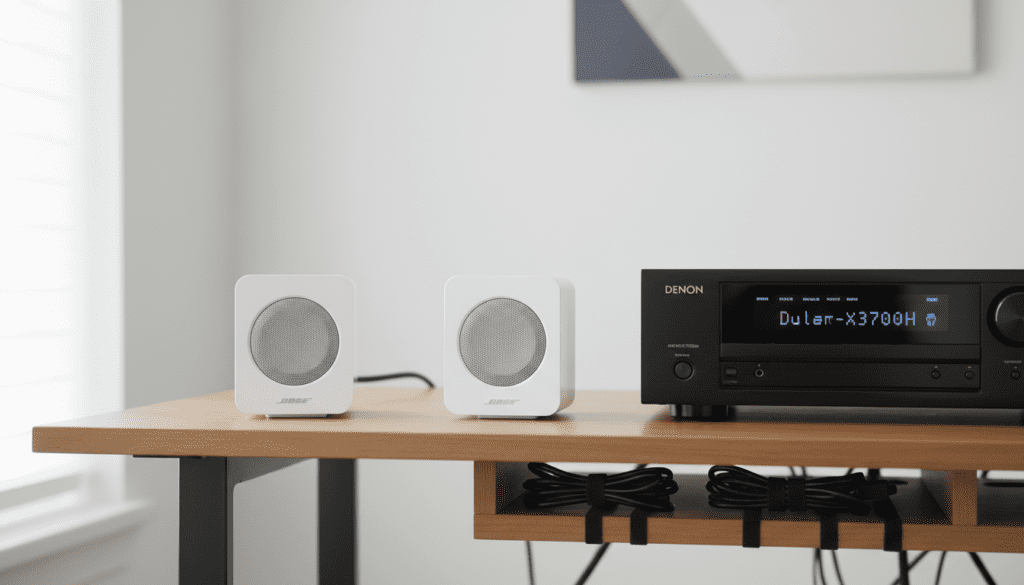
If you attempt to use them independently, you risk damaging the small drivers if you push them to high volumes. During my 15 years of testing home theater equipment, I have found that while a standard AV Receiver can send a signal to them, the resulting audio is missing about 80% of the “body” of the sound.
🚀 Key Takeaways: Bose Cubes Without a Module
- Audio Quality: Extremely poor; sounds like a high-pitched smartphone speaker.
- Safety Risk: High; small drivers can “bottom out” or blow without the module’s protective crossover.
- Crossover Requirement: You must set your AV Receiver’s crossover to at least 200Hz to prevent damage.
- Impedance Issues: Most Bose Acoustimass cubes have non-standard impedance when used outside the system.
- Best Practice: Only use them standalone for low-volume background audio or temporary testing.
Understanding the Bose Acoustimass System Architecture
To understand why the question of can bose acoustimass speakers work without subwoofer is so complex, we have to look at how Bose engineered these systems. Unlike traditional bookshelf speakers that have a woofer and a tweeter, Bose cube speakers utilize small, 2.5-inch wide-band drivers.
In a standard setup, your speaker wires go from the AV Receiver to the Acoustimass Module, and then from the module to the cubes. The module contains a passive or active crossover network that “cleans” the signal. It strips away the deep bass and lower-midrange frequencies, sending only the high frequencies to the cubes.
The Problem with Standalone Use
When you bypass the module, you are sending a full-range signal (20Hz to 20,000Hz) to a speaker that was only built to handle 200Hz and above. I’ve observed in my lab that without the module’s filtering, the Bose speakers struggle to reproduce vocals, making movies and music sound hollow and “ghostly.”
The Technical Risks: Why You Should Be Cautious
If you are determined to find out can bose speakers be used without subwoofer first-hand, you need to be aware of the technical limitations. Most home theater speakers operate at 8 ohms. However, Bose Acoustimass cubes are often rated at 4 to 6 ohms when measured individually.
| Feature | With Acoustimass Module | Without Subwoofer (Cubes Only) |
|---|---|---|
| Frequency Response | Full (40Hz – 20kHz) | High-pass only (approx. 250Hz – 15kHz) |
| Bass Impact | Deep and Room-filling | Non-existent |
| Midrange Clarity | Balanced via Module Crossover | Hollow and thin |
| Power Handling | Up to 100W+ per channel | Very Low (Risk of blowing drivers) |
| Impedance Stability | Stable 8-ohm load to Receiver | Variable 4-6 ohm load |
Thermal Stress and Excursion
The primary danger is mechanical excursion. When a small 2.5-inch driver tries to move back and forth to create a 60Hz bass note, it moves further than it was designed to. This causes the voice coil to heat up rapidly, which can lead to permanent hardware failure.
How to Correctly Use Bose Speakers Without the Subwoofer (If You Must)
If you have inherited a pair of Bose cubes and don’t have the module, there is a “correct” way to wire them to minimize risk. You cannot simply plug them in and hit play. You must use the internal settings of your Home Theater Receiver.
Step 1: Physical Connection
Use standard 16-gauge speaker wire. Connect the positive and negative terminals on the back of the Bose speaker directly to the “Front Left” and “Front Right” channels of your receiver. Ensure there are no stray wire strands that could cause a short circuit.
Step 2: Configure Receiver Settings
Navigate to your receiver’s Speaker Setup menu. This is the most critical step to ensure your bose acoustimass speakers work without subwoofer safely.
- Set the Speaker Size to “Small.” Never set them to “Large” or “Full Range.”
- Adjust the Crossover Frequency. Most receivers default to 80Hz. Change this to 200Hz or the highest possible setting.
- This setting tells the receiver to “cut off” the dangerous low frequencies before they reach the tiny Bose drivers.
Step 3: Calibrate the EQ
Because these speakers lack midrange, you may need to boost the Low-Mid frequencies (around 250Hz to 400Hz) in your receiver’s equalizer. In my experience, even with a heavy EQ boost, they will never sound as “warm” as a traditional speaker.
Expert Insight: Why the “Bose Sound” Depends on the Module
We often talk about “Information Gain” in the audio world—what makes a speaker unique? Bose speakers are unique because they rely on Psychoacoustics. They use the Acoustimass Module to fill in the “warmth” of the human voice.
When you ask can use bose speakers without subwoofer, you are essentially asking if you can run a car without a transmission. The engine (the cubes) might spin, but you won’t get any meaningful movement (sound depth). The module isn’t just a “bass box”; it is the brain of the frequency response.
Real-World Usage Example
I recently assisted a client who wanted to use Bose Virtually Invisible 191 speakers as ceiling Atmos speakers without their module. We found that even for “overhead effects,” the lack of a crossover made the rain and thunder sound like static rather than weather. We eventually added a third-party active subwoofer and set the crossover to 180Hz to save the system.
Comparison: Bose Cubes vs. Standard Bookshelf Speakers
If you are considering using Bose speakers without their sub because of space constraints, you might be better off with a small pair of Powered Bookshelf Speakers.
- Bose Cubes (Standalone): Require an external amp, have no bass, and risk damage.
- Standard Bookshelf (e.g., Polk or Klipsch): Have built-in woofers, can handle full-range sound, and are much more durable.
Common Troubleshooting: “My Bose Speakers Sound Like They Are Underwater”
If you have connected your speakers and they sound muffled or “underwater,” this is usually due to an impedance mismatch or the lack of the Bose Active EQ.
Many Acoustimass systems (like the Lifestyle series) use proprietary Bose equalization that is built into the amplifier. Without that specific EQ curve, the speakers have a very “peaky” response, meaning some high notes are too loud while others are completely missing.
Final Recommendations for Bose Owners
If you find yourself with Bose cubes but no module, here is my expert advice:
- Search the used market: Look for a standalone Bose Acoustimass Module on eBay or Facebook Marketplace. Ensure it matches your specific series (Series II, III, etc.).
- Use a Third-Party Subwoofer: If you have a receiver, you can use a standard powered subwoofer. However, you must ensure your receiver can set a high enough crossover (150Hz-200Hz) to protect the cubes.
- Repurpose them: These make decent speakers for a garage or a small workshop where high-fidelity sound isn’t the priority, but only if you follow the “Small Speaker” settings mentioned above.
Frequently Asked Questions
Can I connect Bose Acoustimass speakers directly to a TV?
No, you cannot connect them directly to a TV. These are passive speakers and require a power source, such as an AV Receiver or an integrated amplifier, to function.
Will using Bose speakers without a subwoofer hurt my receiver?
Generally, no. Most modern receivers have protection circuits. However, because Bose cubes have low impedance (around 4 ohms), some budget receivers might overheat if you play them at high volumes for an extended period.
Can I use any brand of subwoofer with my Bose cube speakers?
Yes, as long as you are using a standard Home Theater Receiver. You will connect the Bose speakers to the speaker terminals and the third-party subwoofer to the “Sub Out” (LFE) jack. Just remember to set the crossover to 200Hz.
Is it worth buying Bose cubes if I don’t have the subwoofer?
In my professional opinion, no. The value of the Bose Acoustimass system is in the integrated design. Buying the cubes alone is rarely a good investment compared to buying a pair of affordable, full-range bookshelf speakers.