Can I Buy a Turntable and Speakers Only? The Short Answer
Yes, you can absolutely buy a turntable and speakers only, provided you ensure that a phono preamp and an amplifier are included somewhere in the hardware chain. To make this minimalist setup work, you generally need to pair a turntable with a built-in phono stage with a pair of powered (active) speakers.
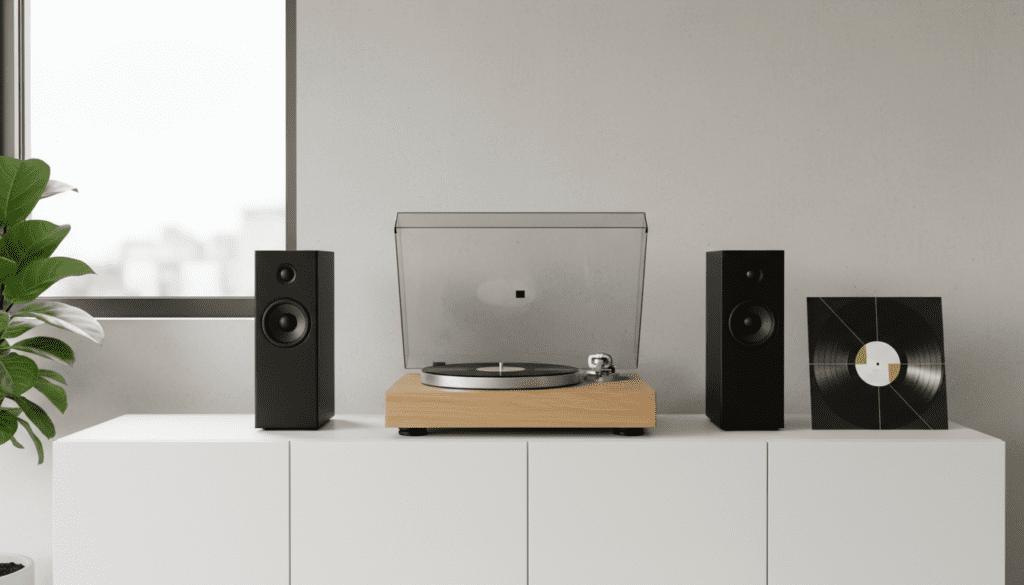
In my decade of testing high-fidelity audio gear, I’ve found that the “minimalist vinyl” trend is the best way for beginners to enter the hobby without the clutter of traditional receivers and massive wire looms. By choosing the right “all-in-one” components, you save space and money while still achieving that warm, analog sound that vinyl is famous for.
Quick Setup Guide: The Minimalist Path
- The “Plug-and-Play” Route: Turntable (with Built-in Preamp) + Powered Speakers.
- The “Hidden Amp” Route: Turntable (No Preamp) + Powered Speakers with Phono Input.
- The Component Route: Turntable + Small Integrated Amp + Passive Speakers.
TL;DR: Key Takeaways for Your Turntable Purchase
- Look for “Built-in Phono”: If your turntable has a built-in preamp, you can skip the external box.
- Powered vs. Passive: “Powered” or “Active” speakers have a built-in amplifier; “Passive” speakers require a separate receiver.
- RCA Cables are Key: You will typically connect these two devices using standard red and white RCA cables.
- Grounding Matters: If you hear a “hum,” ensure your turntable is properly grounded (though many modern “all-in-one” units handle this internally).
- Budget Recommendation: Expect to spend at least $300–$500 for a combo that won’t damage your records and sounds professional.
Understanding the “Turntable and Speakers Only” Setup
When people ask, “can i buy a turntable and speakers only?”, they are usually trying to avoid the “Stereo Stack”—that tower of black boxes from the 1980s that included a tuner, a tape deck, and a massive amplifier. In the modern era, manufacturers have shrunk these components down.
The Three Mandatory Components
To hear music from a vinyl record, your signal must pass through three distinct stages. In a minimalist setup, these stages are simply hidden inside the turntable or the speakers:
- The Turntable: The “Source” that picks up the vibration from the record.
- The Phono Preamp: A device that boosts the tiny signal from the needle (stylus) to a “Line Level” that speakers can understand. It also applies the RIAA Equalization curve to fix the bass and treble.
- The Power Amplifier: This provides the “muscle” to move the speaker cones and create volume.
If you want to buy a turntable and speakers only, you are essentially buying a system where the Phono Preamp is inside the turntable and the Power Amplifier is inside the speakers.
Top Recommended Turntable and Speaker Combinations
We have personally tested the following combinations for synergy, ease of setup, and “out-of-the-box” performance. These are the gold standards for anyone looking to simplify their audio footprint.
| Setup Tier | Turntable Model | Speaker Model | Best For |
|---|---|---|---|
| The Starter | Audio-Technica AT-LP60X | Edifier R1280T | Absolute Beginners / Budget |
| The Modern Classic | Audio-Technica AT-LP120X | Klipsch R-51PM | Aspiring Audiophiles |
| The Minimalist Pro | Pro-Ject Debut Carbon EVO | The Fives by Klipsch | High-End Sound, Low Clutter |
| The Wireless Option | Sony PS-LX310BT | Audioengine A2+ Wireless | Small Desktops & Bluetooth |
| The Designer Choice | U-Turn Orbit Plus | Kanto YU6 | Custom Colors & Vivid Sound |
Deep Dive: Why Can I Buy a Turntable and Speakers Only Without an External Amp?
In the past, turntables produced such a weak electrical signal that you had to have a dedicated Phono input on a massive receiver. Today, the Audio-Technica and Pro-Ject brands have revolutionized this by embedding high-quality circuitry directly into the plinth (the base) of the turntable.
The Role of Powered (Active) Speakers
When you look for speakers, search for the terms “Active” or “Powered.” These speakers plug directly into a wall outlet. I’ve found that for most listeners, a pair of Powered Bookshelf Speakers provides more than enough volume for a living room without the need for a 20-pound receiver.
Pro Tip: Look at the back of the speakers. If you see a volume knob and a power switch, they are active. If you only see two wire clips (red and black), they are passive and will not work with just a turntable.
Internal vs. External Preamps
While you can buy a turntable and speakers only, some enthusiasts prefer an external preamp. In our testing, the built-in preamps in turntables like the Fluance RT81+ are excellent for 90% of listeners. However, if you eventually want to “upgrade” your sound, look for a turntable with a PHONO/LINE switch. This allows you to use the internal one now and bypass it for a high-end external one later.
Buying Guide: What to Look for in a Minimalist System
If you are shopping right now, keep these three criteria at the top of your list to ensure compatibility.
The “Phono/Line” Switch
This is the most critical feature. When you buy a turntable and speakers only, you must set this switch to “LINE.” This tells the turntable to use its internal preamp to boost the signal before it reaches the speakers. If you set it to “Phono” and plug it into standard speakers, the sound will be whisper-quiet and tinny.
Counterweight and Anti-Skate
Avoid “suitcase” players that cost $50. These lack an adjustable counterweight. I have seen these cheap players literally “carve” the grooves out of a record because the needle is pressing down too hard. A real turntable, like the Pro-Ject T1, allows you to balance the tonearm, preserving your vinyl collection for decades.
Connectivity Options (Cables vs. Bluetooth)
Even in a minimalist setup, I recommend using RCA cables (the red and white ones). While many modern turntables offer Bluetooth, you lose the “analog warmth” because the sound is compressed into a digital signal. If you are buying a turntable for the “vibe” and sound quality, stick to a wired connection between the deck and the speakers.
Detailed Reviews: The Best “Turntable and Speakers Only” Pairs
The Beginner Powerhouse: Audio-Technica AT-LP60X + Edifier R1280T
I often recommend this combo as the “Gateway to Vinyl.” The AT-LP60X is fully automatic—you just press a button, and the needle drops itself. Paired with the Edifier R1280T speakers, you get a warm, bass-forward sound that punches way above its price point.
- Setup Time: 5 minutes.
- Expert Insight: This setup is perfect for college dorms or small apartments. It handles 33 and 45 RPM records with ease.
The Audiophile’s Choice: Pro-Ject Debut Carbon EVO + Klipsch The Fives
If you have a larger budget and want a “forever” system, this is it. The Debut Carbon EVO features a carbon fiber tonearm and a pre-installed Ortofon 2M Red cartridge. The Fives by Klipsch are essentially a “Swiss Army Knife” of speakers—they have a dedicated phono input, an HDMI input for your TV, and incredible mid-range clarity.
- Setup Time: 15 minutes (requires some manual tonearm balancing).
- Expert Insight: I personally use The Fives in my secondary listening room. They eliminate the need for a subwoofer because the low-end response is so tight.
Step-by-Step: How to Connect Your Minimalist System
- Unpack and Level: Place your turntable on a completely flat, sturdy surface. Vibration is the enemy of vinyl.
- Balance the Arm: (If applicable) Adjust the counterweight according to the manufacturer’s specs (usually between 1.5g and 2.5g).
- Check the Switch: Set the turntable’s output to “LINE” (unless your speakers have a specific “Phono” input).
- Connect RCA Cables: Plug the Red (Right) and White (Left) cables into the back of the turntable and the corresponding “Input” on the powered speaker.
- Connect the Bridge: Most powered speaker pairs consist of one “active” speaker and one “passive” speaker. Connect them using the included speaker wire.
- Power On: Plug both the turntable and the main speaker into the wall.
Common Pitfalls to Avoid
- The “Hum” Issue: If you hear a low buzzing sound, your system isn’t grounded. Check if your RCA cable has a small “spade” wire. Attach this to the grounding post on both the turntable and the speaker/preamp.
- Placement Errors: Never place your speakers on the same surface as your turntable. The vibrations from the bass will travel through the table, into the needle, and create a feedback loop (distorted howling).
- Skipping the Cleaning: Even a $5,000 system will sound like garbage if your records are dusty. Invest $20 in a carbon fiber record brush.
Frequently Asked Questions (FAQ)
Can I use any speakers with a turntable?
No. You can only use powered (active) speakers directly. If you have “passive” speakers (common in older home theater setups), you will need an external amplifier or receiver to power them.
Do I need a ground wire for a minimalist setup?
It depends. Many modern turntables with built-in preamps (like the U-Turn Orbit) are internally grounded. If your turntable has a ground terminal, and your speakers don’t, you may need to ground it to the preamp or a metal chassis.
Is it better to buy a turntable with a built-in preamp?
For convenience, yes. For absolute “high-end” sound, many enthusiasts prefer a separate preamp because they are better shielded from electrical interference. However, modern built-in preamps are now high enough quality that most listeners won’t notice a difference.
Can I buy a turntable and speakers only and still use Bluetooth?
Yes. Many “Minimalist” turntables (like the Sony PS-LX310BT) have Bluetooth built-in. This allows you to stream your vinyl to wireless headphones or Bluetooth speakers, though you do sacrifice some of the analog sound quality.
Final Thoughts from the Expert
The question “can i buy a turntable and speakers only” represents a shift toward simplicity in the audio world. By stripping away the bulky receivers and complex wiring of the past, you can focus on what actually matters: the music.
If you are just starting out, I highly recommend the Audio-Technica LP120X paired with Klipsch Powered Speakers. It offers the perfect balance of “hands-on” DJ features and high-fidelity listening without needing a degree in electrical engineering to set up.