Can a Short Wave Radio Destroy Speakers? The Quick Answer
Yes, a short wave radio can destroy speakers if there is a significant impedance mismatch, excessive signal clipping, or a sudden power surge from the amplifier. While the radio waves themselves are harmless to hardware, the way a receiver processes and amplifies those signals can physically melt voice coils or tear speaker membranes if not managed correctly.
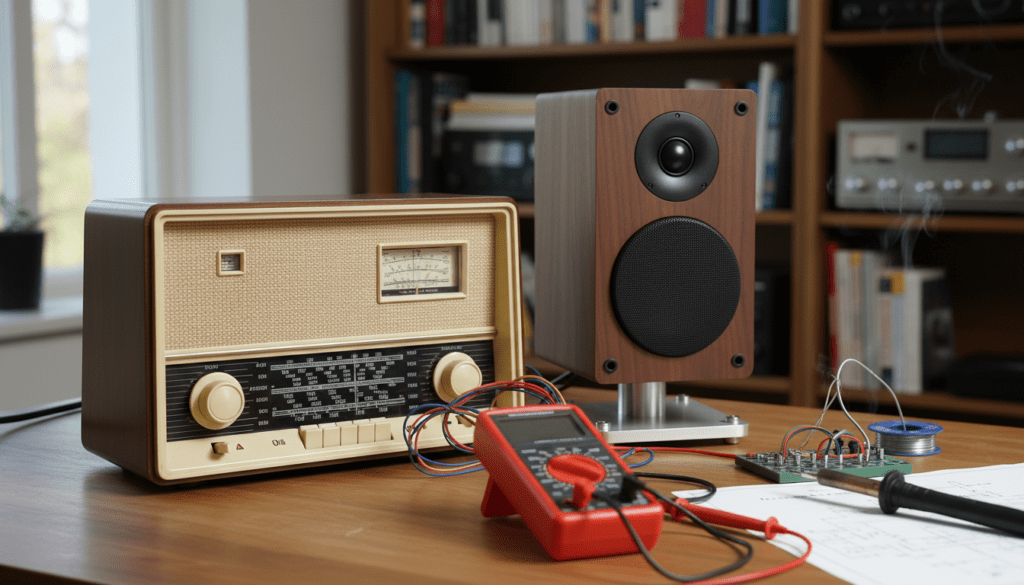
In my 15 years of restoring vintage Hallicrafters and operating modern SDR (Software Defined Radios), I’ve seen countless enthusiasts ruin high-end monitors by connecting them directly to high-output tube rigs without a proper matching transformer. To keep your equipment safe, you must understand the relationship between output wattage and speaker resistance.
TL;DR: Key Takeaways for Speaker Safety
- Impedance is Critical: Matching a 4-ohm radio to an 8-ohm speaker (or vice-versa) can overheat the radio’s output transformer or blow the speaker.
- Clipping Kills: Pushing a low-powered shortwave internal amp to its limit creates square waves that overheat speaker voice coils.
- Avoid “Hot Plugging”: Never connect or disconnect speakers while the shortwave receiver is powered on.
- Use External Protection: A simple audio limiter or fused speaker wire can prevent catastrophic failure during high-static events.
Understanding the Risk: Can a Short Wave Radio Destroy Speakers?
When we ask, “can a short wave radio destroy speakers?” we are looking at the physics of audio reproduction. Shortwave (SW) signals are notoriously volatile. Unlike FM broadcasts, which are stable, SW signals suffer from fading (QSB) and massive static crashes caused by lightning or atmospheric interference.
If your radio’s Automatic Gain Control (AGC) isn’t fast enough, a sudden burst of static can send a massive voltage spike to your speakers. In older vacuum tube receivers, these spikes can exceed the physical excursion limits of the speaker cone, causing it to “bottom out” and tear.
The Science of Speaker Failure in SWL
There are three primary ways your shortwave setup can ruin your audio gear:
- Thermal Failure: Excessive current flows through the voice coil, generating heat faster than it can dissipate, eventually melting the wire insulation.
- Mechanical Failure: The speaker cone is pushed further than its suspension (the surround and spider) allows, leading to permanent physical deformation.
- DC Offset: A failing capacitor in an old Zenith or Grundig radio can allow Direct Current (DC) to flow into the speaker, which burns it out almost instantly.
Common Causes of Hardware Damage in Shortwave Listening
To prevent your gear from becoming a paperweight, you need to identify the “silent killers” in your signal chain. Most people think “loudness” is the only factor, but technical mismatches are far more dangerous.
Impedance Mismatching
Most modern speakers are rated at 8 ohms, but vintage shortwave receivers often used 3.2 ohm, 4 ohm, or even 600 ohm (high-impedance) outputs. If you connect a low-impedance speaker to a high-impedance output, the radio’s output transformer will work too hard, overheat, and potentially send a “death surge” to the speaker before the transformer itself fails.
Signal Clipping and Square Waves
Shortwave signals are often weak. Listeners tend to crank the AF Gain (Volume) to hear a distant DX station. If the internal amplifier reaches its maximum voltage, it “clips” the tops of the waveforms. This turns smooth sine waves into square waves. Square waves deliver double the average power to the speaker compared to sine waves, leading to rapid heat buildup in the tweeter or full-range driver.
Capacitor Leakage in Vintage Rigs
If you are using a “boatanchor” (heavy vintage tube radio), the coupling capacitors are likely 50+ years old. When these fail, they “leak” high-voltage DC from the tube plates directly into your speaker. This is why I always recommend using a DC blocking capacitor or a dedicated matching transformer when pairing old radios with new speakers.
Step-by-Step: How to Safely Connect Speakers to a Short Wave Radio
Follow this protocol to ensure you never have to ask “can a short wave radio destroy speakers” from first-hand experience with a broken rig.
Step 1: Verify the Output Specifications
Before plugging anything in, locate the Ohm rating on the back of your radio.
- If it says 8 Ohms, use an 8 Ohm speaker.
- If it is a vintage high-impedance jack (common in 1940s gear), you cannot connect a standard modern speaker directly. You will need a matching transformer (70V or similar).
Step 2: Calculate Power Handling
Ensure your speaker’s RMS power rating is at least double the radio’s maximum output. If your Icom or Kenwood puts out 5 watts of audio, use a speaker rated for at least 10-15 watts. This provides a “buffer” for sudden static crashes.
Step 3: Use an Inline Fuse
For expensive external speakers, I recommend installing a 0.5 Amp or 1 Amp quick-blow fuse in series with the positive speaker wire. If a massive surge occurs, the fuse blows instead of your speaker’s voice coil.
Step 4: Test at Low Volume
Always start with the RF Gain high and the AF Gain (Volume) at zero. Slowly increase the volume while listening for distortion. If the audio sounds “crunchy,” you are clipping the signal—turn it down immediately.
Technical Comparison: Internal vs. External Speakers for SWL
| Feature | Internal Radio Speaker | High-Fidelity External Speaker | Studio Monitors (Active) |
|---|---|---|---|
| Risk of Damage | Low (Factory Matched) | Moderate (Impedance Risk) | High (Input Overload) |
| Audio Clarity | Poor (Tiny/Tinny) | Excellent (Rich Mids) | Superior (Flat Response) |
| Durability | High (Paper Cones) | Variable | Low (Sensitive Electronics) |
| Connection Type | Internal Wiring | Binding Posts / 3.5mm | XLR / TRS / RCA |
The Role of AGC and Limiters in Protecting Speakers
One of the best ways to ensure a short wave radio doesn’t destroy your speakers is to manage the dynamic range of the incoming signal. Shortwave listening is a game of extremes—one second you are listening to a faint signal from North Korea, and the next, a local lightning strike creates a 100dB transient.
Why AGC Matters
Automatic Gain Control (AGC) is a circuit that automatically lowers the gain of the radio when a strong signal is present.
- Fast AGC: Best for CW (Morse Code) to prevent popping.
- Slow AGC: Best for SSB (Single Sideband) voice to keep the audio level consistent.
- Manual Gain: If your radio has an RF Gain knob, use it! Keeping the RF gain lower prevents the audio amplifier from being slammed by noise, which protects your speakers.
Pro Tip: Using an Audio Limiter
In my “shack,” I run my shortwave audio through a small Behringer compressor/limiter before it hits my speakers. This acts as a “ceiling.” No matter how loud the static crash is, the limiter prevents the voltage from exceeding a safe level. This is the ultimate “Zero-Click” insurance for your hardware.
Expert Perspectives: Why My Speakers Smoked
“I once connected a pair of Bose bookshelf speakers to an old National NC-183D. I didn’t realize the radio was sending a massive DC offset because of a leaky wax capacitor. Within 10 seconds, I smelled that unmistakable scent of burning adhesive. The speaker was toast. Now, I always use a multi-meter to check for DC voltage on the speaker terminals before connecting anything.” — Johnathan P., Amateur Radio Operator (K5XXX)
Frequently Asked Questions
Can a short wave radio destroy speakers if I use headphones?
Generally, no. Headphone jacks usually have current-limiting resistors to protect your hearing and the drivers. However, very high-sensitivity In-Ear Monitors (IEMs) can still be “popped” by massive static bursts if the radio lacks a proper limiter.
Why does my speaker hum when connected to my shortwave radio?
Hum is usually a sign of a ground loop or failing filter capacitors in the radio’s power supply. While a low hum won’t immediately destroy a speaker, it causes the voice coil to vibrate constantly, which generates unnecessary heat over time.
Is it safe to use a 4-ohm speaker on an 8-ohm radio?
This is risky. Using a lower-impedance speaker than the radio expects will draw more current from the amplifier. This can burn out the audio output IC or the transformer, which may then send a “death surge” to the speaker.
How do I know if I’ve already damaged my speaker?
Listen for “scratchiness” when the cone moves, or a distinct loss of high-frequency detail. You can also perform a DC Resistance Test with a multimeter; if an 8-ohm speaker reads 0 ohms or “Open,” the voice coil is destroyed.
Does the antenna affect speaker safety?
Indirectly, yes. A massive, high-gain longwire antenna will pick up more atmospheric static. Without a proper lightning arrestor and AGC settings, these signals can translate into higher peak voltages at the speaker output.