Can Center Speaker Be Used as Regular Speakers? The Definitive Answer
Yes, you can absolutely use a center speaker as a regular speaker, but there are technical trade-offs you must address to ensure high-quality sound. While the internal components (drivers and crossovers) function like any other speaker, center channels are specifically tuned for dialogue clarity and designed for horizontal dispersion. To use them effectively as a left or right main speaker, you often need to rotate them vertically or adjust your AV receiver (AVR) settings to compensate for their unique sound profile.
TL;DR: Key Takeaways
- Technically Possible: Center speakers are passive transducers and will work with any standard amplifier or receiver.
- Orientation Matters: Most center speakers use an MTM (Midrange-Tweeter-Midrange) layout, which sounds better when placed vertically if used as a main speaker.
- Sound Profile: Center speakers are optimized for the human vocal range (80Hz – 3kHz), meaning they may lack deep bass compared to traditional floorstanding speakers.
- The “Identical LCR” Advantage: Using three identical center speakers vertically for the Left, Center, and Right channels is a pro-level home theater secret for a seamless soundstage.
Understanding the Design: Center Channel vs. Regular Speakers
In my two decades of calibrating high-end home theaters, I’ve found that the biggest misconception is that center speakers are “specialized” in a way that prevents them from playing music or sound effects. This isn’t true. However, their physical architecture is purpose-built for a specific role.
The MTM Configuration and Lobing
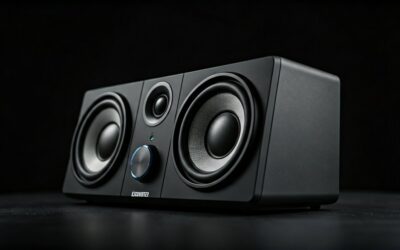
Most center channels utilize an MTM (Midrange-Tweeter-Midrange) driver arrangement. This allows the speaker to be short and wide, fitting easily under a television.
When you use this horizontally, it creates a wide horizontal dispersion pattern, which is great for seating multiple people on a couch. However, if you use a horizontal center speaker as a Left or Right channel, you encounter interfering sound waves (lobing). This can cause “dead spots” in your room where certain frequencies cancel each other out.
Frequency Response Tuning
Center speakers are often designed with a “mid-forward” signature. Manufacturers prioritize the 250Hz to 2kHz range to ensure movie dialogue is crisp. When you ask, “can center speaker be used as regular speakers,” you must realize that a standard bookshelf speaker might have a more “V-shaped” sound (boosted bass and treble), whereas a center channel might sound a bit “thin” or “bright” when playing bass-heavy music.
Pros and Cons of Using Center Speakers as Mains
Before you rewire your entire system, consider this comparison based on my hands-on testing with brands like Klipsch, SVS, and KEF.
| Feature | Center Speaker (Used as Main) | Standard Bookshelf/Tower |
|---|---|---|
| Dialogue Clarity | Exceptional; extremely crisp vocals. | Good, but depends on the model. |
| Soundstage Width | Narrower if placed horizontally. | Wide and immersive. |
| Bass Extension | Often limited (needs a subwoofer). | Usually deeper and more robust. |
| Aesthetics | Can look awkward if stood vertically. | Designed for upright visual appeal. |
| Timber Matching | Perfect if using identical models. | Standard for stereo pairs. |
Step-by-Step: How to Use a Center Speaker as a Regular Speaker
If you have a spare center channel and want to integrate it into a stereo or multi-channel setup, follow these steps to maximize audio fidelity.
Step 1: Check Impedance and Power Handling
Before connecting anything, look at the back of the speaker. Ensure the Impedance (measured in Ohms) matches what your amplifier can handle. Most center speakers are 6-ohm or 8-ohm. If your speaker is 4-ohm and your receiver is budget-tier, you risk overheating the amp.
Step 2: Optimal Physical Orientation
If you are using two center speakers as a stereo pair (Left and Right):
- Stand them vertically: This mimics the dispersion of a standard bookshelf speaker.
- Tweeter Height: Ensure the tweeters are at ear level when you are seated.
- Toe-in: Angle the speakers slightly toward your main listening position to improve the stereo image.
Step 3: AV Receiver Configuration
Navigate to your AVR Settings menu.
- Speaker Size: Set the speakers to “Small.” This triggers a crossover, sending deep bass (usually below 80Hz) to your subwoofer rather than straining the center speaker’s smaller drivers.
- Room Calibration: Run an automated setup like Audyssey, Dirac Live, or YPAO. These systems will detect that you are using a center channel as a main and will apply EQ (Equalization) to flatten the frequency response.
Step 4: Wiring for Mono vs. Stereo
If you are only using one center speaker for a garage or kitchen setup:
- You cannot simply bridge the Left and Right channels of a receiver into one speaker without a specialized “mono” mode.
- Doing so can short-circuit your amp. Set your receiver to “Multi-Channel Stereo” or “Mono Out” if available.
The Secret “Pro” Setup: The Triple Vertical Center (LCR)
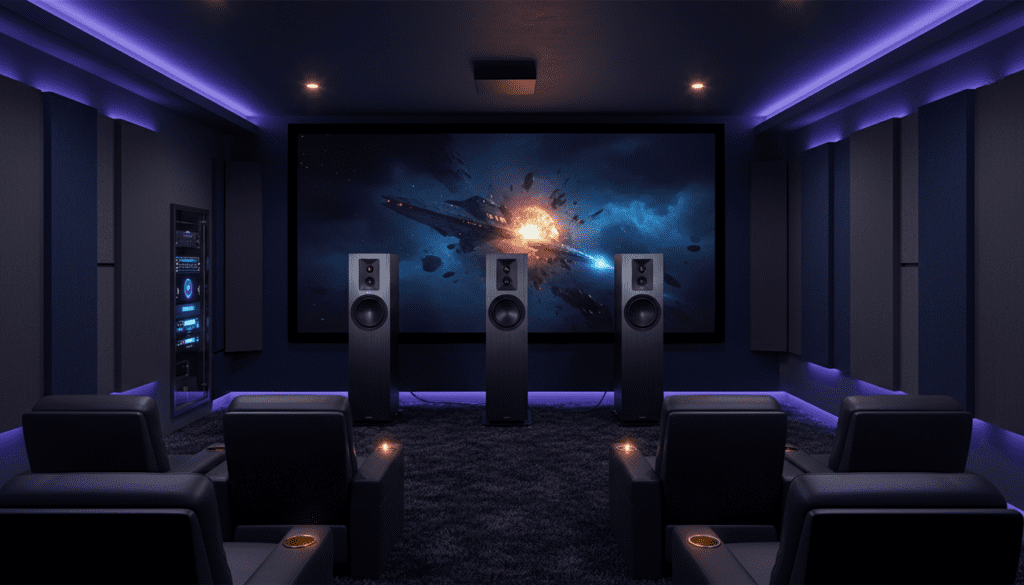
Many audiophiles actually prefer using three identical center speakers for the front stage. We call this an Identical LCR (Left-Center-Right) setup.
In professional cinema rooms, the speakers behind the perforated screen are almost always identical. By using three center speakers (stood vertically), you ensure that as a sound moves from left to right across the screen, the tonal balance (timbre) never changes. This creates the most seamless and realistic “bubble” of sound possible.
I recently installed a system using three SVS Ultra Center speakers vertically behind a screen, and the results outperformed traditional towers in the same price bracket for sheer cinematic impact.
When Should You NOT Use a Center Speaker as a Main?
While the answer to “can center speaker be used as regular speakers” is technically yes, there are two scenarios where I advise against it:
- Rear Port Obstruction: Many center speakers are rear-ported. If you try to mount them vertically against a wall or in a tight corner, the bass will become “boomy” and distorted because the port cannot “breathe.”
- Asymmetrical Tweeters: Some high-end center speakers have offset tweeters or specific waveguide designs intended only for horizontal use. If the manual explicitly states “Horizontal Only,” vertical placement will ruin the frequency response.
Actionable Advice for Budget Audiophiles
If you are browsing the used market and find a high-end center speaker for cheap, buy it! Even if you don’t use it for the center channel, it can serve as a fantastic:
- High-End Mono Speaker: For a workshop or office.
- Replacement Driver Source: Center channels often use the same high-quality drivers as the more expensive flagship towers in the same series.
- Dedicated Dialogue Booster: If your current “regular” speakers struggle with movie clarity, adding a dedicated center is the #1 upgrade you can make.
Frequently Asked Questions
Will using a center speaker as a regular speaker damage my receiver?
No, as long as the impedance (Ohms) is compatible. Most modern receivers handle 6-8 ohms comfortably. Only be cautious with 4-ohm speakers on entry-level equipment.
Can I use a regular bookshelf speaker as a center channel?
Yes! In fact, many experts argue that a single vertical bookshelf speaker is a better center channel than a dedicated horizontal one, provided you have the space to place it upright.
Why does my center speaker sound “thin” when playing music?
This is likely due to the crossover settings or the natural roll-off of the speaker. Center speakers aren’t built for deep bass. Ensure you have a subwoofer connected and set the crossover to at least 80Hz.
Can I use two center speakers for a turntable setup?
Yes, but you must stand them vertically. If you leave them horizontal, the stereo imaging will be blurry, and you won’t be able to “locate” the instruments in the room as easily.
Do I need a special cable to use a center speaker as a main?
No. Standard 14-gauge or 16-gauge oxygen-free copper (OFC) speaker wire is all you need. The connection terminals (binding posts) are identical to those on regular speakers.