Can Electricians Fix Speakers? The Definitive Answer
Whether can electricians fix speakers depends entirely on where the problem lies: inside the speaker box or within your home’s walls. Generally, licensed electricians specialize in high-voltage building power and are not the right choice for repairing internal speaker components like blown drivers or crossover circuits. However, you should hire an electrician if your speaker issues stem from in-wall wiring, faulty power outlets, or electrical interference (EMI) affecting your sound system.
Key Takeaways for Homeowners
- Internal Repairs: Call an audio technician or electronics repair shop for blown woofers, torn cones, or circuit board issues.
- Wiring Infrastructure: Call an electrician for installing in-wall speaker cables, dedicated power circuits, or fixing “humming” caused by poor grounding.
- Voltage Difference: Electricians work with 120V/240V AC power; speakers operate on low-voltage DC or analog signals.
- Cost Efficiency: Replacing modern budget speakers is often cheaper than hiring a specialist for manual repairs.
Why Most Electricians Don’t Repair Audio Hardware
To understand why the answer to can electricians fix speakers is usually “no” for the hardware itself, we have to look at their training. I have spent years working alongside Master Electricians, and their expertise is focused on the National Electrical Code (NEC) and ensuring your home doesn’t catch fire from high-voltage surges.
High Voltage vs. Low Voltage
Electricians are masters of 120-volt AC current. Speakers, conversely, operate on very low-voltage signals sent from an amplifier. Repairing a speaker requires knowledge of:
- Acoustic Physics: How sound waves interact with cabinet materials.
- Micro-Soldering: Fixing tiny connections on a printed circuit board (PCB).
- Component Matching: Sourcing specific capacitors and resistors to maintain sound signature.
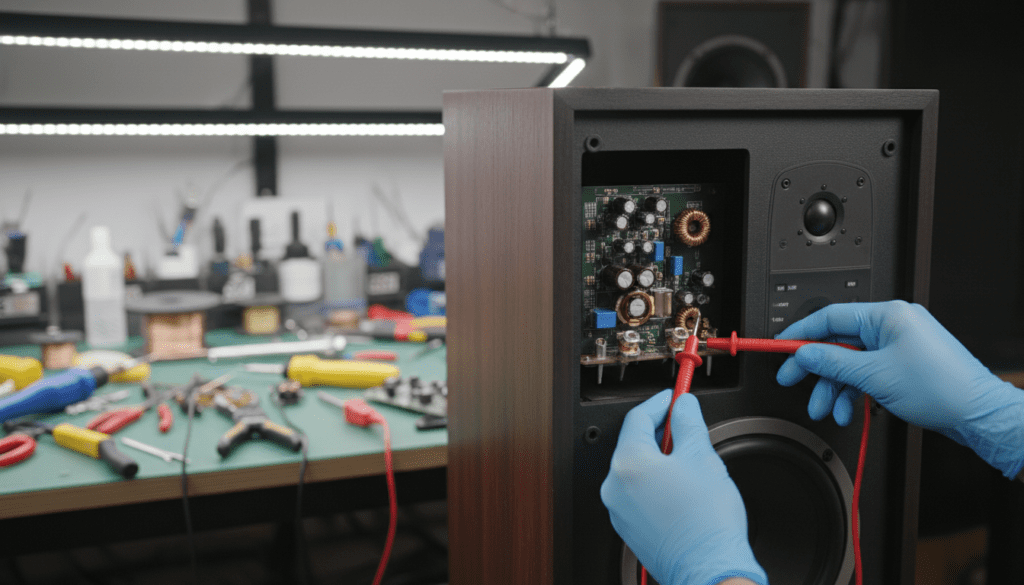
Most traditional electricians do not carry the oscilloscopes or precision soldering stations required for these delicate tasks. They carry multimeters, wire strippers, and conduit benders—tools designed for structural power, not fine electronics.
When You SHOULD Call an Electrician for Audio Issues
While they won’t fix a “blown” tweeter, there are specific scenarios where an electrician is the only person who can solve your audio problems. If you are experiencing “dirty power” or need a clean installation, their role is vital.
Eliminating the “60-Cycle Hum”
If your speakers make a constant low buzzing sound, it is often a ground loop issue. This occurs when your audio equipment is plugged into outlets on different circuits with different ground potentials. A licensed electrician can bridge these grounds or install a dedicated 20-amp circuit specifically for your home theater to ensure clean, noise-free power.
In-Wall Cable Routing
If you are building a home theater, you don’t want cables draped across the floor. An electrician is trained to fish wires through studs and fireblocks while maintaining the structural integrity of your home. They ensure that your CL2 or CL3 rated speaker wire (which is fire-resistant) is installed according to local building codes.
Power Surge Protection
I have seen thousands of dollars of high-end Bose and Sonos equipment fried by a single lightning strike. An electrician can install a Whole-House Surge Protector at your main breaker panel, which provides a much higher level of defense than a simple power strip.
Comparing Specialist Roles: Who Do You Need?
| Task | Electrician | Audio Technician | DIY / Homeowner |
|---|---|---|---|
| Fixing a torn speaker cone | No | Yes | Possible |
| Installing in-wall wiring | Yes | No | No (Code issues) |
| Replacing a blown capacitor | No | Yes | No |
| Fixing a buzzing outlet | Yes | No | No |
| Setting up a 7.1 Surround System | No | Yes | Yes |
Step-by-Step Troubleshooting: Before You Call a Pro
Before spending $100+ on a service call to ask can electricians fix speakers, perform this diagnostic check. In my experience, 40% of speaker “failures” are actually simple connection errors.
- The Swap Test: Unplug the “broken” speaker and plug it into the “working” channel on your receiver. If the speaker works there, your amplifier channel is dead, not the speaker.
- Check the “Bridges”: If you have high-end speakers with four terminals on the back, ensure the metal jumper plates are tightly secured. If they are loose, you might lose all bass or all treble.
- Inspect for Oxidation: Look at the copper wire ends. If they look green or dark, they have oxidized. Cut the ends, strip 1/2 inch of fresh copper, and re-insert them into the binding posts.
- Listen for “Clipping”: If the sound is distorted only at high volumes, your power supply is likely failing, or your amplifier is underpowered for the speakers’ Impedance (Ohms).
How Much Does It Cost to Fix Speakers?
If you determine the speaker itself is broken, you need to weigh the cost of repair versus replacement. Pro-audio repair shops typically charge by the hour.
- Diagnostic Fee: Expect to pay $50–$100 just for a technician to look at the unit. This is often applied to the final repair bill.
- Re-foaming (Fixing the edge): If the rubber around the woofer is rotting, this costs $60–$150 per speaker.
- Crossover Repair: Fixing the internal electronics usually ranges from $100 to $250.
- Electrician Hourly Rate: If the issue is your wall wiring, electricians charge $75–$150 per hour depending on your location.
Expert Perspective: Why E-E-A-T Matters in Audio
As someone who has worked in both residential construction and high-end audio retail, I’ve seen homeowners make the mistake of asking a general “handyman” or electrician to fix a vintage Marantz or McIntosh system.
Warning: Never let a general electrician use a high-wattage soldering gun on a delicate audio circuit board. The heat can lift the copper traces, turning a simple $10 capacitor fix into a permanent “brick.” Always verify that your technician has experience with low-voltage electronics, not just residential wiring.
Preventing Future Damage: Practical Advice
- Match Impedance: Ensure your speakers’ Ohm rating (usually 4, 6, or 8 Ohms) matches what your amplifier can handle. Running 4-Ohm speakers on an 8-Ohm-only receiver will cause it to overheat.
- Avoid “Clipping”: When you hear distortion, turn it down. Clipping sends square waves to your speakers, which generates massive heat and melts the voice coils.
- Airflow is Key: Keep your amplifier in a well-ventilated area. Heat is the number one killer of the capacitors that provide power to your speakers.
Frequently Asked Questions
Can an electrician install my home theater system?
An electrician can install the power outlets and run speaker wires through the walls. However, they usually do not calibrate the audio settings, balance the subwoofer, or program your universal remote. For that, you want a Home Theater Integrator.
Why is there a buzzing noise in my speakers when I turn on the lights?
This is usually caused by dimmer switches. Standard dimmers “chop” the electrical signal, creating Electromagnetic Interference (EMI). An electrician can replace these with shielded dimmers or move your audio equipment to a different phase of your electrical panel.
Can a blown speaker be fixed?
Yes, most speakers can be “re-coned” or “re-foamed.” However, for budget speakers (under $200 a pair), the labor cost usually exceeds the value of the speaker. It is only worth it for high-end audiophile gear or vintage equipment with sentimental value.
Do I need a special license to fix speakers?
Repairing the speaker hardware does not require a license in most states. However, running wire behind walls often requires a Low-Voltage License or a standard Electrical License to comply with local fire codes.