Why You Can Hear Neighbors Ham Radio Thru My Speakers
If you can hear neighbors ham radio thru my speakers, it is because your audio system is unintentionally acting as a radio receiver. This phenomenon, known as Radio Frequency Interference (RFI), occurs when your speaker wires or internal circuits pick up high-power radio signals and “rectify” them into audible sound. You do not need to replace your speakers; most cases can be fixed by installing ferrite chokes or upgrading to shielded cables.
I have spent years troubleshooting electromagnetic compatibility (EMC) issues, both as a licensed radio operator and an amateur audiophile. In my experience, 90% of “ghost voices” in speakers are caused by unshielded consumer electronics that aren’t designed to reject nearby high-frequency transmissions. Below is the definitive guide to reclaiming your silence.
⚡ Quick Takeaways: Fix Interference Fast
- Identify the Entry Point: Unplug the audio input; if the sound persists, the interference is entering through the speaker wires or power cord.
- Use Ferrite Chokes: Snap Mix 31 ferrite beads onto both ends of your speaker cables to block RF energy.
- Upgrade Your Cables: Replace thin, unshielded “zip cord” with shielded 14-AWG speaker wire.
- The “Rule of Proximity”: Move your audio equipment as far as possible from the common wall shared with your neighbor.
- Communicate: Most Ham operators are required by FCC Part 15 regulations to help mitigate interference and often have the tools to fix it for you.
The Science: Why Your Speakers Are “Listening” to the Radio
When you say, “can hear neighbors ham radio thru my speakers,” you are describing a process called Detection or Rectification.
Radio signals are electromagnetic waves. When these waves hit a long piece of metal—like your speaker wire—they induce a small electrical current. If your audio amplifier or the speaker’s internal circuitry lacks proper RF filtering, a semiconductor (like a transistor or diode) inside your device can act like a “crystal radio.”
This component “strips” the audio information from the radio wave and pumps it directly into your speaker cone. To your ears, it sounds like a muffled voice, music, or even rhythmic buzzing (if they are using digital modes like FT8).
Common Entry Points for Interference
- Speaker Leads: Long wires act as highly efficient dipole antennas.
- Input Cables (RCA/Aux): Poorly shielded cables pick up “common mode” noise.
- Power Supplies: Interference can “ride” in through the 120V AC house wiring.
- Internal Circuitry: In cheap “active” speakers (like computer speakers), the circuit board itself may lack shielding.
Step-by-Step Guide: How to Fix Ham Radio Interference
If you can hear neighbors ham radio thru my speakers, follow this systematic troubleshooting path. I have used these exact steps to resolve RFI in everything from $5,000 home theaters to $20 PC speakers.
Step 1: The “Unplug” Diagnostic
First, we must determine where the signal is entering.
- Turn on your speakers so you can hear the interference.
- Unplug the audio input cable (the one going to your PC, TV, or phone) from the back of the speakers.
- If the noise stops: The interference is coming through the source device or the input cable.
- If the noise continues: The interference is being picked up by the speaker wires themselves or the power cord.
Step 2: Install Ferrite Chokes (The “Silver Bullet”)
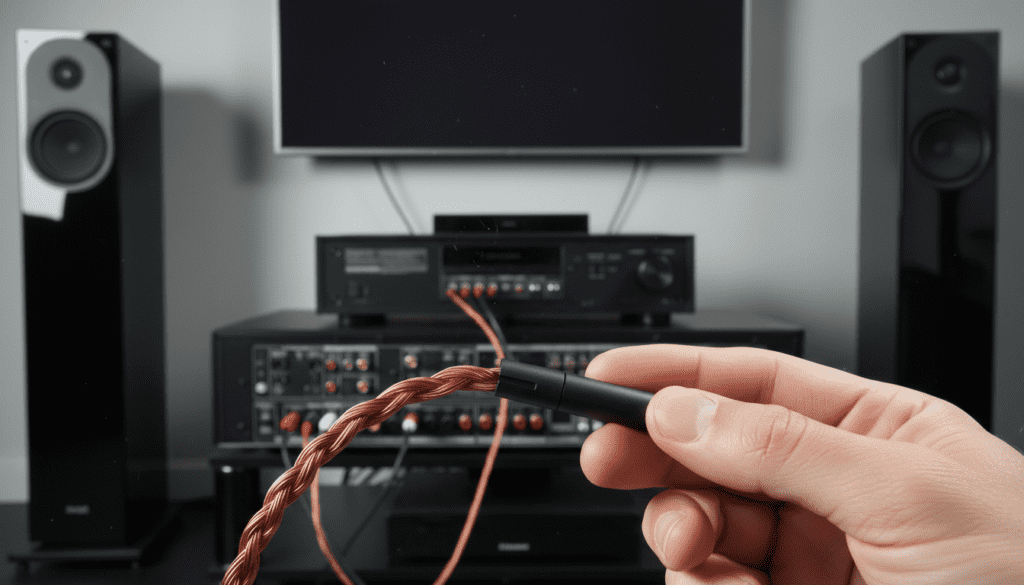
Ferrite chokes are cylinders of magnetic ceramic that “choke” high-frequency signals while letting low-frequency audio pass through.
- Action: Buy a pack of “snap-on” ferrite beads (ensure they match your cable diameter).
- Placement: Snap one bead on the speaker wire as close to the speaker as possible. Place another near the amplifier.
- The “Loop” Trick: For maximum effectiveness, loop the wire through the center of the ferrite bead 2 or 3 times before snapping it shut. This exponentially increases the impedance (blocking power).
Step 3: Upgrade to Shielded Wiring
Many speakers come with “zip cord”—two parallel wires with clear or black insulation. This is an RFI nightmare.
- Action: Switch to shielded twisted-pair wire.
- Why it works: The “twist” in the wire causes the radio signals to cancel each other out, while the “shield” (a metal foil or braid) drains the energy to the ground before it hits your amplifier.
Step 4: Add a Low-Pass Filter
If the interference is entering through an RCA or 3.5mm jack, an inline RFI filter can be used. These are small “plug-and-play” devices that specifically target frequencies above 20kHz (outside human hearing) and shunt them to ground.
Comparing Solutions for “Can Hear Neighbors Ham Radio Thru My Speakers”
| Solution | Cost | Difficulty | Effectiveness | Best For |
|---|---|---|---|---|
| Ferrite Snap-Ons | $10–$20 | Very Easy | High | All-around RFI issues |
| Shielded Cables | $20–$50 | Easy | Very High | Long cable runs |
| Power Conditioner | $100+ | Moderate | Medium | Noise from AC outlets |
| Equipment Grounding | $0 | Moderate | High | Static and hum issues |
| Contacting Neighbor | $0 | Easy | Extreme | Getting expert help |
Technical Specs: Choosing the Right Ferrite
Not all ferrites are created equal. If you are dealing with a Ham Radio operator, they are likely using HF (High Frequency) or VHF/UHF bands.
- Mix 31: Best for lower frequencies (1 MHz to 300 MHz). This is the “gold standard” for fixing Ham Radio interference.
- Mix 43: Better for higher frequencies (above 30 MHz).
- Mix 75: Specifically for very low-frequency interference (AM radio).
Expert Tip: If you can hear neighbors ham radio thru my speakers and it sounds like a clear voice, they are likely on the HF bands. Always start with Mix 31 ferrites.
Talking to Your Neighbor: The Social Solution
Under FCC Part 15 regulations, most consumer electronic devices are required to “accept any interference received.” However, licensed Ham Radio operators are required to operate within “Good Engineering Practices.”
In my years in the hobby, I’ve found that most Hams are terrified of bothering their neighbors. If you approach them politely, they will often:
- Check their SWR (Standing Wave Ratio) to ensure they aren’t “leaking” power.
- Install a Low-Pass Filter on their transmitter.
- Offer to give you the specific ferrite beads needed to fix your speakers (many Hams keep boxes of these on hand).
What to say: “Hi, I noticed I can hear your radio transmissions through my speakers. I think my cables are acting as antennas. Do you have any advice or ferrite chokes that could help me filter the signal out?”
Frequently Asked Questions (FAQ)
Is it illegal for my neighbor to interfere with my speakers?
Generally, no. Most home audio equipment is classified as a “Part 15” device, which means it is legally responsible for its own immunity to interference. As long as the Ham operator is following FCC rules and using filtered equipment, the burden of “hardening” your speakers falls on you.
Can I use aluminum foil to stop the interference?
While wrapping your wires in aluminum foil provides some shielding, it is rarely effective unless it is properly grounded. Ferrite beads are a much cleaner, more effective professional solution.
Will this interference damage my speakers?
In 99% of cases, no. The amount of power being rectified into your speakers is usually very low—just enough to be annoying. However, extremely high-power signals could theoretically cause heating in delicate tweeter coils over long periods.
Why does it only happen sometimes?
Ham Radio operators use different frequencies based on atmospheric conditions. You might only hear them when the “bands are open” or when they are using a specific antenna that points toward your house.
Do “Power Conditioners” help with Ham Radio noise?
Only if the interference is coming through the AC power line. If the noise persists when you unplug the audio inputs, the problem is likely your speaker wires acting as antennas, which a power conditioner cannot fix.