Can I Change My Speakers in My Bose Nissan?
Yes, you can change your speakers in your Bose Nissan system, but it is not a simple “plug-and-play” process like standard car audio. Because Bose uses proprietary low-impedance speakers (typically 1-ohm or 2-ohm), swapping them for standard 4-ohm aftermarket speakers will result in a significant drop in volume and poor sound quality. To do it correctly, you must either select specific high-sensitivity 2-ohm speakers or bypass the factory Bose amplifier entirely.
Quick Summary: Upgrading Your Nissan Bose Audio
- Impedance Matching: Most Nissan Bose systems run at 2 ohms. If you install 4-ohm speakers, they will receive half the power and sound “thin.”
- The Amp Factor: The Bose amp has built-in EQ curves designed specifically for cheap paper cones. New speakers may highlight “harsh” frequencies because of this processing.
- Physical Fit: Nissan uses unique three-bolt mounting patterns. You will almost certainly need mounting adapters and wiring harnesses (like Metra 72-7401).
- Best Results: For a true upgrade, use a Line Output Converter (LOC) like the AudioControl LC2i to bypass the Bose processing and add a dedicated aftermarket amplifier.
Understanding the Nissan Bose Ecosystem
When I first started working on Nissan Altima and Nissan Rogue sound systems, I assumed a quick speaker swap would solve the “muddy” bass problem. I was wrong. The Nissan Bose system is an integrated ecosystem where the Head Unit, Amplifier, and Speakers are tuned to work only with each other.
The Bose amplifier uses Digital Signal Processing (DSP) to protect the factory speakers. It rolls off the bass as you turn up the volume to prevent distortion. If you simply “change my speakers in my Bose Nissan” without addressing the signal coming from the amp, your new, expensive Focal or JL Audio speakers might actually sound worse than the factory ones.
The Challenge of Proprietary Impedance
Standard home and car audio speakers are usually 4 ohms. However, Bose engineers their systems to be highly efficient with low voltage. They do this by dropping the electrical resistance (impedance) to 2 ohms or even 1 ohm.
If you connect a 4-ohm speaker to a 2-ohm Bose amp, the amp sees more resistance. It will output significantly less power, leading to a “hollow” sound. To successfully change your speakers in your Bose Nissan, you must look for “Bose-compatible” or 2-ohm rated aftermarket speakers.
Recommended Tools and Materials
Before you begin the teardown, ensure you have the correct equipment. Using the wrong tools is the fastest way to snap a plastic Nissan door clip.
| Category | Recommended Item | Purpose |
|---|---|---|
| Speaker Selection | JBL GTO Series or Infinity Kappa | High-sensitivity 2-ohm speakers that match Bose output. |
| Adapters | Metra 82-7400 | Converts Nissan 3-bolt pattern to standard 6.5-inch. |
| Wiring | Metra 72-7401 | Plug-and-play harness to avoid cutting factory wires. |
| Sound Proofing | Kilmat or Dynamat | Reduces door vibrations and improves mid-bass response. |
| Tools | Plastic Trim Tool Set | Essential for removing door panels without scratching plastic. |
Step-by-Step Guide: How to Change My Speakers in My Bose Nissan
Following this process will ensure you don’t trigger an Airbag light (often caused by disconnecting seat sensors in some Nissan models) or damage your Power Window switches.
Step 1: Disconnect the Battery
Safety first. Disconnect the negative terminal of your battery. This prevents any short circuits when you are unplugging the window master switch or working near the side-impact sensors located inside the doors.
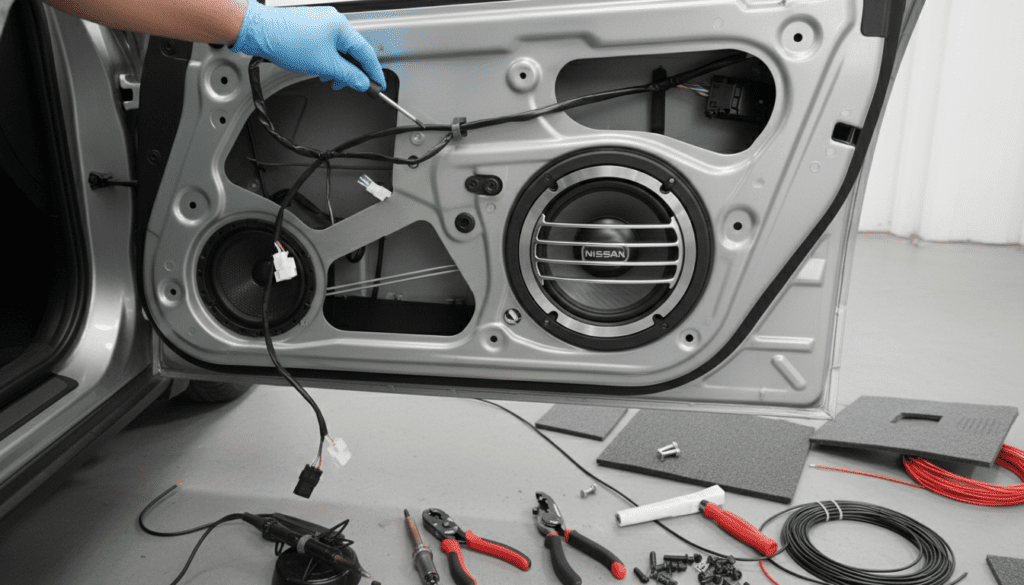
Step 2: Remove the Door Panels
Most Nissan vehicles (like the Sentra, Maxima, and Pathfinder) follow a similar door panel design.
- Remove the plastic cap behind the interior door handle to reveal a 10mm bolt.
- Pop off the armrest trim or the window switch panel to find the second and third 10mm bolts.
- Use your plastic trim tool to pry the bottom of the door panel away from the metal frame.
- Lift the panel upward to clear the window track and disconnect the actuator cables for the locks and handles.
Step 3: Remove the Factory Bose Speaker
The Bose speakers are usually held in by three 10mm bolts. Unlike standard speakers, they are housed in a plastic “pod.”
- Unplug the white Nissan factory harness.
- Unscrew the bolts and remove the speaker.
- Pro Tip: Hold onto the factory screws; aftermarket adapters often don’t include them.
Step 4: Prepare the New Speaker and Bracket
Since you decided to change your speakers in your Bose Nissan, you’ll notice the new speakers don’t line up with the factory holes.
- Screw your new 2-ohm speaker into the Metra adapter bracket.
- Apply a small strip of foam gasket (often included with the speaker) between the speaker and the bracket to prevent air leaks.
- Connect the Metra 72-7401 harness to the speaker terminals. The larger slide-on connector is usually positive (+).
Step 5: Install Sound Deadening
While the door panel is off, I highly recommend applying a 12×12 inch square of butyl-based sound deadener (like Noico) directly onto the metal outer skin of the door. This stops the “tinny” vibration common in Nissan doors and makes your new speakers sound much “punchier.”
Step 6: Mount and Test
- Bolt the new speaker/bracket assembly into the door.
- Reconnect the battery temporarily to test the sound.
- Check for phase consistency. If the speaker cone moves inward during a bass hit instead of outward, swap your positive and negative wires.
- Reassemble the door panel in the reverse order of removal.
The Expert Secret: Bypassing the Bose Amp
If you are an audiophile, simply swapping speakers might not satisfy you. The Bose Amp has a built-in “Pink Noise” filter that flattens the response of high-end speakers. To get the best sound, you should consider an Amp Bypass.
Why Bypass the Amp?
- Clean Signal: You get a full-range signal without the Bose “Muddy” EQ.
- Power: You can use standard 4-ohm high-fidelity speakers.
- Control: You can add a Subwoofer that actually blends with your door speakers.
How to do it (The Easy Way)
Use a T-Harness (like those from LLJ Customs or Apex Adaptive). These allow you to intercept the signal before it enters the Bose amp, send it to your own DSP/Amplifier, and then send the powered signal back through the factory wires to your new speakers. This avoids cutting a single factory wire.
The Best Speaker Options for Nissan Bose Systems
When I am asked “can i change my speakers in my bose nissan,” I always suggest these three specific models. They are proven to work with the factory Bose output levels.
- JBL GTO629 (6.5-inch Coaxial): These feature a Patented Plus One™ woofer cone and a 3-ohm voice coil. They are designed to compensate for the high-resistance factory wiring, making them a perfect match for the Bose amp.
- Infinity Kappa 62ix: These are 2.5-ohm speakers. They offer incredible clarity and can handle the high-frequency boost that the Bose amp often pushes out.
- PowerBass OE652-NS: Specifically engineered for Nissan and Infiniti. These are 2-ohm and feature a “plug-and-play” basket that fits the 3-bolt Nissan pattern without an adapter.
Common Pitfalls to Avoid
- Using 4-Ohm Speakers: I cannot stress this enough. If you buy a standard pair of Pioneer or Kenwood 4-ohm speakers, you will be disappointed by the lack of volume.
- Ignoring the Tweeters: Most Nissan Bose systems have dash-mounted tweeters. If you replace the door speakers with coaxial speakers (which have built-in tweeters), you will have four tweeters playing at once. This results in “screechy” high frequencies. Use component speakers and replace the dash tweeters at the same time.
- Polarity Issues: Nissan wiring colors are notoriously inconsistent. Always use a AA battery to “pop” the factory speaker wires to verify which is positive and negative before installing the new ones.
Frequently Asked Questions
Will changing my speakers void my Nissan warranty?
Replacing speakers generally does not void your entire vehicle warranty. Under the Magnuson-Moss Warranty Act, a dealer cannot void your warranty unless they can prove the aftermarket speaker caused a specific failure (like shorting out the head unit). Always use plug-and-play harnesses to avoid claims of “tampering with factory wiring.”
Does the Bose system have a hidden subwoofer?
Yes, in many Nissan models like the Rogue or Murano, the “subwoofer” is located inside the spare tire well. In the Altima or Maxima, it is usually located on the rear parcel shelf. These are also low-impedance drivers and require specific 1-ohm or 2-ohm replacements if you choose to upgrade them.
Can I just add a subwoofer to my Bose system?
Absolutely. The easiest way is to tap into the low-level signal before the Bose amp or the high-level signal after the amp using a Line Output Converter (LOC). I recommend the Kicker KEYLOC because it can actually “undo” the factory Bose EQ settings to provide a flat bass signal to your new sub.
Why do my new speakers have no bass?
This is usually caused by phase cancellation. If one speaker is wired correctly and the other is reversed, the sound waves cancel each other out, resulting in zero bass. Double-check your positive and negative connections. If the wiring is correct, remember that aftermarket speakers often require a 20-40 hour “break-in” period before the suspension loosens up to produce full bass.