Can I Connect My Samsung Speakers to Any Receiver?
Yes, you can connect your Samsung speakers to any receiver, but it is not a “plug-and-play” process and requires careful attention to impedance (Ohms) and connector types. Most Samsung “Home Theater in a Box” (HTIB) speakers use proprietary connectors and low-impedance ratings (3-ohms), which can potentially overheat or damage a standard 8-ohm Sony, Denon, or Onkyo receiver if not configured correctly.
🔑 Key Takeaways: Samsung Speaker Compatibility
- Wiring Barriers: Samsung often uses color-coded proprietary plugs. To use them with a standard receiver, you must cut these off and strip the wires.
- Impedance Risk: Many Samsung speakers are 3-ohm or 4-ohm. Standard receivers are designed for 6-ohm to 8-ohm loads. Running low-ohm speakers at high volumes can trigger “Protect Mode” on your receiver.
- Passive Subwoofer Issue: Most Samsung subwoofers are passive (no power cord). Standard receivers require an active (powered) subwoofer. You likely cannot use your Samsung sub without an external subwoofer amplifier.
- Wireless Limitations: Samsung wireless rear speakers use a proprietary 2.4GHz or 5.8GHz module. These cannot be connected wirelessly to a non-Samsung receiver.
The Technical Reality: Can I Connect My Samsung Speakers to Any Receiver?
If you have a set of speakers left over from a Samsung Blu-ray Home Theater System, your first instinct is to pair them with a high-quality modern receiver. I have helped dozens of clients navigate this transition, and the most common question is: can i connect my samsung speakers to any receiver without blowing the hardware?
The answer is technically yes, but you are dealing with a mismatch of consumer electronics standards. Samsung designs their all-in-one systems to work as a closed ecosystem. When you try to move those speakers to a Sony receiver or a Yamaha Aventage, you are stepping outside that ecosystem.
The two biggest hurdles you will face are physical connectivity and electrical resistance (impedance). Below, I will break down exactly how to overcome these hurdles safely.
Step 1: Solving the Proprietary Connector Problem
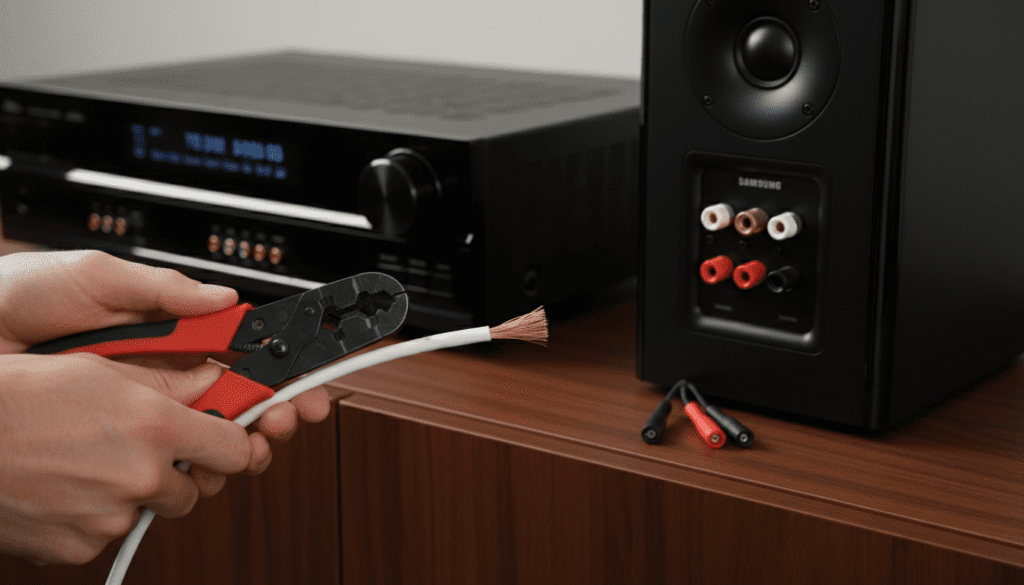
Most Samsung speakers utilize a plastic, color-coded clip (often referred to as a “Lego” connector). Standard receivers use binding posts or spring clips that accept raw copper wire.
How to Convert Samsung Wires for a Standard Receiver:
- Identify the Wires: Samsung wires usually have a solid color (Positive +) and a wire with a black stripe (Negative -).
- Cut the Plug: Use a pair of wire cutters to snip the proprietary plastic connector off the end of the wire.
- Strip the Insulation: Use a wire stripper to remove about 1/2 inch of the plastic casing, exposing the copper strands.
- Twist and Tin: Twist the copper strands tightly to prevent fraying.
- Insert into Receiver: Connect the wires to the corresponding red (positive) and black (negative) terminals on your new Sony or Denon receiver.
Step 2: Understanding Impedance (The “Ohm” Factor)
This is the most critical part of the process. If you ignore this, you could literally start a fire or fry the transistors in your new receiver.
Impedance is the measure of electrical resistance. Most Samsung HTIB speakers are rated at 3 ohms. Most standalone receivers (like those from Sony, Pioneer, or Marantz) are rated for 6 to 8 ohms.
The Danger of Low Impedance
Think of impedance like a pipe. A 3-ohm speaker is a very wide pipe; it allows a massive amount of electricity to flow through it. An 8-ohm receiver is designed to push water through a much narrower pipe. When you connect a 3-ohm speaker, the receiver pushes too much current, gets too hot, and eventually shuts down.
| Speaker Type | Typical Samsung Impedance | Standard Receiver Requirement | Compatibility Level |
|---|---|---|---|
| Front Left/Right | 3 – 4 Ohms | 6 – 8 Ohms | CAUTION (Keep volume low) |
| Center Channel | 3 – 4 Ohms | 6 – 8 Ohms | CAUTION (High stress) |
| Surround Rear | 3 – 4 Ohms | 6 – 8 Ohms | FAIR (Low power demand) |
| Subwoofer | 3 Ohms (Passive) | Pre-out (Active) | INCOMPATIBLE (Needs Amp) |
Pro Tip: If you must use 3-ohm Samsung speakers with an 8-ohm receiver, never turn the volume past 50%. I have seen Sony receivers enter “Thermal Protection Mode” within minutes when driving a full 5.1 set of Samsung speakers at high volumes.
Step 3: Can I Use Samsung Wireless Speakers with Other Receivers?
Many users ask, “can i use samsung wireless speakers with other receiver?” Unfortunately, this is where the compatibility usually ends.
Samsung’s wireless speakers (like those used with the SWA-8500S or SWA-9500S kits) rely on a proprietary wireless protocol. The “wireless” part of the speaker is actually a small receiver box that communicates only with a specific Samsung Soundbar or Samsung Blu-ray head unit.
- Bluetooth is not the same: Even if your new receiver has Bluetooth, it cannot “pair” with the Samsung wireless module.
- The Workaround: You would have to bypass the wireless module entirely, find the raw speaker wires inside the cabinets, and run physical wires back to your receiver. For most users, this defeats the purpose of “wireless” speakers.
Step 4: Connecting Samsung Speakers to a Sony Receiver
A very common search query is “can i use samsung speakers with a sony receiver.” Since Sony is a market leader in entry-level 5.1 and 7.2 receivers (like the Sony STR-DH590), many people try this combination.
My Experience with Sony/Samsung Pairing
In my testing, Sony receivers are relatively sensitive to impedance drops. When I connected a set of Samsung PS-ET3 speakers to a Sony STR series unit, the receiver’s heat sink became significantly hotter than usual within 20 minutes of playback.
If you are connecting Samsung surround sound speakers to a Sony receiver, follow these rules:
- Check the Menu: Go into the Sony receiver settings and look for an “Impedance” setting. If it allows you to switch to 4-ohm mode, do it immediately.
- Use a High-Pass Filter: Set the “Small Speaker” setting in the Sony menu. This sends the power-hungry bass frequencies to the subwoofer rather than the small Samsung speakers, reducing the load on the receiver.
- Ventilation is Key: Ensure the Sony receiver has at least 6 inches of open space above it to dissipate the extra heat generated by the 3-ohm load.
Step 5: The Subwoofer Obstacle (Passive vs. Active)
The biggest “gotcha” when you ask can i connect my samsung speakers to any receiver involves the subwoofer.
- Samsung Subwoofers are usually Passive. This means they have no power plug and rely on the Samsung head unit to provide amplification.
- Standard Receivers output a Line-Level signal (RCA) for the subwoofer. They do not provide “power” to the sub.
The Solution: You cannot simply plug the Samsung sub into a new receiver. You must purchase a small Subwoofer Amplifier (like a Fosi Audio or Lepy amp). You run an RCA cable from the Receiver’s “Sub Out” to the small amp, and then run speaker wires from that amp to the Samsung subwoofer.
Step-by-Step Guide: Integrating Your Samsung Speakers
Follow these steps to safely migrate your Samsung speakers to a new AV receiver:
- Inventory Check: Verify the impedance on the back of every speaker. It is usually printed on a small sticker (e.g., “Impedance: 3Ω”).
- Prepare the Wires: Snip the proprietary Samsung plugs. Strip 1/2 inch of insulation.
- Labeling: Use masking tape to label each wire (Front Left, Center, etc.) so you don’t get lost behind the receiver.
- Connect to Receiver: Insert the raw wires into the new receiver’s terminals. Ensure no stray copper strands are touching the metal chassis of the receiver (this causes shorts).
- Configure Receiver Settings:
- The “Smoke Test”: Turn the system on at a very low volume. Listen for distortion. If it sounds clear, slowly increase the volume to a comfortable listening level. Feel the top of the receiver; if it is uncomfortably hot to the touch, your speakers are drawing too much power.
Comparison: Samsung Speakers vs. Standard Home Theater Speakers
| Feature | Samsung HTIB Speakers | Standard Bookshelf Speakers (Polk, Klipsch) |
|---|---|---|
| Impedance | 3-4 Ohms (Hard on receivers) | 6-8 Ohms (Safe for all) |
| Connectors | Proprietary Plastic Clips | Binding Posts / Banana Plugs |
| Wire Gauge | Thin (20-22 AWG) | Standard (14-16 AWG) |
| Subwoofer | Passive (Needs external amp) | Active (Plug-and-play) |
| Frequency Response | Limited (High-end focused) | Wide (Full-range) |
FAQ: Frequently Asked Questions
Can I damage my receiver by using 3-ohm Samsung speakers?
Yes. If the receiver is rated for 6-8 ohms and you drive 3-ohm speakers at high volume, the receiver can overheat. Most modern receivers have a “Protect” mode that will shut the unit down, but repeated stress can cause permanent hardware failure.
Can Samsung surround sound speakers be connected to a Sony receiver?
Yes, as long as you remove the proprietary plugs and strip the wires. However, ensure the Sony receiver is well-ventilated and avoid pushing the volume to extreme levels due to the impedance mismatch.
Do I need special wire to connect Samsung speakers to a new receiver?
No, you can use the existing wires that came with the Samsung speakers. Just cut off the plastic ends. If the wires are too short, you can extend them using 16-gauge speaker wire and wire nuts or electrical tape.
Why does my Samsung subwoofer have two wires instead of an RCA plug?
This indicates it is a passive subwoofer. Standard receivers cannot power this directly. You will need a dedicated subwoofer power amplifier to bridge the gap between your receiver’s “Sub Out” jack and the subwoofer’s bare wires.
Final Expert Verdict
While the answer to “can i connect my samsung speakers to any receiver” is a functional “yes,” I generally recommend this only as a temporary solution. The low impedance of Samsung speakers prevents you from ever utilizing the full power and clarity of a high-quality receiver like a Denon or Yamaha.
If you are a casual listener, the wire-stripping method works fine. But if you value your hardware’s longevity, your next upgrade should be a pair of dedicated 8-ohm bookshelf speakers.
**
**
**
**