Yes, You Can Control Speaker Volume with Your TV Remote: The Quick Answer
Yes, you can control the volume of your external speakers using your TV remote, primarily by utilizing HDMI-CEC (Consumer Electronics Control) via an ARC or eARC port. If your speakers or receiver are older, you can also achieve this through IR Learning on a universal remote or by setting your TV’s audio output to “Variable” mode when using analog connections.
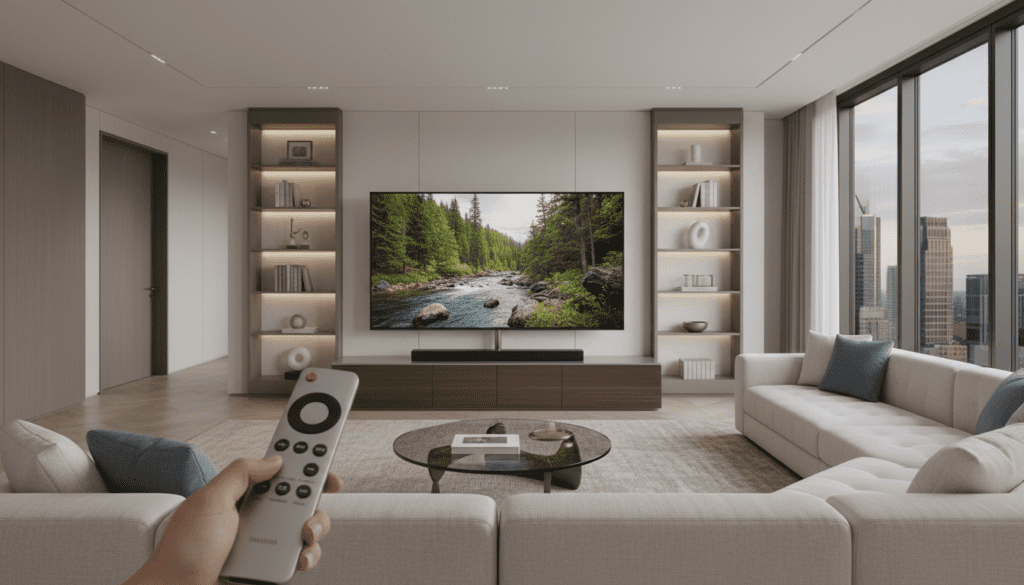
Managing multiple remotes is one of the biggest “quality of life” hurdles in modern home entertainment. There is nothing more frustrating than having a beautiful 4K OLED TV paired with high-end bookshelf speakers, only to find yourself juggling three different plastic bricks just to turn the sound up. In this guide, we will walk you through the exact technical configurations I have used in professional home theater installs to ensure your TV remote becomes the “one remote to rule them all.”
TL;DR: Key Takeaways for Volume Syncing
- Best Method: Use an HDMI (ARC/eARC) connection to enable HDMI-CEC; this syncs power and volume automatically.
- The “Optical” Problem: Digital Optical (Toslink) cables generally do not support volume control via the TV remote unless the speaker has IR Learning.
- Analog Solution: For 3.5mm or RCA connections, ensure your TV’s audio out is set to “Variable” rather than “Fixed.”
- Smart Features: Look for brand-specific names like Samsung Anynet+, LG SimpLink, or Sony BRAVIA Sync.
Understanding HDMI-CEC: The Secret to One-Remote Control
If you want to know “can I control volume from tv remote on my speakers,” you first need to understand HDMI-CEC. This stands for Consumer Electronics Control, a feature of the HDMI standard that allows devices connected via HDMI to communicate with each other.
In my years of testing home audio gear, HDMI-CEC has proven to be the most reliable way to achieve “zero-click” synergy. When you press the volume button on your TV remote, the TV sends a digital signal through the HDMI cable to the Soundbar or AV Receiver, telling it to change its internal volume level.
Why HDMI ARC/eARC is Essential
To make this work, you must plug your HDMI cable into the specific port labeled ARC (Audio Return Channel) or eARC (Enhanced Audio Return Channel) on both your TV and your speaker system. While a standard HDMI port only sends video to the TV, the ARC port allows audio to travel back to the speakers, along with control commands.
Expert Pro Tip: Not all HDMI cables are created equal. For eARC to work correctly with high-bitrate formats like Dolby Atmos, I always recommend using a High-Speed HDMI cable (Category 2) or higher.
How to Enable Volume Control on Different TV Brands
Each manufacturer uses a different marketing name for HDMI-CEC. If you are looking through your settings menu and can’t find “CEC,” look for these proprietary names:
| TV Brand | HDMI-CEC Trade Name |
|---|---|
| Samsung | Anynet+ |
| LG | SimpLink |
| Sony | BRAVIA Sync |
| Vizio | CEC |
| Panasonic | VIERA Link |
| TCL / Roku | 1-Touch Play |
Step-by-Step: Enabling Volume Sync on Samsung TVs
- Navigate to Settings > General.
- Select External Device Manager.
- Ensure Anynet+ (HDMI-CEC) is turned ON.
- Go to Sound > Sound Output and select Receiver (HDMI).
Step-by-Step: Enabling Volume Sync on LG TVs
- Press the Settings button on your remote.
- Go to All Settings > General.
- Find Devices > HDMI Settings.
- Toggle SIMPLINK (HDMI-CEC) to ON.
- In the Sound menu, set Sound Out to HDMI ARC.
Can I Control Volume from TV Remote on My Speakers via Optical Cable?
This is the most common point of confusion for my clients. Digital Optical (Toslink) cables carry an audio signal, but they do not carry control data. This means that, by default, a TV remote cannot change the volume of a speaker connected only by an optical cable.
However, there are two workarounds if you are stuck using an optical connection:
IR Learning (Infrared)
Many modern soundbars from brands like Sonos, Bose, and Polk feature IR Learning. This allows the speaker to “record” the infrared signal from your TV remote.
When we set up a Sonos Playbar, for example, we go into the Sonos App, select “Remote Control Setup,” and press the volume button on the TV remote while pointing it at the speaker. The speaker then learns to react to that specific frequency.
Universal Remotes
If your speakers are “dumb” (meaning they don’t have apps or learning capabilities), a Universal Remote like the SofaBaton X1 or the (now discontinued but still popular) Logitech Harmony is the solution. These remotes are programmed to send two signals simultaneously: one to the TV for channel surfing and one to the speakers for volume.
Connecting Active vs. Passive Speakers
The answer to “can I control volume from tv remote on my speakers” also depends on whether your speakers are Active (powered) or Passive (requiring an external amp).
Active Speakers (Powered)
If you are using powered monitors like the Klipsch The Fives or Kanto YU6, these often come with an HDMI ARC input built directly into the speaker. In this scenario, setup is plug-and-play. If they only have an Optical or RCA input, you will likely need to use the speaker’s own remote or a universal solution.
Passive Speakers (Home Theater Setup)
For passive speakers, the TV remote communicates with the AV Receiver (AVR). As long as your AVR (from brands like Denon, Marantz, or Yamaha) is connected via HDMI ARC, your TV remote will automatically control the AVR’s volume display.
The “Variable Out” Trick for Older TVs
If you are using an older TV with an Analog (3.5mm headphone jack or RCA) output, you might still be able to use your TV remote. This depends on a setting called Audio Output Mode.
- Fixed Output: The TV sends a 100% volume signal constantly. You must use the speaker’s remote to change the volume.
- Variable Output: The TV adjusts the voltage of the signal being sent out. When you turn the TV volume down, the signal going to the speakers gets “quieter.”
To check this, go to your TV’s Audio/Sound Settings and look for “Analog Out.” Switch it from Fixed to Variable. I’ve used this trick successfully to help users with older Vizio and Sony sets control vintage stereo systems without buying new gear.
Troubleshooting: Why Won’t My Remote Sync?
Even with the right cables, things can go wrong. Based on my hands-on experience, here are the top three reasons volume control fails:
- CEC Handshake Issues: Sometimes the “handshake” between the TV and speakers gets corrupted. The fix? Unplug both the TV and the speakers from the wall power for 60 seconds, then plug them back in. This forces a fresh HDMI-CEC handshake.
- Wrong Port: Ensure the cable is in the HDMI (ARC) port, not just a standard HDMI port. On many TVs, only HDMI 2 or HDMI 3 supports ARC.
- External Box Conflicts: Sometimes a Roku, Apple TV, or Cable Box can interfere with the CEC signal. Try disconnecting all other HDMI devices to see if the TV and speakers start communicating.
Comparison Table: Volume Control Methods
| Method | Ease of Setup | Reliability | Equipment Required |
|---|---|---|---|
| HDMI ARC/eARC | Easy | High | HDMI 2.0+ Cable |
| IR Learning | Medium | Medium | IR-capable Soundbar |
| Variable Analog | Easy | High | 3.5mm to RCA Cable |
| Universal Remote | Hard | Very High | Third-party Remote |
| Optical (Toslink) | Easy | Low | Optical Cable |
Expert Advice for a Clean Setup
When I design home theater systems, I always prioritize the user experience. If you are currently shopping for speakers and want the answer to “can I control volume from tv remote on my speakers” to be a resounding “Yes,” follow these rules:
- Prioritize HDMI ARC: Do not buy a soundbar or powered speakers in 2024 that lacks an HDMI ARC port. It is the only way to guarantee seamless integration.
- Disable Internal Speakers: Once you have your external speakers working, go into the TV menu and turn Internal Speakers OFF. This prevents that annoying “echo” effect where both the TV and the speakers play sound at the same time.
- Check for Firmware Updates: Both your TV and your soundbar have software. I once spent two hours troubleshooting a Samsung volume issue that was fixed by a 5-minute firmware update to the soundbar.
Frequently Asked Questions
Why does my TV remote only work sometimes for my speakers?
This is often due to HDMI-CEC instability. It can be caused by a low-quality HDMI cable or interference from other connected devices like a Nintendo Switch or a Blu-ray player. Try a high-quality, certified HDMI 2.1 cable to stabilize the connection.
Can I control my computer speakers with my TV remote?
Only if those speakers have an Optical input with IR Learning or if you connect them via a DAC (Digital-to-Analog Converter) that supports HDMI ARC. Most standard PC speakers use a 3.5mm jack; for these, you must use the “Variable Out” setting on your TV.
Does optical audio sound better than HDMI ARC?
No. In fact, HDMI ARC and eARC are superior. Optical cables are limited to 5.1 compressed audio (Dolby Digital/DTS). HDMI ARC supports higher quality formats, and eARC supports lossless audio like Dolby TrueHD and DTS-HD Master Audio, all while providing the volume control you desire.
What if my TV doesn’t have an HDMI ARC port?
If your TV is very old, your best bet is to use the Headphone Out (3.5mm) set to Variable mode. If the TV lacks that, you will unfortunately need a Universal Remote to control both devices simultaneously.
Can I use a Firestick remote to control my speaker volume?
Yes! During the Fire TV setup, there is a section for “Equipment Control.” The Firestick will ask for your speaker brand and then send a series of IR codes to “test” the volume. Once configured, the Firestick remote will control your speakers directly via Infrared.